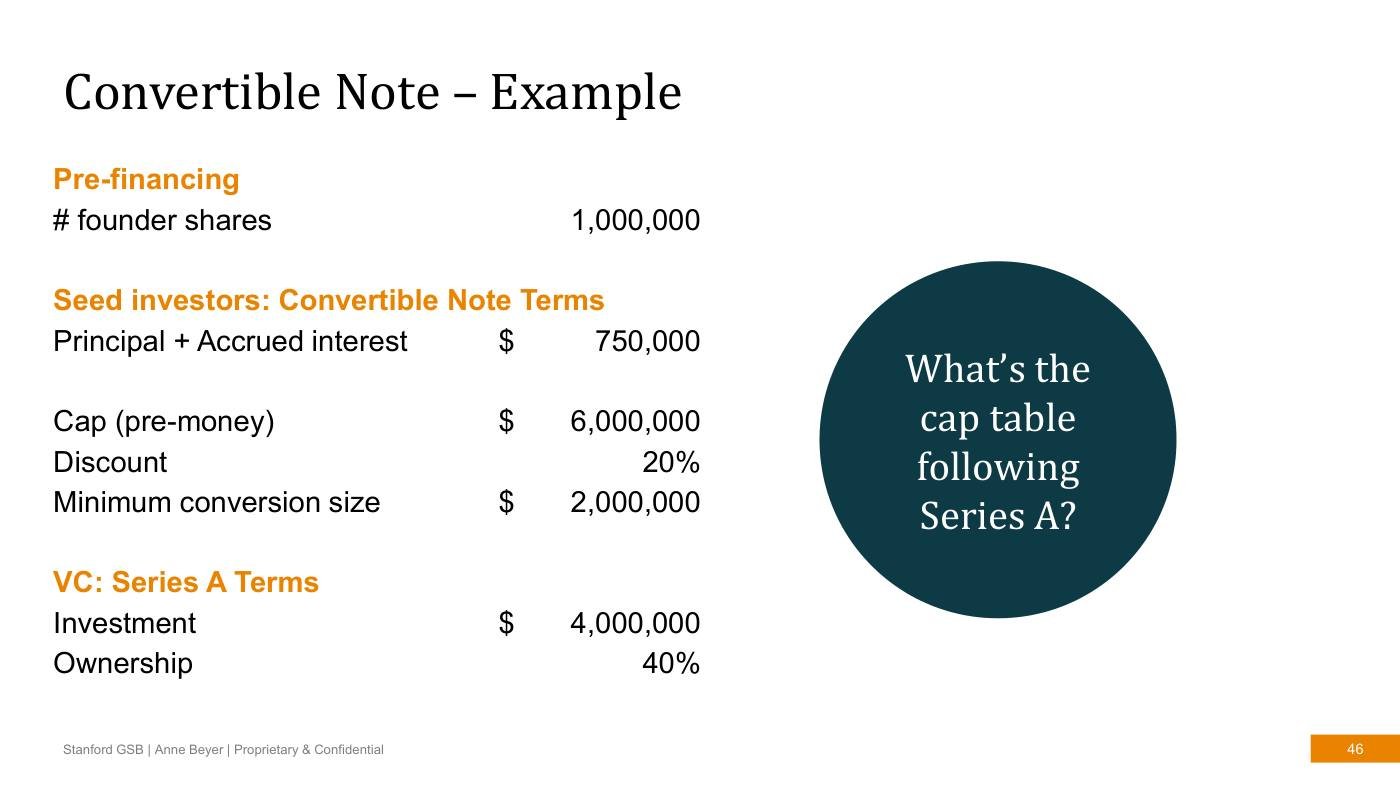
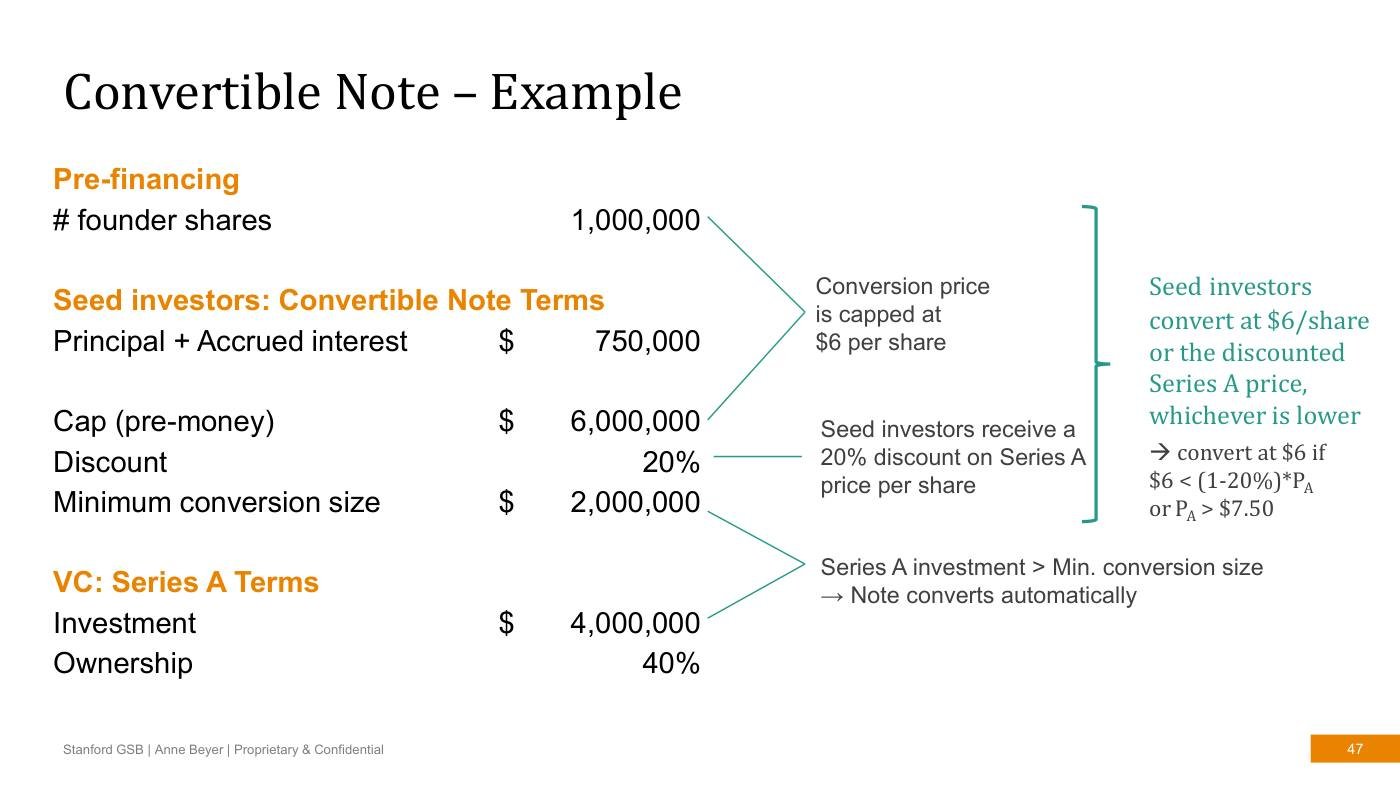
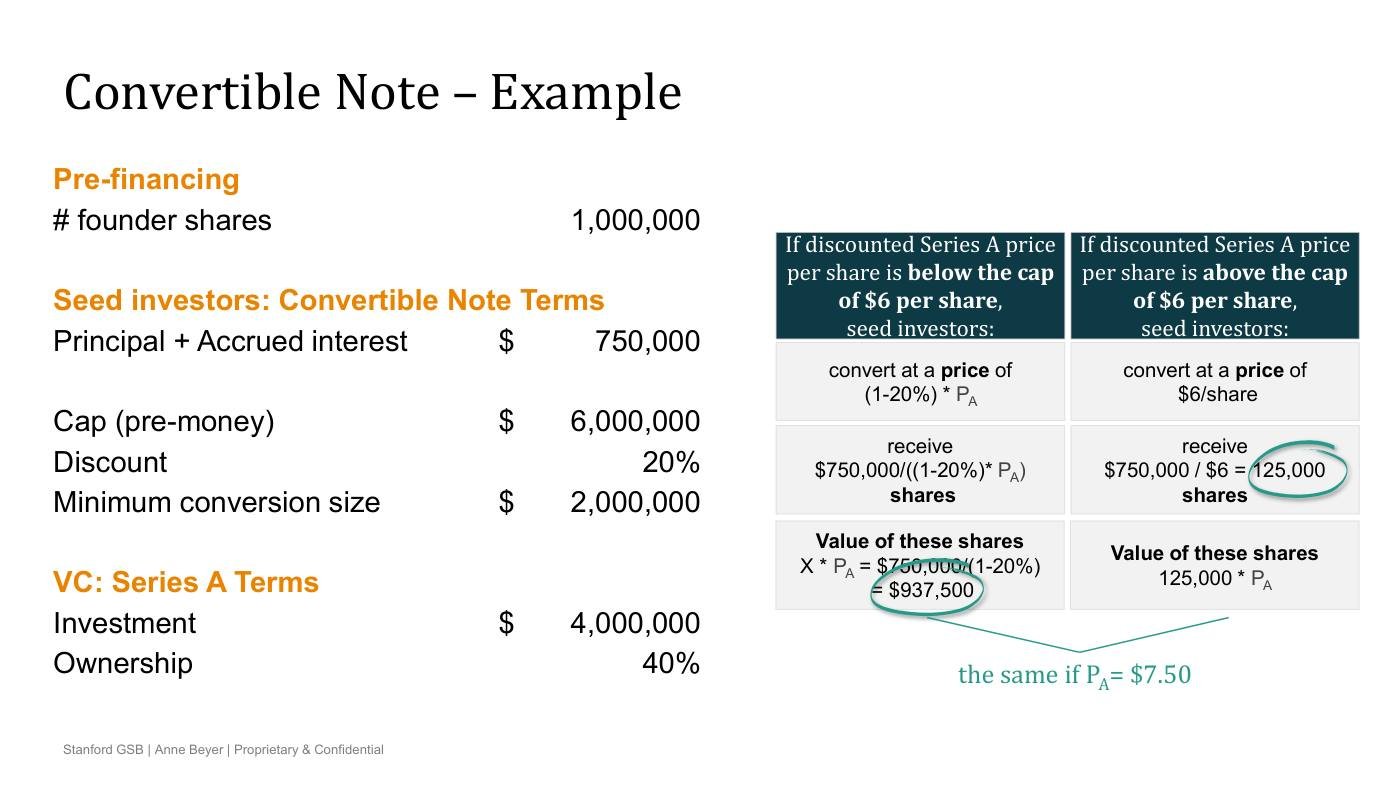
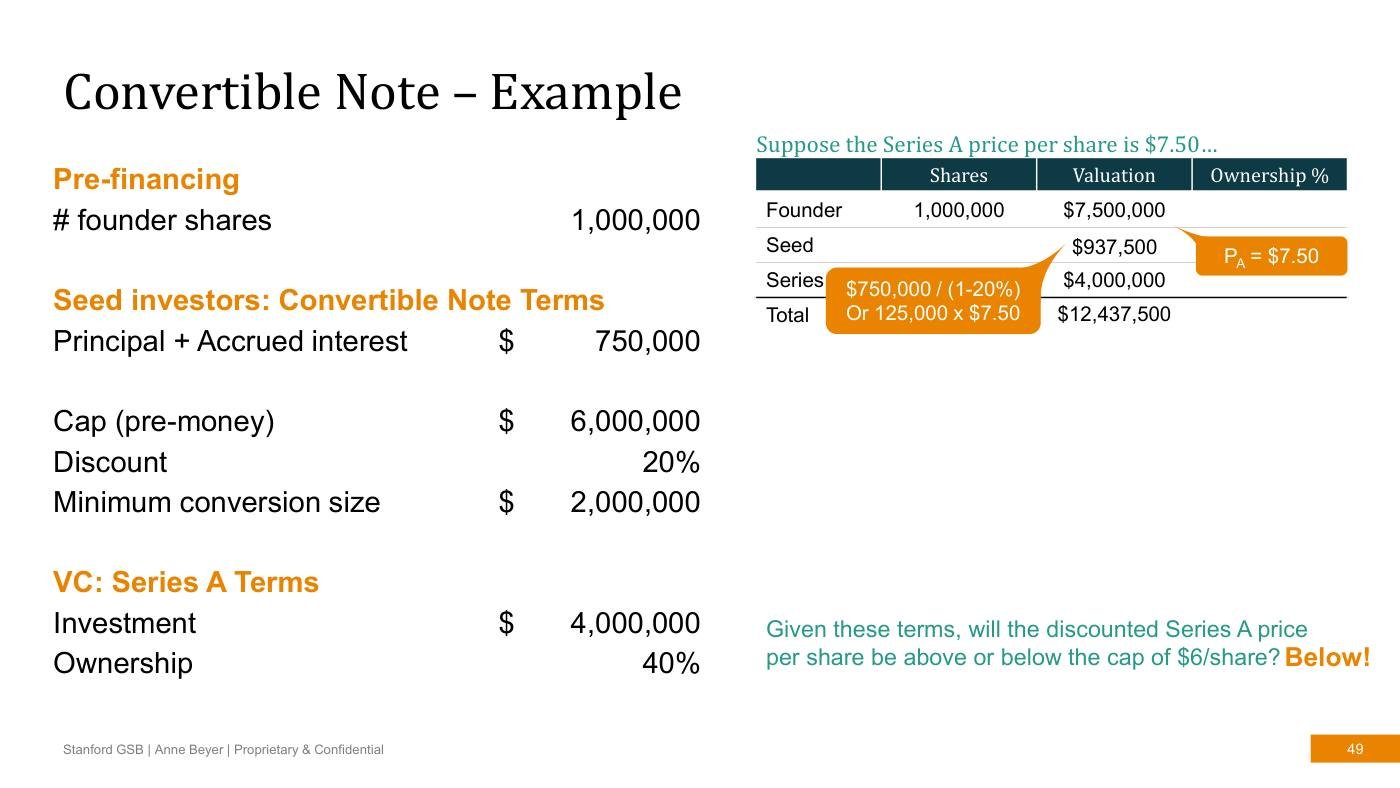
How do later rounds change today’s ownership requirement?
A multiple-round capitalization and VC-method calculation.
1
31 / OpeningMultiple rounds, dilution & the VC method
The decision and the learning goals
Work backward from exit value and target proceeds.
Adjust an early ownership requirement for future dilution.
Reconcile round valuations and the final ownership shares.
90-minute workshopOpening 5 minConcepts and original examples 35 minPractice 25 minDebrief 15 minReview 10 min
2
31 / TheoryMultiple rounds, dilution & the VC method
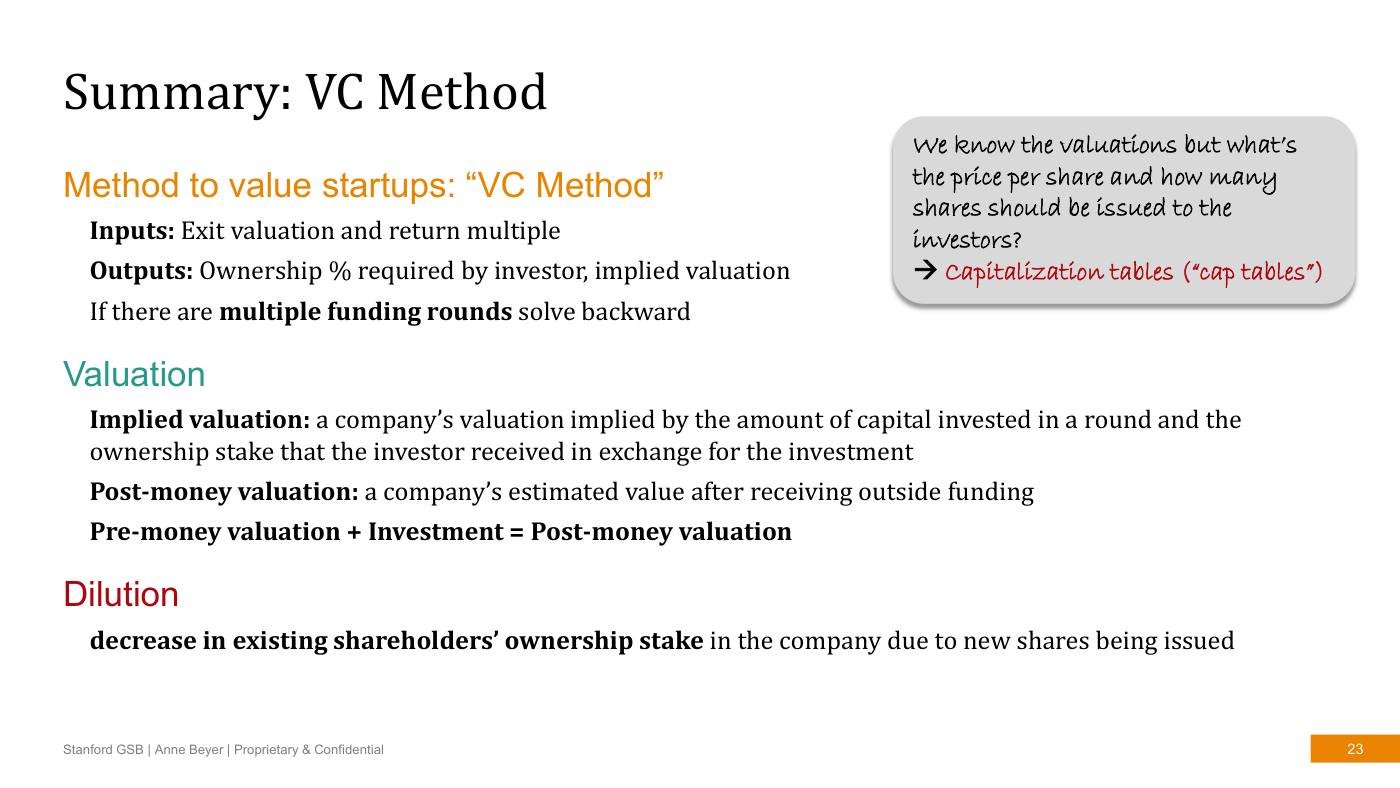
The VC method works backward from a hypothetical exit
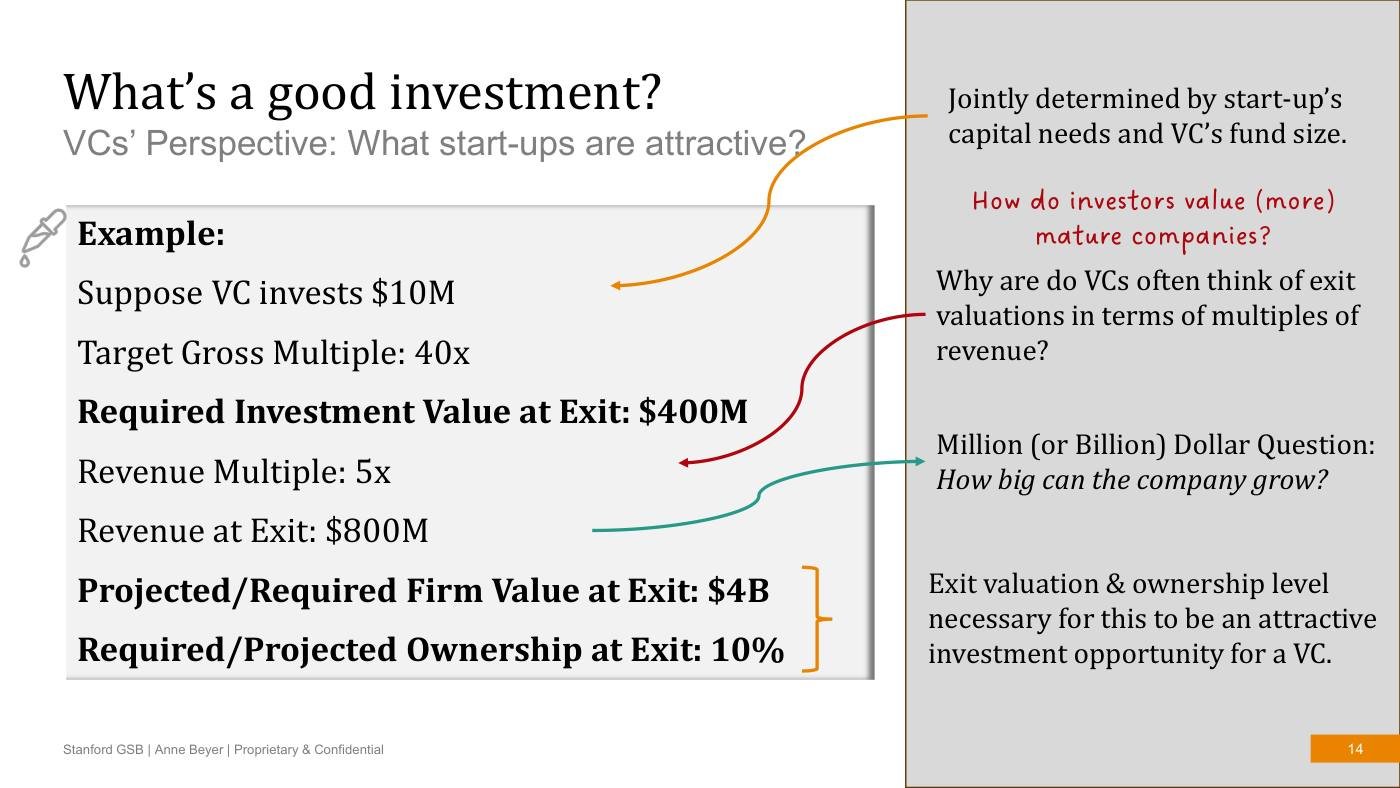
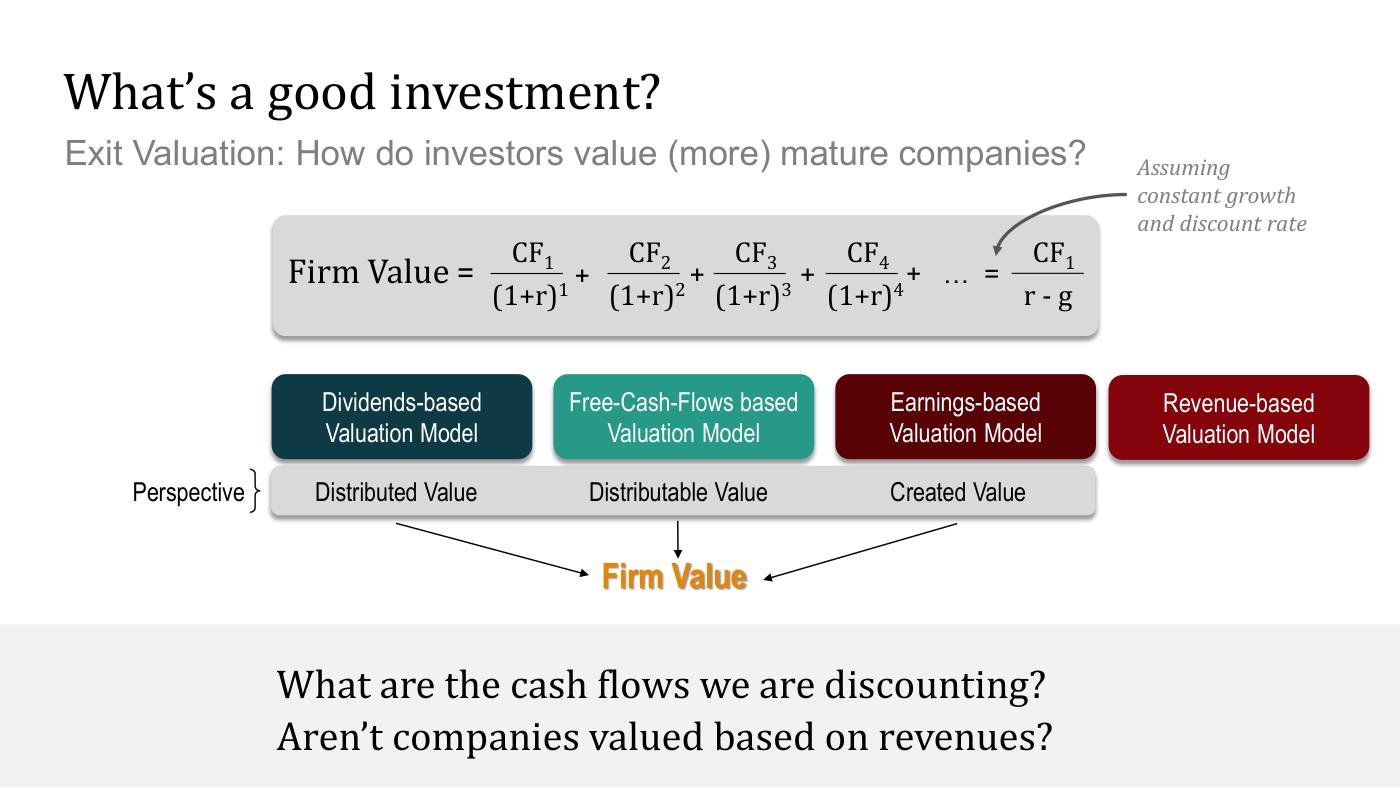
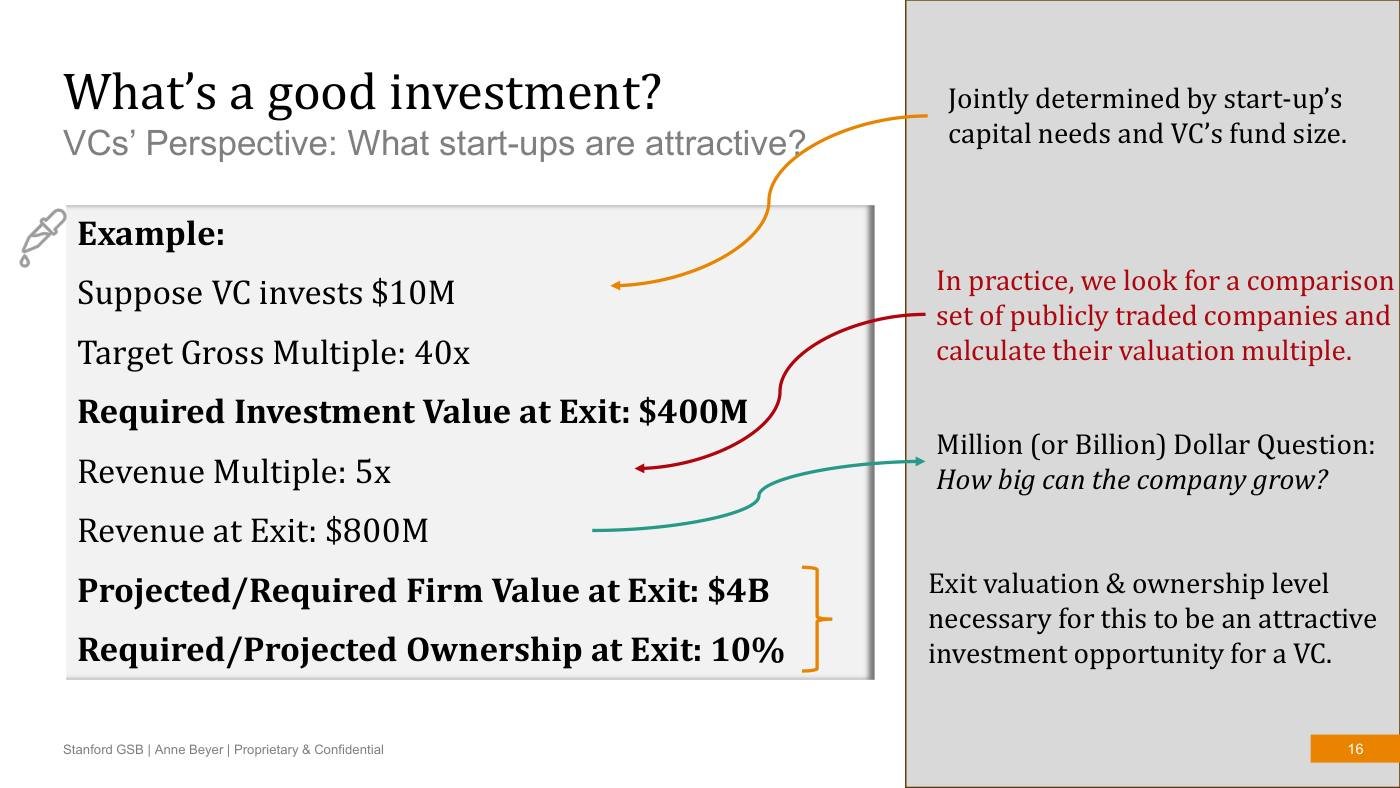
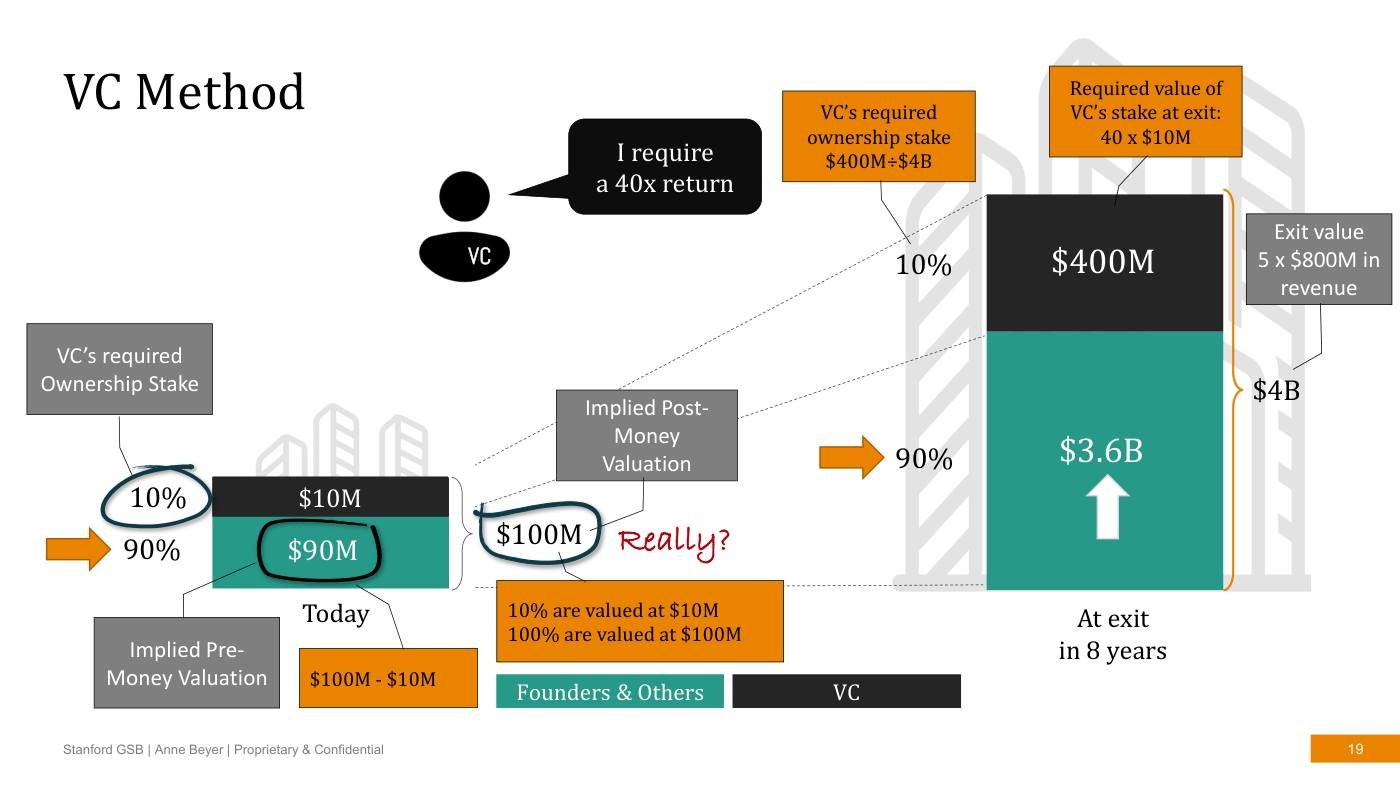
The source first projects an exit value from revenue and a valuation multiple. It then calculates how much value an investor’s stake must return to meet a target multiple. Dividing the required proceeds by the projected exit value gives the required ownership at exit.
This is a negotiation and valuation model driven by assumptions. Revenue, the exit multiple, financing needs and the target return can all change. Show those inputs explicitly and avoid treating the resulting valuation as an independently observed market fact.
3
31 / TheoryMultiple rounds, dilution & the VC method
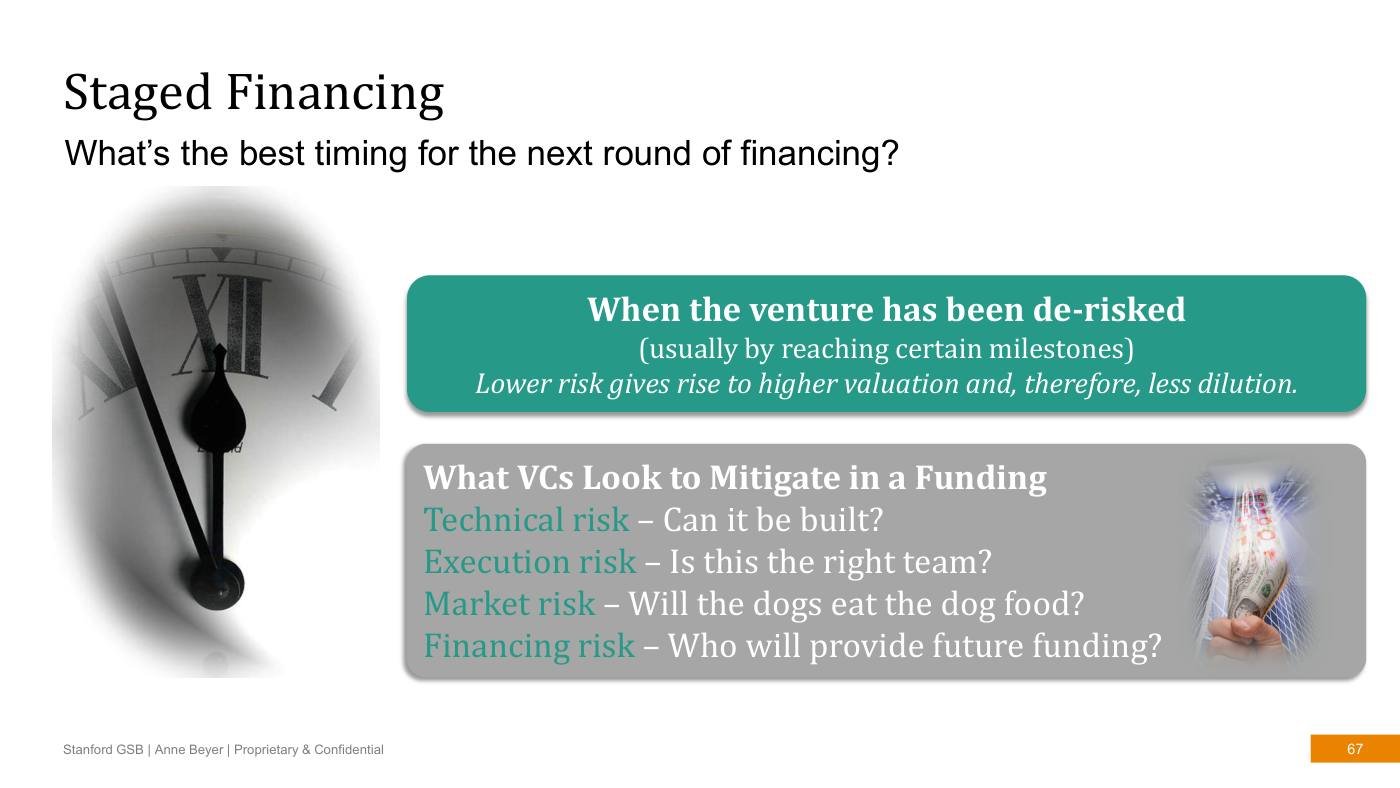
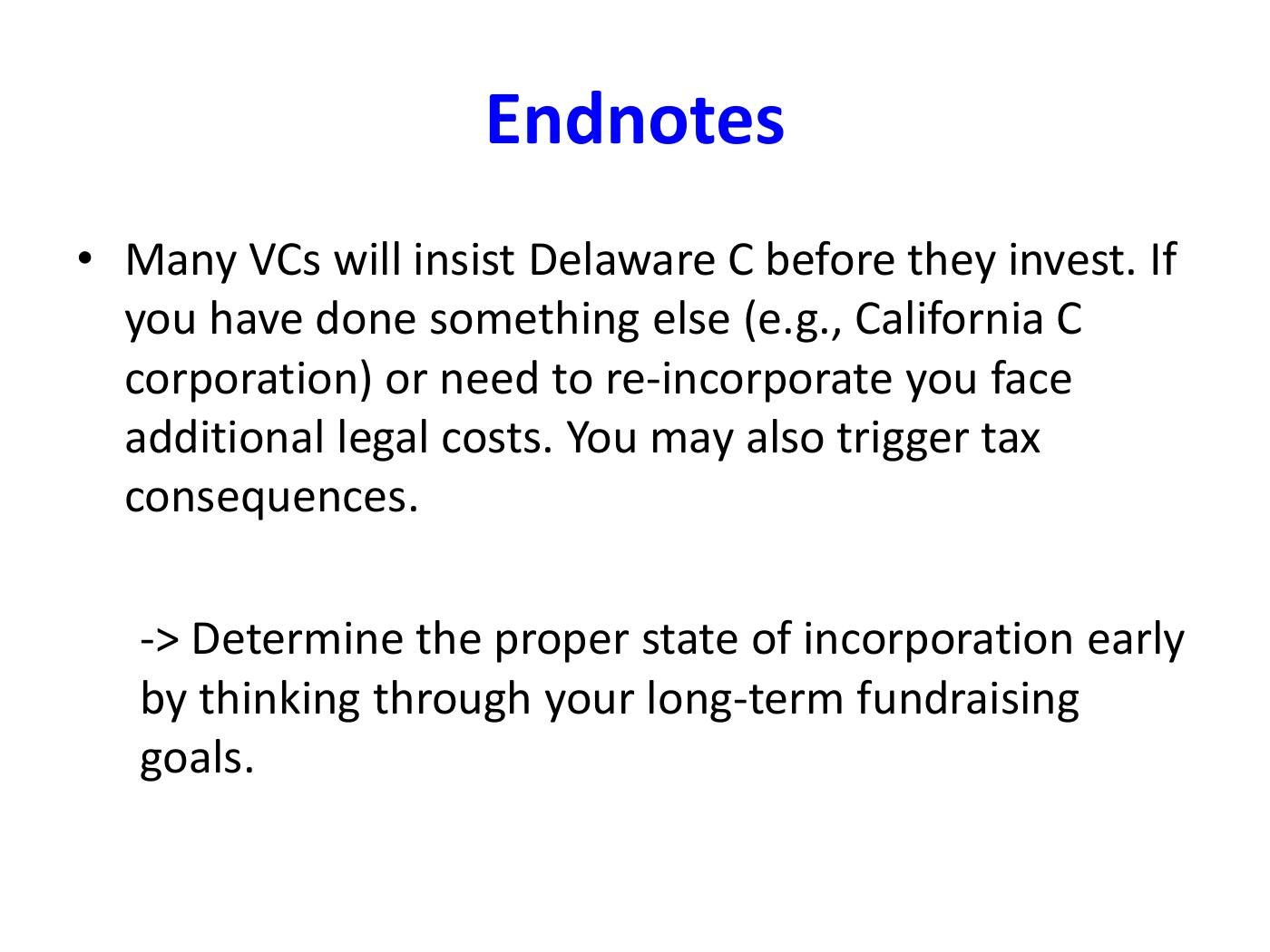
Future rounds change the stake needed today
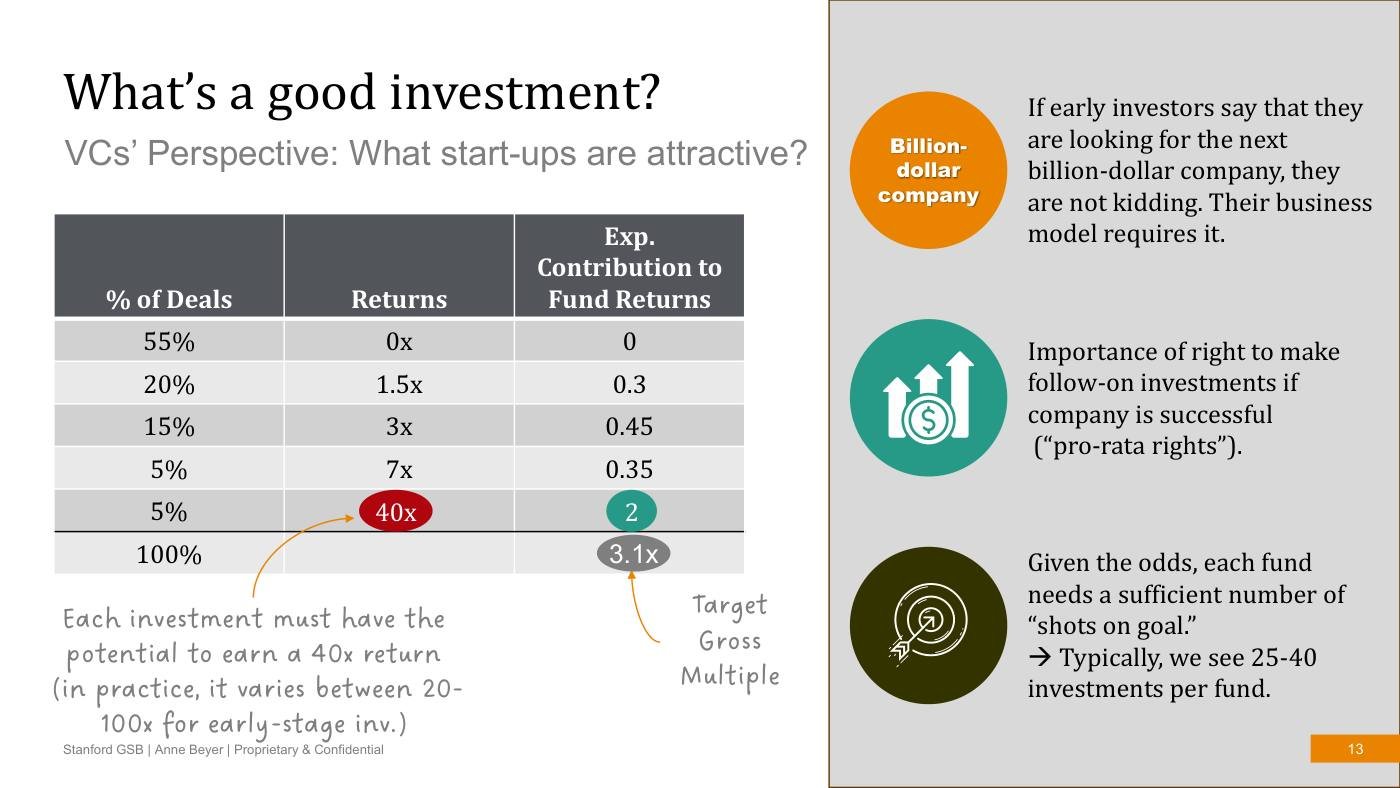
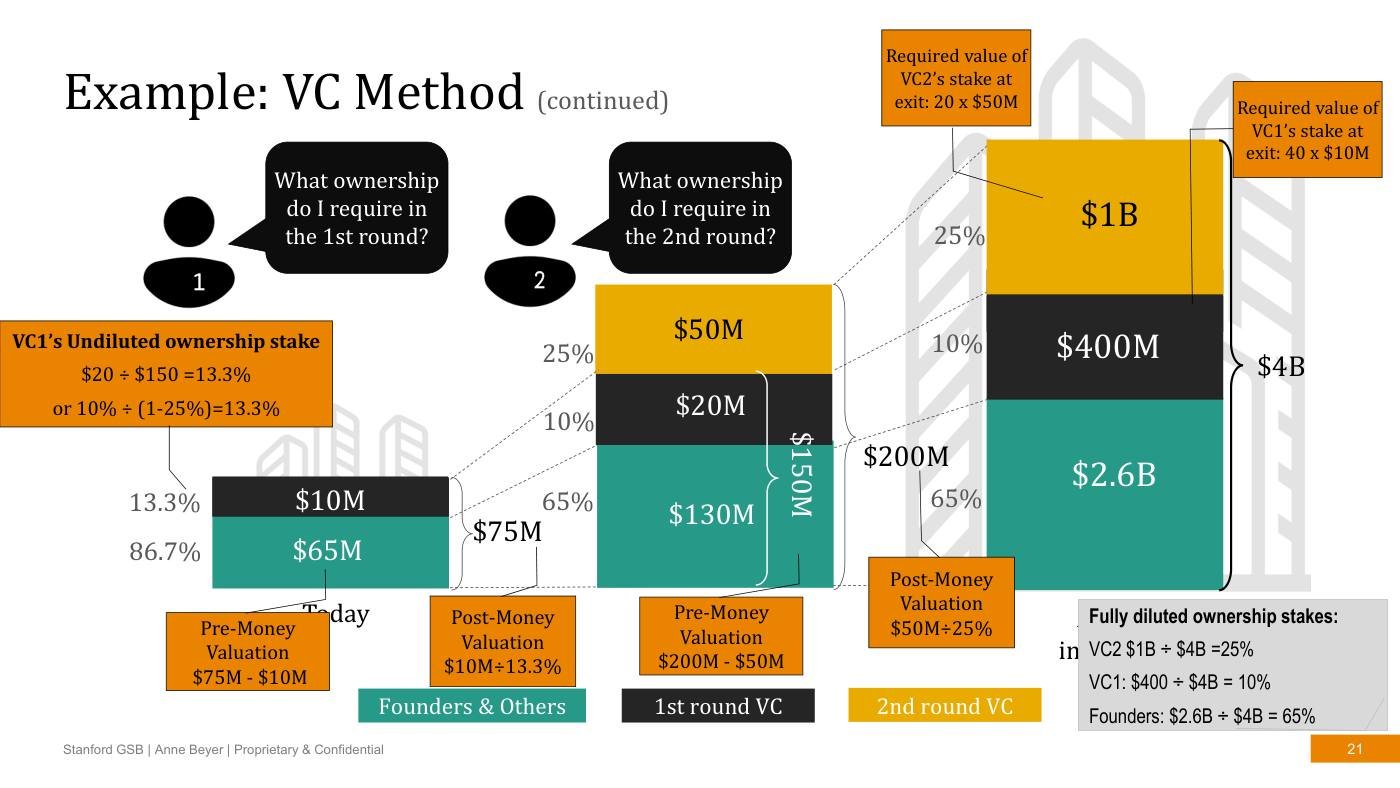
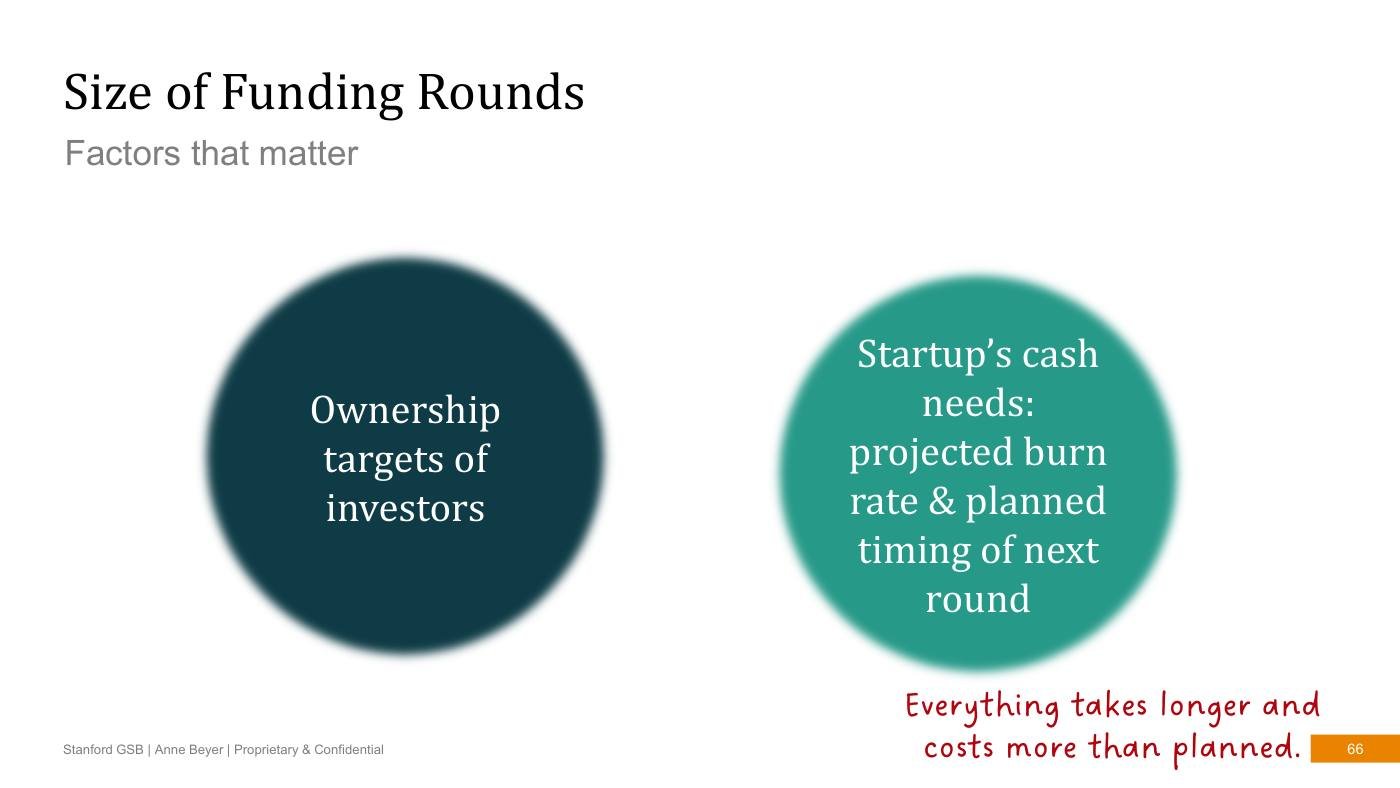
The source’s second example introduces another round: 50m invested after two years, targeting 20×. At the same 4,000m projected exit, that investor requires 1,000m of proceeds and therefore 25% of the company at exit.
The first investor still needs 10% at exit. Because the later round leaves old holders with 75%, the first investor must initially own 10%/75% = 13.333%. The corresponding current post-money value is 10m/13.333% = 75m, rather than the 100m from the one-round example.
4
31 / TheoryMultiple rounds, dilution & the VC method
A second priced round
PRICE PER SHARE = PRE-MONEY VALUE ÷ PRE-ROUND SHARES
Illustrative inputs
$15m pre-money; 10m existing shares; $5m new cash.
Share price
$15m ÷ 10m = $1.50.
New shares
$5m ÷ $1.50 ≈ 3.333m.
5
31 / TheoryMultiple rounds, dilution & the VC method
Round 2: dilution without changing old share counts
Holder
Shares (millions)
Ownership
Founders
8.000
60%
Seed investor
2.000
15%
New investor
3.333…
25%
Total
13.333…
100%
Illustrative priced round. Existing shares stay the same; the denominator grows.
6
31 / Source pageMultiple rounds, dilution & the VC method
VC method diagram: from a $4B exit back to a $100M post-money
7
31 / Source pageMultiple rounds, dilution & the VC method
Two-round VC method solved backward
8
31 / TheoryMultiple rounds, dilution & the VC method
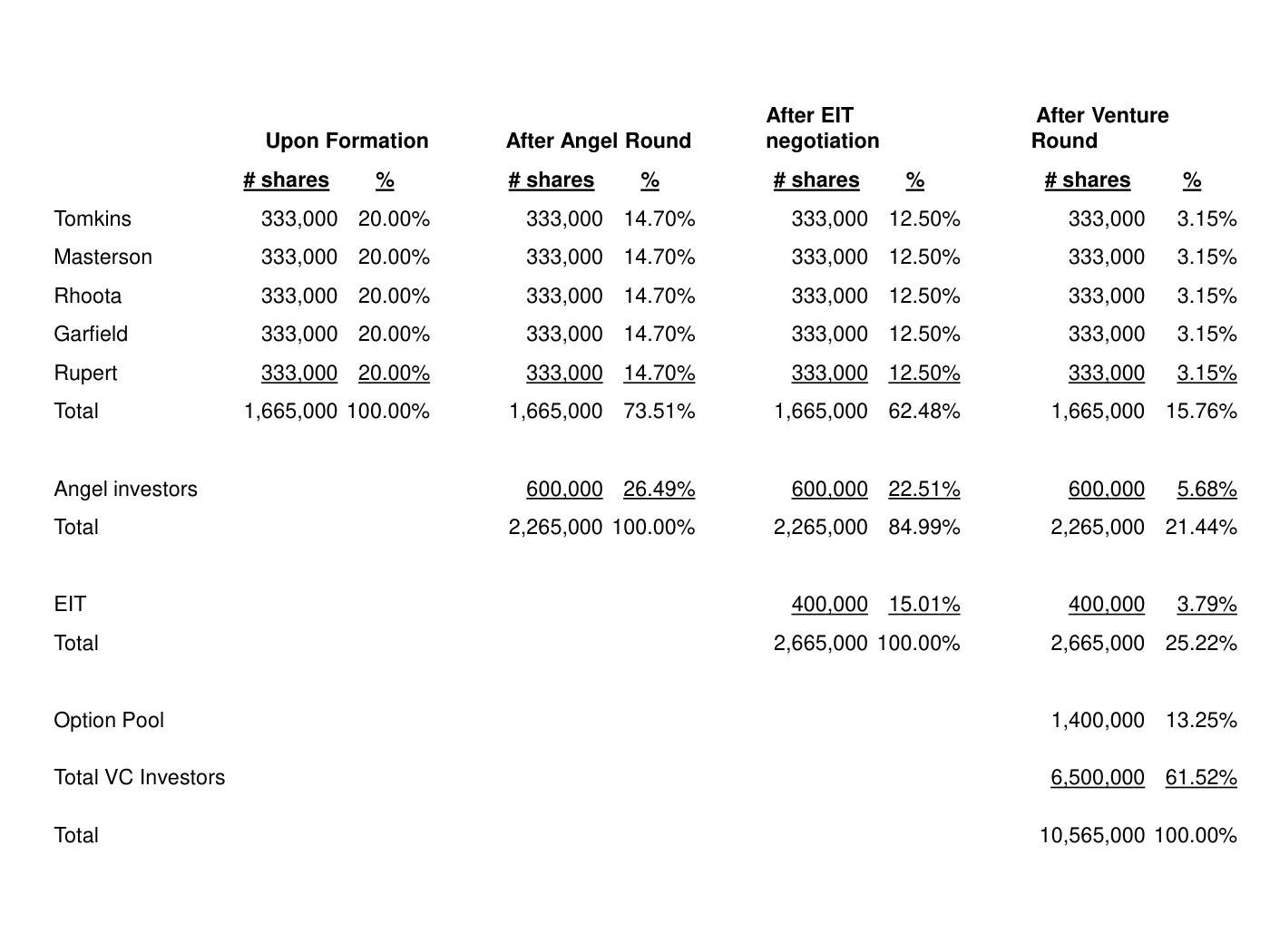
Dilution compounds through successive denominators
When each round sells a fraction of the enlarged company, earlier holders retain the product of the fractions left after those rounds. Adding the percentages sold generally gives the wrong answer because the percentages use different denominators.
Track share counts to verify the percentage shortcut. Include option-pool changes and converting instruments when the agreed basis requires them. A model that treats all rounds as simple common-equity issuances cannot describe every negotiated financing structure.
9
31 / TheoryMultiple rounds, dilution & the VC method
Ownership at exit and cash returned
A fully diluted percentage can be used to estimate simple pro-rata proceeds only under the rights and capital-structure assumptions of the model. Later preferences, debt and transaction costs can alter the amount a holder receives.
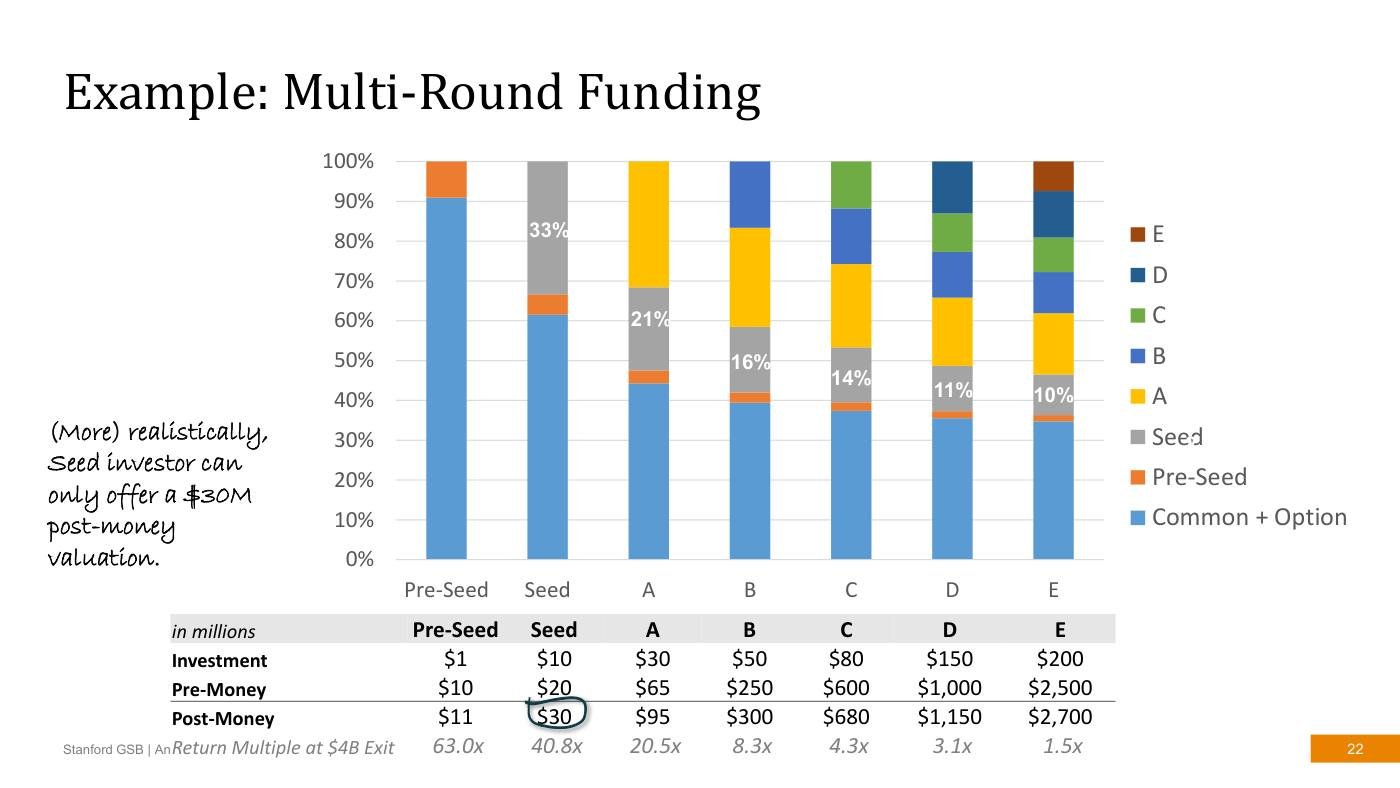
The source’s multi-round return chart combines ownership changes with a common hypothetical exit. It demonstrates why a later investor can have a smaller return multiple at the same exit value. More capital, a higher entry valuation and less remaining time can produce a different investment proposition.
10
31 / TheoryMultiple rounds, dilution & the VC method
Two-round VC method: ownership and implied value
Source assumptions: 4,000m projected exit value, 40× target for investor 1 and 20× target for investor 2.
Quantity
Round 1 now
Round 2 after two years
Investment
10m
50m
Target proceeds at exit
400m
1,000m
Required ownership at exit
10.000%
25.000%
Ownership required when investing
13.333%
25.000%
Implied post-money value
75m
200m
Implied pre-money value
65m
150m
The first investor’s 13.333% is diluted by the later 25% issuance to 10%. These are implied values under the example, not forecasts or market quotes.
11
31 / Deep diveMultiple rounds, dilution & the VC method
Relay's Series A: the lead's model vs the founders' ask
Illustrative: $12M raised; 10x target; $100M year-6 revenue x 6 = $600M exit; post-seed 17,102,041 fully diluted shares; no pool top-up.
The difference between the two columns is a single assumption: whether a 20% Series B happens before exit. Proceeds are pro rata; lesson 32 adds the 1x non-participating preferences.
Quantity
Founders' ask (no later round)
Lead's model (20% Series B)
Required proceeds at exit
$120M
$120M
Required stake at exit
20.0%
20.0%
Stake needed at Series A
20.0%
20% / 0.80 = 25.0%
Post-money / pre-money
$60M / $48M
$48M / $36M
Price per share
$2.8067
$2.1050
Series A shares issued
4,275,510
5,700,680
Total fully diluted shares
21,377,551
22,802,721
Maya / Daniel
24.33% / 22.45%
22.80% / 21.05%
SAFE / granted options / unallocated pool
7.35% / 1.87% / 8.00%
6.89% / 1.75% / 7.50%
Seed / Series A
16.00% / 20.00%
15.00% / 25.00%
Lead's proceeds at $600M after a 20% Series B
16% = $96M (8.0x)
20% = $120M (10.0x)
12
31 / TheoryMultiple rounds, dilution & the VC method
Ownership across two rounds
Illustrative percentages: founders 80% / seed 20%, then founders 60% / seed 15% / new investor 25%.
13
31 / Deep diveMultiple rounds, dilution & the VC method
Sensitivity: implied Series A post-money
$12M raised at a 10x target. Implied post-money = $12M / [($120M / exit) / (1 - later dilution)].
Percentages in brackets are the stake the lead needs at the Series A. The exit assumption moves the answer more than the dilution assumption does, so the founders' best evidence is whatever supports year-6 revenue: cohort retention for multi-location groups, expansion within accounts, and the Northpoint pipeline.
Exit value
No later round
12% later dilution
20% later dilution
$400M
$40.0M (30.0%)
$35.2M (34.1%)
$32.0M (37.5%)
$600M
$60.0M (20.0%)
$52.8M (22.7%)
$48.0M (25.0%)
$800M
$80.0M (15.0%)
$70.4M (17.0%)
$64.0M (18.8%)
14
31 / TheoryMultiple rounds, dilution & the VC method
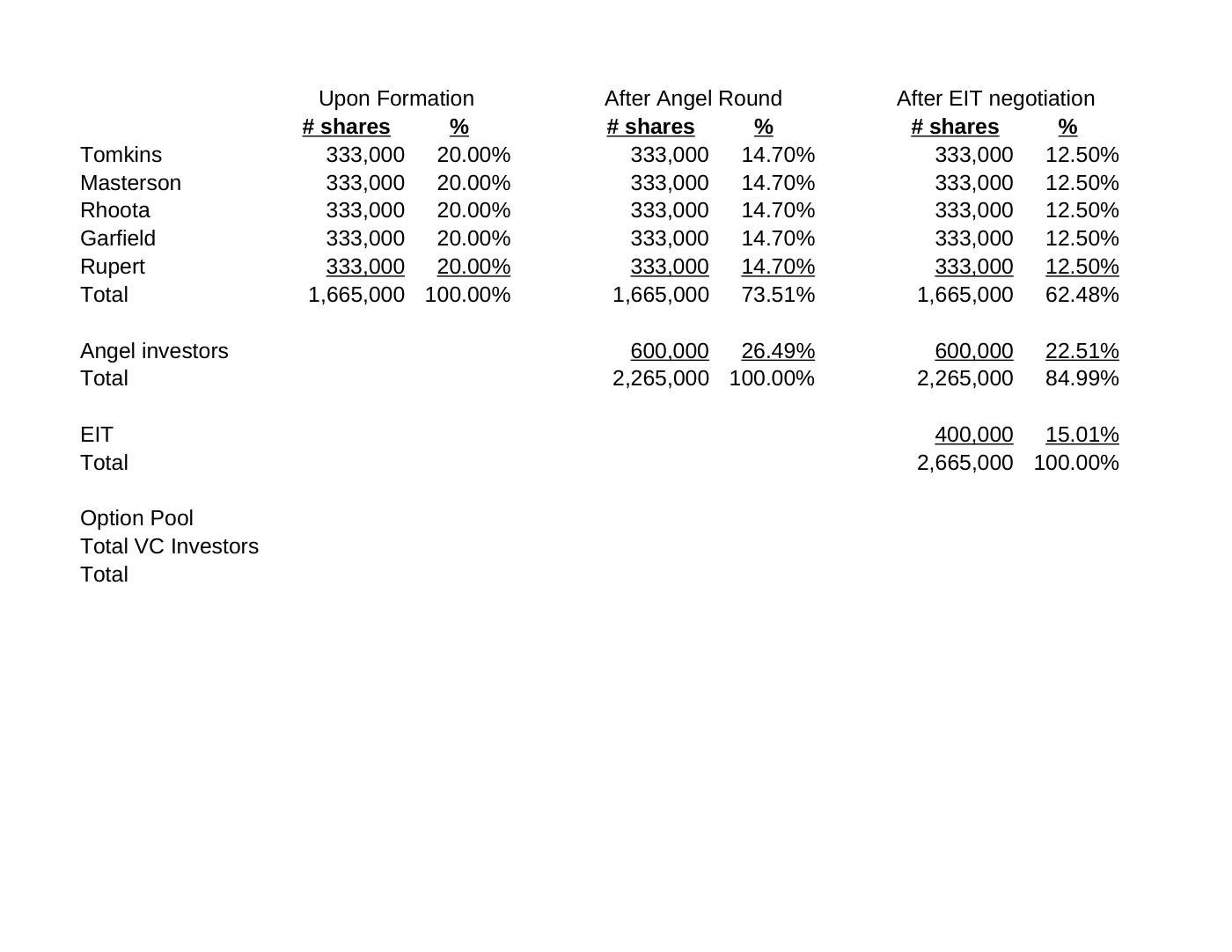
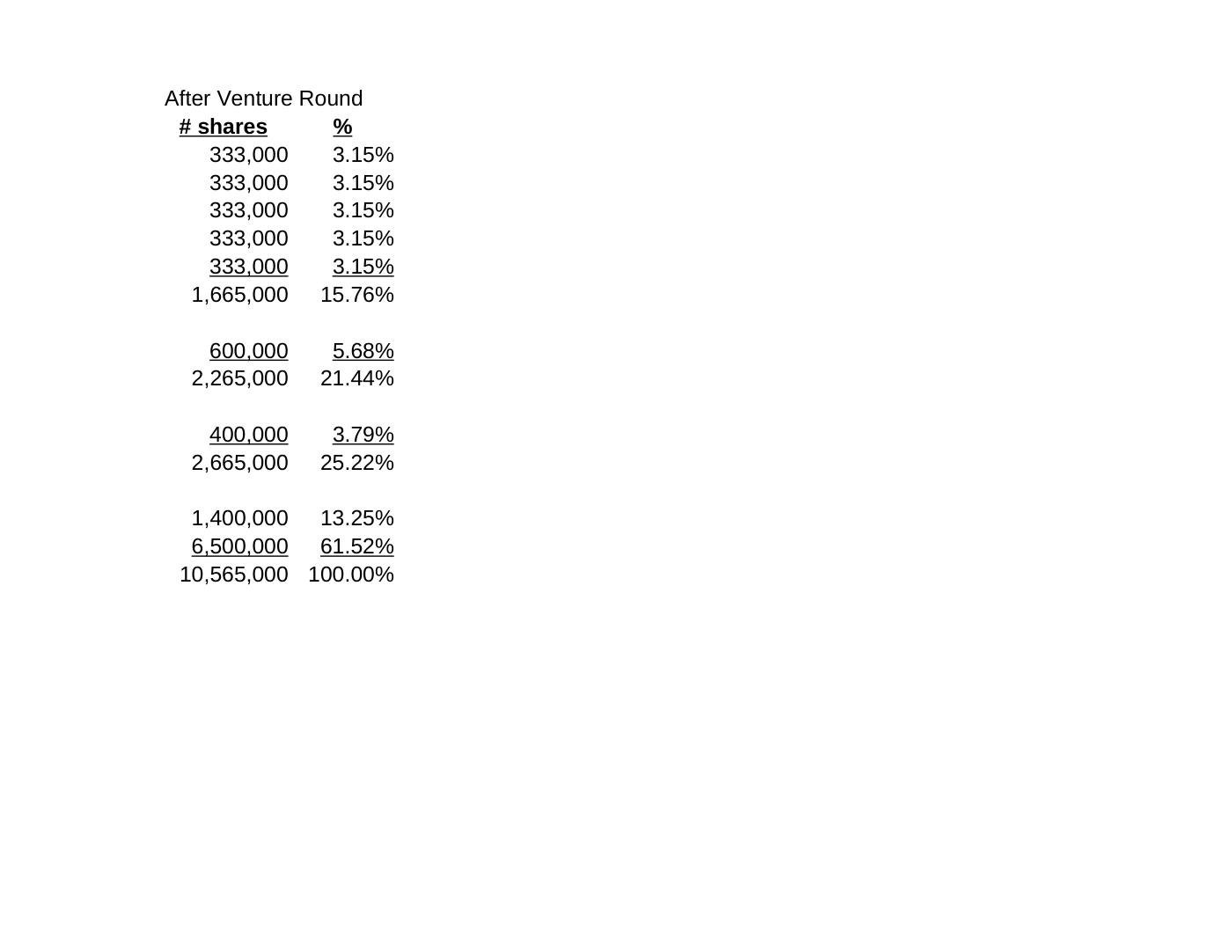
Reconcile a cap table
Shares add to the total on the stated basis.
Ownership percentages add to 100%.
Investment, price and new shares are consistent.
Value and ownership are not confused with cash received by each holder.
15
31 / Source pageMultiple rounds, dilution & the VC method
Multi-round funding: ownership and returns from pre-seed to Series E
16
31 / Source pageMultiple rounds, dilution & the VC method
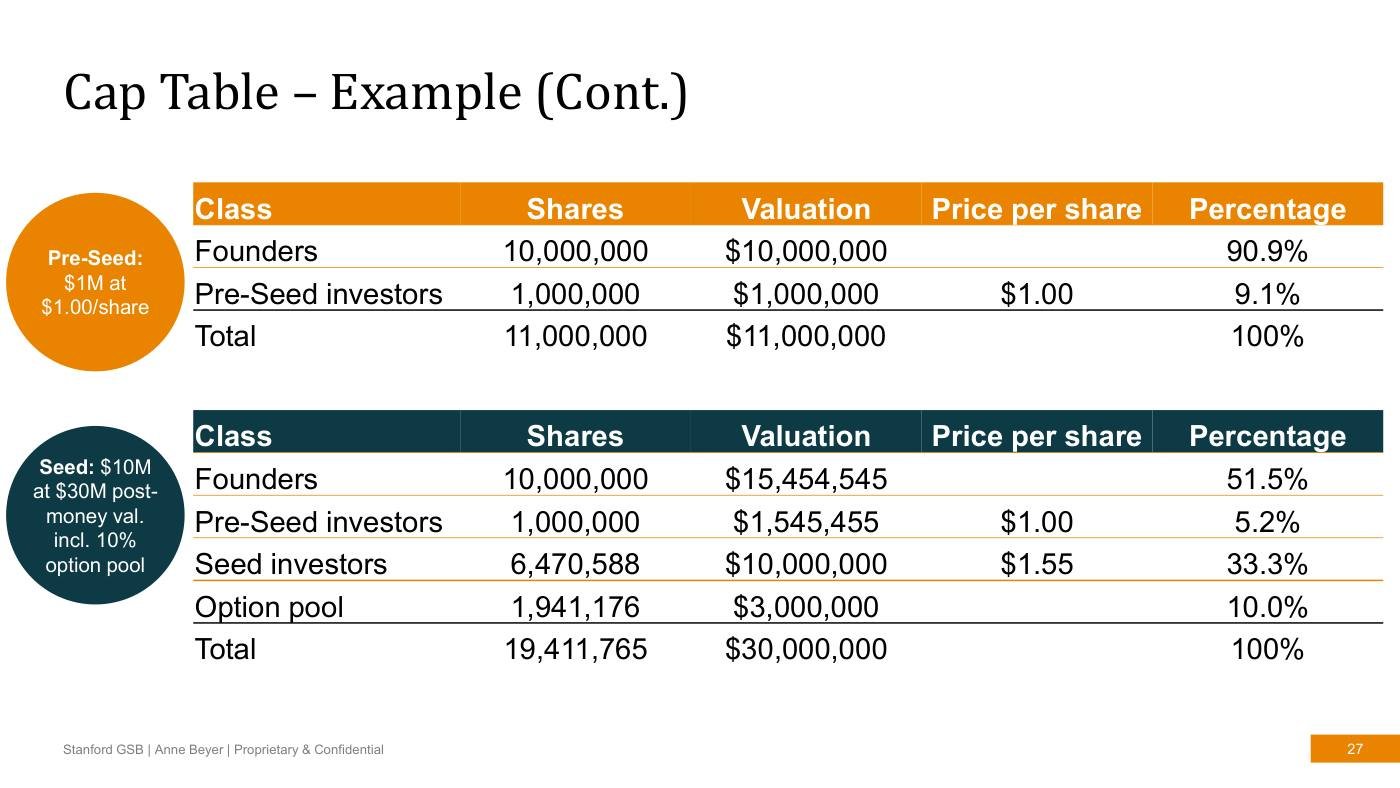
Pre-seed and seed cap tables with a 10% post-money pool
17
31 / Current practiceMultiple rounds, dilution & the VC method
Current practice: Series A pricing and the gap between rounds
Market reference points
Carta reported a median Series A post-money of $60M across 2025 ($75M for AI companies, $55M for others), and median Series A dilution of 18% for software rounds raised in the six months to July 2026. Relay's founders' ask, $12M for 20% at $60M post, is close to the median; the lead's $48M is an argument built from its own model.
Longer gaps mean more interim rounds
The median time from seed to Series A on Carta reached about 2.1 years in 2025, up from 1.5 years five years earlier, and Series A to B reached 2.5 years. About 29% of seed and Series A rounds were bridges. A VC model with clean A-to-B steps understates dilution unless it allows for a bridge.
AI's share is heaviest at late stages
Carta found that AI companies took 58% of cash raised at Series D in 2025, while AI's share of early-stage dollars held roughly steady. A Series B investor in Relay Scheduler will compare it with AI-native peers on gross margin (about 72% for v2) as well as on growth.
31 / PracticeMultiple rounds, dilution & the VC method
The source’s two-round VC method
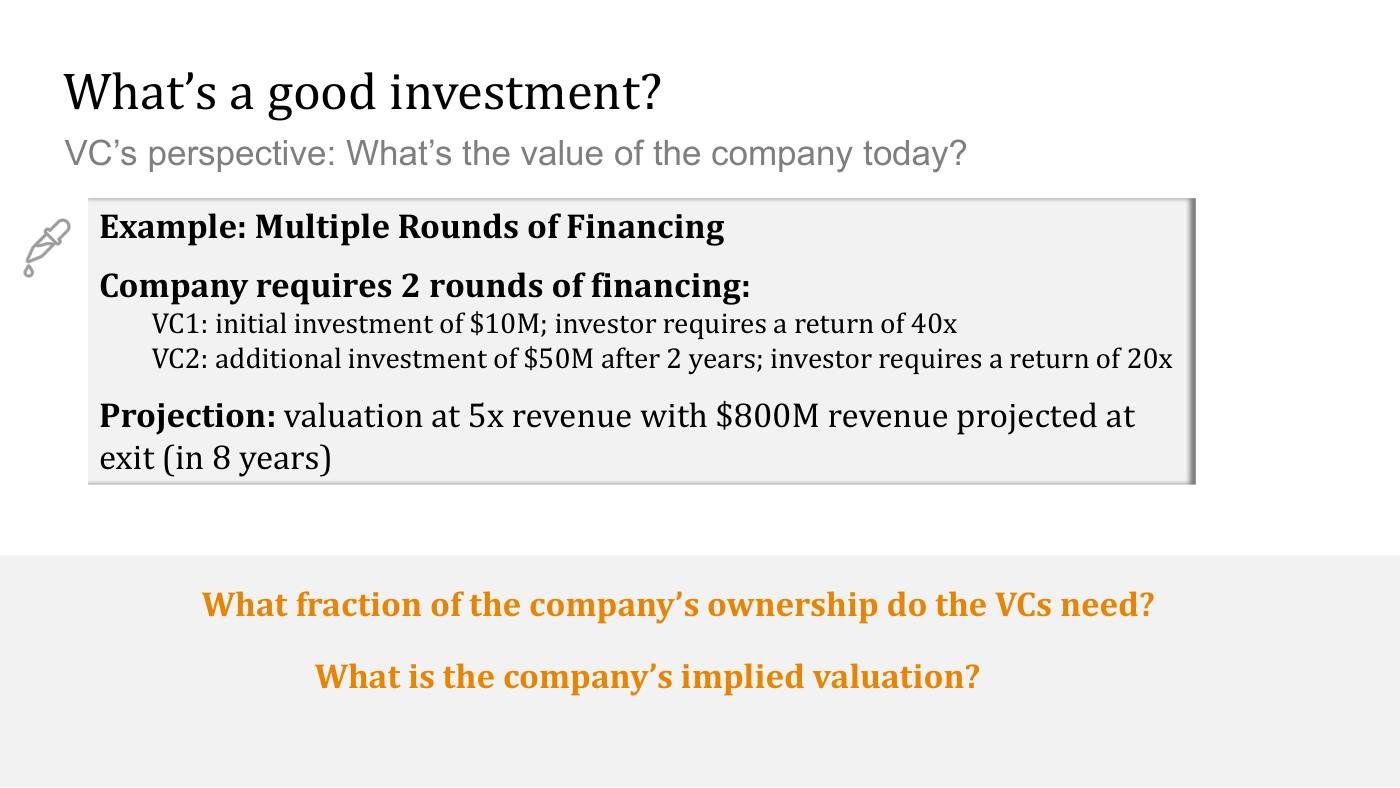
Projected exit revenue is $800m at a 5× valuation multiple. Investor 1 contributes $10m now and targets 40× proceeds. Investor 2 contributes $50m after two years and targets 20× proceeds. Use simple pro-rata ownership, no other dilution and the source’s target-multiple model.
Your task
Calculate each required exit stake, investor 1’s initial stake, and pre- and post-money values for both rounds.
19
31 / DebriefMultiple rounds, dilution & the VC method
Worked answer and reasoning
Projected exit is 4,000m. Investor 1 needs 400m, or 10%; investor 2 needs 1,000m, or 25%.
Investor 1 initially needs 10%/75% = 13.333%. Current post-money is 75m and pre-money 65m.
Round 2 post-money is 50m/25% = 200m and pre-money 150m. At exit, founders and others retain 65% under these assumptions.
20
31 / Venture stepMultiple rounds, dilution & the VC method
Venture step: Price Relay's Series A with the VC method
Relay · venture step 31
Month 30. Relay raises $12,000,000. The lead targets 10x in six years and projects year-6 revenue of $100M at a 6x revenue multiple, an exit of $600M (illustrative). Maya and Daniel ask for $48M pre-money ($60M post). The lead expects Relay to need a Series B that sells 20% before exit and argues that its model supports only $48M post-money. Post-seed, Relay has 17,102,041 fully diluted shares; Maya holds 30.41%.
Your task
Write the VC-method calculation from both sides, a sensitivity table (exit value x later dilution), the Series A cap table under $60M and $48M post-money, and a recommended negotiating position with the arguments for it.
21
31 / Venture stepMultiple rounds, dilution & the VC method
Venture step: worked reasoning
Lead's requirement: 10 x $12M = $120M of proceeds; $120M / $600M = 20% at exit. If a Series B sells 20%, the lead must start with 20% / 0.80 = 25%, so post-money = $12M / 25% = $48M and pre-money = $36M. With no later round, 20% gives $60M post, the founders' ask.
Cap table at $60M post: price $48M / 17,102,041 = $2.8067; Series A shares 4,275,510; total 21,377,551; Maya 24.33%, Daniel 22.45%, seed 16.00%, Series A 20.00%. At $48M post: price $2.1050; 5,700,680 new shares; total 22,802,721; Maya 22.80%. The roughly 1.5-point gap is worth about $7.3M to Maya at a $600M exit after a Series B.
The lead's own numbers at $60M post: 20% x 0.80 = 16% at exit, or $96M. That is 8.0x, about 41% a year over six years, versus a 10x target of about 47% a year. The disagreement is 2x on the multiple, not a question of whether Relay is a good investment.
Founders' arguments: (1) pro-rata rights let the lead buy part of the Series B and keep its stake, so applying the full 20% dilution double-counts; (2) the Series A could fund Relay to break-even (late-FY1 net burn was about $60k a month), making a B optional; (3) the 2025 median Series A post-money on Carta was about $60M. A middle position, $54M post (22.2%), corresponds to 11% later dilution.
Recommendation: anchor at $60M post with no pool top-up, concede up to about $54M post if the lead commits to a board composition and protective provisions the founders can accept, and keep a bridge from existing investors as the fallback (lesson 40). All figures illustrative.
22
31 / DebriefMultiple rounds, dilution & the VC method
Reasoning traps
Adding the percentages sold
Selling 20% and then 20% leaves 64%, not 60%, because each round is sold from an enlarged company. Multiply the fractions kept, and check against share counts: Maya goes from 30.41% to 24.33% to 19.46%, not to 18.24%.
Solving forward instead of backward
An early investor's required stake today depends on every round after it. Start from exit ownership, divide by the fraction left after each later round, and only then compute today's post-money ($12M / 25% = $48M).
Treating the model's output as a market price
A 10x target, a $600M exit and 20% future dilution are assumptions. Run a sensitivity table before negotiating: the implied post-money ranges from $32M to $80M across plausible inputs.
23
31 / ReviewMultiple rounds, dilution & the VC method
What you can now explain
A Series A pricing memo for Relay: the lead's VC-method calculation ($48M post) and the founders' ($60M post), a sensitivity table, cap tables for both prices, and a negotiating position with fallback.
The VC method sets required ownership at exit as (target multiple x investment) / exit value, then divides by the fraction left after each later round to get today's stake.
Dilution compounds: each holder's final stake is its entry stake multiplied by (1 - stake sold) for every later round, so percentages sold cannot be added.
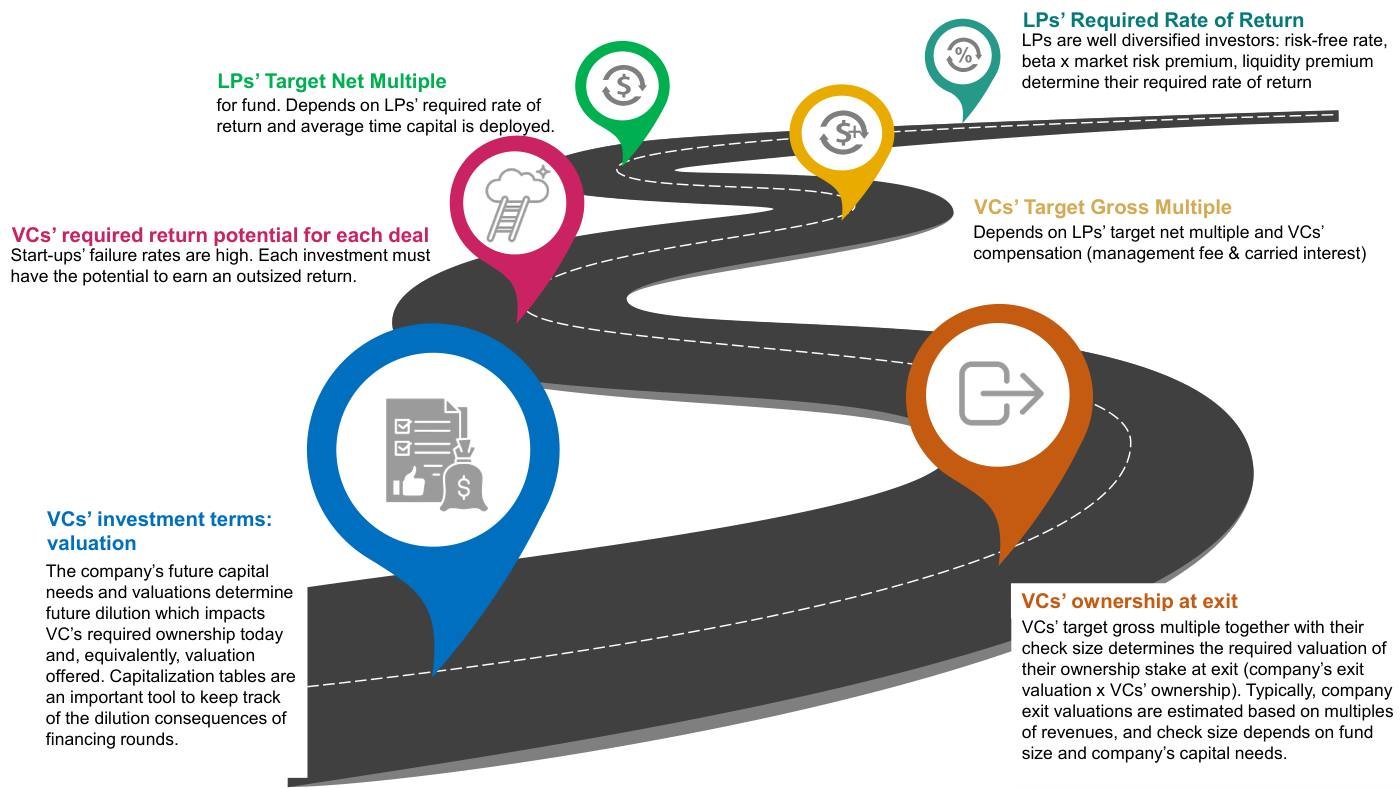
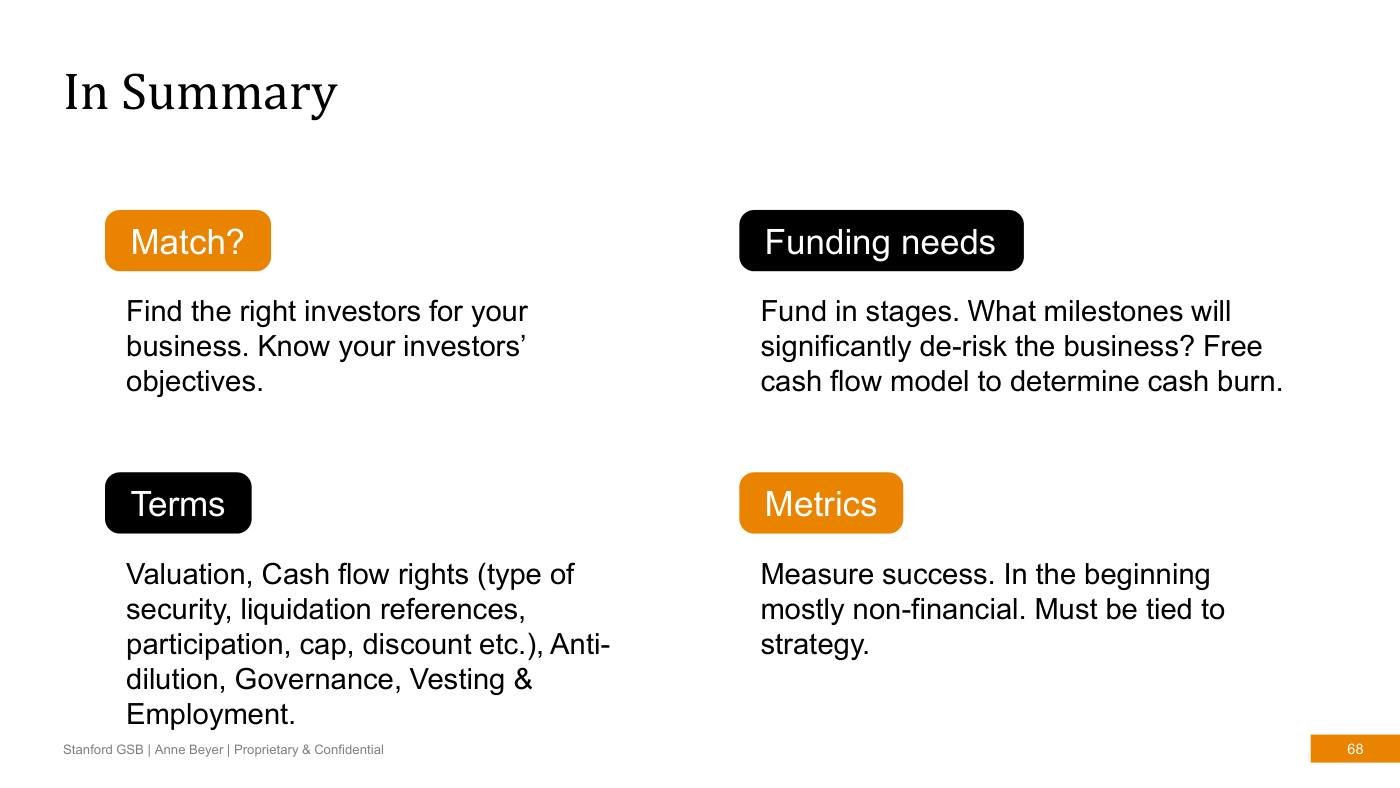
The implied valuation is only as good as its inputs; dispute the inputs (exit size, future rounds, pro-rata) rather than the headline price.
Next lesson: Preferred equity & payoff waterfalls
24
Check your understanding
How do later rounds change today’s ownership requirement?
Score
Question 1
Relay's Series A lead invests $12M, targets 10x, and projects a $600M exit. Ignoring any later rounds, what ownership must it hold at exit?
Required proceeds = 10 x $12M = $120M; $120M / $600M = 20%. The 25% answer is the stake needed today if a later round sells 20%, which is the next step of the method, not the exit requirement.
Question 2
The lead now expects a Series B that sells 20% of Relay before the $600M exit. What post-money valuation does its VC method imply for the $12M Series A?
The lead needs 20% at exit, so it must start with 20% / 0.80 = 25%; post-money = $12M / 25% = $48M. $36M is the matching pre-money. $60M ignores the Series B.
Question 3
Maya holds 30.41% after the seed. Relay then sells 20% in the Series A and 20% in a Series B, with no pool top-ups. What does Maya hold after the Series B?
Multiply the fractions kept: 30.41% x 0.80 x 0.80 = 19.46%. Subtracting 40% of her stake (30.41% x 0.60 = 18.24%) treats both rounds as sold from the same denominator; 10.41% subtracts percentage points.
Question 4
If the lead's projected exit rises from $600M to $800M while the 20% Series B assumption stays, what Series A post-money does its VC method imply?
Required exit stake = $120M / $800M = 15%; today's stake = 15% / 0.80 = 18.75%; post-money = $12M / 18.75% = $64M. A 33% rise in the exit assumption moves the implied valuation by 33%, because the method is linear in the exit value.
Question 5
If the lead accepts $60M post (20%) and the Series B still sells 20%, what does it earn at a $600M exit, and how should Maya use that?
20% x 0.80 = 16% at exit, and 16% x $600M = $96M, or 8.0x (about 41% a year over six years). Most funds would be pleased with that outcome. The 10x target is a hurdle the lead uses to price risk and support its negotiating position, not a binding rule.
Question 6
The lead says: 'Our VC method gives $48M post, so that is what Relay is worth.' Which response is most accurate?
The method converts a target multiple and an exit guess into a price. A 10x target in place of a market cost of capital, a $600M exit and 20% later dilution are all choices. Founders can contest each input, such as pro-rata rights and a path to break-even, with evidence.
Workbook
How do later rounds change today’s ownership requirement?
Module output: A capital strategy, cap table, financing comparison and milestone-based funding plan.
Library
Every original page used in this lesson
4 appear in the slides with notes; the rest are kept here for reference.
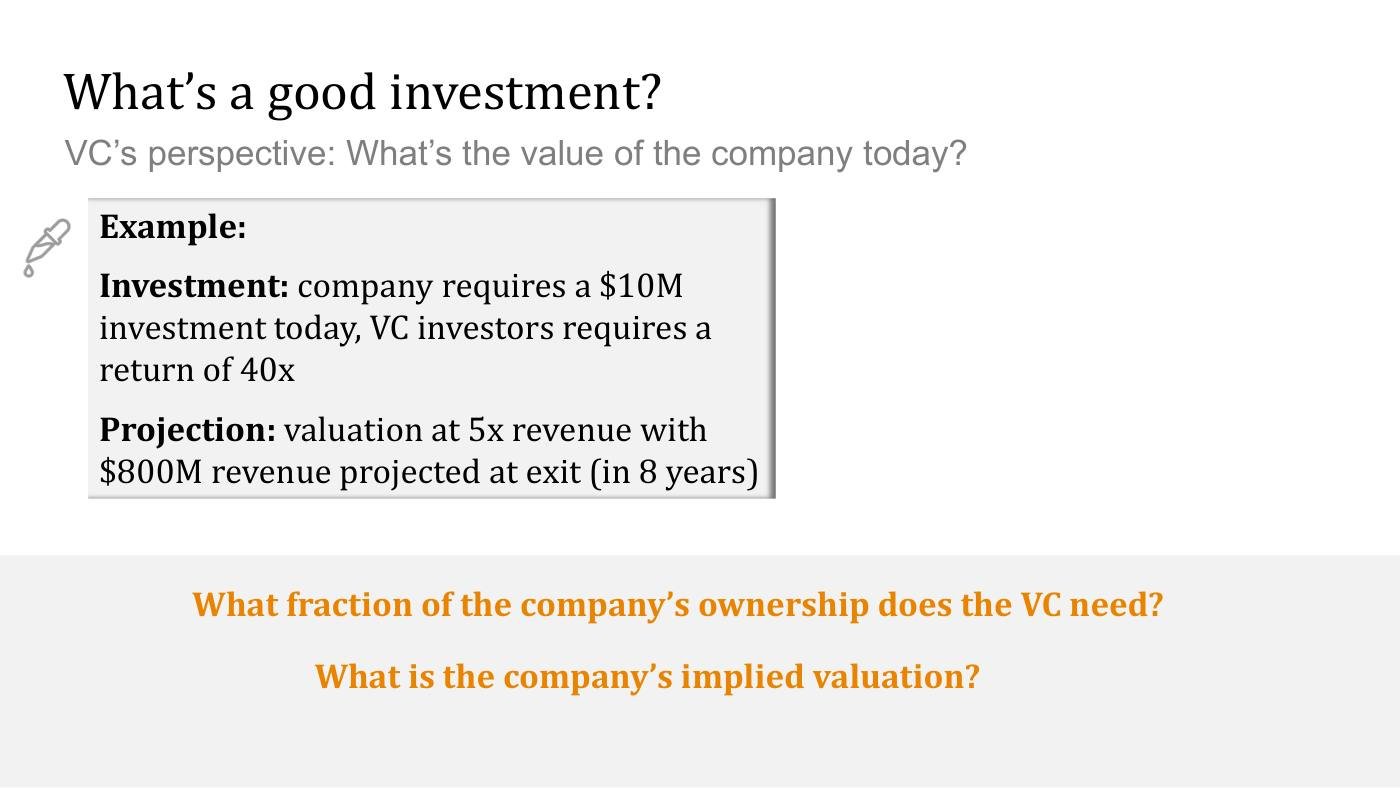
Single-round VC method: the problemA company needs $10M today; the VC requires 40x; exit value is projected at 5x revenue on $800M revenue in eight years. The questions are what fraction the VC needs and what valuation that implies. Setup only; the solution is on slide 8 and in native slide 3.Beyer - Finance Slides (all 3 sessions) · PDF page 18
1
VC method diagram: from a $4B exit back to a $100M post-moneyThe VC needs 40 x $10M = $400M at exit. An exit of 5 x $800M = $4B means the VC needs 10%. Applying that 10% to today's $10M gives an implied post-money of $100M and a pre-money of $90M, annotated 'Really?'. The valuation is an output of four assumptions (exit revenue, exit multiple, target multiple, investment size), not an observed price. The 'Really?' is the right reaction: change any input and the $100M moves. With no later rounds, the stake bought today is also the stake held at exit, which is rarely true.Beyer - Finance Slides (all 3 sessions) · PDF page 19 · in the slides
2
Two-round VC method: the problemVC1 invests $10M now at a 40x target; VC2 invests $50M after two years at a 20x target; same $800M revenue at 5x in eight years. Setup only; the full solution is on slide 10 and in native slide 13.Beyer - Finance Slides (all 3 sessions) · PDF page 20
3
Two-round VC method solved backwardAt the $4B exit VC2 needs $1B (25%) and VC1 needs $400M (10%), leaving founders and others $2.6B (65%). Working backward: round 2 post-money = $50M / 25% = $200M (pre $150M), and VC1 must start with 10% / (1 - 25%) = 13.3%, so round 1 post-money = $10M / 13.3% = $75M (pre $65M). Solve the last round first, because each earlier investor's starting stake depends on everything sold after it. The later round costs VC1 a quarter of its stake, so the round-1 valuation falls from $100M to $75M with no change in the company's prospects.Beyer - Finance Slides (all 3 sessions) · PDF page 21 · in the slides
4
Multi-round funding: ownership and returns from pre-seed to Series EA stacked chart and table for seven rounds (pre-seed $1M at $11M post through Series E $200M at $2.7B post), with each investor's return multiple at a $4B exit falling from 63.0x (pre-seed) and 40.8x (seed) to 1.5x (Series E). A handwritten note says a seed investor can realistically only offer $30M post-money. Later investors pay higher prices with less time left, so the same exit gives them far lower multiples. That is why the 40x target belongs to seed money and 3x to growth money. The seed stake shrinks from 33% to about 10% by exit. Dividing out only the stakes sold in each round leaves 13.5%, so the chart also includes dilution the table does not show, probably pool refreshes. Reconcile share counts before relying on such a chart.Beyer - Finance Slides (all 3 sessions) · PDF page 22 · in the slides
5
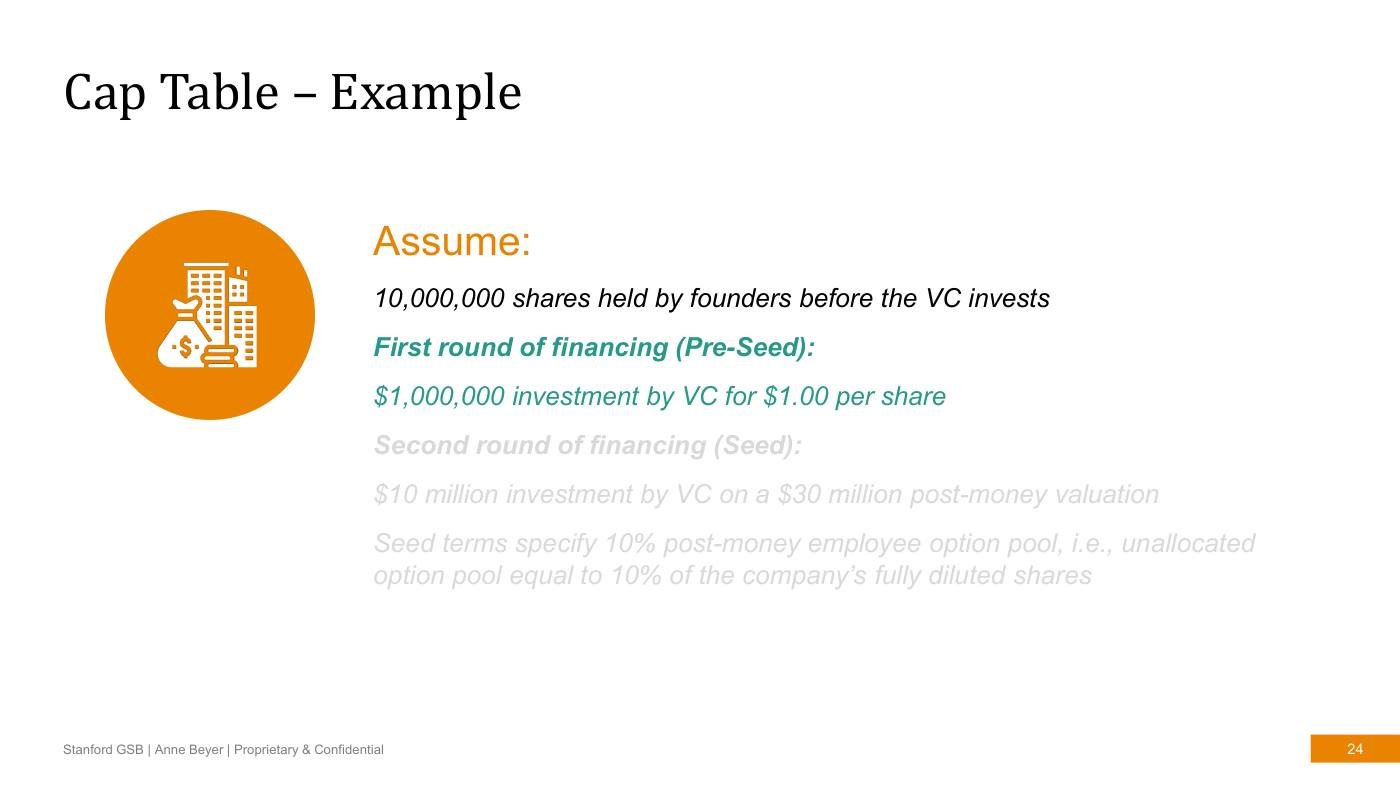
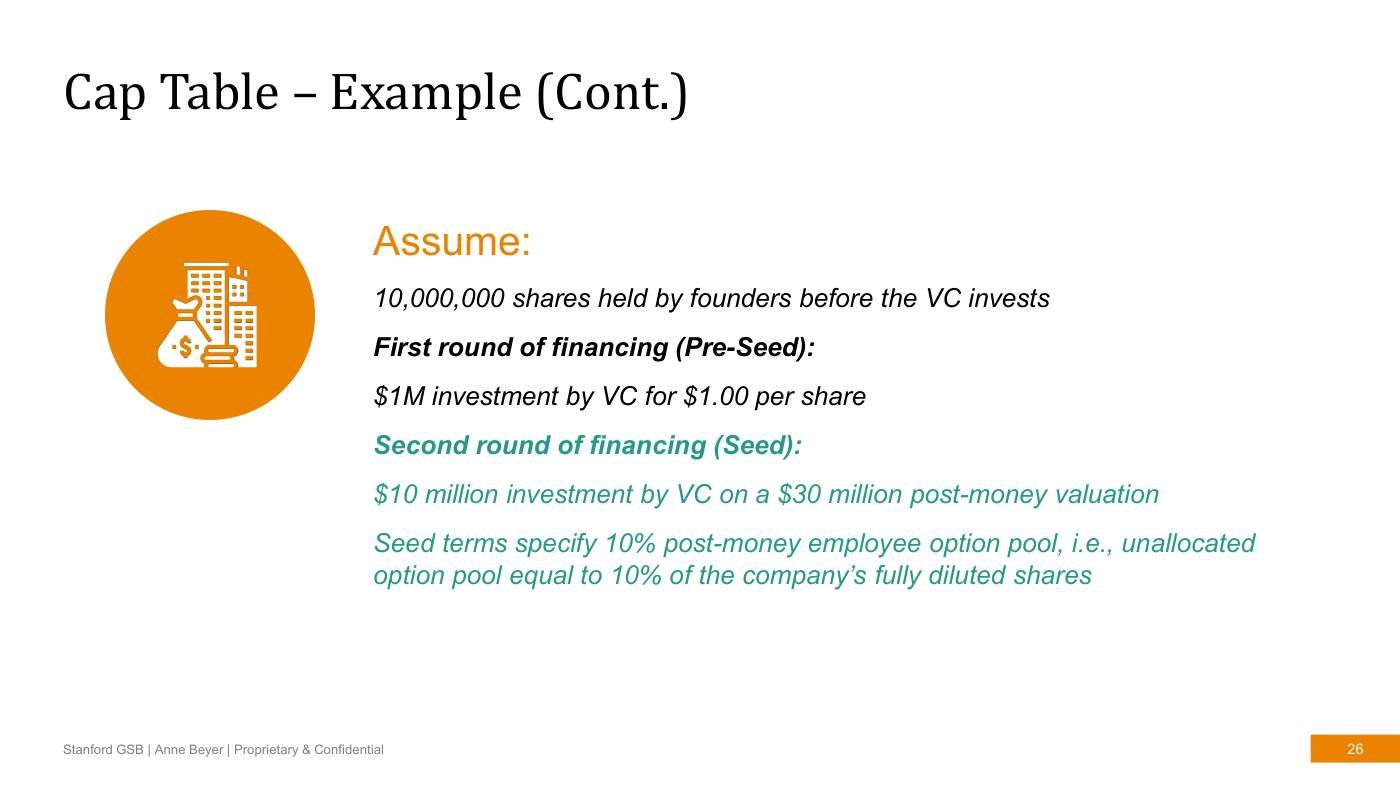
Cap table example: assumptions (seed highlighted)Founders 10,000,000 shares; pre-seed $1M at $1.00; seed $10M at $30M post with a 10% post-money unallocated pool. Same assumptions as lesson 30, native slide 4.Beyer - Finance Slides (all 3 sessions) · PDF page 26
6
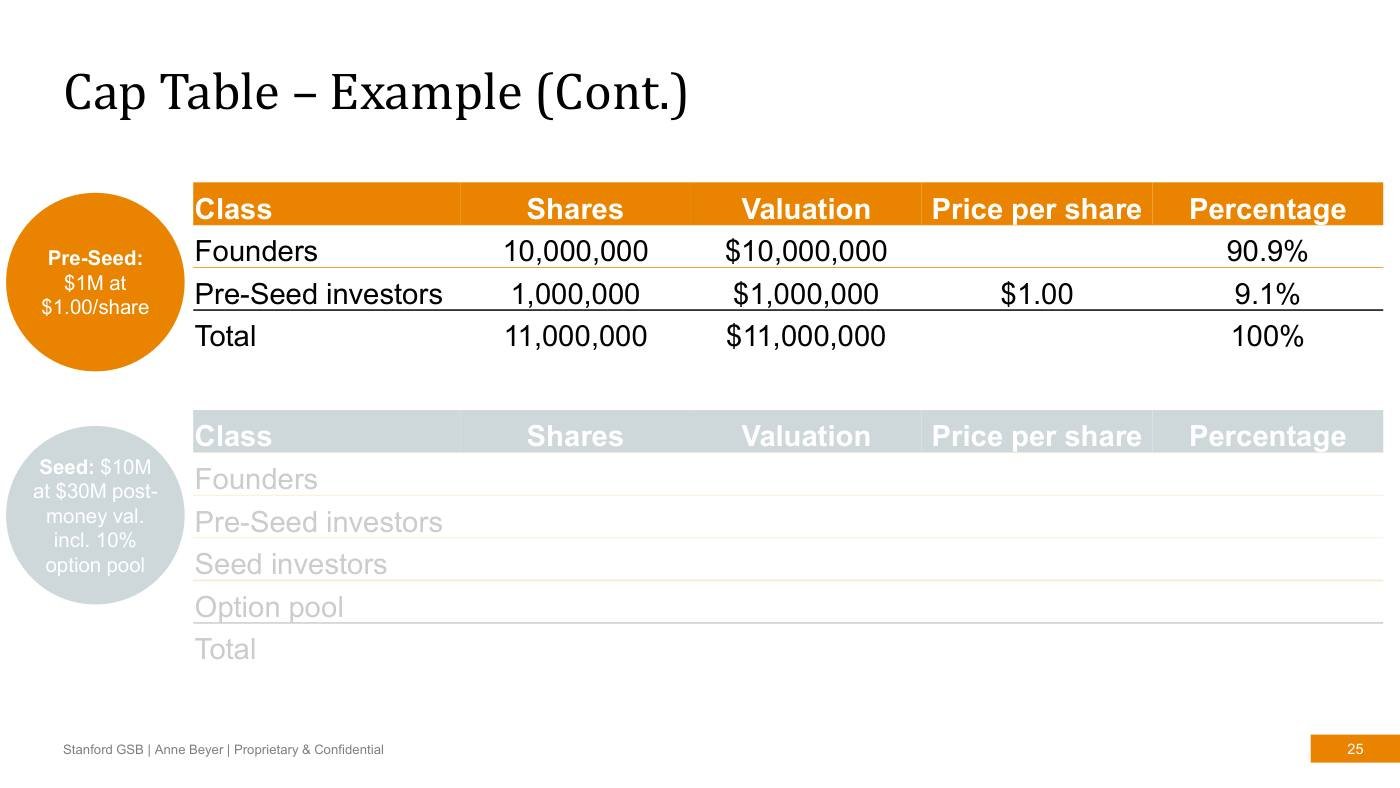
Pre-seed and seed cap tables with a 10% post-money poolAfter the pre-seed: founders 10,000,000 (90.9%), pre-seed 1,000,000 (9.1%). After the seed: founders 10,000,000 (51.5%, $15.45M), pre-seed 1,000,000 (5.2%, $1.55M), seed 6,470,588 at $1.55 (33.3%, $10M), option pool 1,941,176 (10.0%, $3M); total 19,411,765 shares and $30M. The 'Price per share' column shows $1.00 for the pre-seed investors, which is their entry price. At the seed every share is worth $1.545, which is why their 1,000,000 shares appear at $1,545,455. The $3M pool line is the part of the '$20M pre-money' that existing holders never receive.Beyer - Finance Slides (all 3 sessions) · PDF page 27 · in the slides
7
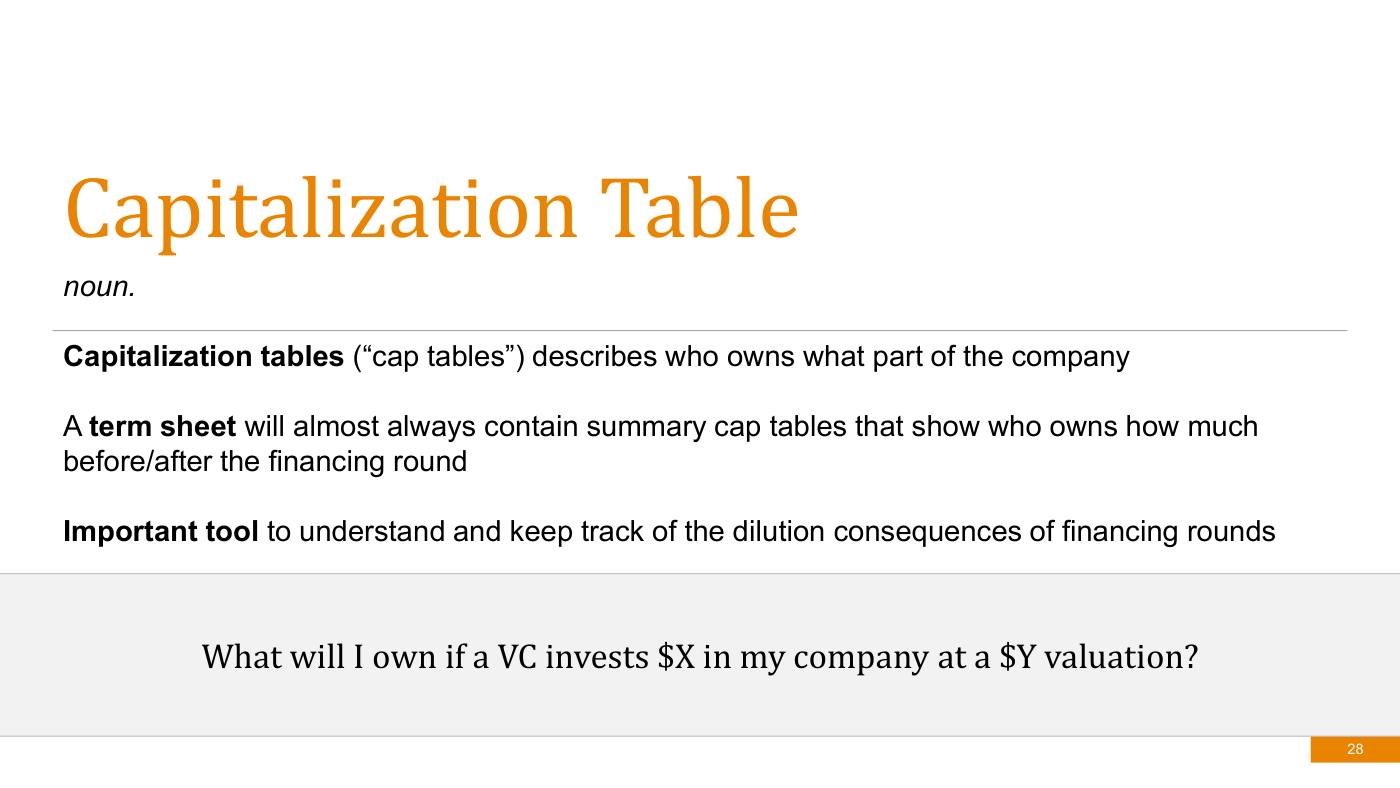
Capitalization table: definitionA cap table describes who owns what; term sheets almost always include summary cap tables before and after the round; it tracks the dilution from financing rounds. Definition only; covered in native slides 6 and 15.Beyer - Finance Slides (all 3 sessions) · PDF page 28