Separate preference, conversion and participation.
Calculate the non-participating conversion crossover.
Identify the claims and assumptions omitted by a simplified waterfall.
90-minute workshopOpening 5 minConcepts and original examples 35 minPractice 25 minDebrief 15 minReview 10 min
2
32 / TheoryPreferred equity & payoff waterfalls
A liquidation preference changes downside allocation
A liquidation preference specifies a claim on proceeds before common holders receive the residual, subject to the actual seniority and available proceeds. A 1× preference commonly refers to a multiple of the original invested amount in the example.
The source payoff diagrams separate preference, conversion and participation. These features answer different questions: the amount paid first, whether the holder can elect common treatment, and whether the holder also shares the residual. Headline ownership alone cannot describe the resulting payoff.
3
32 / TheoryPreferred equity & payoff waterfalls
Non-participating convertible preferred chooses one route
Under the simplified non-participating example, the holder takes the available preference or converts to common for a pro-rata share, whichever is better. The holder does not receive the preference and then also participate in the remaining proceeds.
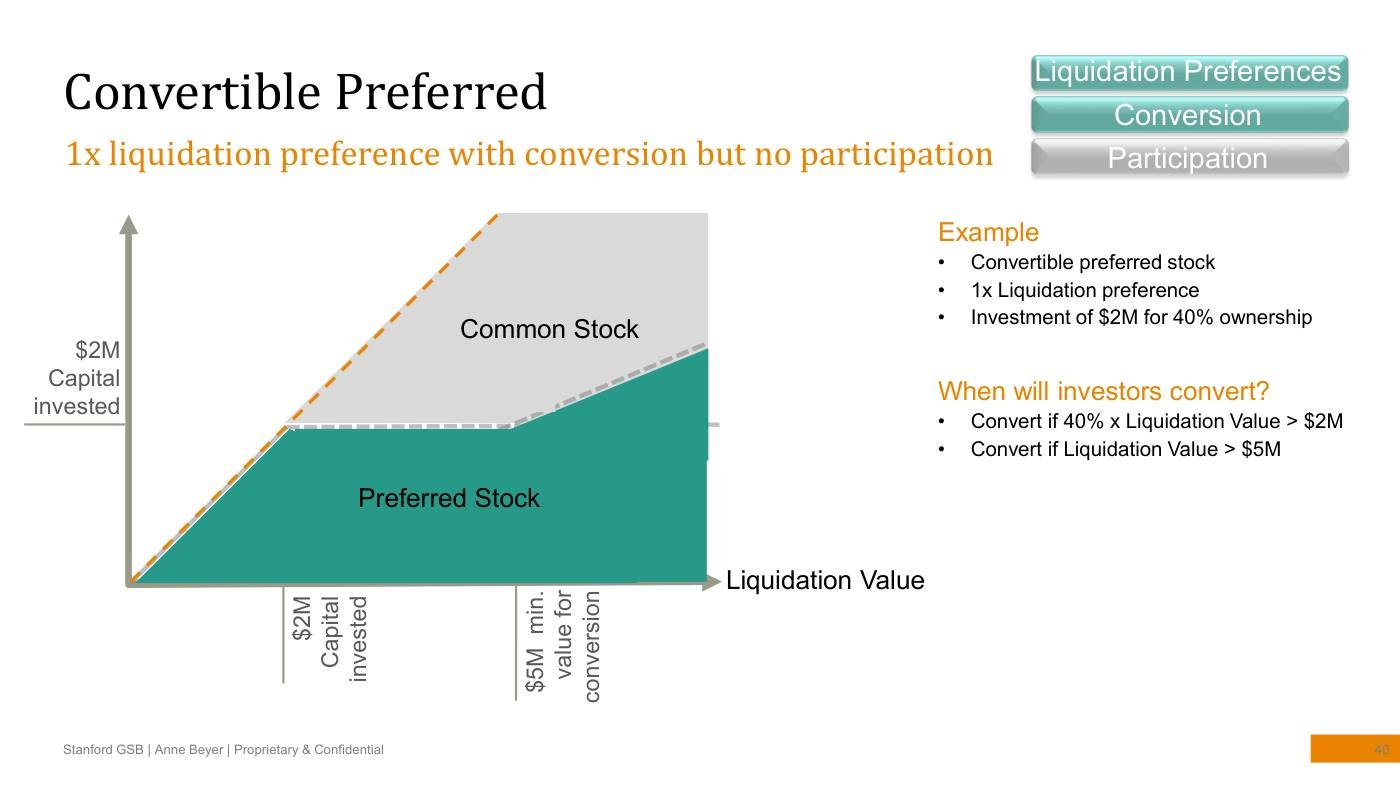
For a 2m preference and 40% ownership, conversion becomes better above an exit value of 5m because 40% × 5m = 2m. Below that crossover, the preference can allocate more than 40% of proceeds to the investor. Available proceeds still limit the payment.
4
32 / TheoryPreferred equity & payoff waterfalls
Different financing instruments
Instrument
Core economic structure
Common equity
Residual participation in the value available to common holders.
Preferred equity
Equity with specified preferences and other rights.
Convertible note
Debt that can convert under specified terms.
SAFE
Contractual future-equity arrangement; exact form matters.
Venture debt
Debt with repayment and other negotiated features.
Actual contracts determine economic and control rights.
5
32 / TheoryPreferred equity & payoff waterfalls
Ownership and payout are different
Ownership is a fraction of a defined capitalization. Exit proceeds depend on contractual claims and the amount available for distribution.
Ownership percentage
A fraction of shares on a stated basis.
Payout rights
Rules for allocating proceeds, including preferences, participation and conversion. Identical headline percentages can have different economics.
Worked application
Illustrative application: an investor contributes $2m for 40% and holds 1× non-participating convertible preferred. With $3m available and no other claims, taking the $2m preference exceeds converting for $1.2m. The investor therefore receives more than 40% of that low-exit amount under the model.
Read the instrument and the waterfall before translating a headline percentage into expected proceeds.
6
32 / TheoryPreferred equity & payoff waterfalls
Non-participating convertible preferred
PREFERRED CHOOSES PREFERENCE OR CONVERSION
Illustrative terms
$2m investment for 40% ownership, 1× preference, non-participating.
Available proceeds
Cannot distribute more than is available.
At a $10m exit
Conversion gives $4m, exceeding the $2m preference.
7
32 / TheoryPreferred equity & payoff waterfalls
Illustrative exit payoffs, $ millions
Exit
Non-participating preferred
Common remainder
Participating preferred
Common remainder
1
1.0
0.0
1.0
0.0
3
2.0
1.0
2.4
0.6
10
4.0
6.0
5.2
4.8
$2m invested for 40%; 1× preference; participation uncapped; ignore debt, costs, taxes and other securities.
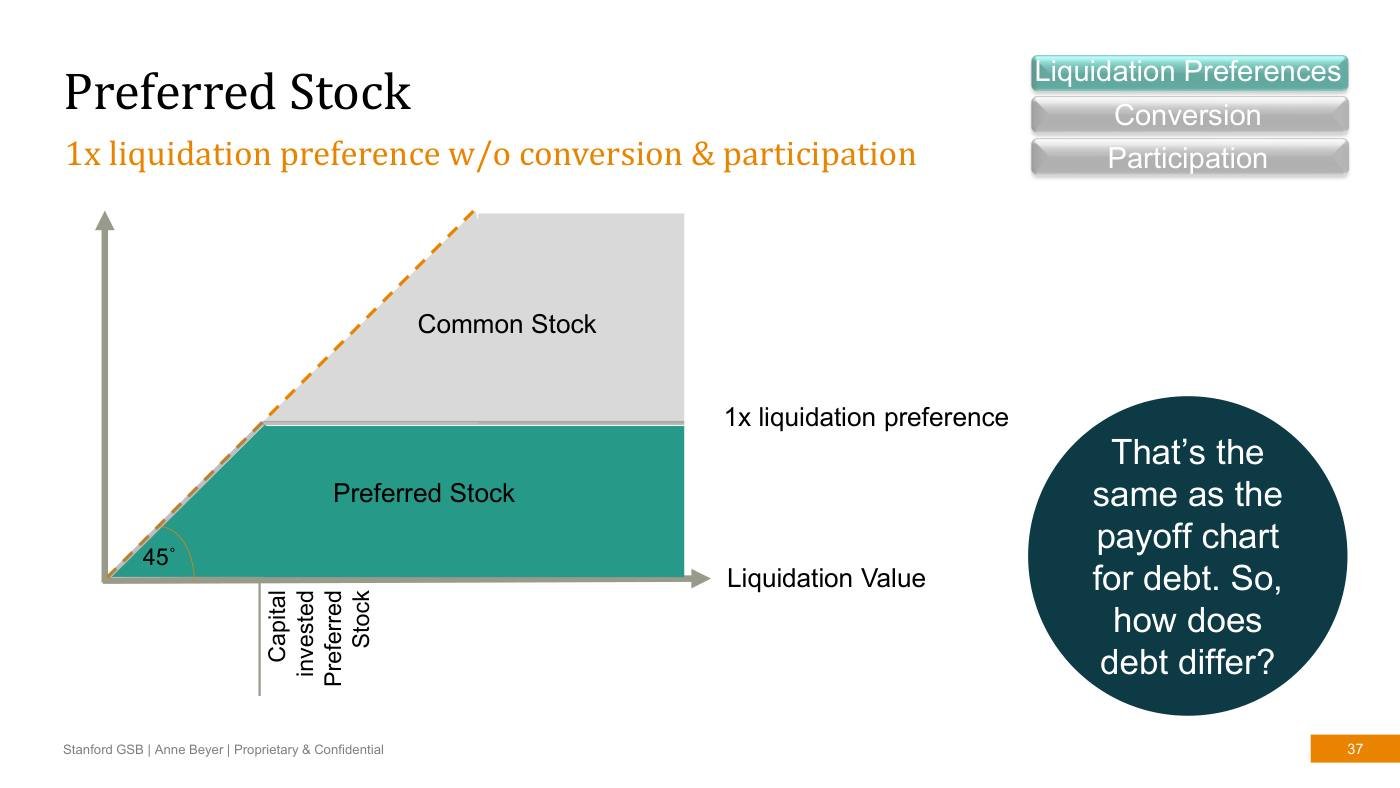
1× preference without conversion: a debt-shaped claim
12
32 / TheoryPreferred equity & payoff waterfalls
Participation creates another claim on the residual
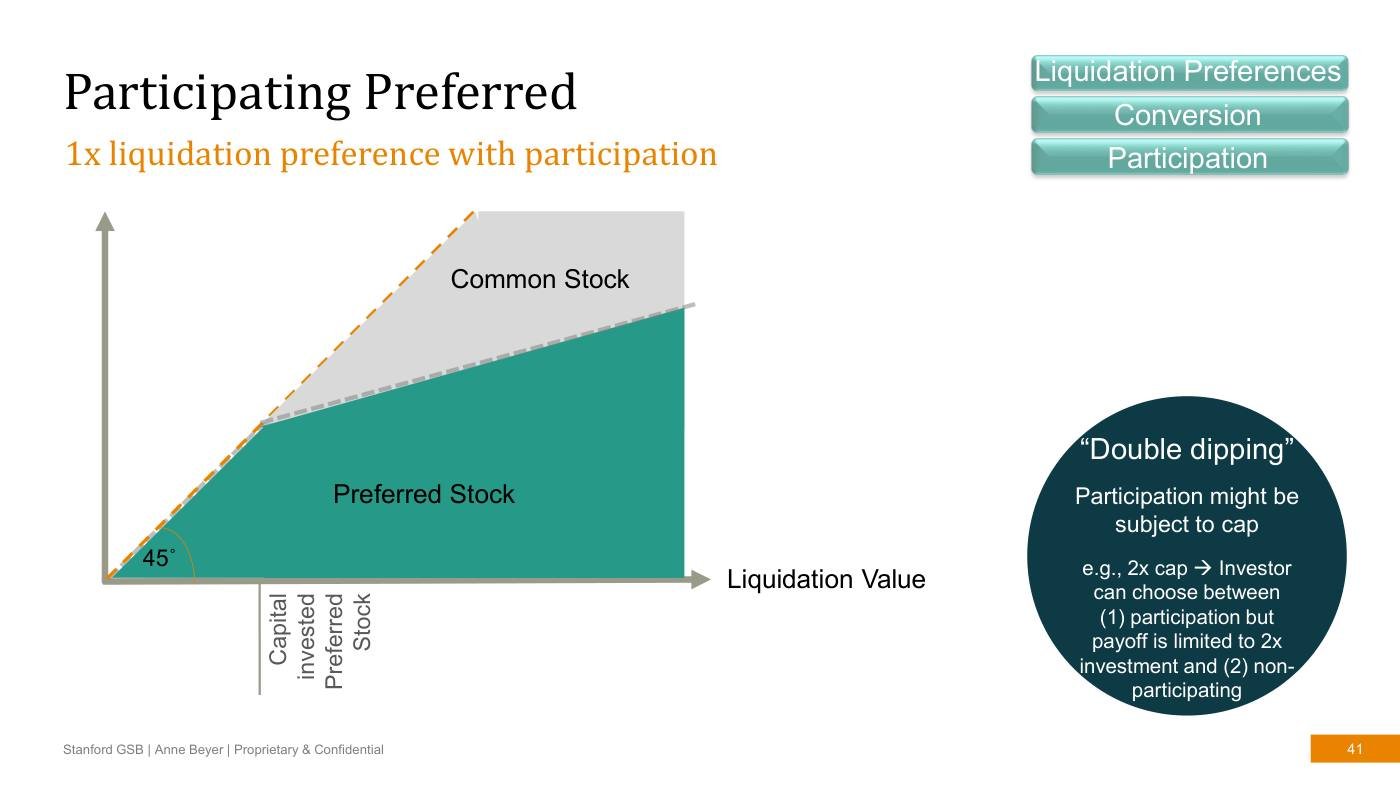
Uncapped participating preferred first receives its preference and then receives its ownership share of the remaining proceeds under the example. This changes the payoff even when the investment, headline valuation and ownership percentage remain identical.
Caps and conversion rights can change the comparison, so the actual terms must be read together. A payoff table over several exit values makes the difference visible and exposes which range matters most to the parties. A single large-exit comparison can hide a consequential downside transfer.
13
32 / TheoryPreferred equity & payoff waterfalls
A waterfall needs every relevant claim
A real payoff calculation begins with proceeds available after obligations such as debt and transaction costs, then applies the relevant seniority, preferences and conversion choices. Multiple classes can interact in ways a single-investor illustration omits.
The teaching diagrams isolate one feature at a time so its effect can be understood. State those omissions before using the result in a comparison. Also distinguish economic rights from control rights, which can affect decisions before an exit occurs.
14
32 / TheoryPreferred equity & payoff waterfalls
Preference and participation across exit values
2m investment, 40% ownership and a 1× preference. The participating case is uncapped.
Exit available, $m
Non-part. preferred
Non-part. common
Participating preferred
Participating common
1
1.0
0.0
1.0
0.0
3
2.0
1.0
2.4
0.6
5
2.0
3.0
3.2
1.8
10
4.0
6.0
5.2
4.8
The comparison omits debt, costs, other securities and negotiated caps. At the 5m non-participating crossover, preference and conversion both yield 2m.
15
32 / TheoryPreferred equity & payoff waterfalls
The same headline ownership, different payouts
Illustrative $10m exit: non-participating preferred gets $4m; uncapped participating preferred gets $5.2m under the stated terms.
16
32 / TheoryPreferred equity & payoff waterfalls
Economic and control terms interact
Payout and conversion rights.
Voting, board and consent rights.
Future financing, transfer and exit provisions.
Employment, vesting and other linked obligations.
17
32 / TheoryPreferred equity & payoff waterfalls
Headline value and economic value
A financing valuation describes the transaction under its definitions. The distribution of value also depends on preferences, participation, dilution and control provisions.
Headline post-money
A summary number for a round.
Economic outcome
Depends on who owns which rights and what happens in the relevant future scenario.
Worked application
Illustrative application: with $10m available, a $2m investor holding 40% receives $4m under the simplified non-participating structure, but $5.2m under uncapped participation. The common holders’ receipts differ even though the quoted ownership fraction is the same.
Compare the outcomes across plausible exits and the complete terms rather than comparing valuation labels alone.
18
32 / Deep divePreferred equity & payoff waterfalls
Relay after the Series A: who shares in an exit
Exit proceeds go to outstanding shares and exercised options, not to the fully diluted count.
The Series A priced the company on 21,377,551 fully diluted shares. At an exit, the 1,710,204 unallocated pool shares have not been issued and receive nothing, so the as-converted base is 19,667,347.
Both preferred classes are 1× non-participating and pari passu (illustrative assumption from the Relay term sheets). Granted options are treated as vested and exercised with strike price ignored; former SAFE holders are treated as converted holders per the Relay cap table.
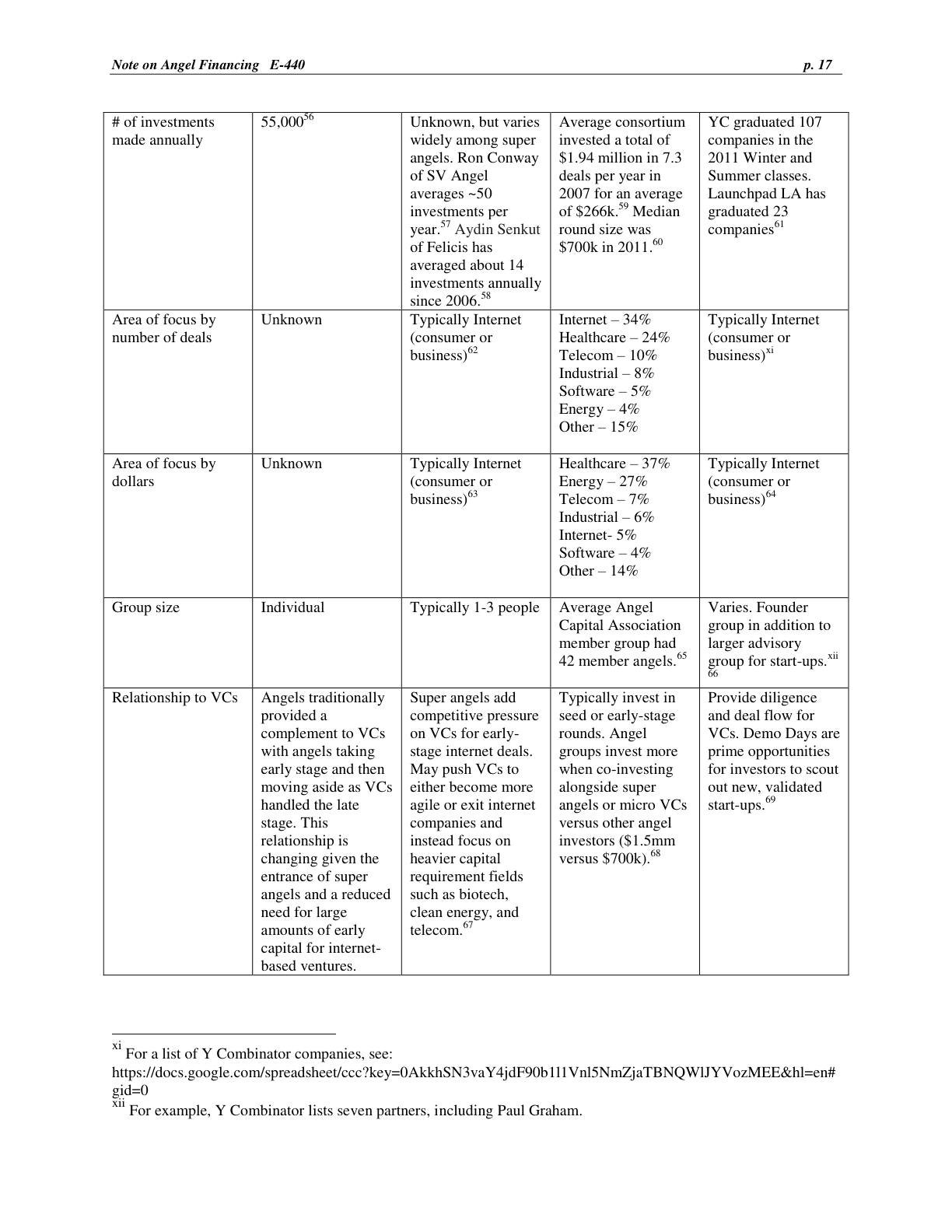
Holder
Shares
Fully diluted %
As-converted % at exit
Preference
Maya Chen
5,200,000
24.33%
26.44%
None
Daniel Okafor
4,800,000
22.45%
24.41%
None
Former SAFE holders
1,571,429
7.35%
7.99%
None (see notes)
Granted options
400,000
1.87%
2.03%
None
Unallocated pool
1,710,204
8.00%
0%
None
Seed preferred
3,420,408
16.00%
17.39%
$4.0M, 1×, non-participating
Series A preferred
4,275,510
20.00%
21.74%
$12.0M, 1×, non-participating
Total
21,377,551 / 19,667,347
100%
100%
$16.0M
19
32 / Worked modelPreferred equity & payoff waterfalls
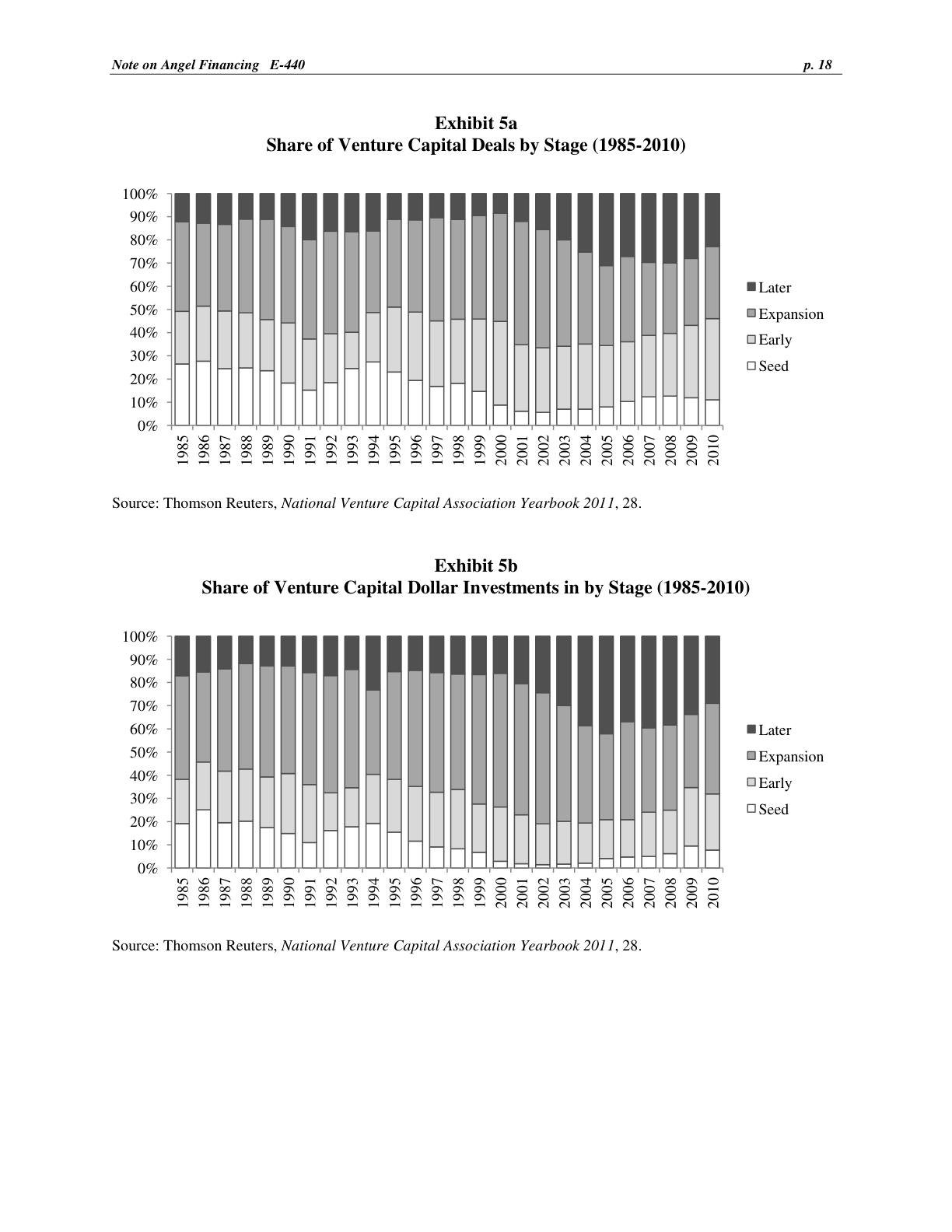
The payoff changes with the exit value
20
32 / Deep divePreferred equity & payoff waterfalls
Relay's waterfall at $40M, $150M and $600M
Each preferred class takes the greater of its preference or its as-converted share; the choices are solved together.
$40M: the Series A would get only $8.70M by converting, so it takes $12M. The remaining $28M is shared by 15,391,837 shares; the seed's 22.22% is worth $6.22M, above its $4M preference, so it converts. Rechecking the Series A leaves its choice unchanged, so the solution is stable.
$150M and $600M: both classes convert and every holder is paid strictly in proportion to as-converted shares. Figures in $M; rows may not sum exactly due to rounding.
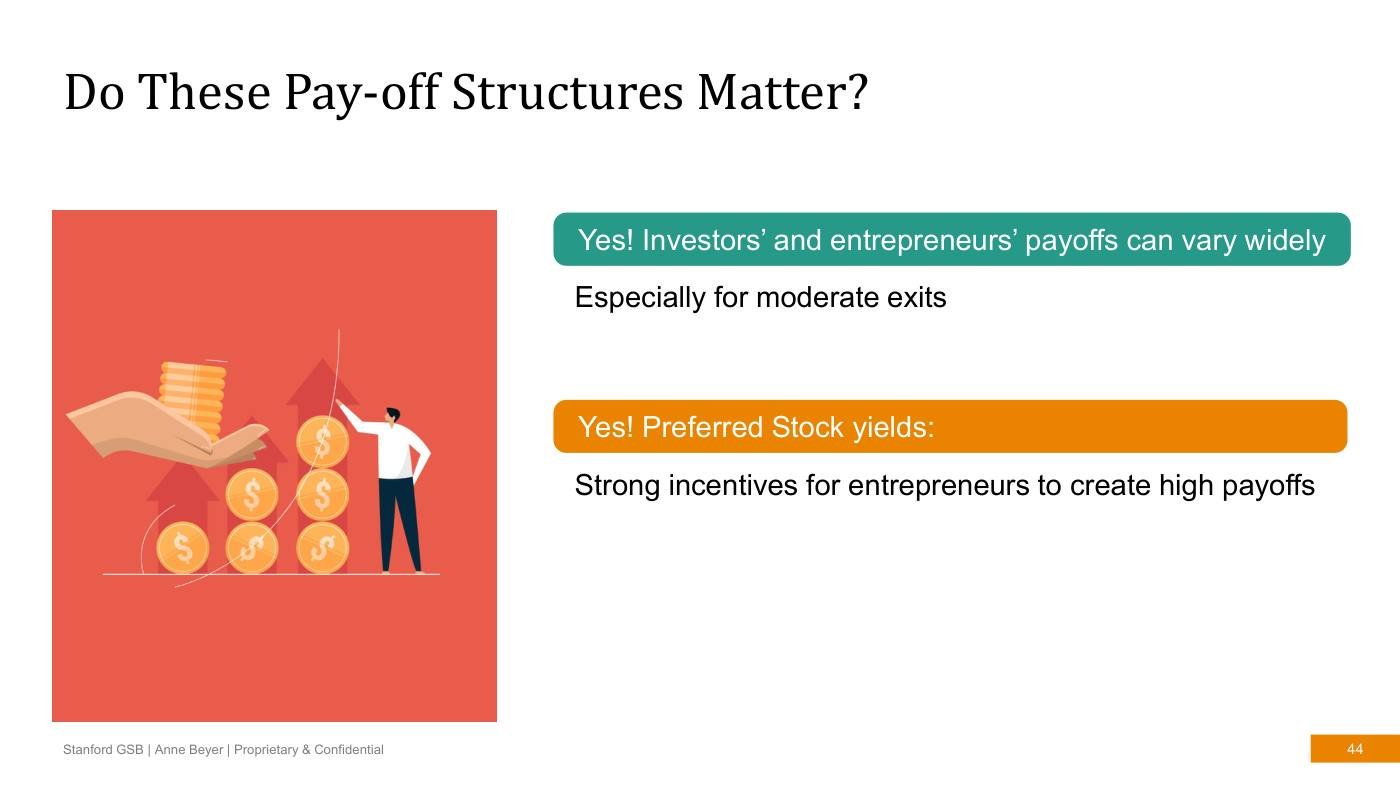
Do payoff structures matter? Yes, mostly at moderate exits
25
32 / Current practicePreferred equity & payoff waterfalls
Current practice: preference terms and SAFEs in exit waterfalls
1× non-participating remains the market norm
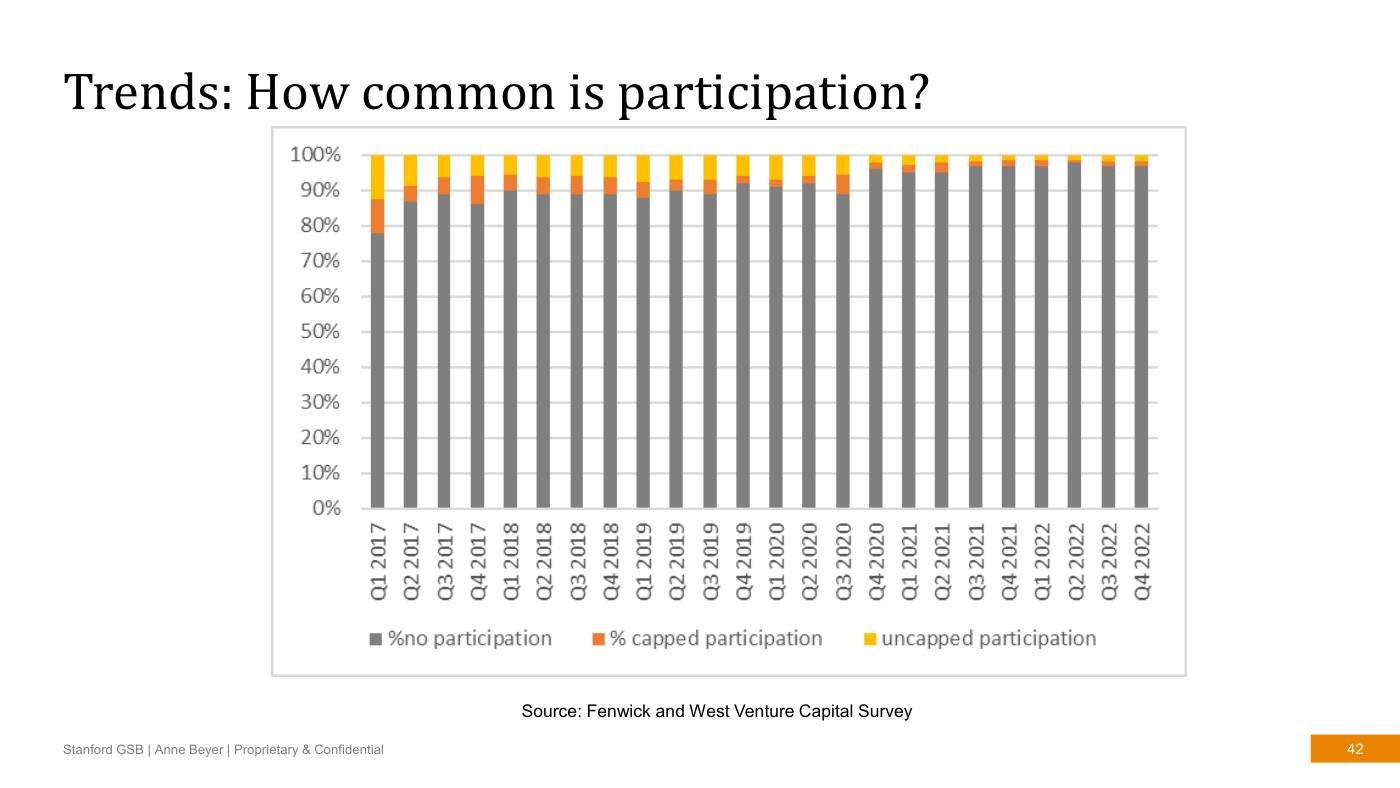
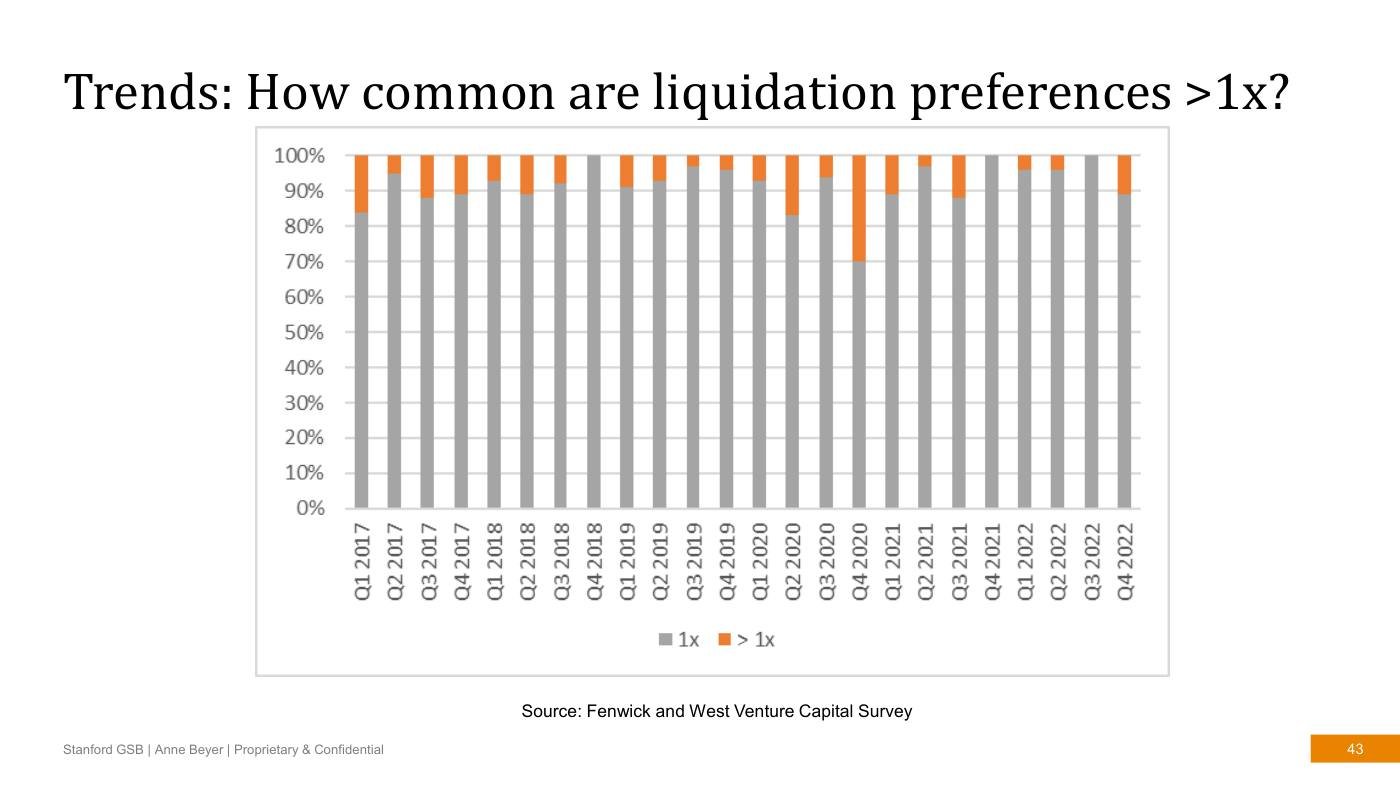
Carta reported that liquidation preferences above 1× appeared in about 8% of new rounds on its platform in Q1 2024, tied for the highest share this decade, while the vast majority of rounds still carried no such structure. Relay's 1× non-participating terms reflect that norm; a request for 2× or participation is a signal to model the moderate-exit range carefully.
Unconverted SAFEs have a place in the waterfall
Under Y Combinator's post-money safe, if the company is sold before the safe converts, the holder receives the greater of its purchase amount or its as-converted amount. The safe ranks below debt, on par with non-participating preferred and other safes, and ahead of common. A sale before Relay's seed would have needed this line in the waterfall.
An investor contributes $2m for 40% ownership. Compare 1× non-participating convertible preferred with 1× uncapped participating preferred at available exit proceeds of $1m, $3m and $10m. Omit debt, costs, other classes and any participation cap.
Your task
Calculate preferred and common payouts in each case. Find the non-participating conversion crossover and explain why the same 40% produces different payoffs.
27
32 / DebriefPreferred equity & payoff waterfalls
Worked answer and reasoning
Non-participating preferred receives 1, 2 and 4; common receives 0, 1 and 6, in $m.
Participating preferred receives 1, 2.4 and 5.2; common receives 0, 0.6 and 4.8.
The non-participating crossover is 2/40% = 5m. Participation adds a claim on the residual after the preference.
Relay has closed its Series A: $12,000,000 for 4,275,510 Series A preferred shares, after a $4,000,000 seed (3,420,408 seed preferred shares). Both are 1× non-participating and pari passu. Outstanding as-converted shares are 19,667,347: Maya 5,200,000, Daniel 4,800,000, former SAFE holders 1,571,429, granted options 400,000, seed 3,420,408, Series A 4,275,510. The 1,710,204 unallocated pool shares are not outstanding. The board wants to understand three illustrative outcomes: a $40M acquisition, a $150M acquisition and the VC-method $600M exit.
Your task
A waterfall table for $40M, $150M and $600M showing each class's conversion decision and payout, the two conversion crossovers, a check that each decision is stable, and a list of the assumptions the simplified model omits.
Basis: as-converted shares 19,667,347. Series A = 4,275,510/19,667,347 = 21.74%; seed = 17.39%. The headline 20% and 16% use the fully diluted count of 21,377,551, which includes 1,710,204 unissued pool shares that receive nothing at an exit.
$40M: start with both converting: Series A would get 21.74% × 40 = $8.70M < $12M, so it takes its preference. Remaining $28M is shared by 15,391,837 shares; seed converting gets 3,420,408/15,391,837 = 22.22% × 28 = $6.22M > $4M, so seed converts. Recheck Series A: converting still yields $8.70M < $12M. Stable. Payouts: A $12.00M, seed $6.22M, Maya $9.46M, Daniel $8.73M, SAFE holders $2.86M, options $0.73M.
$150M and $600M: both convert (A gets $32.61M and $130.43M, far above $12M). Everyone is paid pro rata: Maya $39.66M / $158.64M, Daniel $36.61M / $146.44M, seed $26.09M / $104.35M, SAFE holders $11.99M / $47.94M, options $3.05M / $12.20M.
Crossovers: seed converts once 22.22% × (X − $12M) > $4M, i.e., X > $30.0M (given A holds its preference). Series A converts once 21.74% × X > $12M, i.e., X > $55.2M. Below $16M the two preferences share proceeds pro rata to $12M:$4M and common receives nothing.
Omitted: debt and transaction costs, option exercise prices, unvested options and acceleration, management carve-outs, escrows and earn-outs, and the fact that a real SAFE usually converts into shadow seed preferred with its own $1.5M preference (it would convert anyway at all three exits, since $2.86M > $1.5M).
30
32 / Deep divePreferred equity & payoff waterfalls
Relay's conversion map
Two crossovers divide the exit range into four regimes.
Seed crossover: with the Series A in preference, the seed converts when 22.22% × (X − $12M) > $4M, i.e., X > $30.0M. Series A crossover: with the seed converted, the Series A converts when 21.74% × X > $12M, i.e., X > $55.2M.
The preferences change the outcome only below $55.2M. That is the range where founders and investors can disagree about accepting an offer.
Exit range
Series A
Seed
Common holders receive
Up to $16M
Preference (75% of proceeds)
Preference (25% of proceeds)
Nothing
$16M to $30M
$12M preference
$4M preference
Exit − $16M
$30M to $55.2M
$12M preference
Converts: 22.22% of (exit − $12M)
77.78% of (exit − $12M)
Above $55.2M
Converts: 21.74%
Converts: 17.39%
60.87% of exit
31
32 / DebriefPreferred equity & payoff waterfalls
Reasoning traps
Using headline fully diluted percentages at exit
Relay's Series A is '20%', but unissued pool shares get nothing, so it holds 21.74% of the shares actually paid. Waterfalls run on outstanding and exercised shares, not the fully diluted count used for pricing.
Solving each class's conversion in isolation
Whether the seed converts depends on whether the Series A takes its preference, and vice versa. Make a decision for every class, recompute, and check that no class wants to switch; at $40M the stable answer is A preference, seed converts.
Assuming seniority without reading the charter
Pari passu and senior structures pay identical amounts above total preferences but very different amounts below them: at a $10M exit Relay's seed gets $2.5M pari passu and nothing if the Series A is senior.
32
32 / ReviewPreferred equity & payoff waterfalls
What you can now explain
Relay's exit waterfall at $40M, $150M and $600M, with conversion decisions, crossovers at $30.0M and $55.2M, and a list of omitted claims.
A non-participating preferred holder takes the greater of its preference or its as-converted share, and in a multi-class table those choices must be solved jointly.
Relay's preferences matter only below $55.2M: under $16M the investors take everything, between $30M and $55.2M only the Series A is in preference, and above $55.2M all classes are paid pro rata.
Exit payouts use outstanding as-converted shares, so unallocated pool shares raise everyone else's percentage at exit relative to the fully diluted cap table.
Next lesson: Convertible notes, caps, discounts & SAFEs
33
Check your understanding
How do financing rights divide the exit proceeds?
Score
Question 1
Relay's Series A holds 4,275,510 of 19,667,347 as-converted shares, a 1× non-participating $12M preference, and the seed has already converted. Above what exit value does the Series A prefer converting to taking its preference?
Conversion pays 21.74% × X; it beats $12M when X > 12/0.2174 = $55.2M. $60M divides by the headline 20%, which counts unissued pool shares that never receive proceeds; $48M is the pre-money valuation, not a payoff threshold.
Question 2
At a $40M sale of Relay, the Series A takes its $12M preference. How much does the seed investor (3,420,408 shares, $4M 1× non-participating preference) receive?
With A out of the common pool, the seed shares 3,420,408/15,391,837 = 22.22% of the remaining $28M = $6.22M, more than its $4M preference. Applying 16% or 17.39% to the full $40M ignores that A's preference has already been paid off the top.
Question 3
ClinicOS offers $10M for Relay, below the $16M of combined preferences. Seed and Series A are pari passu 1× non-participating. What do the investors receive?
Pari passu classes share a shortfall pro rata to their preference amounts, $12M:$4M = 75%:25%, so $7.5M and $2.5M. Paying the Series A first would require it to be senior. Converting would pay each class far less than its preference.
Question 4
A founder says: 'At a $600M exit Maya gets 24.33% of the proceeds, her post-Series A fully diluted ownership.' The model shows $158.64M (26.44%). What explains the difference?
Fully diluted counts include reserved but ungranted options. Proceeds go only to shares and exercised options that exist. Non-participating preferred cannot both take its preference and convert, and the SAFE converted at the seed.
Question 5
Suppose the Series A had been 1× participating (uncapped) instead. At a $40M exit, with the seed converting, roughly how much less would Maya receive?
Participating A takes $12M plus 21.74% of the remaining $28M = $18.09M. Maya's share of what is left is 5,200,000/19,667,347 × $28M = $7.40M versus $9.46M non-participating, a $2.06M loss. Participation bites hardest at moderate exits.
Question 6
An $18M offer arrives for Relay. Under the cap table, common holders (Maya, Daniel, former SAFE holders, option holders) share only $2M; Maya would receive about $0.87M. What is the most important governance implication?
At $18M the investors recover their full $16M while founders get little, so incentives diverge. Drag-along and protective provisions decide who can force or block the sale. Preferred holders cannot be required to convert against their interest.
Workbook
How do financing rights divide the exit proceeds?
Module output: A capital strategy, cap table, financing comparison and milestone-based funding plan.
Library
Every original page used in this lesson
8 appear in the slides with notes; the rest are kept here for reference.
Section divider: the debt–equity continuumTitle page listing common stock, preferred stock, convertible notes and venture debt along one continuum. No content beyond the ordering; slide 10 makes the same point with payoff diagrams.Beyer - Finance Slides (all 3 sessions) · PDF page 32
1
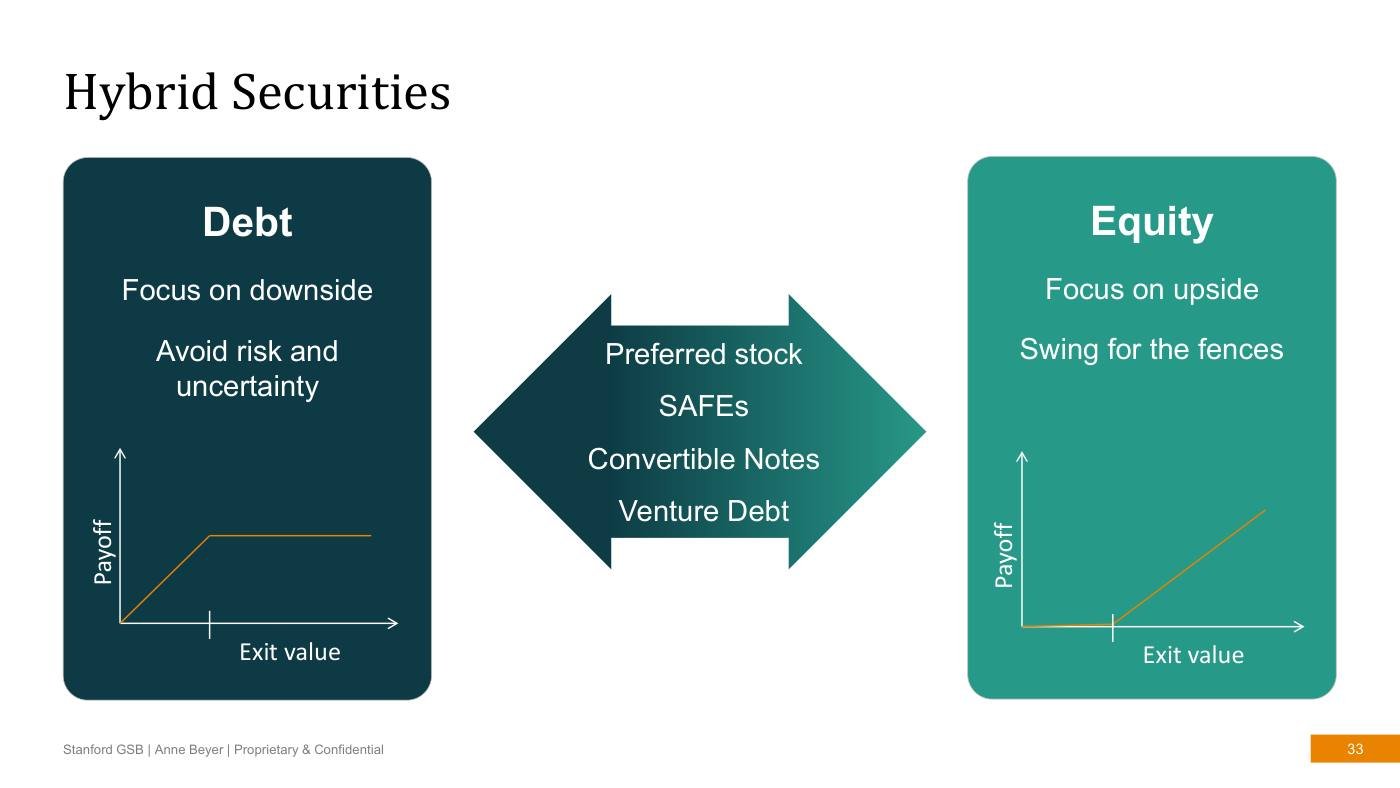
Debt and equity payoffs, with hybrids in betweenTwo payoff diagrams against exit value: debt pays rising value up to a fixed claim and then goes flat; equity pays nothing until a threshold and then rises with value. Preferred stock, SAFEs, convertible notes and venture debt sit in the middle. A non-participating convertible preferred share is literally the two shapes stitched together: the debt-like flat line at low exits and the equity line at high exits. Every waterfall in this lesson is a kink between those two regimes.Beyer - Finance Slides (all 3 sessions) · PDF page 33 · in the slides
2
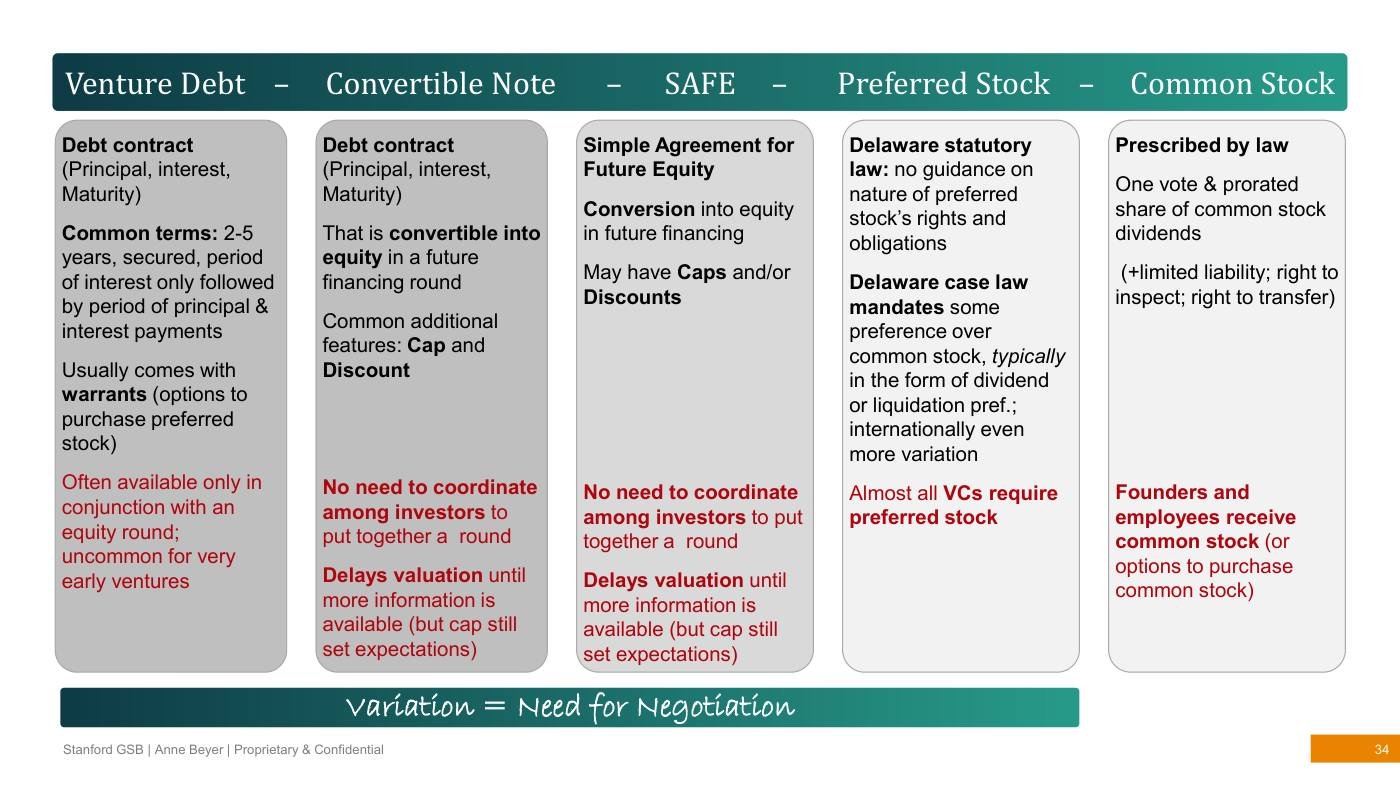
Five instruments compared: venture debt to common stockA side-by-side table: venture debt (principal, interest, 2–5 year terms, often with warrants), convertible notes (debt that converts, with cap and discount), SAFEs (conversion into future equity, no maturity), preferred stock (rights set by contract under Delaware law) and common stock (one vote, residual claim). The red notes give the practical reason each exists: notes and SAFEs avoid coordinating a priced round and defer valuation, while almost all VCs require preferred stock. Relay used all three in sequence: SAFE, seed preferred, Series A preferred.Beyer - Finance Slides (all 3 sessions) · PDF page 34 · in the slides
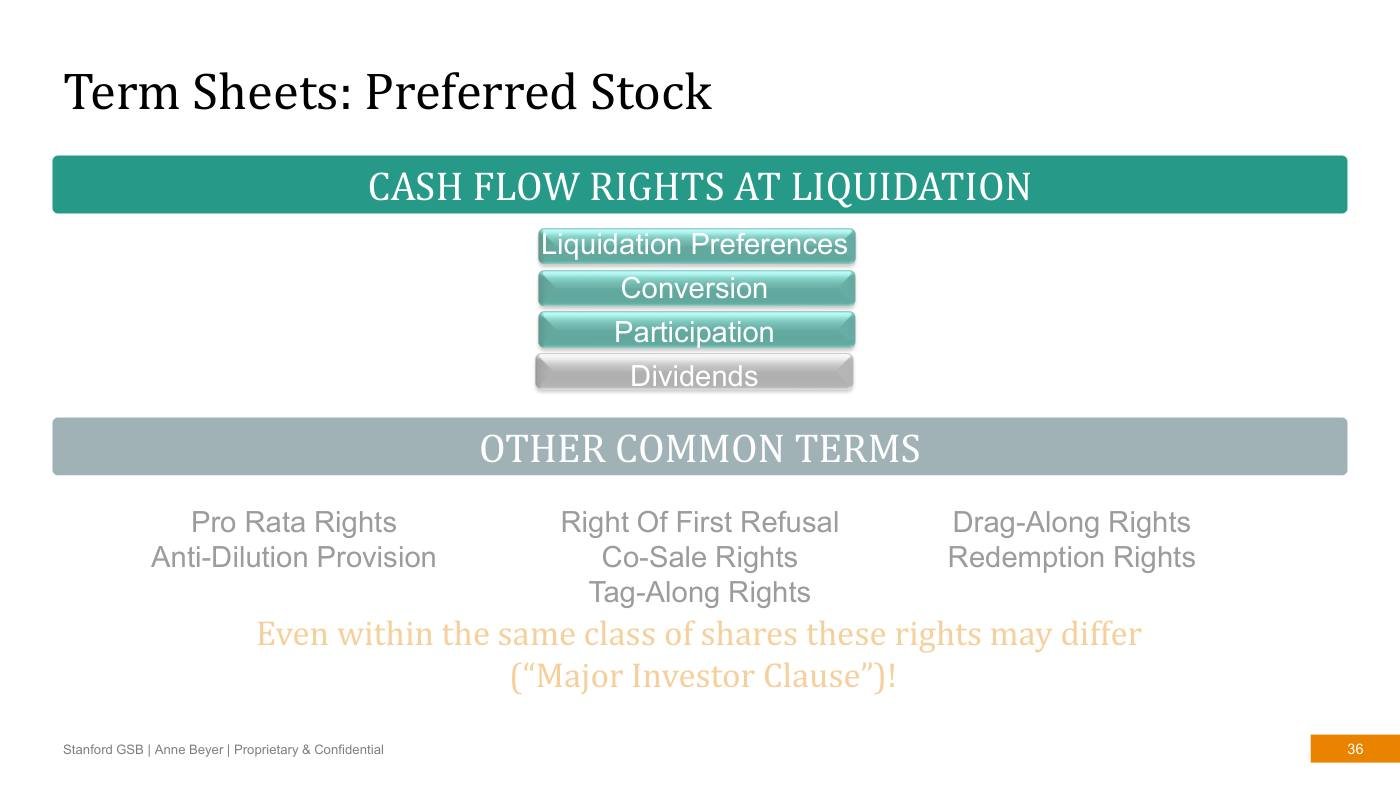
Term-sheet map: cash-flow rights versus other termsCash-flow rights at liquidation are grouped as liquidation preference, conversion, participation and dividends; other common terms include pro rata, anti-dilution, ROFR, co-sale, tag-along, drag-along and redemption rights. Only the first group enters a waterfall calculation, but drag-along and redemption rights decide whether and when a sale happens at all. The faded note matters: holders of the same class can have different rights through a major-investor clause.Beyer - Finance Slides (all 3 sessions) · PDF page 36 · in the slides
5
1× preference without conversion: a debt-shaped claimArea chart: below the invested amount, preferred takes 100% of liquidation value along the 45-degree line; above it, preferred is capped at 1× and common takes everything else. The callout asks how this differs from debt. The payoff shape is the same, but preferred has no maturity date, no interest that accrues by default and no right to force repayment before a liquidation event, unless redemption rights were negotiated.Beyer - Finance Slides (all 3 sessions) · PDF page 37 · in the slides
6
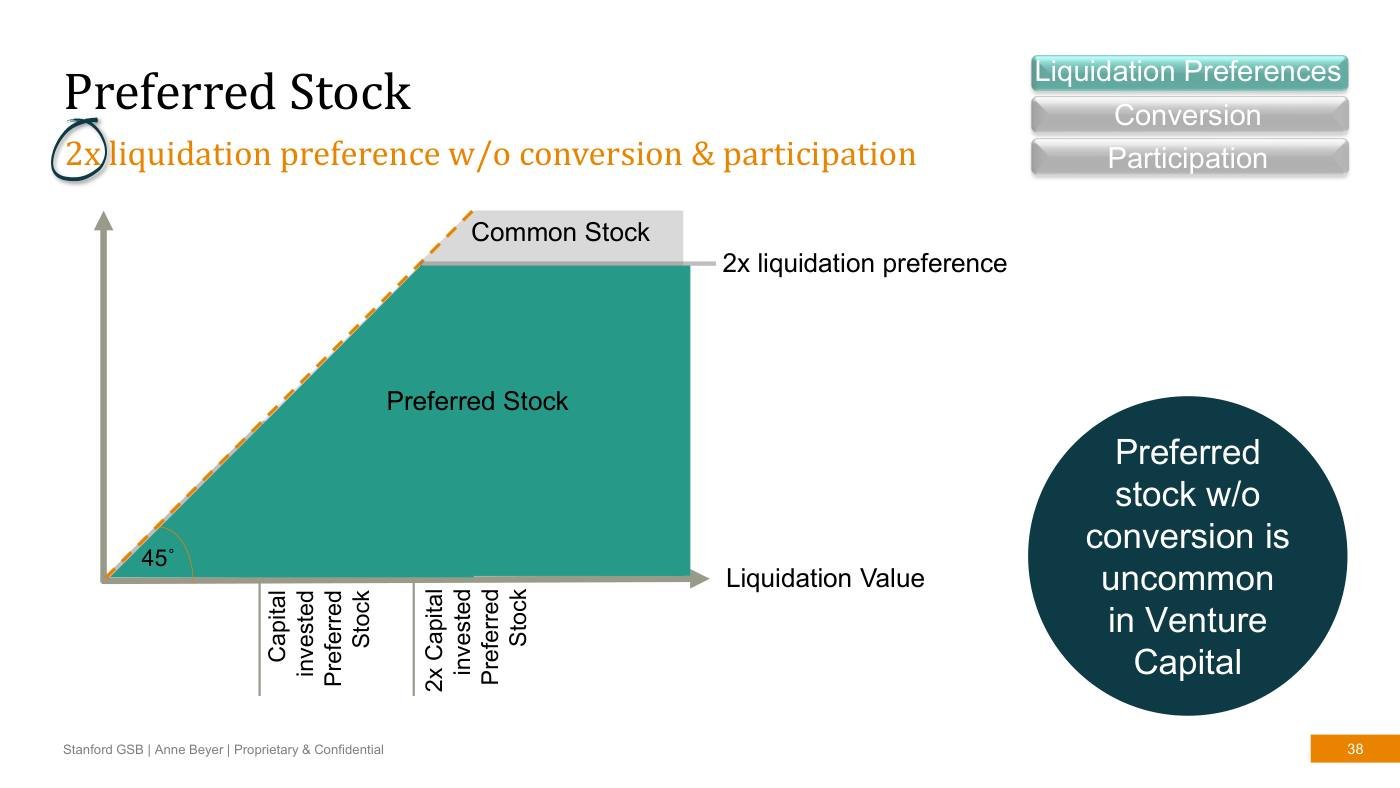
2× preference without conversionSame chart with the preferred band raised to twice the capital invested, so common receives nothing until proceeds exceed 2× the investment. The callout states this structure is uncommon in venture capital. A 2× multiple matters most in exactly the moderate exits founders are most likely to face; at Relay's $40M exit a 2× Series A preference would take $24M before anyone else is paid.Beyer - Finance Slides (all 3 sessions) · PDF page 38 · in the slides
7
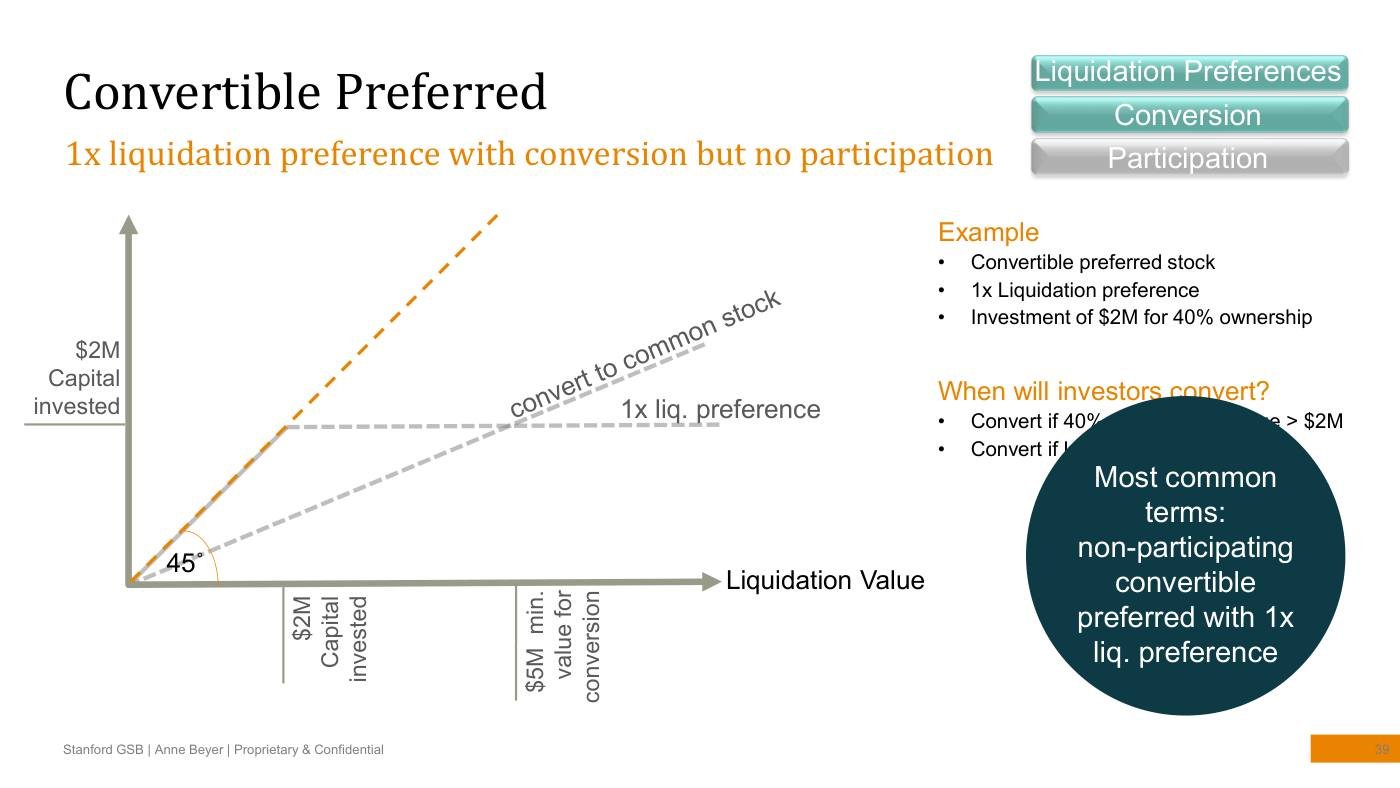
Convertible preferred build-up (partial)Earlier build of the convertible-preferred chart for a $2M investment for 40%, with the convert-to-common line and the 1× preference line drawn as dashes. Superseded by slide 24, which shows the finished chart and both conversion conditions.Beyer - Finance Slides (all 3 sessions) · PDF page 39
8
Convertible preferred: the $5M conversion pointPayoff chart for $2M invested for 40% with a 1× non-participating preference: preferred takes everything up to $2M, stays flat at $2M until $5M, then rises at 40% of value. Conditions: convert if 40% × value > $2M, i.e., value > $5M. The flat segment between $2M and $5M is where the preference transfers value from common to the investor. In a multi-class cap table each class has its own flat segment and its own crossover, which is why Relay's waterfall needs iteration.Beyer - Finance Slides (all 3 sessions) · PDF page 40 · in the slides
9
Participating preferred: the double dipChart for 1× participating preferred: the investor takes the preference and then shares in everything above it, so the preferred band keeps widening with value. The callout notes participation is often capped (for example at 2× the investment), in which case the holder chooses between the capped participating payoff and converting. A capped participating security therefore has its own conversion crossover.Beyer - Finance Slides (all 3 sessions) · PDF page 41 · in the slides
10
Do payoff structures matter? Yes, mostly at moderate exitsTwo conclusions: investor and entrepreneur payoffs can diverge widely, especially for moderate exits; and preferred stock gives entrepreneurs strong incentives to aim for high payoffs. Relay's numbers confirm both claims: at $40M common holders receive $21.78M (54.4% of proceeds) although they hold 60.87% of as-converted shares, while at $150M and above every class is paid strictly pro rata.Beyer - Finance Slides (all 3 sessions) · PDF page 44 · in the slides