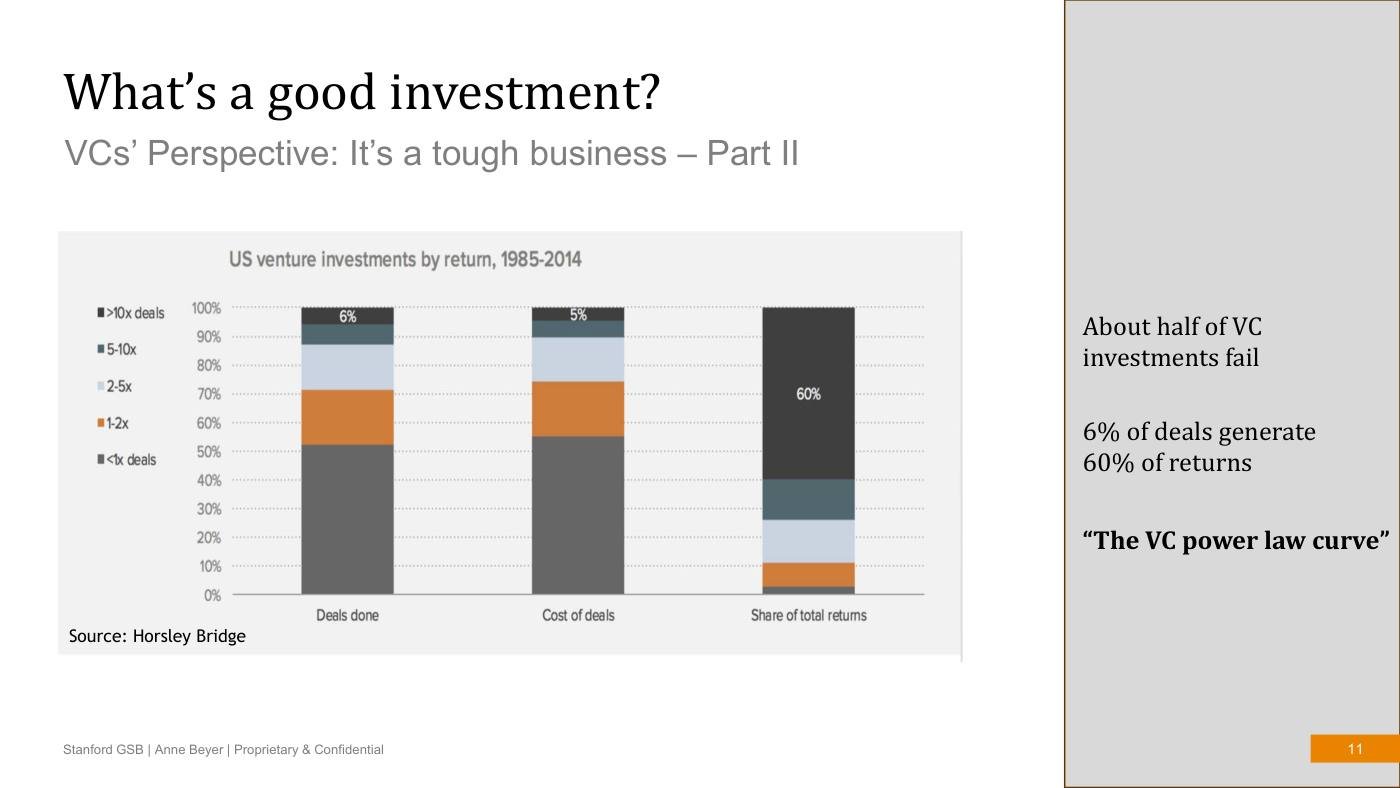
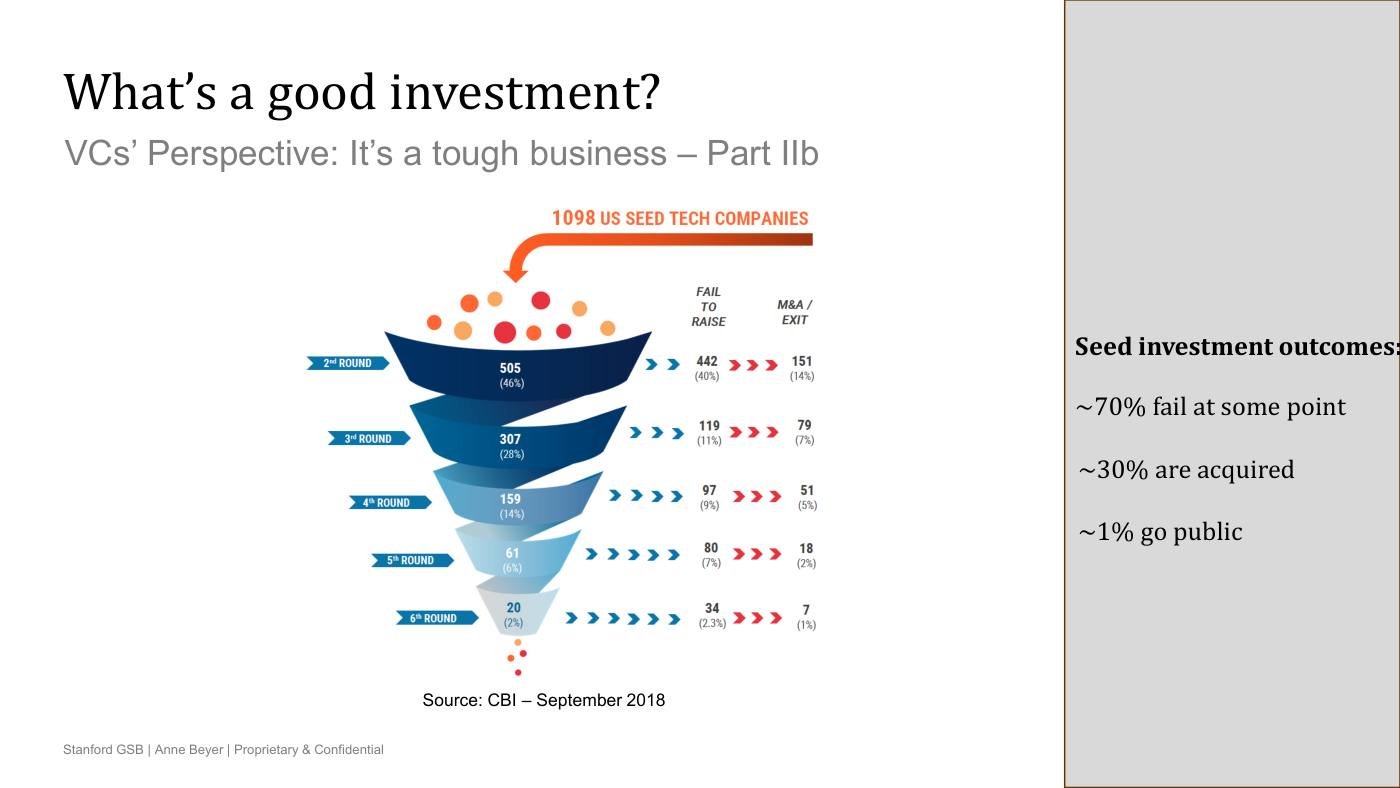
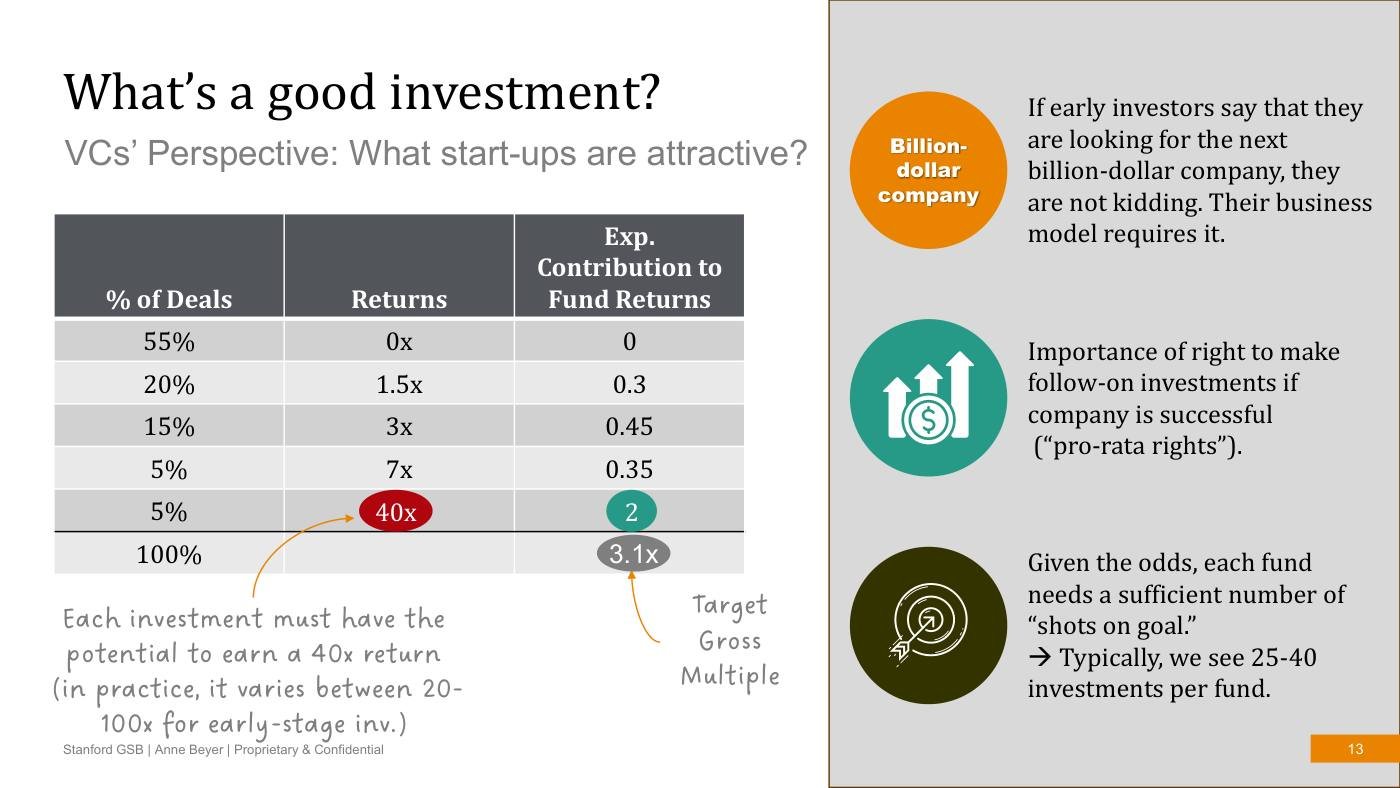
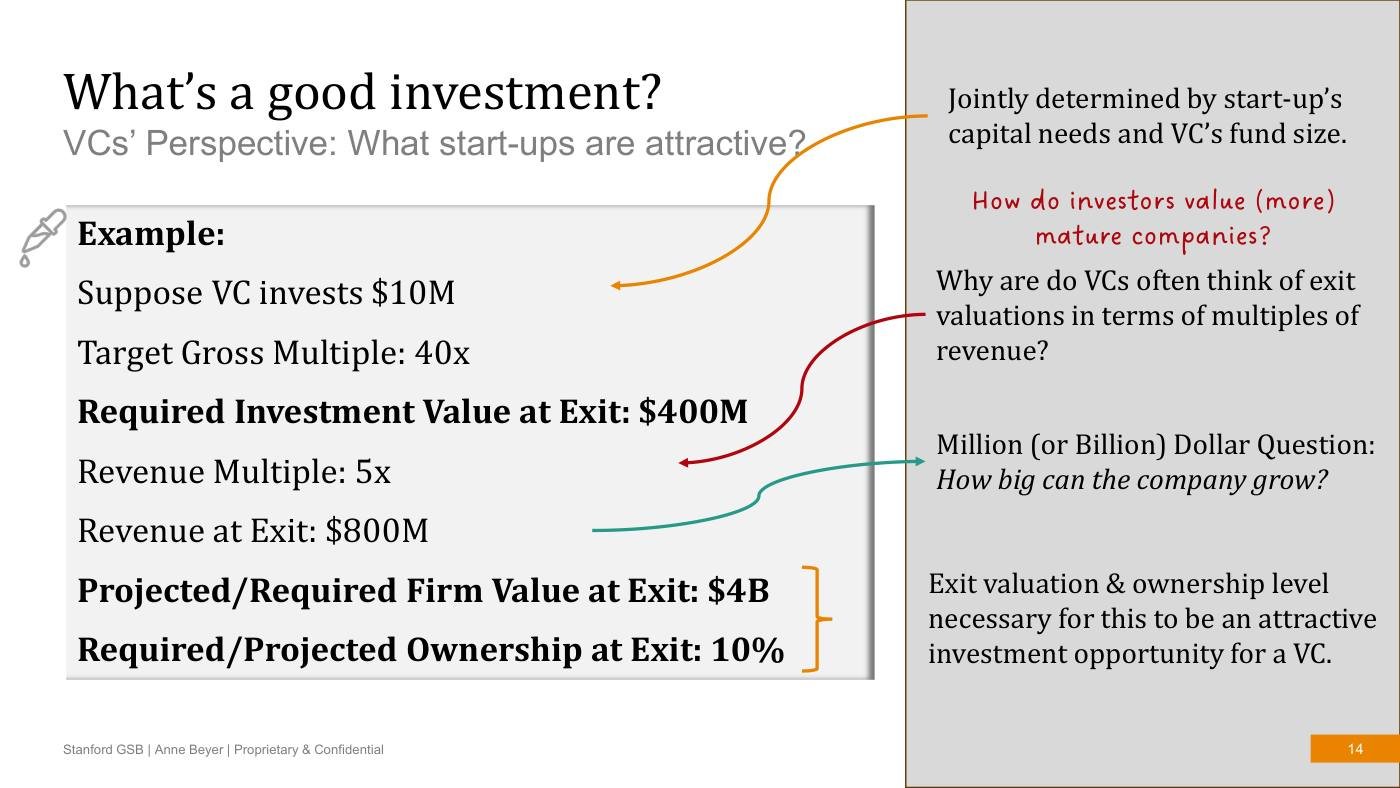
Calculate price, new shares and ownership on a stated basis.
Solve the source’s post-money option-pool example.
Explain who bears dilution under different pool timings.
90-minute workshopOpening 5 minConcepts and original examples 35 minPractice 25 minDebrief 15 minReview 10 min
2
30 / TheoryOwnership, share prices & option pools
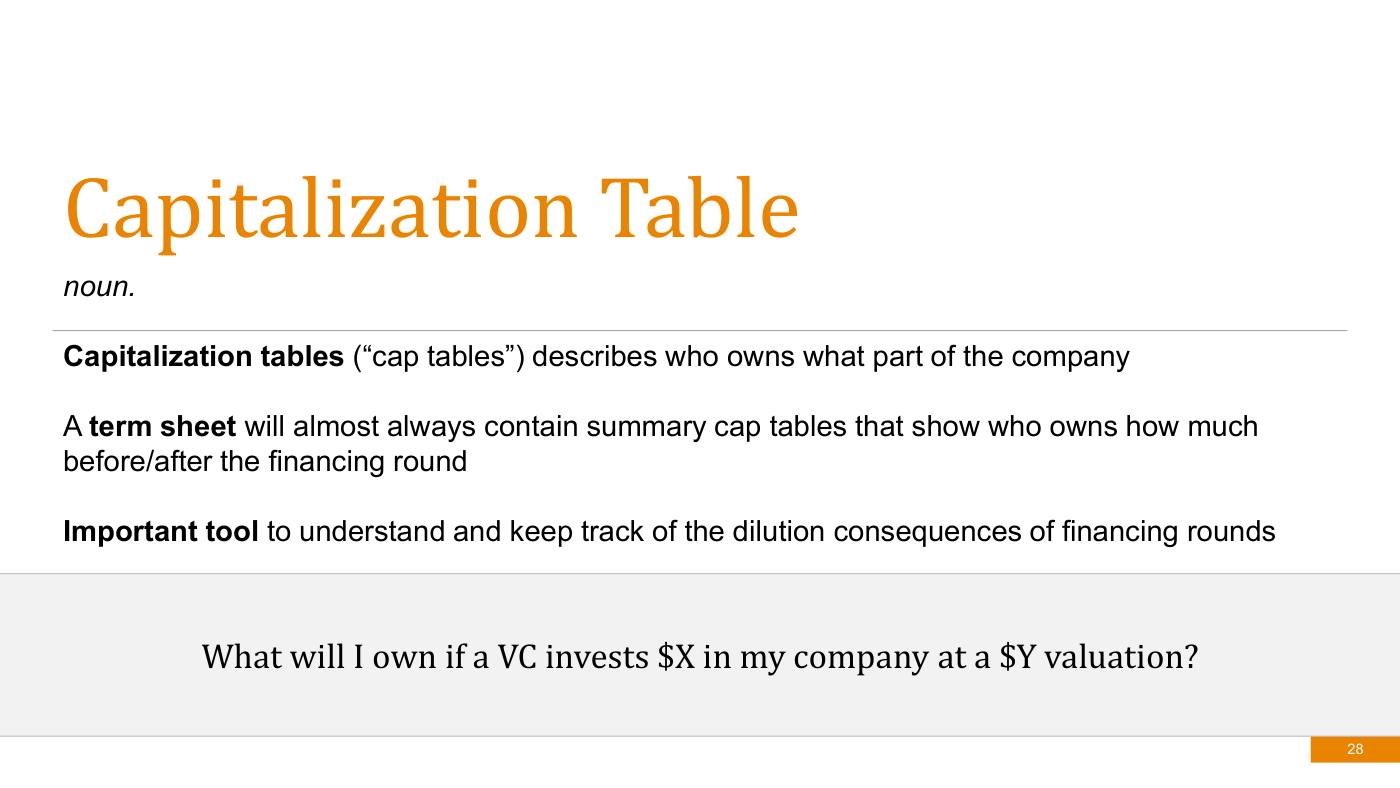
Share price connects valuation to ownership
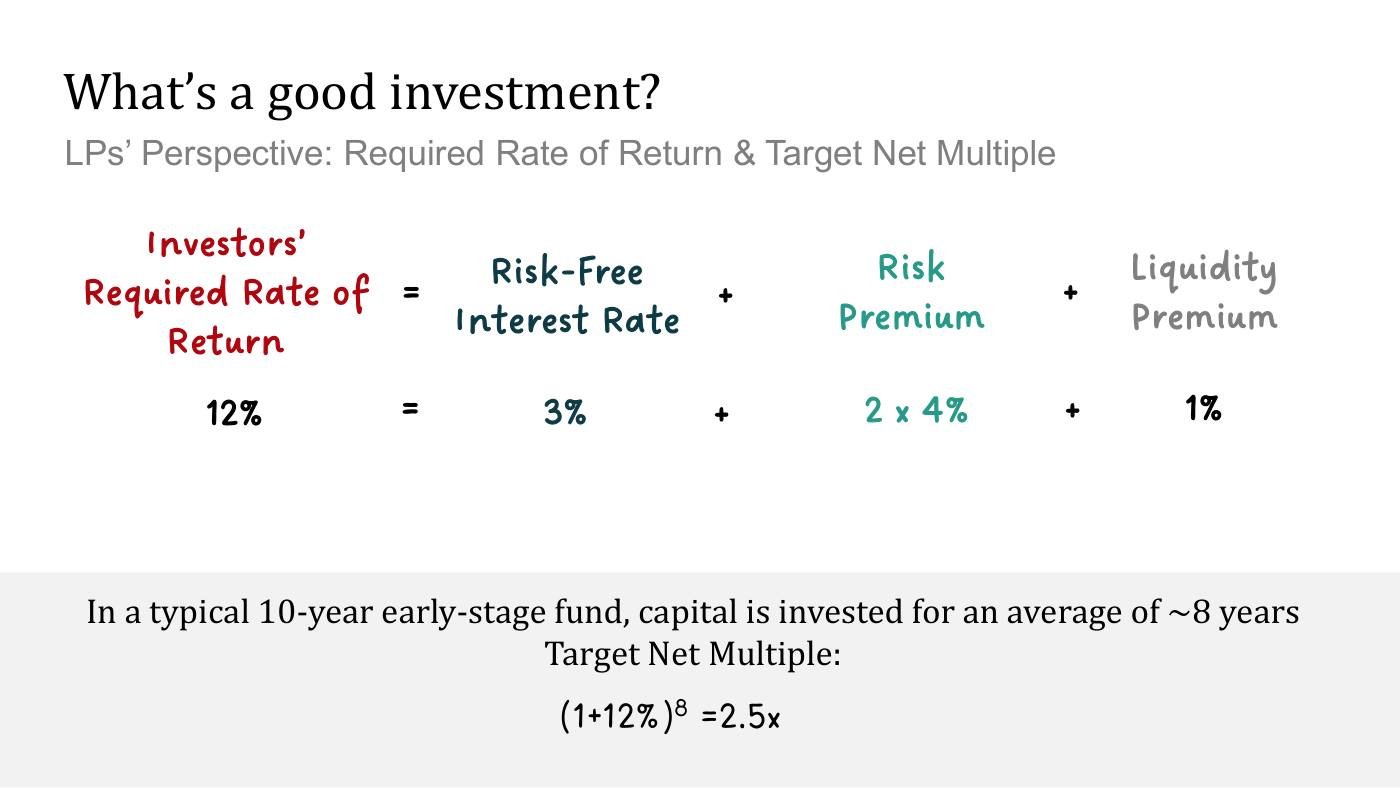
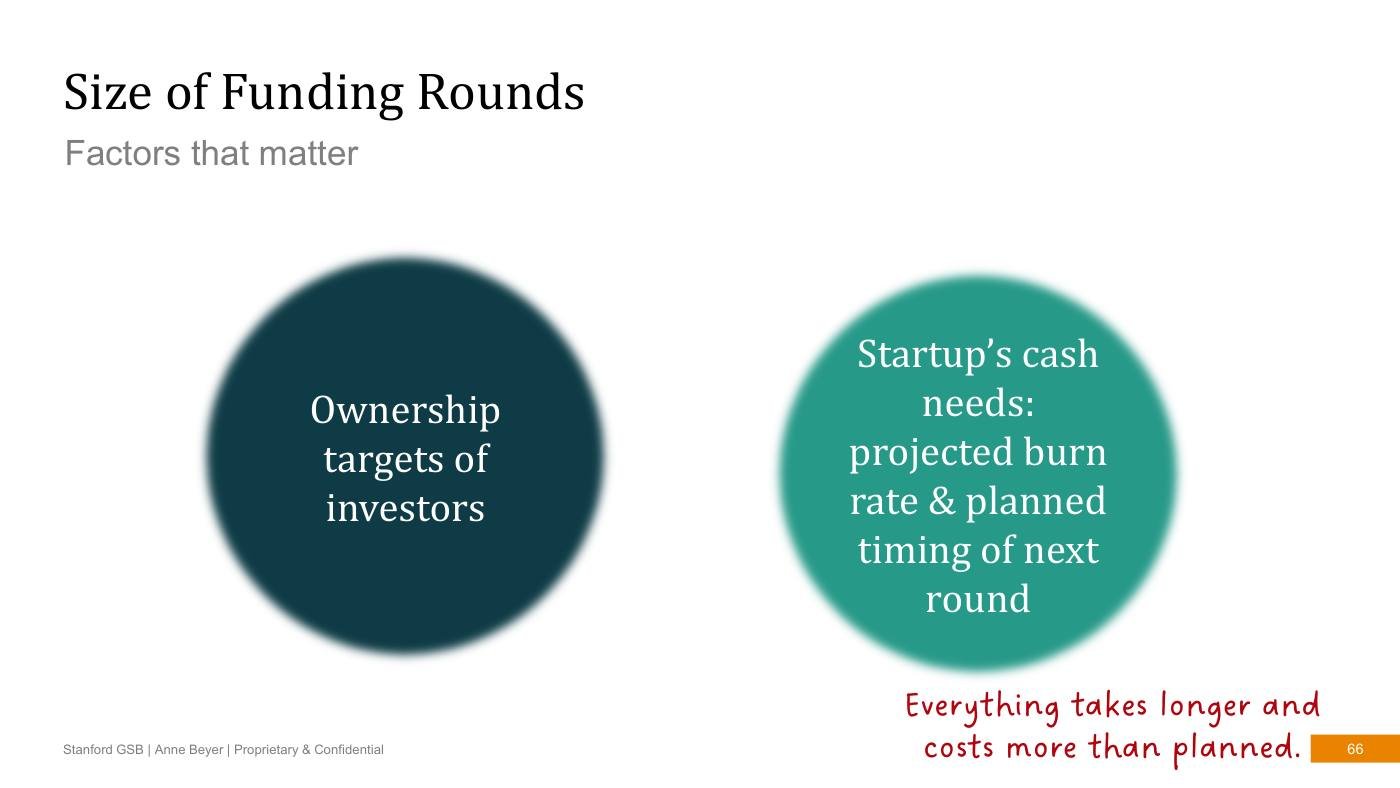
A priced round adds newly issued shares. Pre-money value describes the negotiated value before the new investment, on a specified capitalization basis. Post-money value adds the new investment under the simple cash-in model.
Divide pre-money value by the agreed pre-round share count to obtain the price per share. Divide investment by that price to obtain new shares. Recompute all percentages using the post-round denominator. Existing holders can retain the same number of shares while their percentage declines.
3
30 / TheoryOwnership, share prices & option pools
An option pool changes the denominator
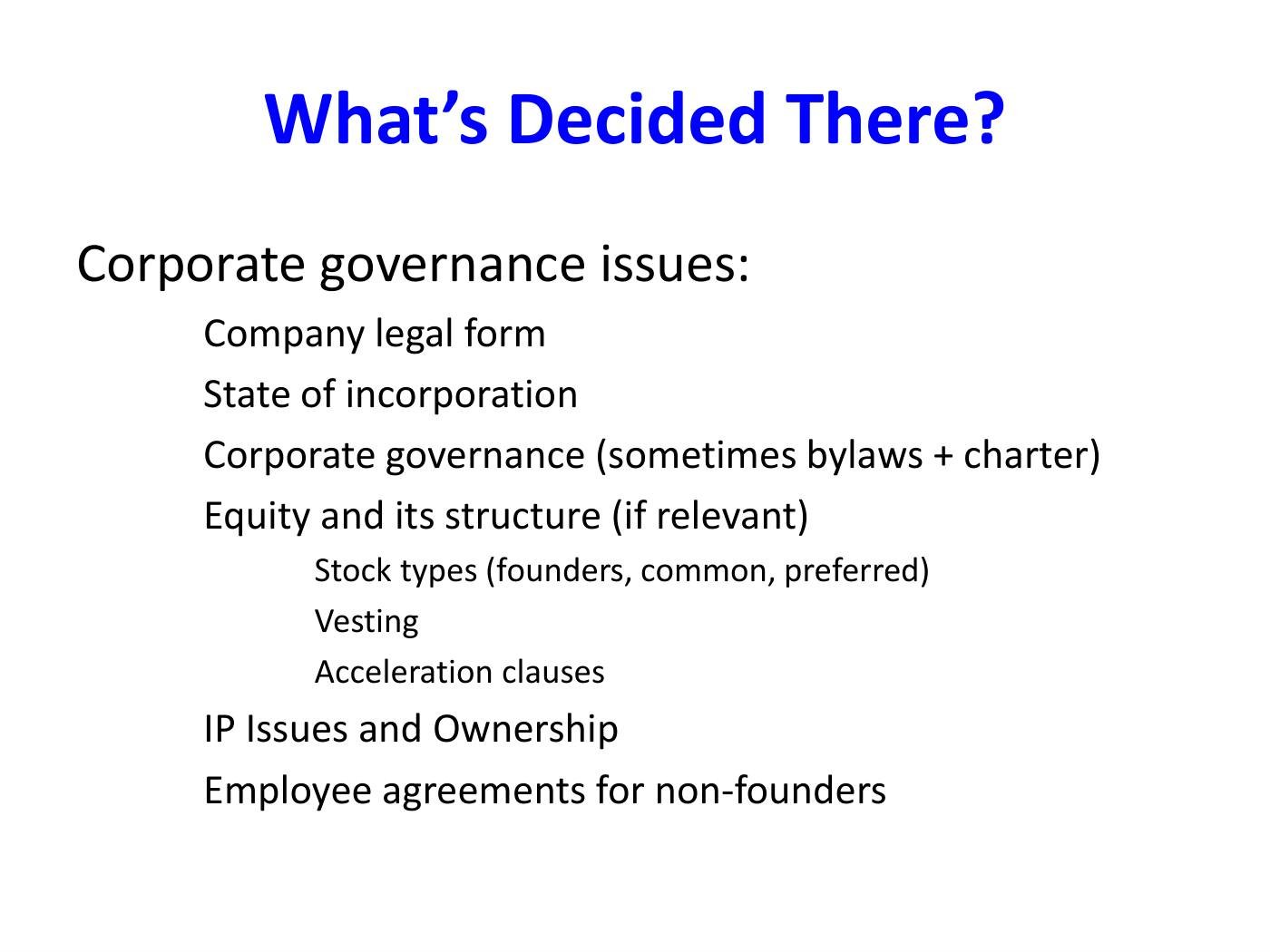
A pool reserves equity for future grants on the basis specified in the transaction. The phrase “10% pool” is incomplete without knowing whether it means a percentage before or after the round and whether existing grants or reserves count toward it.
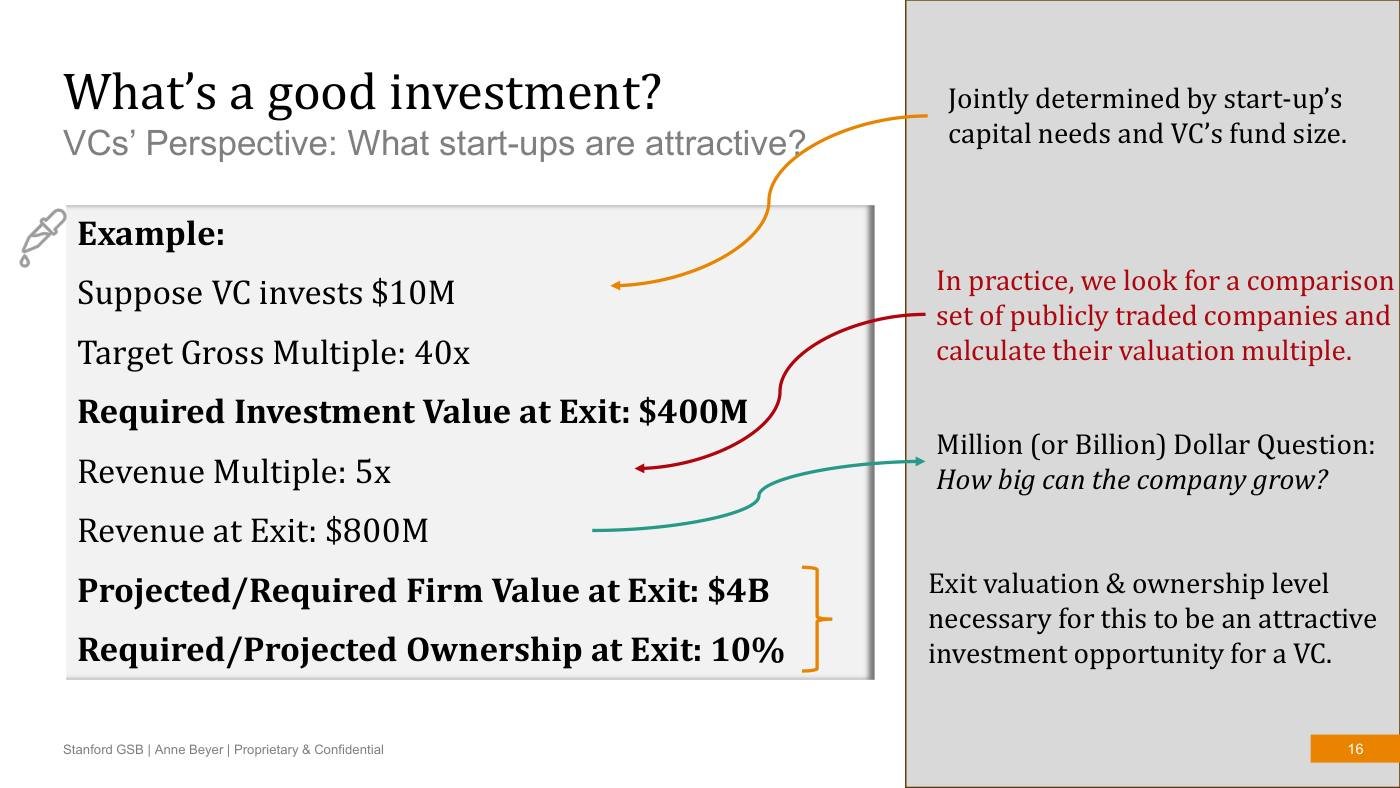
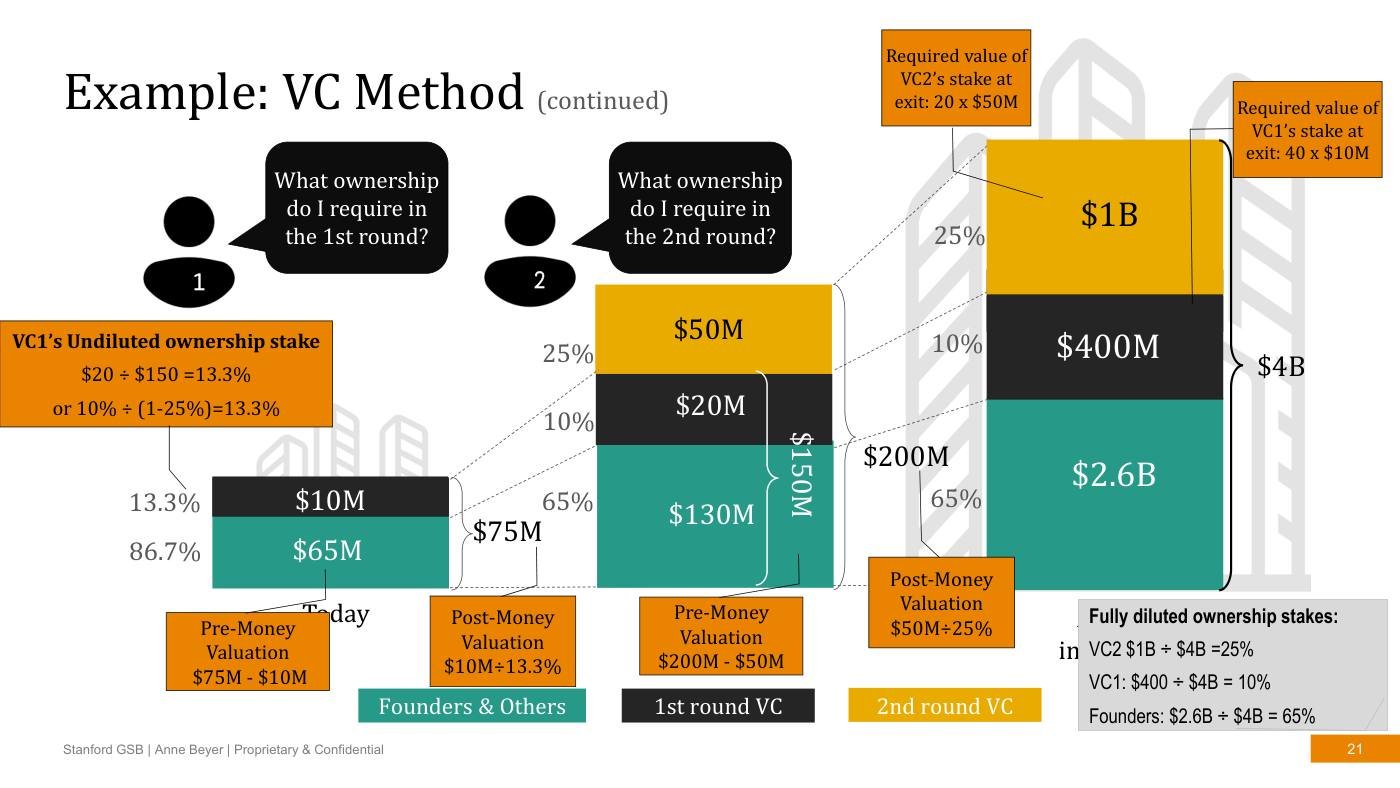
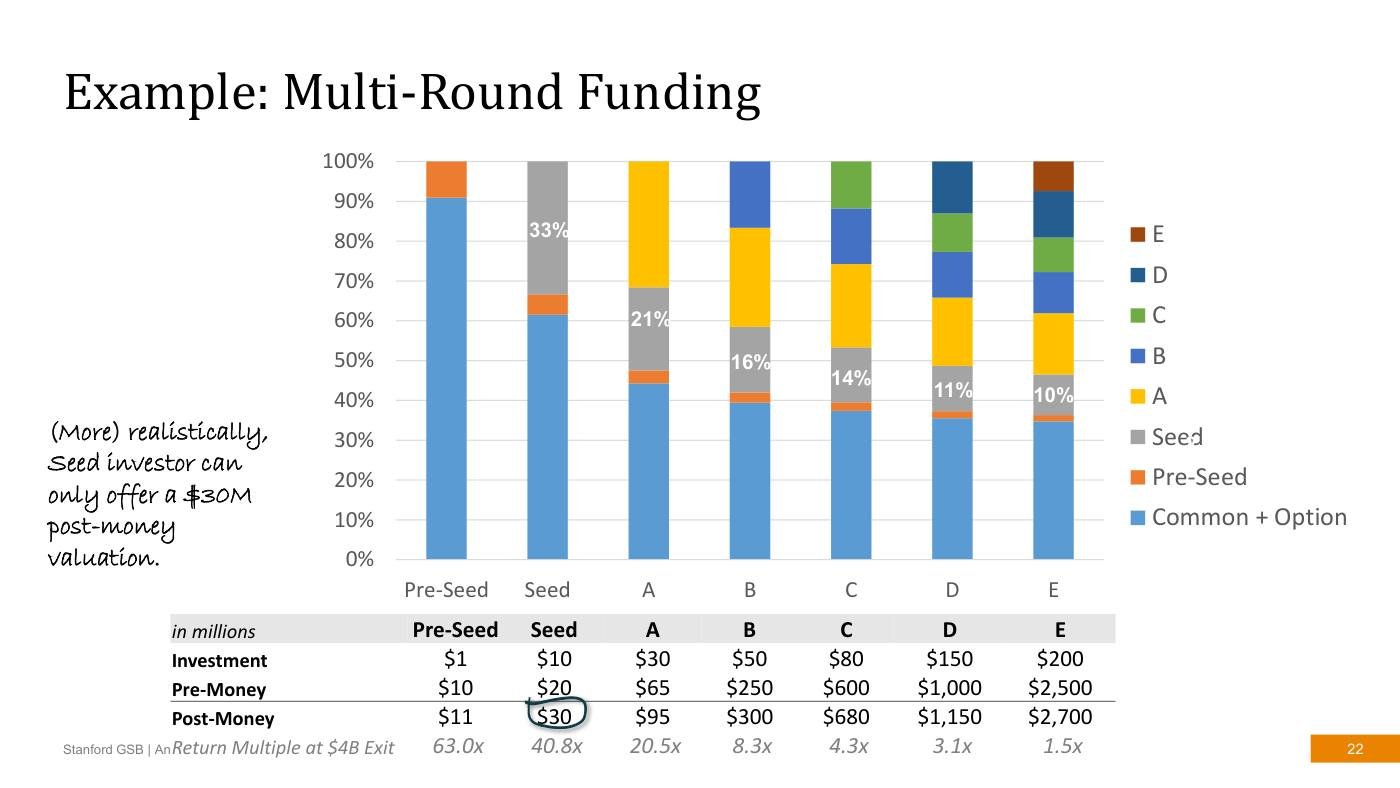
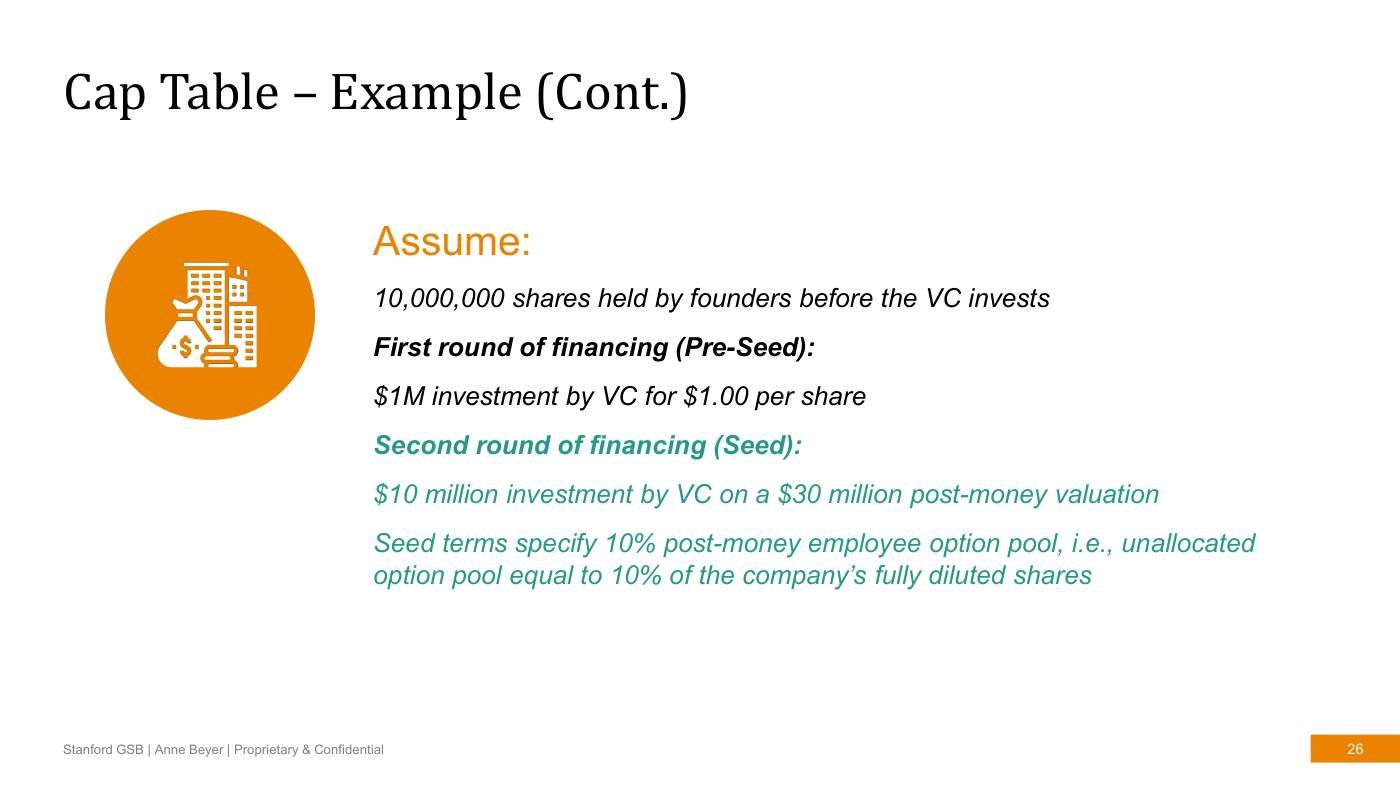
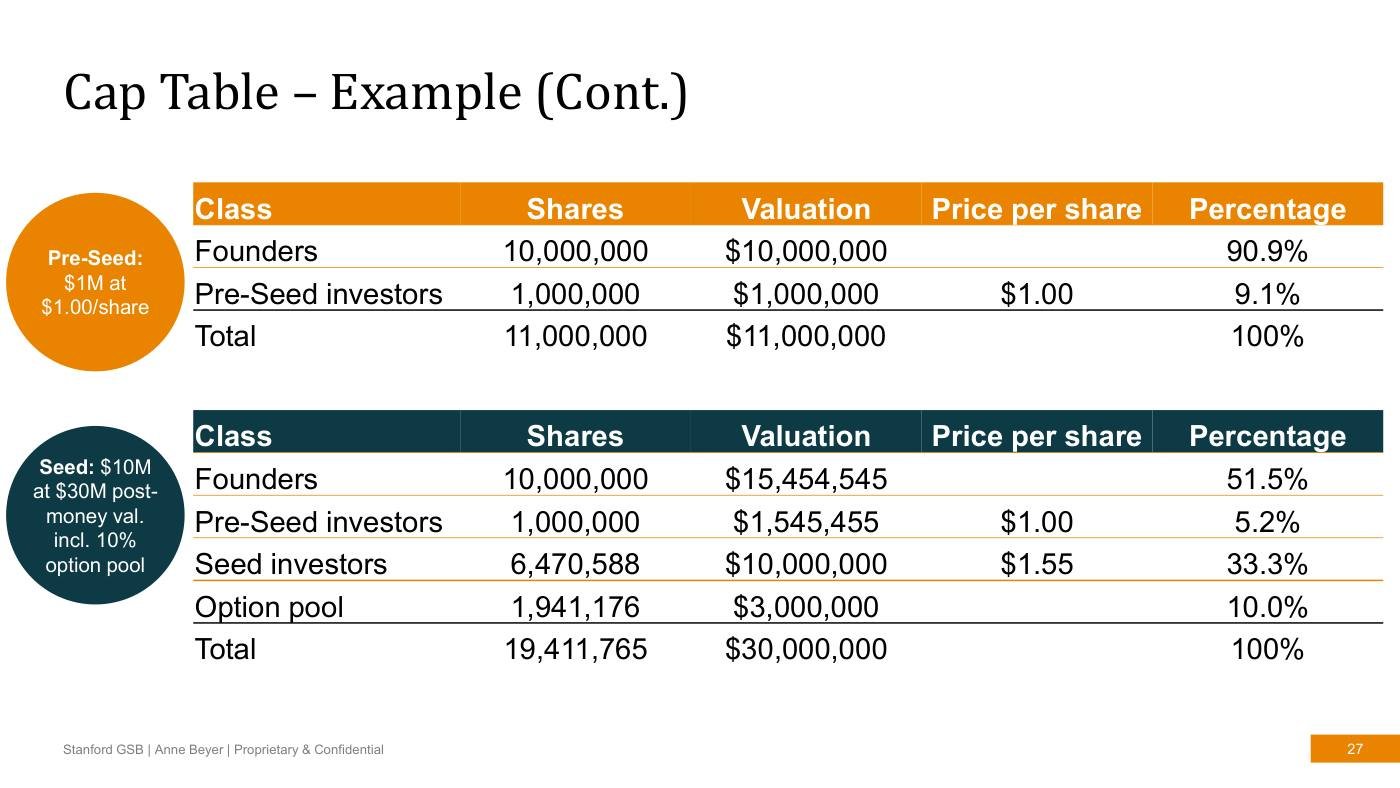
In the source cap-table example, the next investor contributes $10 million at $30 million post-money with a 10% post-money unallocated pool. The investor owns 33.333% and the pool owns 10%, leaving 56.667% for the existing 11 million shares.
4
30 / TheoryOwnership, share prices & option pools
Pre-money and post-money value
PRE-MONEY + NEW INVESTMENT = POST-MONEY
Simplified priced round
Assumes the stated ownership basis and treatment of other instruments are clear.
Investor ownership
New investment ÷ post-money value under that simple setup.
$8 million pre-money + $2 million investment = $10 million post-money; new investor owns 20%.
5
30 / TheoryOwnership, share prices & option pools
Round 1: price and shares
Holder
Shares
Ownership
Founders
8,000,000
80%
Seed investor
2,000,000
20%
Total
10,000,000
100%
Illustrative: $1 per share; $8m pre-money and $2m new cash; no other securities or pool.
6
30 / TheoryOwnership, share prices & option pools
Fully diluted ownership needs a definition
Include the instruments and reserved interests specified in the comparison.
Options, warrants and convertibles can change the denominator.
State whether a pool is created or increased before or after the investment.
A percentage is not meaningful without the agreed basis.
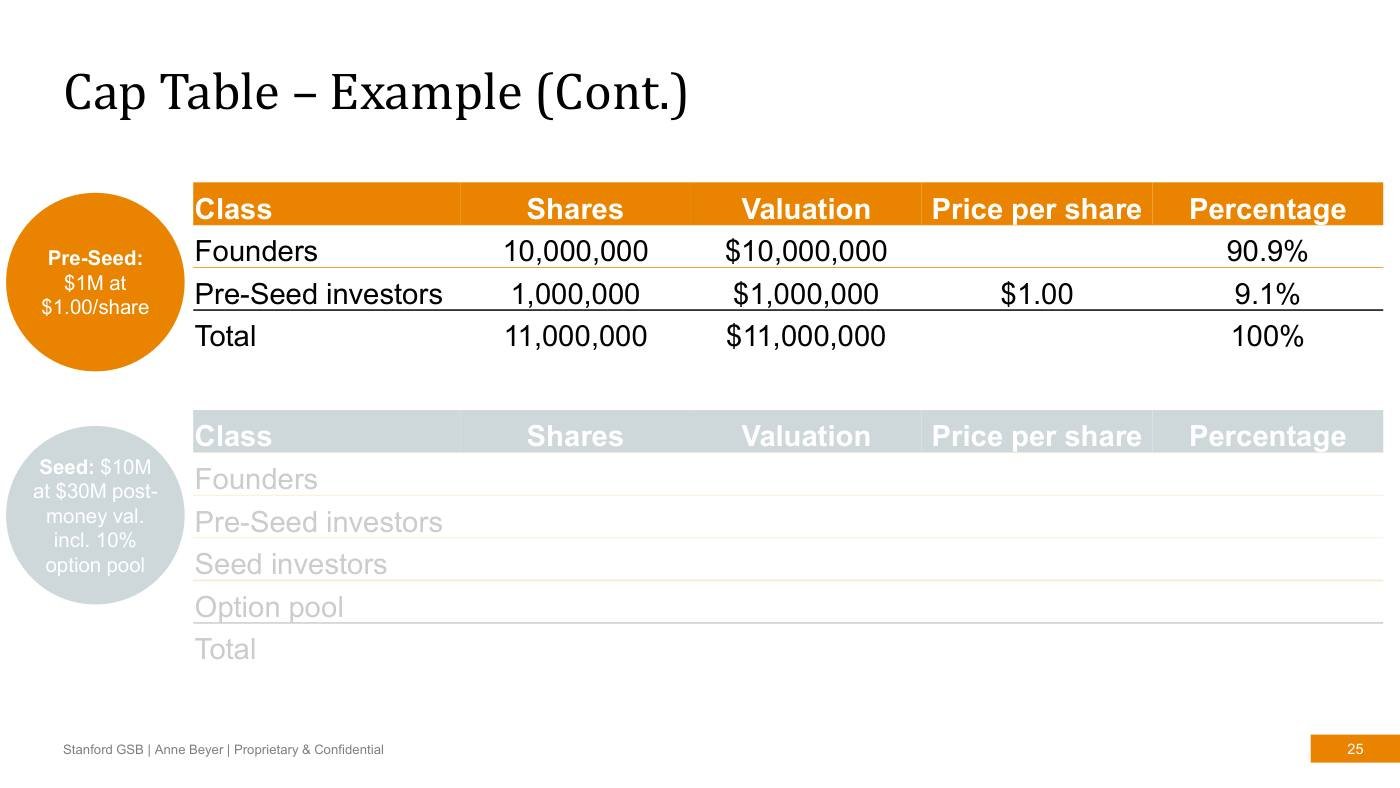
Pre-seed cap table: 10M founder shares plus 1M at $1.00
9
30 / TheoryOwnership, share prices & option pools
Pool timing determines who bears the dilution
A pool established as part of the pre-money capitalization generally changes the ownership and pricing of the existing holders before the new investor receives the negotiated percentage. A pool added afterward can also dilute the new investor. The precise result follows the actual definitions.
Compare offers using the same fully diluted basis and the same target pool. A higher headline valuation can be offset by a larger required pool. Convert the terms into share counts so that the comparison does not depend on ambiguous percentages.
10
30 / TheoryOwnership, share prices & option pools
Ownership arithmetic and the economic rights
A cap table answers who holds shares or other interests on a defined basis. It does not by itself describe all payout or voting consequences. Different classes can have different rights even when their percentage ownership appears similar.
Check that shares sum to the stated total and percentages sum to 100%. Reconcile investment, price and shares issued. Then link each class to the relevant terms. This keeps the mechanical ownership calculation separate from the later lesson on liquidation preferences.
11
30 / TheoryOwnership, share prices & option pools
Source cap table: seed round and a 10% pool
Anne Beyer’s example: $10m new investment at $30m post-money, with a 10% post-money unallocated pool.
Holder
Fully diluted shares
Ownership
Founders
10,000,000
51.515%
Pre-seed investor
1,000,000
5.152%
New seed investor
6,470,588
33.333%
Unallocated option pool
1,941,176
10.000%
Total
19,411,765
100.000%
Counts and percentages are rounded for display. The old 11m shares together retain 56.667%. The price per newly issued seed share is approximately $1.54545.
12
30 / TheoryOwnership, share prices & option pools
A simple new option pool
Holder
Before pool
After a 10% post-grant pool
Founder
90%
81%
Investor
10%
9%
Unallocated pool
0%
10%
Separate illustrative example: a new pool dilutes all existing holders proportionately. Different financing terms can allocate the dilution differently.
13
30 / TheoryOwnership, share prices & option pools
Reconcile a cap table
Shares add to the total on the stated basis.
Ownership percentages add to 100%.
Investment, price and new shares are consistent.
Value and ownership are not confused with cash received by each holder.
14
30 / Deep diveOwnership, share prices & option pools
Relay's seed round: the reconciled cap table
Illustrative. $4M at $16M pre-money; unallocated pool topped up to 10% of post-money fully diluted shares inside the pre-money; post-money SAFE converts at the $12M cap.
Pool equation: (10,000,000 + 1,571,429 + 400,000) = 11,971,429 = 70% of T, so T = 17,102,041.
The 'before seed' column counts the SAFE on an as-converted basis at the cap (12.5% of 12,571,429). Values are pro rata and ignore preferences, which lesson 32 adds.
15
30 / Worked modelOwnership, share prices & option pools
An option pool changes existing ownership
16
30 / Deep diveOwnership, share prices & option pools
Same $4M, three pool definitions
Where the pool sits, and how large it is, decides who pays for it. Existing shares = 11,971,429 in every case. Illustrative.
Row 2 shows why investors insist on a pre-money pool: if the pool is topped up after the round, the seed investor shares the dilution and ends below its 20%. Row 3 shows why founders should compare effective pre-money: the higher headline price beats the bible terms by $0.7M even though Maya's percentage is lower.
30 / Current practiceOwnership, share prices & option pools
Current practice: seed rounds and option pools
Seed dilution near 18%
Carta's data for software rounds raised in the six months to July 2026 show median seed dilution of 18% and a median seed of $4.1M at a $24.3M valuation. Relay's illustrative $4M at $20M post (20% sold) is close to the market; a lead asking for 25–30% would be well above the median.
Pools are smaller than investors often ask
Carta reported in June 2025 that the median option pool after a seed round is about 12%, that companies typically use 60–70% of the pool before the next raise, and that requests for 15–20% are usually too large. A hiring plan is the founder's best argument on pool size.
Post-money SAFEs shift the pool cost to founders
Under the standard post-money SAFE, a pool increase made in connection with the priced round is excluded from the capitalization used to convert the SAFE. SAFE holders keep their fixed percentage of the pre-round capitalization, and founders bear the top-up. In Relay's seed, the SAFE converts at $0.9545 into 1,571,429 shares whatever pool the seed lead demands. Exact treatment depends on the documents signed; confirm with counsel.
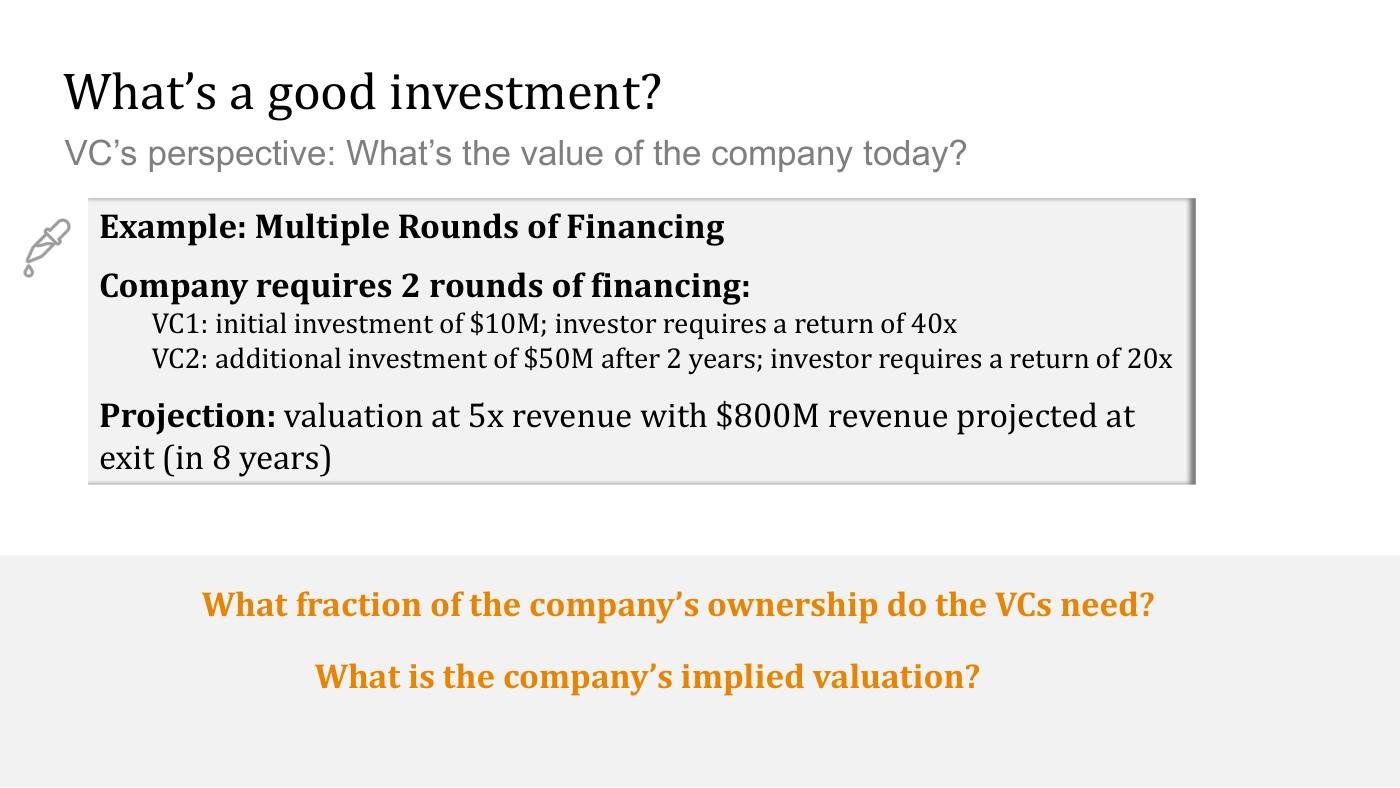
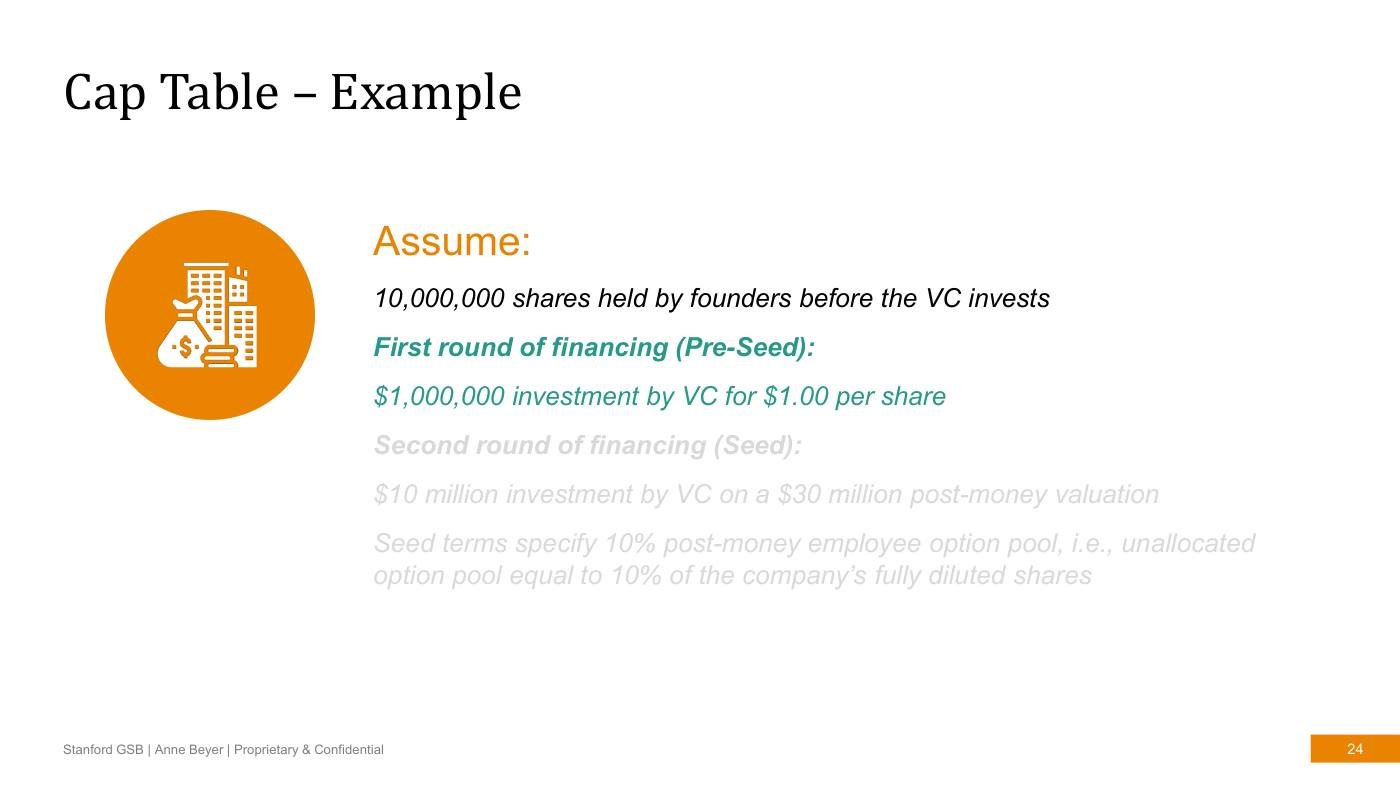
Founders hold 10m shares, the pre-seed investor holds 1m and no unallocated pool exists. A new investor contributes $10m at $30m post-money. The terms require an unallocated pool equal to 10% of post-money fully diluted shares. Use the source’s simple priced-round definitions and ignore other instruments.
Your task
Solve the fully diluted total, new investor shares, pool shares, price and founder ownership. Reconcile all percentages.
Month 16. Relay has 10,000,000 founder shares (Maya 5.2M, Daniel 4.8M), a 1,000,000-share pool with 400,000 options granted (Priya 300,000, two engineers 50,000 each), and $1.5M of post-money SAFEs at a $12M cap that convert into 1,571,429 shares at $0.9545. The seed lead offers $4,000,000 at $16,000,000 pre-money ($20M post) and requires the unallocated pool to be 10% of post-money fully diluted shares, with the top-up counted in the pre-money.
Your task
Produce a reconciled post-seed cap table (shares, percentage, value at the seed price) for every holder, with the pool equation written out, the seed price, the new pool shares, and the effective pre-money valuation for existing holders.
Existing holders other than the unallocated pool: 10,000,000 + 1,571,429 + 400,000 = 11,971,429 shares. They must equal 100% - 20% (seed) - 10% (unallocated pool) = 70% of the post-money total, so T = 11,971,429 / 0.70 = 17,102,041 shares.
Seed shares = 20% x T = 3,420,408; price = $4,000,000 / 3,420,408 = $1.1695 (above the $0.9545 SAFE cap price, so the cap applies). Unallocated pool = 10% x T = 1,710,204, of which 600,000 exist and 1,110,204 are new.
Post-seed ownership: Maya 30.41%, Daniel 28.07%, SAFE holders 9.19%, granted options 2.34%, unallocated pool 10.00%, seed 20.00%. Shares sum to 17,102,041 and percentages to 100%.
Effective pre-money: the existing 11,971,429 shares are worth 11,971,429 x $1.1695 = $14.0M. The other $2.0M of the $16M headline pre-money is the unallocated pool (1,710,204 x $1.1695), of which about $1.3M is the new top-up. That reserve dilutes the existing holders, not the seed investor.
Negotiating lever: if the hiring plan to Series A needs about 700,000 options (illustratively a VP Sales at 171,000, three managers at 85,500 each and nine engineers at 30,000 each, 697,500 in total, or 4.1% of 17.1M), a 6% pool is enough. That gives T = 11,971,429 / 0.74 = 16,177,607 shares, of which 970,656 are unallocated, about 40% more than the plan needs, and Maya would hold 32.14% instead of 30.41%. Recompute the table before agreeing to any change.
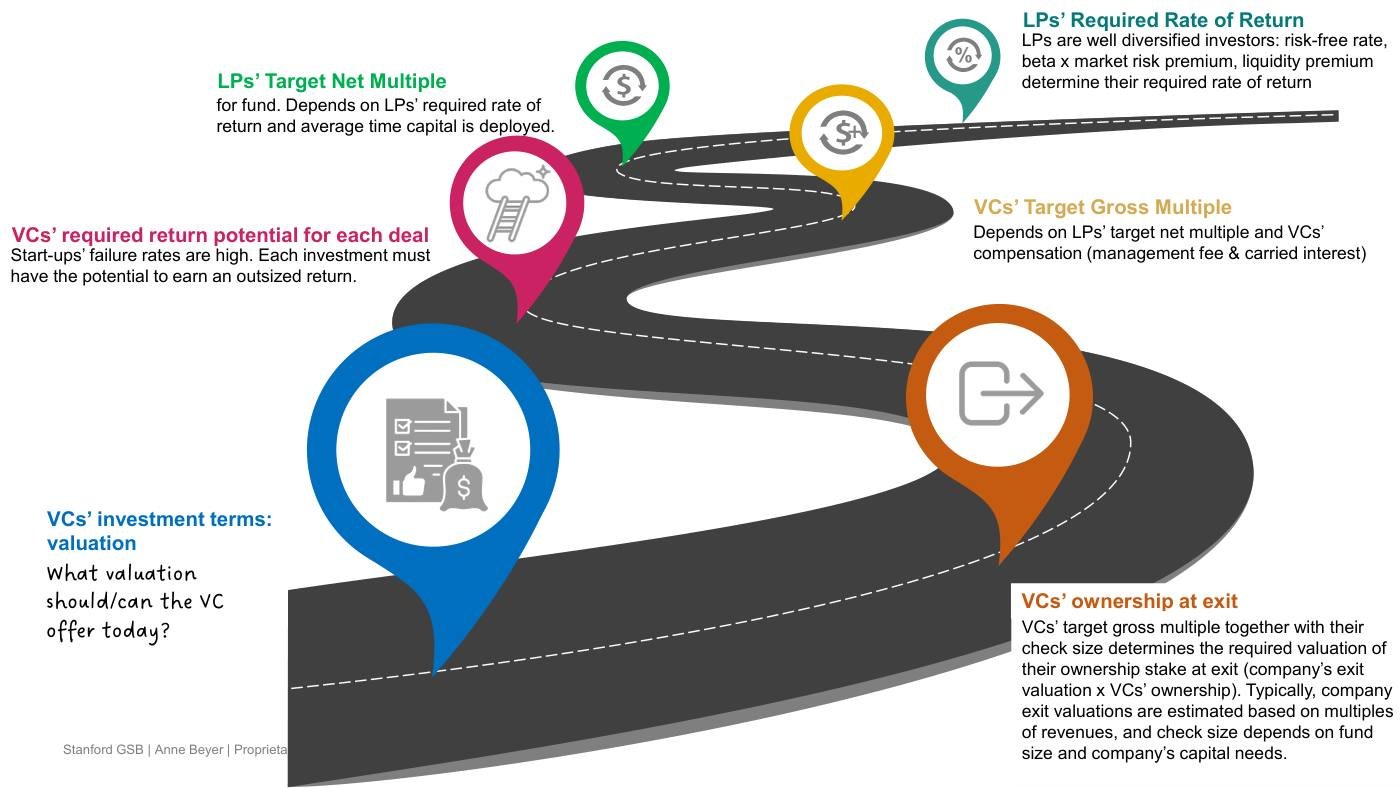
Ten percent of the pre-round shares, of the post-money total, granted plus unallocated, or unallocated only: each gives a different share count and price. Write the equation (others / (1 - investor% - pool%)) into the term sheet discussion and check it against share counts.
Comparing offers on headline pre-money
A larger pool counted in the pre-money transfers value from existing holders to future hires. Convert every offer to effective pre-money (existing shares x price): Relay's $16M headline is $14.0M to the people already on the cap table.
Sizing the pool to a round number
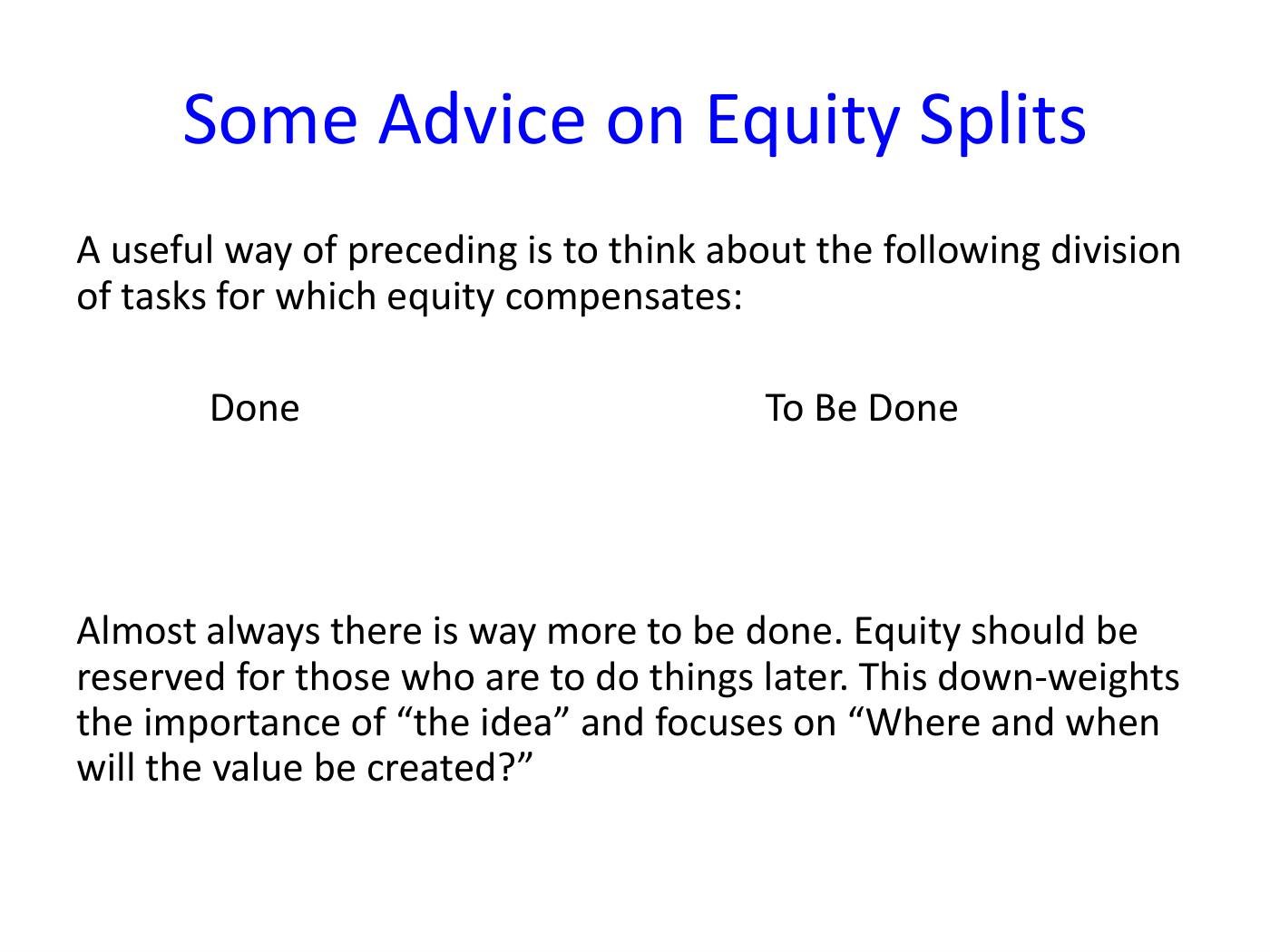
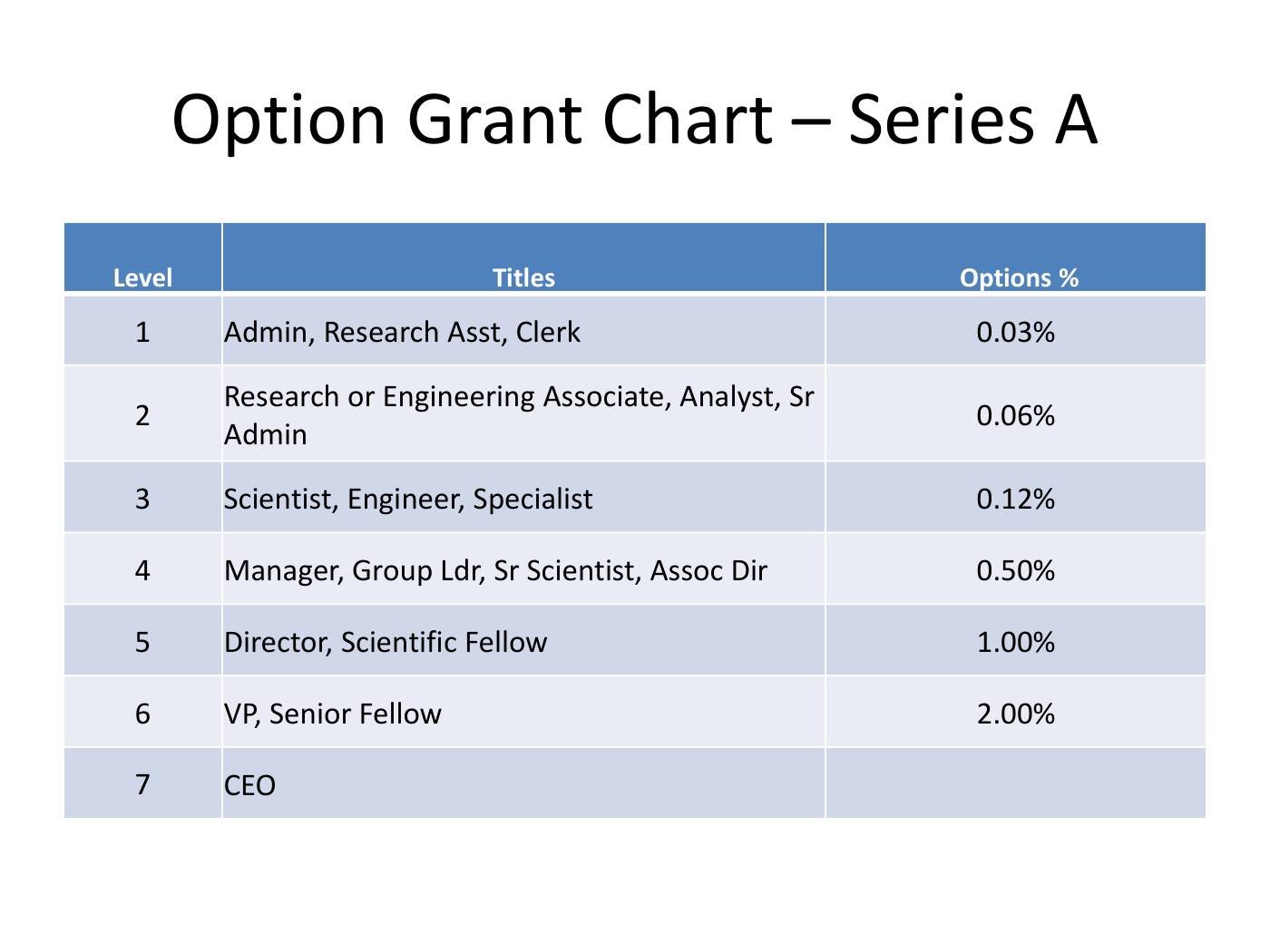
An oversized pool permanently dilutes founders by the unused amount, and unused options do not return value to them. Size the pool from a hiring plan to the next round using a grant chart, and argue down a 15–20% request with that plan.
25
30 / ReviewOwnership, share prices & option pools
What you can now explain
Relay's reconciled post-seed cap table: 17,102,041 fully diluted shares at $1.1695, with Maya 30.41%, Daniel 28.07%, SAFE holders 9.19%, granted options 2.34%, unallocated pool 10.00% and seed 20.00%, plus the $14.0M effective pre-money and a hiring-plan argument on pool size.
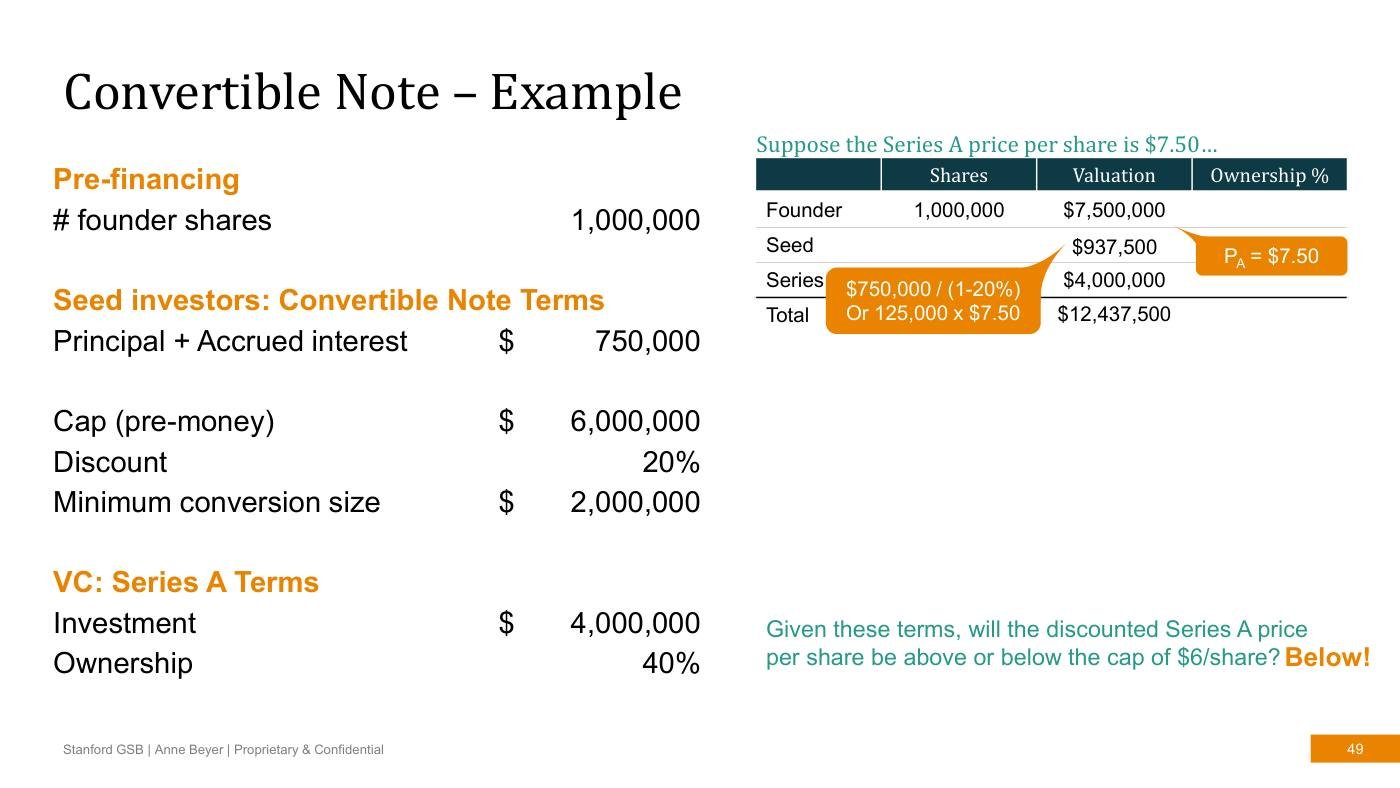
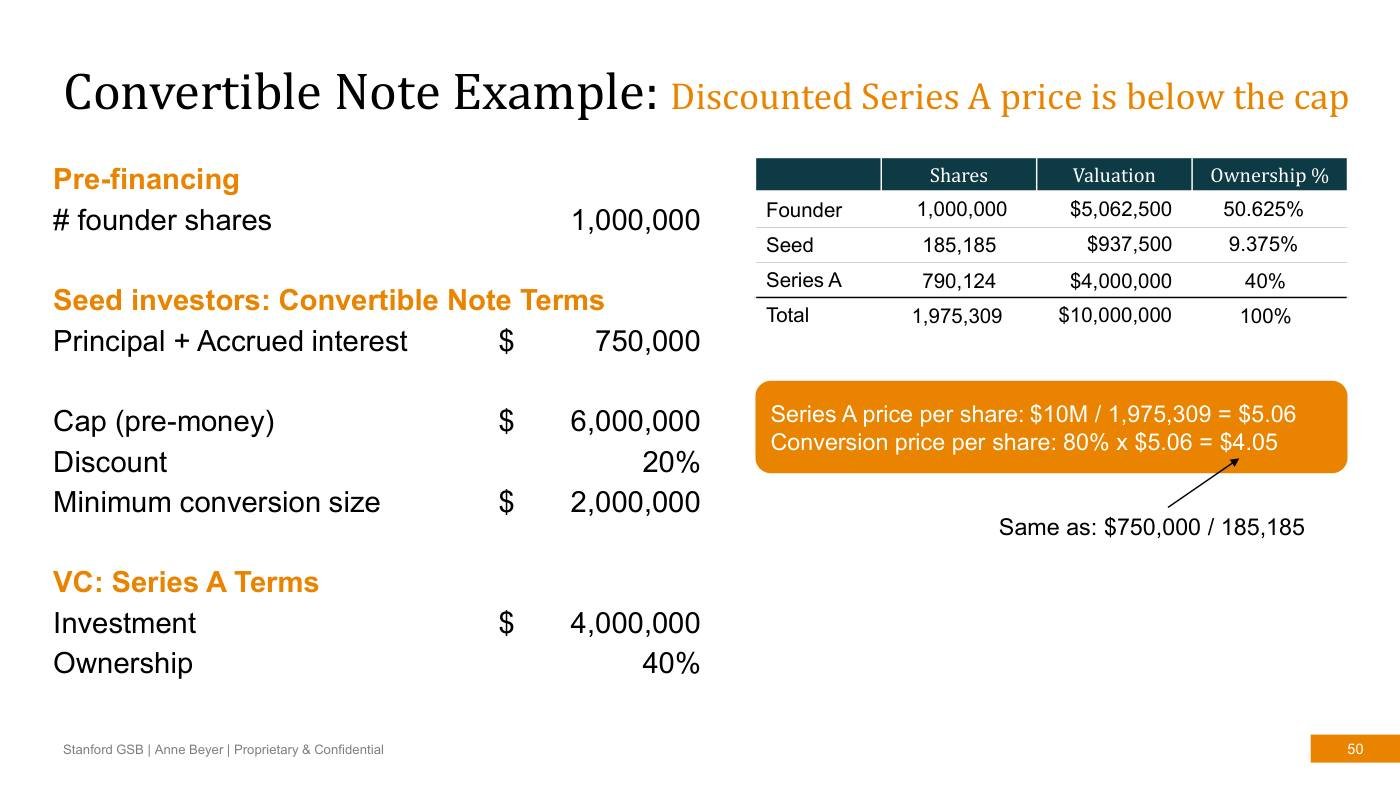
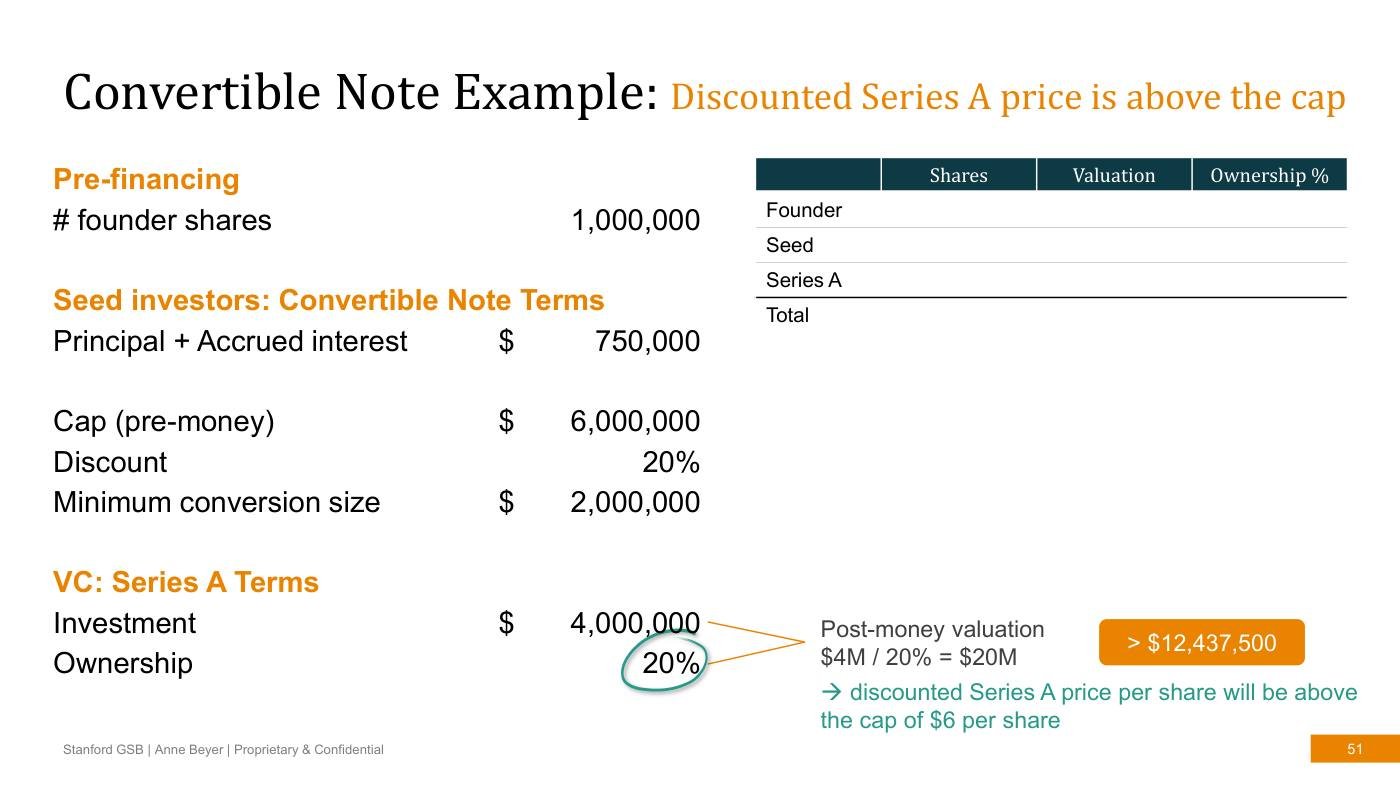
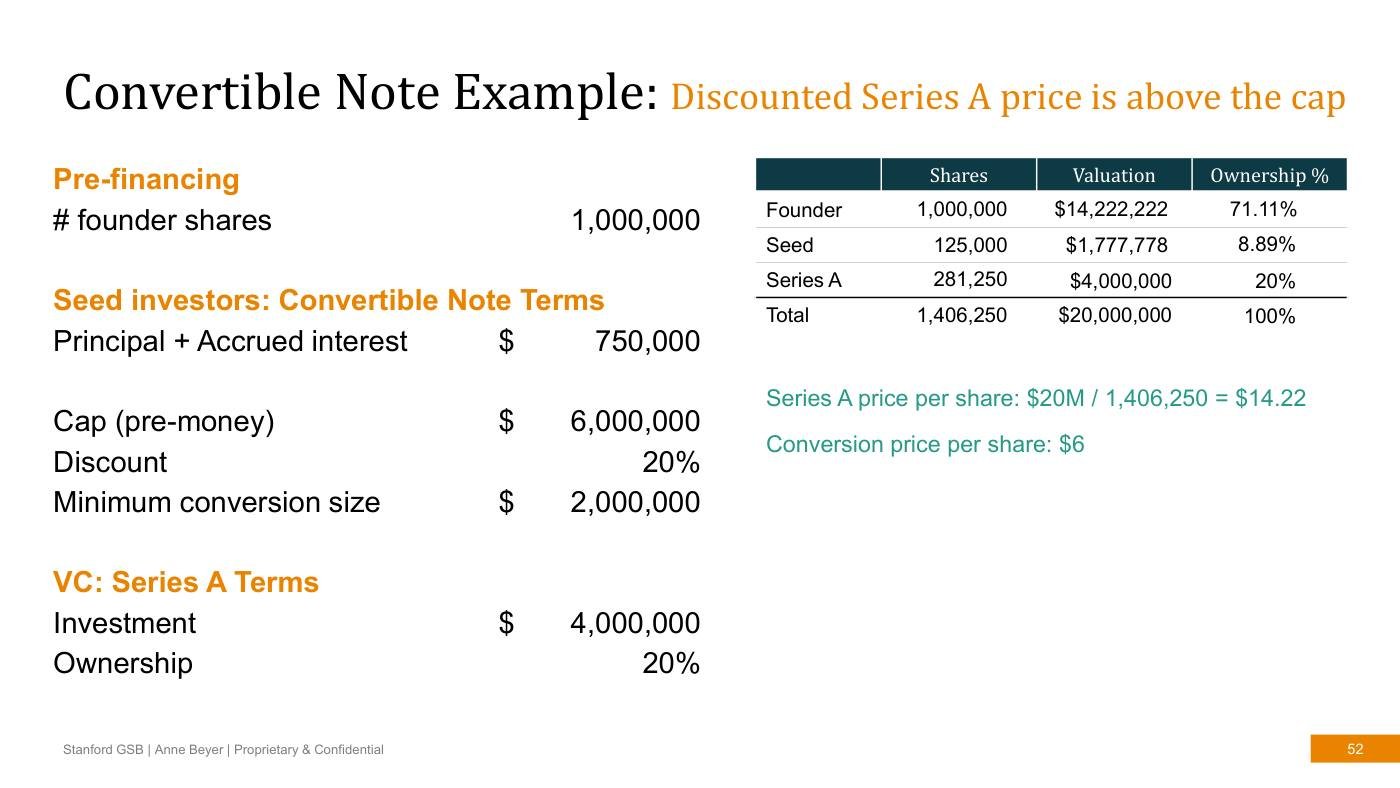
A pool top-up counted in the pre-money is paid for entirely by existing holders, so price per share = investment / (investor% x post-money fully diluted shares).
Solve the cap table with one denominator equation: shares held by everyone except the new investor and pool = (1 - investor% - pool%) x total.
Compare term sheets on effective pre-money and share counts, not headline valuations or percentages.
Next lesson: Multiple rounds, dilution & the VC method
26
Check your understanding
Who owns what after a priced round and an option pool?
Score
Question 1
Relay's seed: $4M at $16M pre-money, unallocated pool topped up to 10% post-money inside the pre-money. Founders, converted SAFEs and granted options total 11,971,429 shares. What is the seed price per share?
T = 11,971,429 / 0.70 = 17,102,041; seed shares = 20% x T = 3,420,408; price = $4M / 3,420,408 = $1.1695. $1.2727 divides $16M by the pre-round shares without the new pool, and $0.9545 is the SAFE cap price.
Question 2
In the same round, what effective pre-money valuation do Relay's existing holders (founders, SAFE holders and granted options) receive?
11,971,429 shares x $1.1695 = $14.0M. The remaining $2.0M of the headline pre-money is the 1,710,204-share unallocated pool. Because the pool sits in the pre-money, its whole cost falls on existing holders and none on the seed investor.
Question 3
Founders hold 8,000,000 shares and nothing else is outstanding. An investor puts in $3M at $12M post-money and requires a 15% post-money unallocated pool. What is the price per share?
The investor gets 25% and the pool 15%, so founders keep 60%: T = 8M / 0.60 = 13.33M shares. Investor shares = 3.33M, price = $0.90. The founders' effective pre-money is 8M x $0.90 = $7.2M, not the $9M headline.
Question 4
After the seed, Priya notices her 300,000 options fell from 2.39% of Relay to 1.75% and asks whether her grant was cut. What is the accurate answer?
Dilution reduces percentages, not share counts. Her 300,000 options were 2.39% of 12,571,429 and are 1.75% of 17,102,041, while the price per share rose about 23%. Anti-dilution provisions protect preferred investors against down rounds, not employees in up rounds.
Question 5
Relay receives a second term sheet: $4M at $18M pre-money with a 15% post-money pool in the pre-money. Compared with $16M pre and a 10% pool, which statement is correct?
Under the $18M offer the investor takes 4/22 = 18.18%, others keep 66.82%, T = 17,916,424 and the price is $1.2279, so existing shares are worth $14.7M. Maya's percentage is lower because the larger pool is counted, but her shares are worth more ($6.39M vs $6.08M). Compare effective pre-money, not headline numbers.
Question 6
Suppose Relay's seed were priced on the 12,571,429 pre-round shares ($1.2727) and the pool were topped up to 10% only after the investment. What percentage would the seed investor end with?
The seed buys 3,142,857 shares (20% of 15,714,286). Topping the pool up to 10% after the investment adds 1,079,365 shares, for 16,793,651 in total, so the seed holds 18.71%. A post-money top-up shares the dilution with the new investor, which is why investors insist that the pool sit in the pre-money.
Workbook
Who owns what after a priced round and an option pool?
Module output: A capital strategy, cap table, financing comparison and milestone-based funding plan.
Library
Every original page used in this lesson
4 appear in the slides with notes; the rest are kept here for reference.
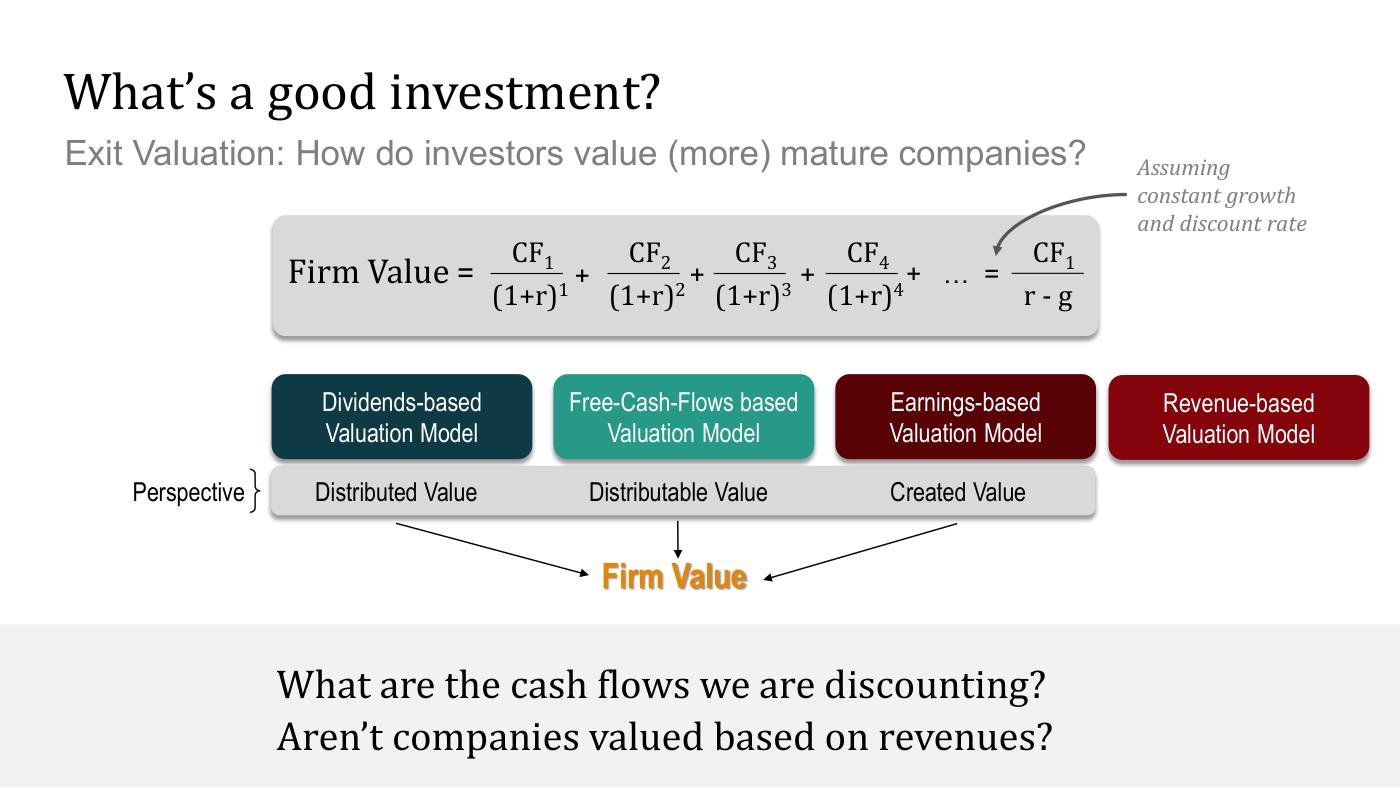
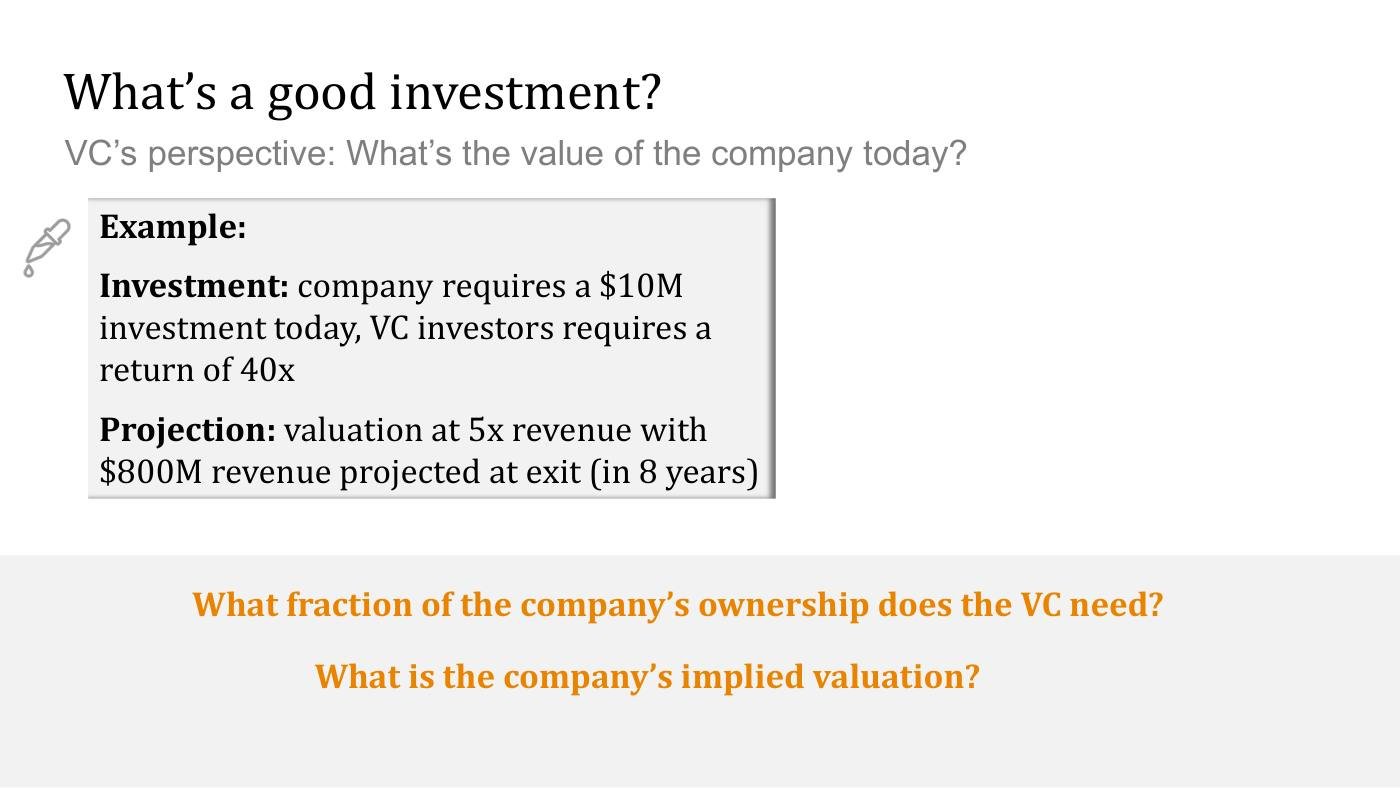
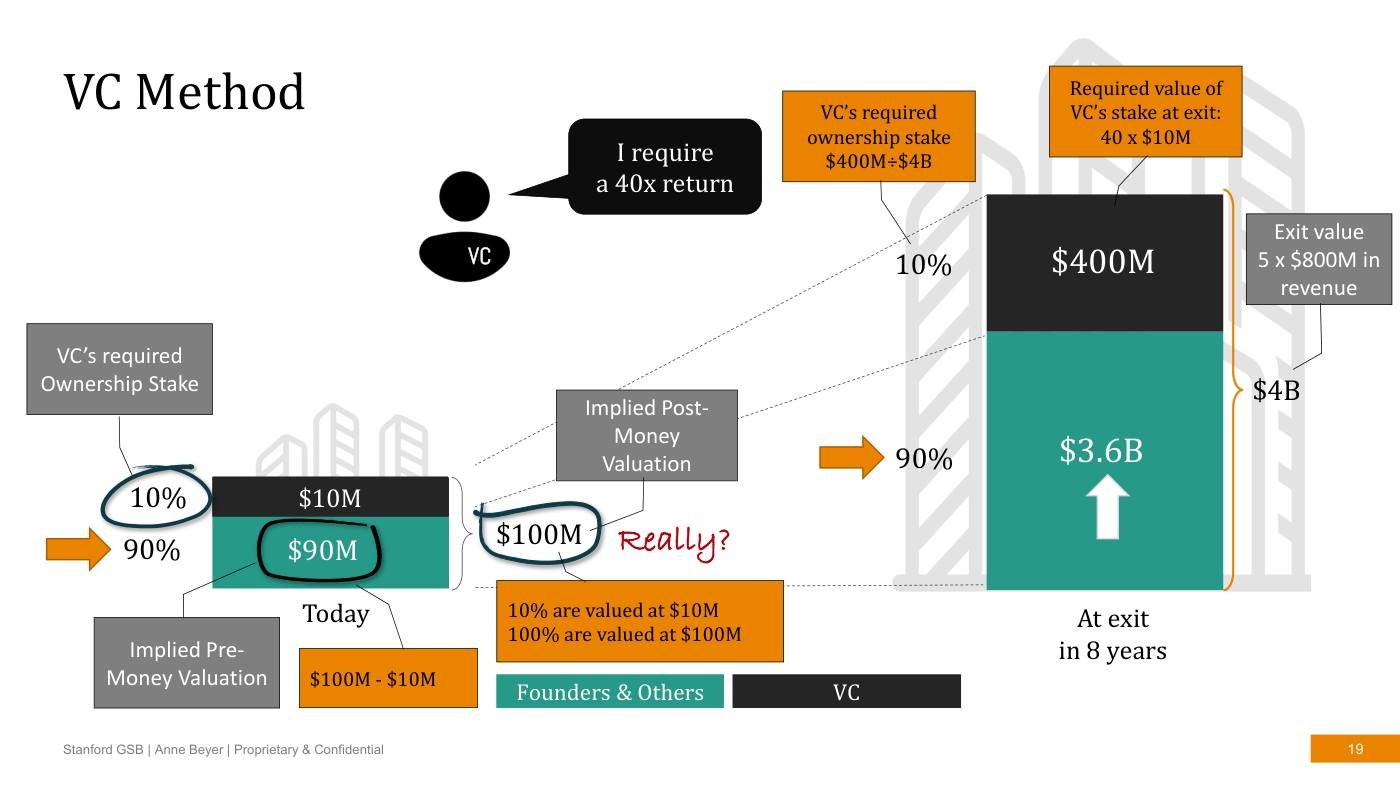
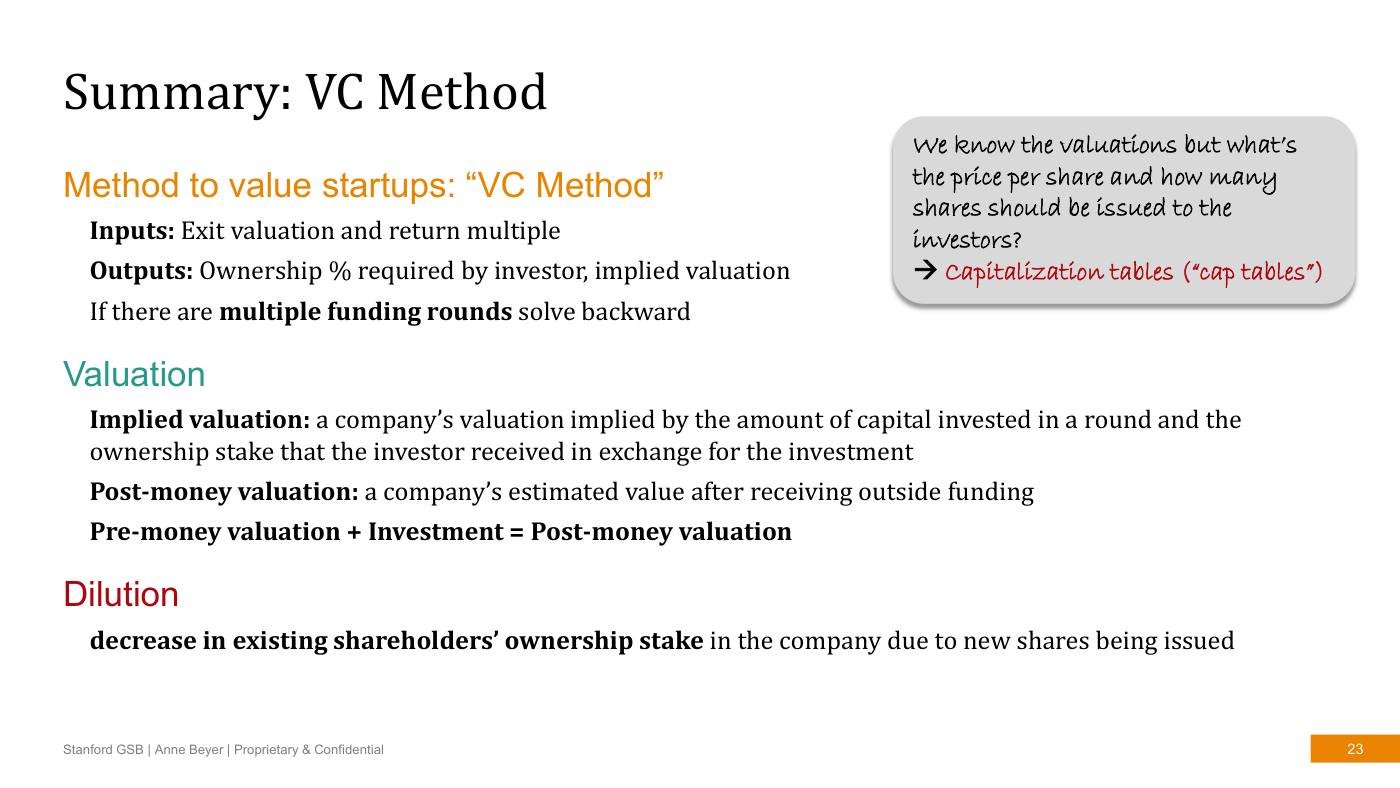
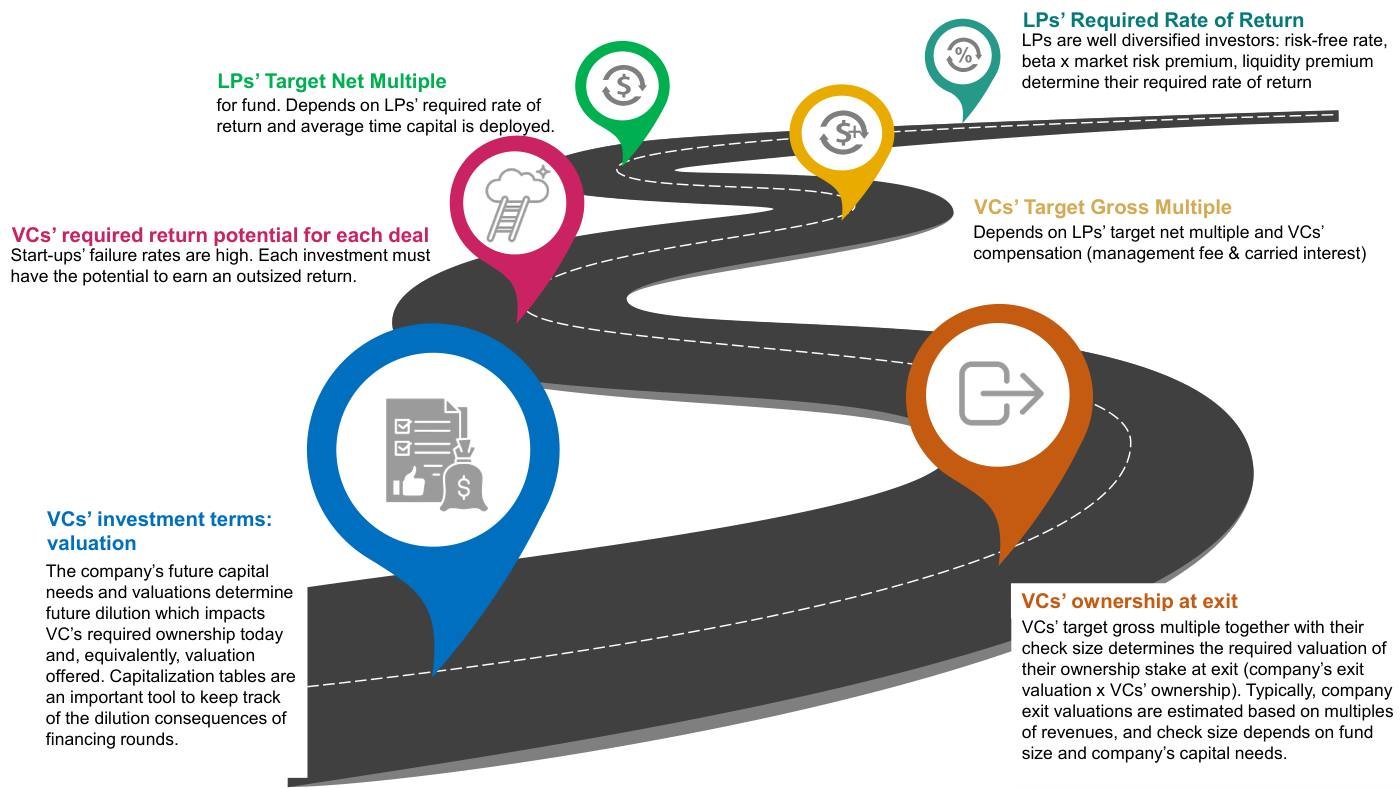
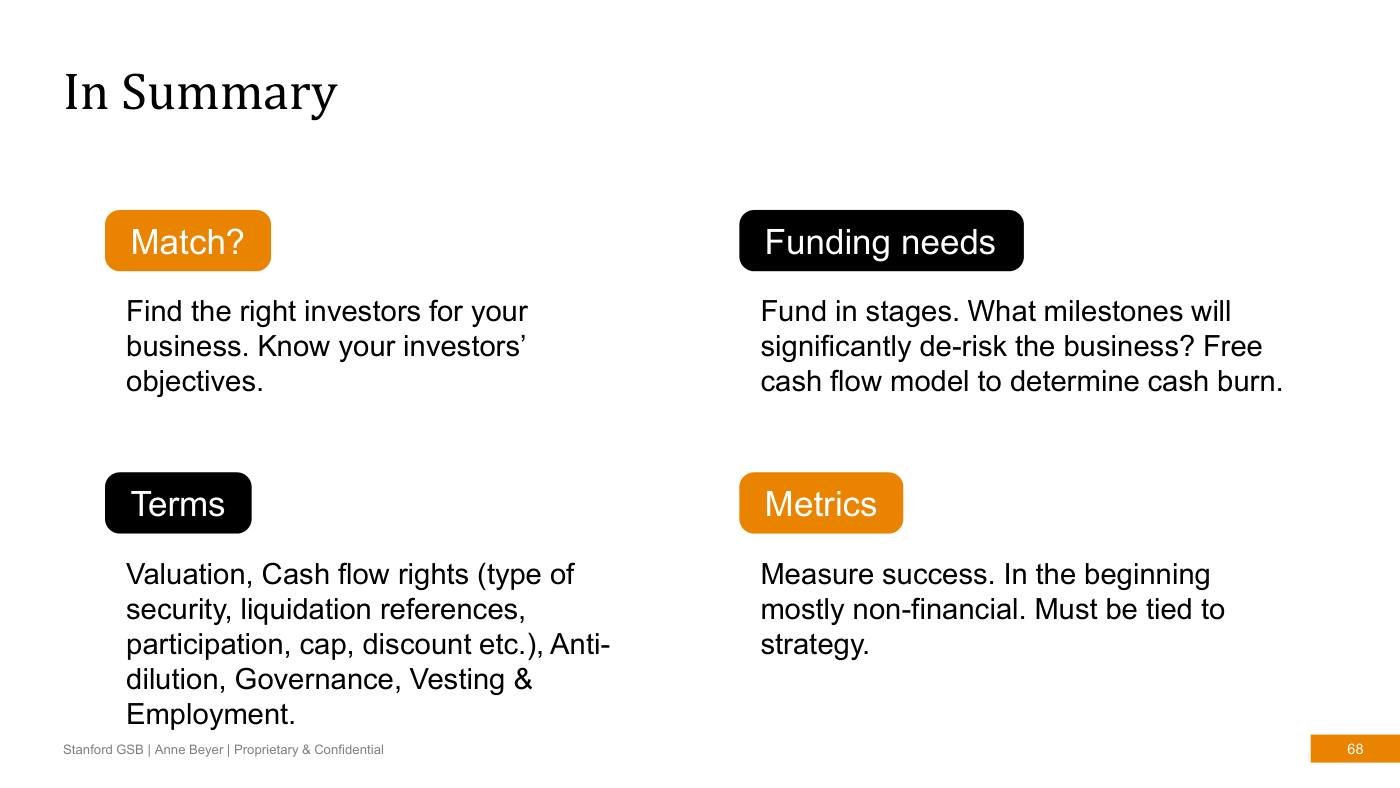
VC method and valuation vocabulary in one pageThe VC method takes an exit valuation and a return multiple as inputs and produces the required ownership and an implied valuation, solved backward when there are several rounds. The page defines implied valuation, post-money valuation (pre-money + investment) and dilution (the fall in existing holders' percentage when new shares are issued). 'Implied' is the key word. A valuation in a term sheet is what the negotiated investment and percentage imply, not a measured price. The callout links valuation to share count: once the percentage is agreed, a cap table is needed to find the price per share and the number of new shares.Beyer - Finance Slides (all 3 sessions) · PDF page 23 · in the slides
1
Cap table example: assumptions (pre-seed highlighted)Founders hold 10,000,000 shares; a pre-seed VC invests $1,000,000 at $1.00 per share. A seed of $10M at $30M post-money with a 10% post-money unallocated pool is shown greyed out. Build slide; the complete assumptions appear in the L31 deck (slide 17) and in native slide 4.Beyer - Finance Slides (all 3 sessions) · PDF page 24
2
Pre-seed cap table: 10M founder shares plus 1M at $1.00Founders hold 10,000,000 shares (90.9%) and pre-seed investors 1,000,000 shares at $1.00 (9.1%), 11,000,000 shares in total, which values the company at $11,000,000 post-money. The empty seed table below previews the next round. Post-money value = price x all shares outstanding (here 11,000,000 x $1.00). The investor paid $1M for 1/11 of the company; the founders' shares are valued at the same $1.00 even though they paid almost nothing for them.Beyer - Finance Slides (all 3 sessions) · PDF page 25 · in the slides
3
Dilution!A one-word title slide. Transition only.Reiss - Founder & Equity Slides · PDF page 44
4
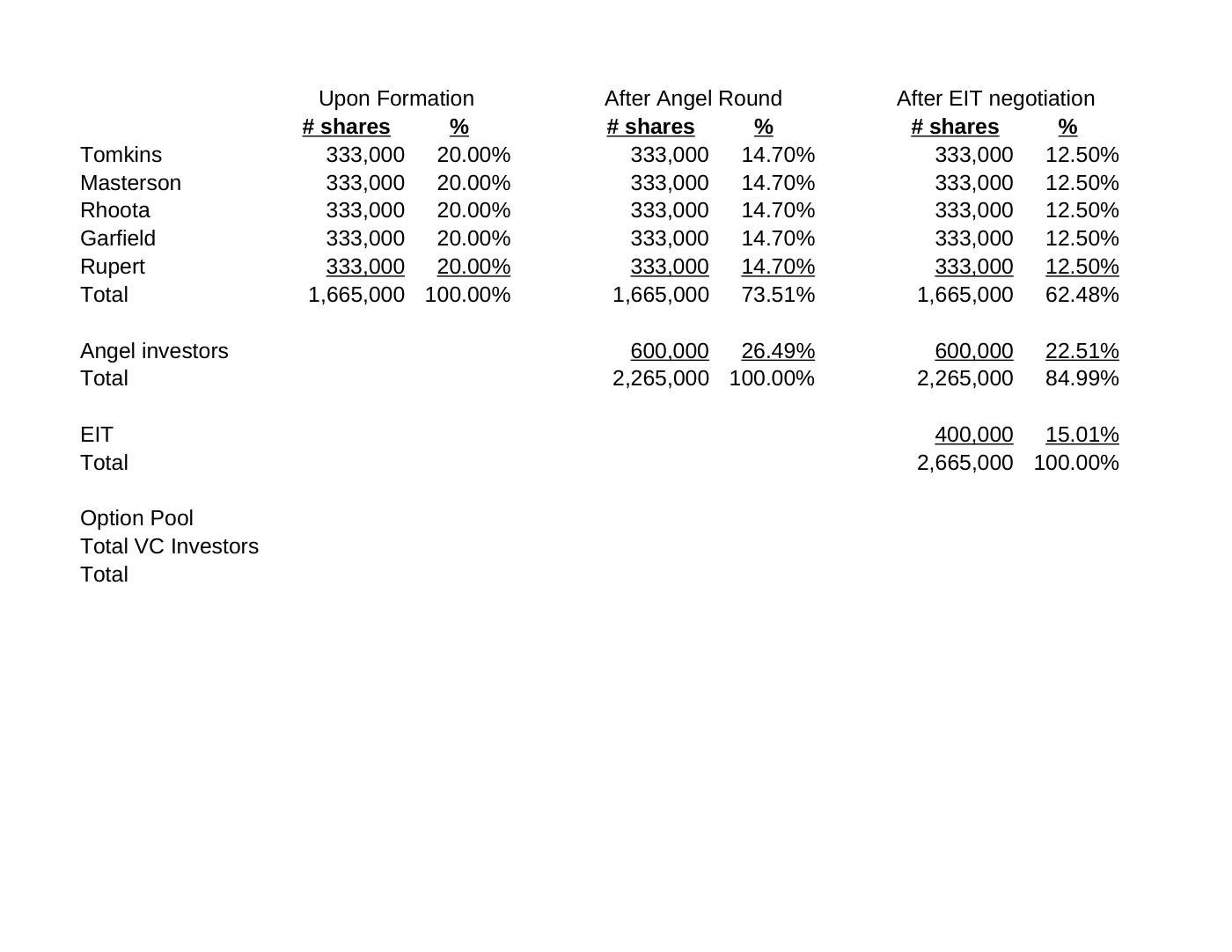
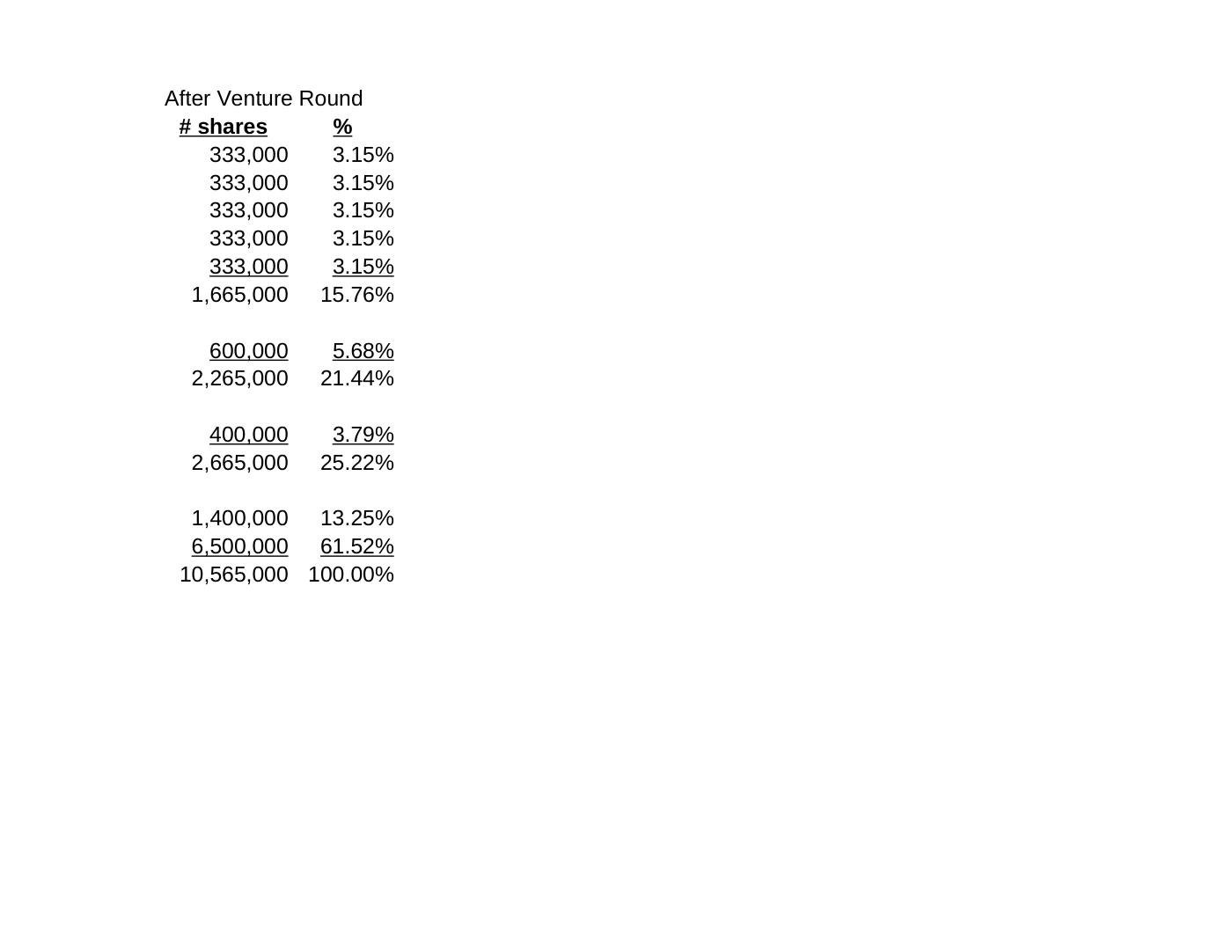
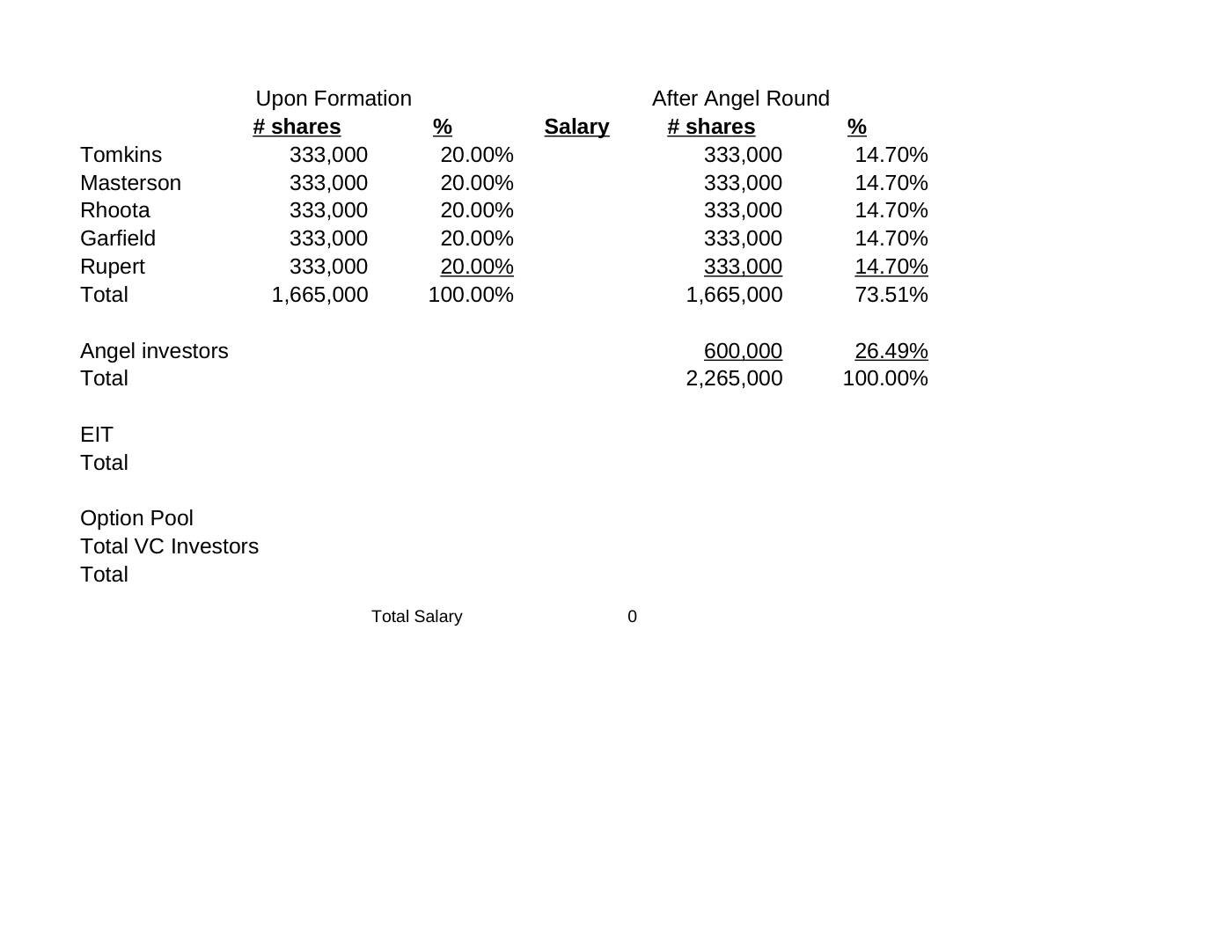
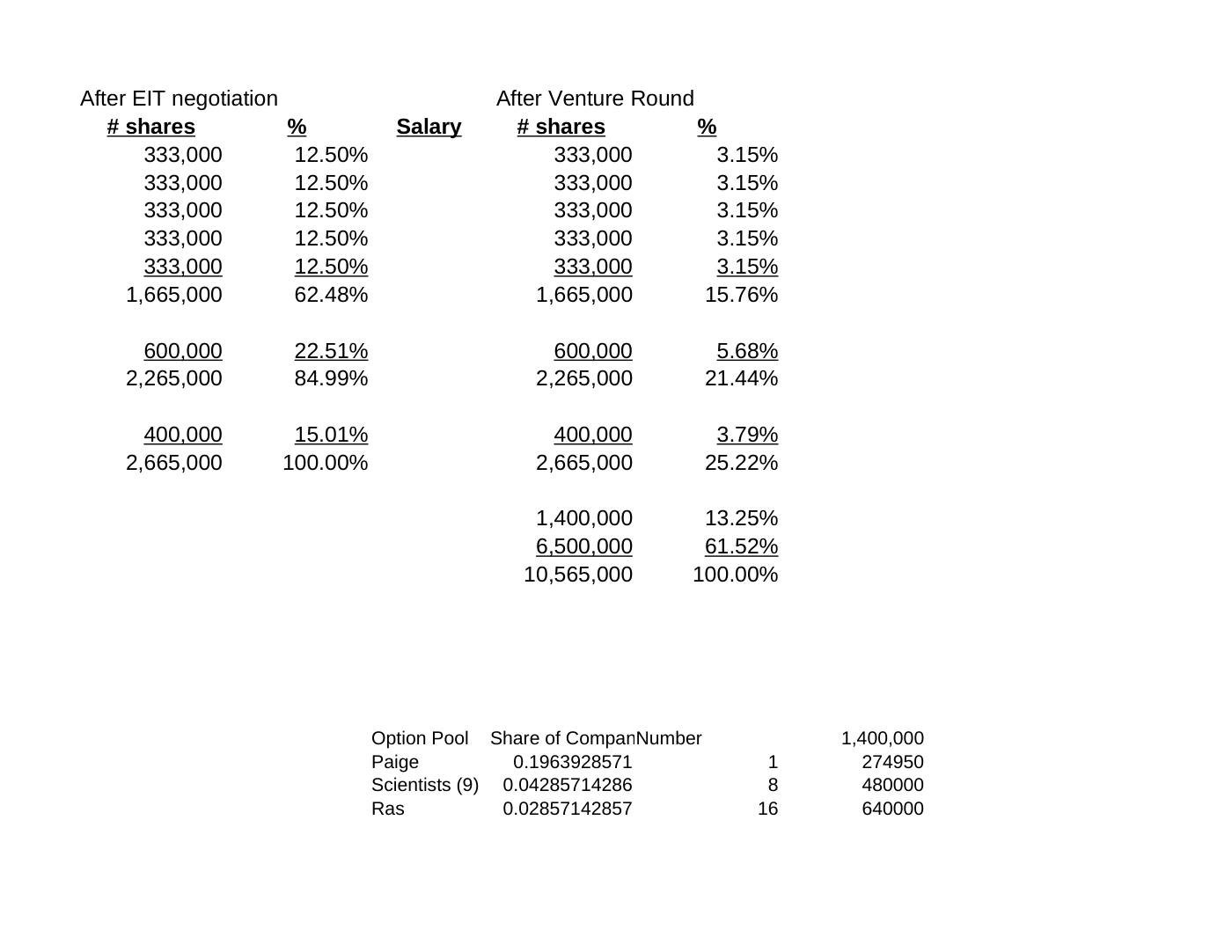
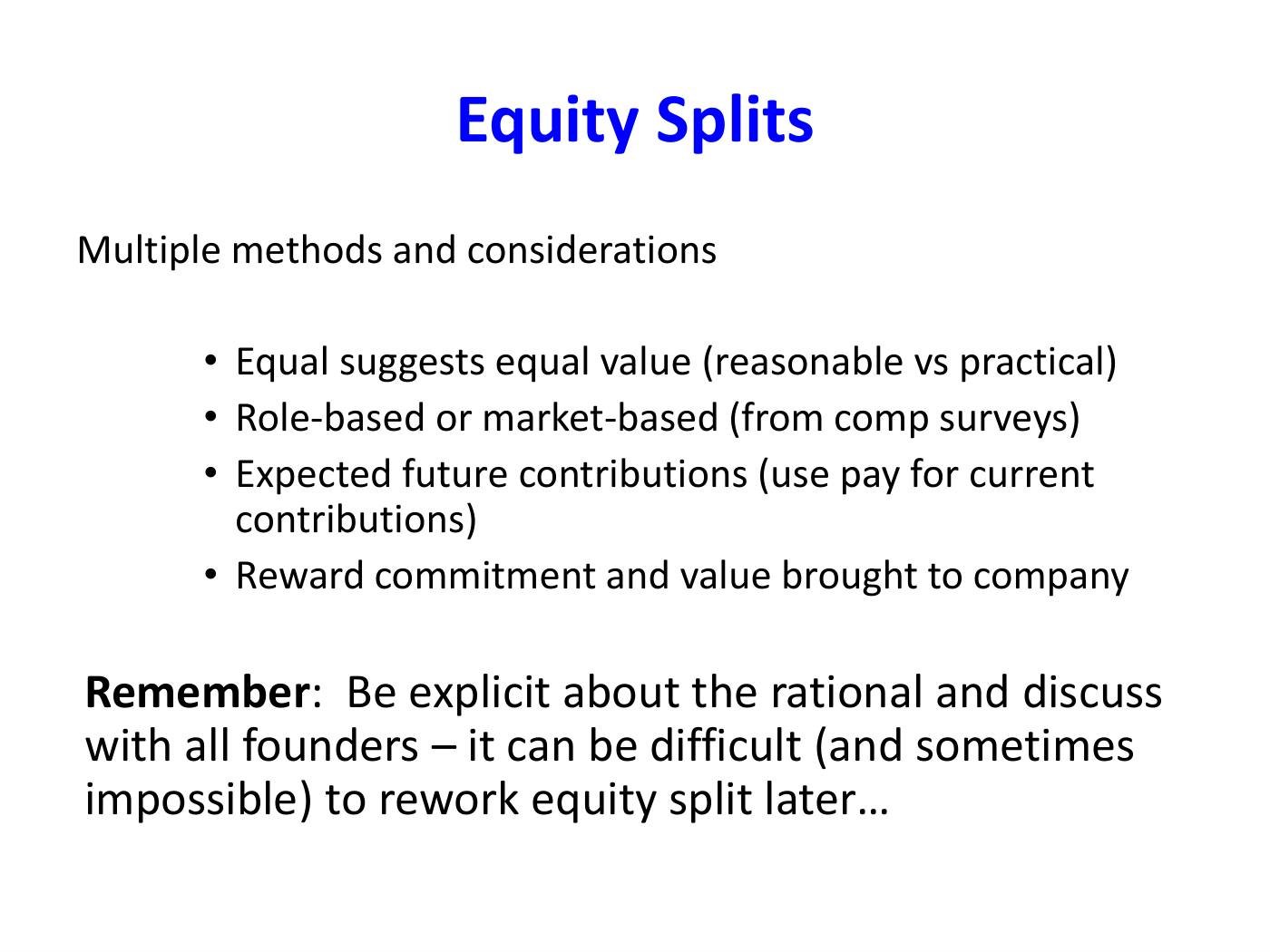
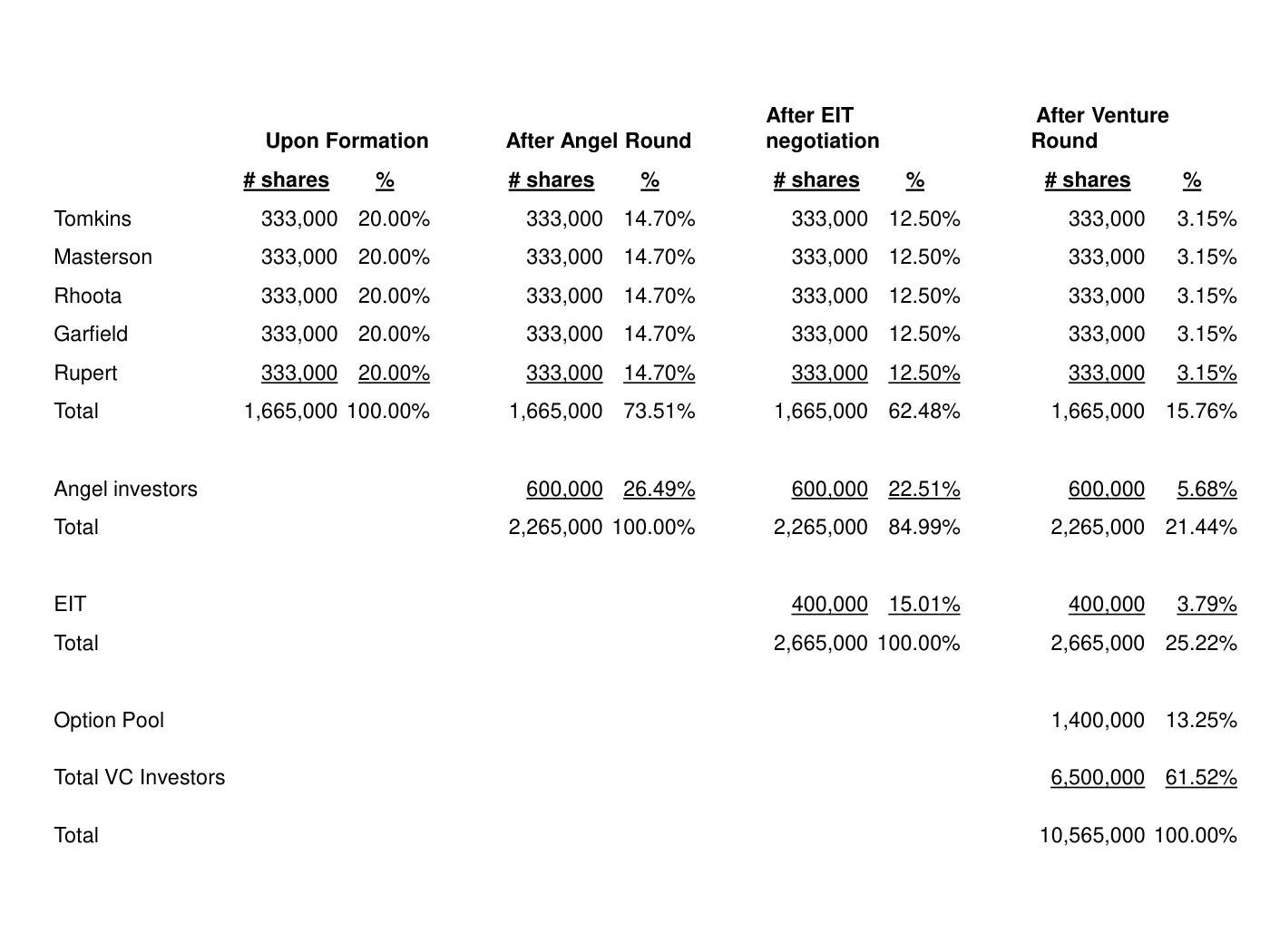
NanoGene cap table: formation to venture roundFive founders with 333,000 shares each (1,665,000 total) fall from 100% to 73.51% after a 600,000-share angel round, to 62.48% after a 400,000-share grant to an executive in transition (EIT), and to 15.76% after a venture round that issues 6,500,000 shares to VCs (61.52%) and creates a 1,400,000-share option pool (13.25%). The total is 10,565,000 shares. Each founder keeps 333,000 shares throughout while the percentage falls from 20.00% to 3.15%. The arithmetic checks: 1,665,000 / 10,565,000 = 15.76%. The venture round takes 61.5% plus a 13% pool, a far heavier round than the 20% to 30% typical of modern seed and Series A deals. That is what happens when founders raise a large amount of capital early at a low valuation.Reiss - Founder & Equity Slides · PDF page 45 · in the slides
5
Option grant guideline by level at Series AA grant chart by job level: 0.03% for admin and clerks, 0.06% for associates and analysts, 0.12% for scientists and engineers, 0.50% for managers, 1.00% for directors and 2.00% for VPs; the CEO line is left blank. The pool is sized from a hiring plan, not chosen as a round number. Applied to Relay's post-seed 17,102,041 shares, 1.00% is about 171,000 shares. Priya's 300,000-share grant is 1.75% post-seed, which is consistent with an early Head of Growth who joined before the seed.Reiss - Founder & Equity Slides · PDF page 53 · in the slides