Company formation creates a contracting and governance structure
An idea becomes an organization when people contribute work or assets, money changes hands and customers or partners need someone accountable for commitments. A legal entity provides a structure for those relationships, but formation alone does not resolve every ownership or responsibility question.
The source discusses common formation triggers and the decisions made with counsel. Identify the owners, the assets they contribute, the planned business and the relevant jurisdictions. Existing employer, university or contractual obligations may affect what the founders can contribute.
Legal form and tax classification are separate decisions
The historical material compares sole proprietorships, partnerships, LLCs and corporations. Legal form affects governance, liability, ownership and administrative requirements. Tax classification determines another set of consequences and does not always follow a simple one-to-one mapping from the entity’s name.
Use the comparisons to generate questions rather than treating an old table as current legal or tax advice. Requirements differ across jurisdictions, owners and financing plans. Current official resources and professional review are needed before applying the concepts to an actual company.
Legal organization and tax treatment are related questions with distinct definitions. Do not infer one entire set of consequences from a familiar entity label.
Legal organization
A framework for ownership, authority, obligations and liability under applicable law.
Tax classification
How the entity or its owners are treated for particular tax purposes; it is not always identical to the legal label.
Worked application
Illustrative review brief: identify owners, intended investors, operating locations, expected distributions and governance needs. Ask which legal arrangements and tax choices are available for those facts, which conditions apply and which documents must align. The historical chart helps organize questions rather than settle a present-day choice.
The comparison should lead to a fact-specific review, with the assumptions and decision consequences made explicit.
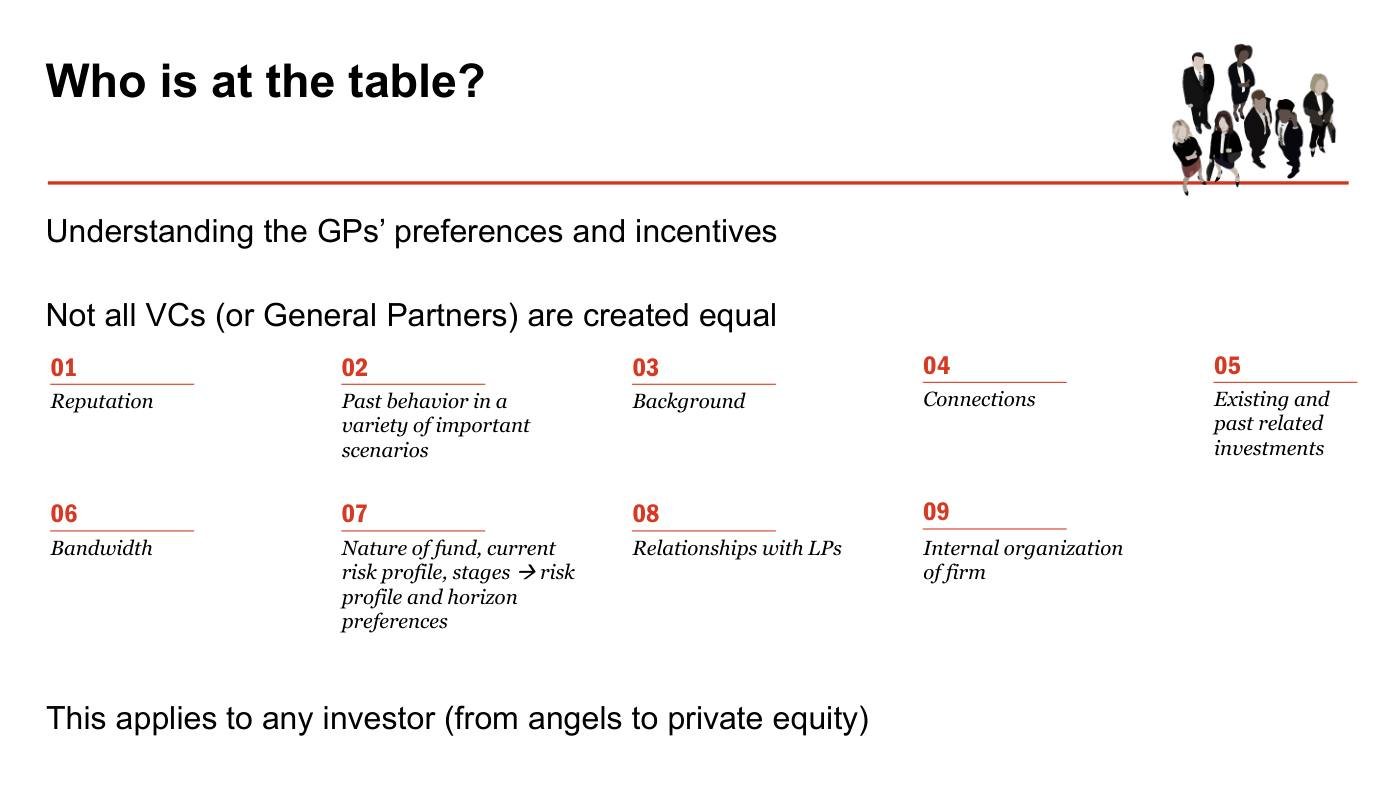
Owners, directors and executives exercise different authority
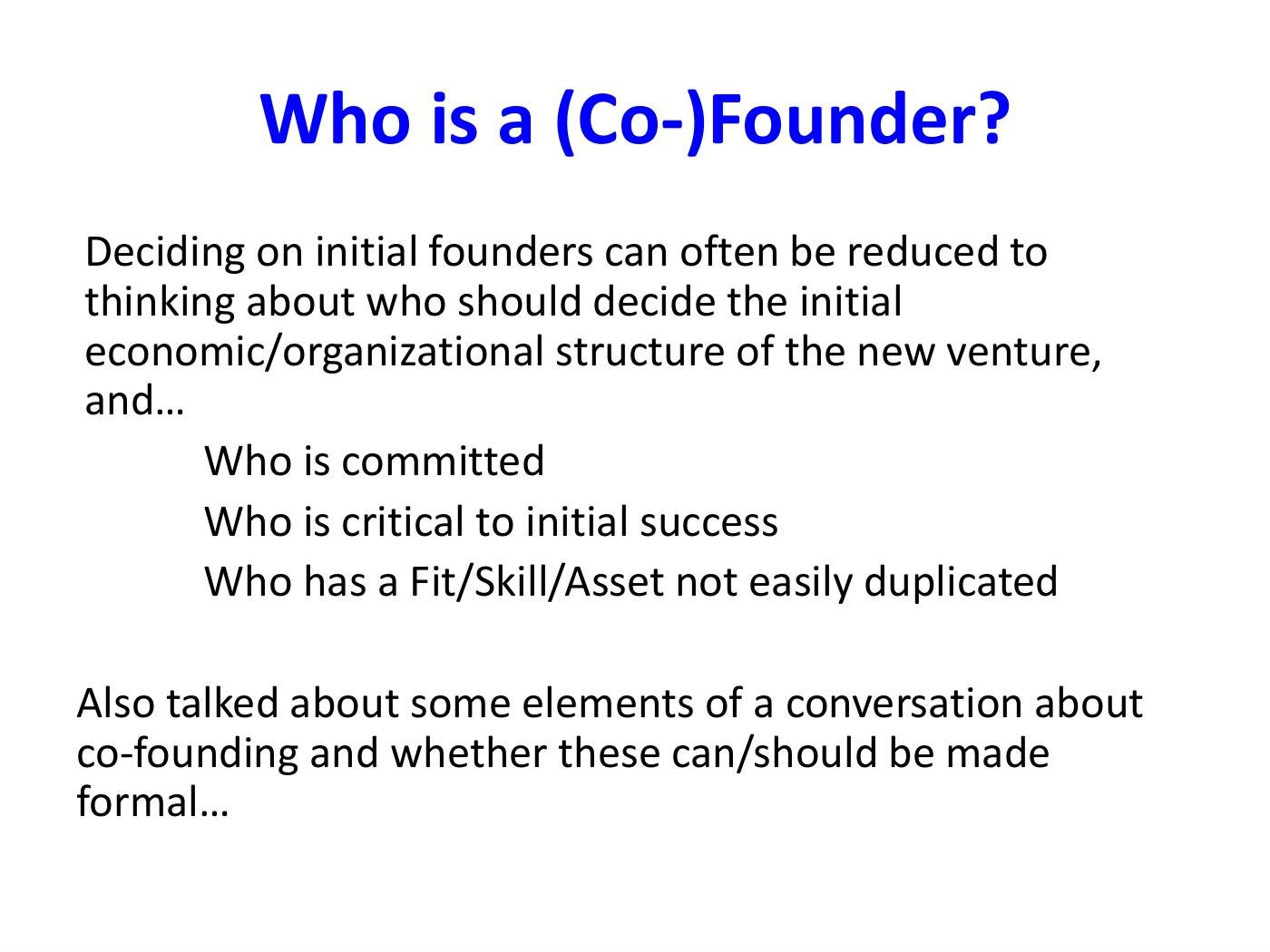
Ownership rights can include economic participation and voting. A board provides governance and oversight under the applicable structure. Executives manage operations within delegated authority. A founder can hold several roles, but their powers arise from the relevant role and documents.
A decision can require more than one approval. Financing, issuing equity or selling major assets can raise different approval questions from an ordinary operating purchase. Make the process explicit so that an informal understanding is not mistaken for valid authorization.
A useful formation brief identifies unresolved facts
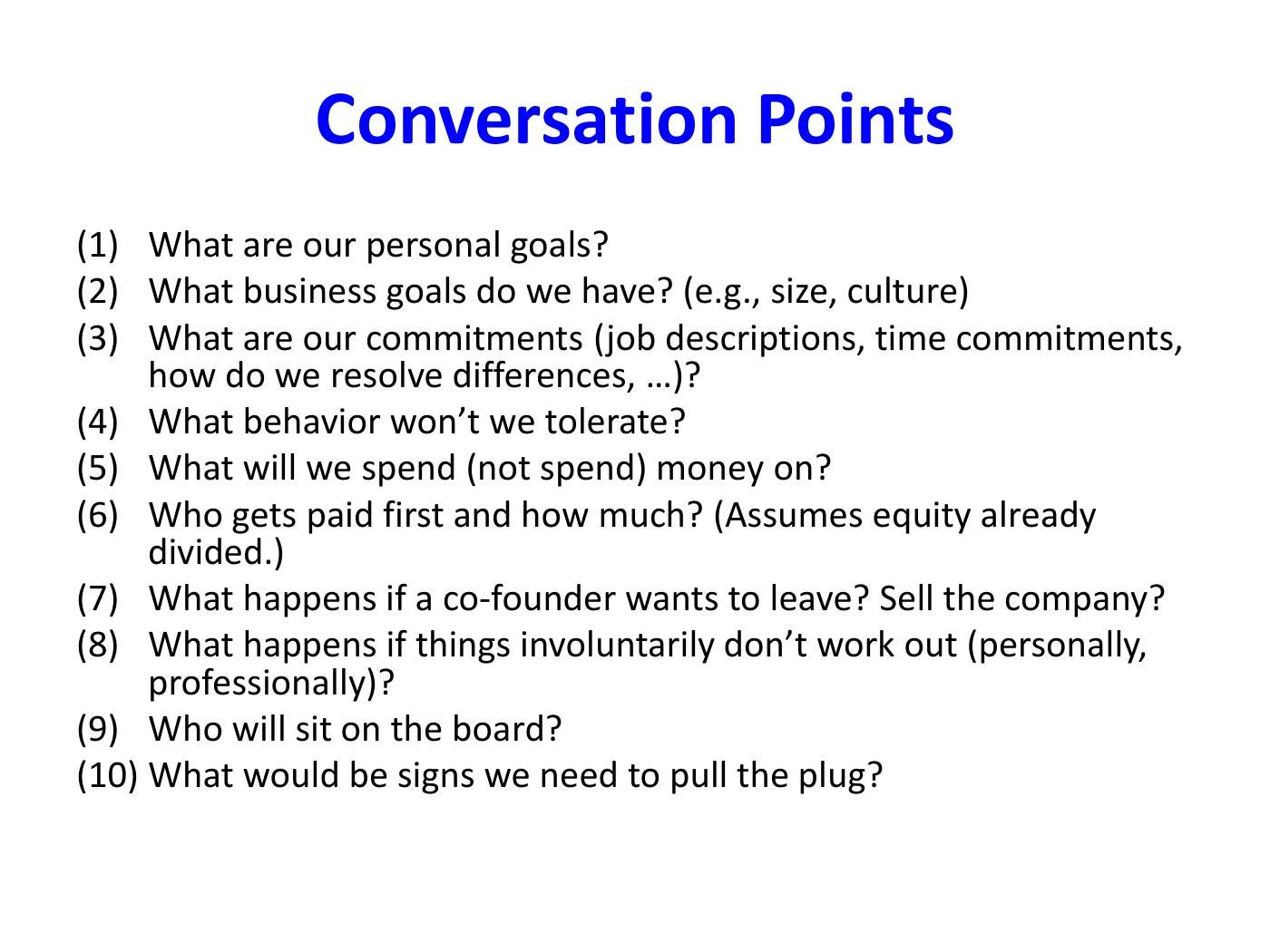
Professional review becomes more effective when the founders describe the actual arrangement. List contributions, existing commitments, intended ownership, financing plans and relevant countries or states. Attach the documents that could affect asset ownership or personal obligations.
Distinguish a fact from a preference. A founder may prefer a simple structure, while an intended investor may require particular rights or a different form. Comparing those constraints is more useful than asking for a universally best structure.
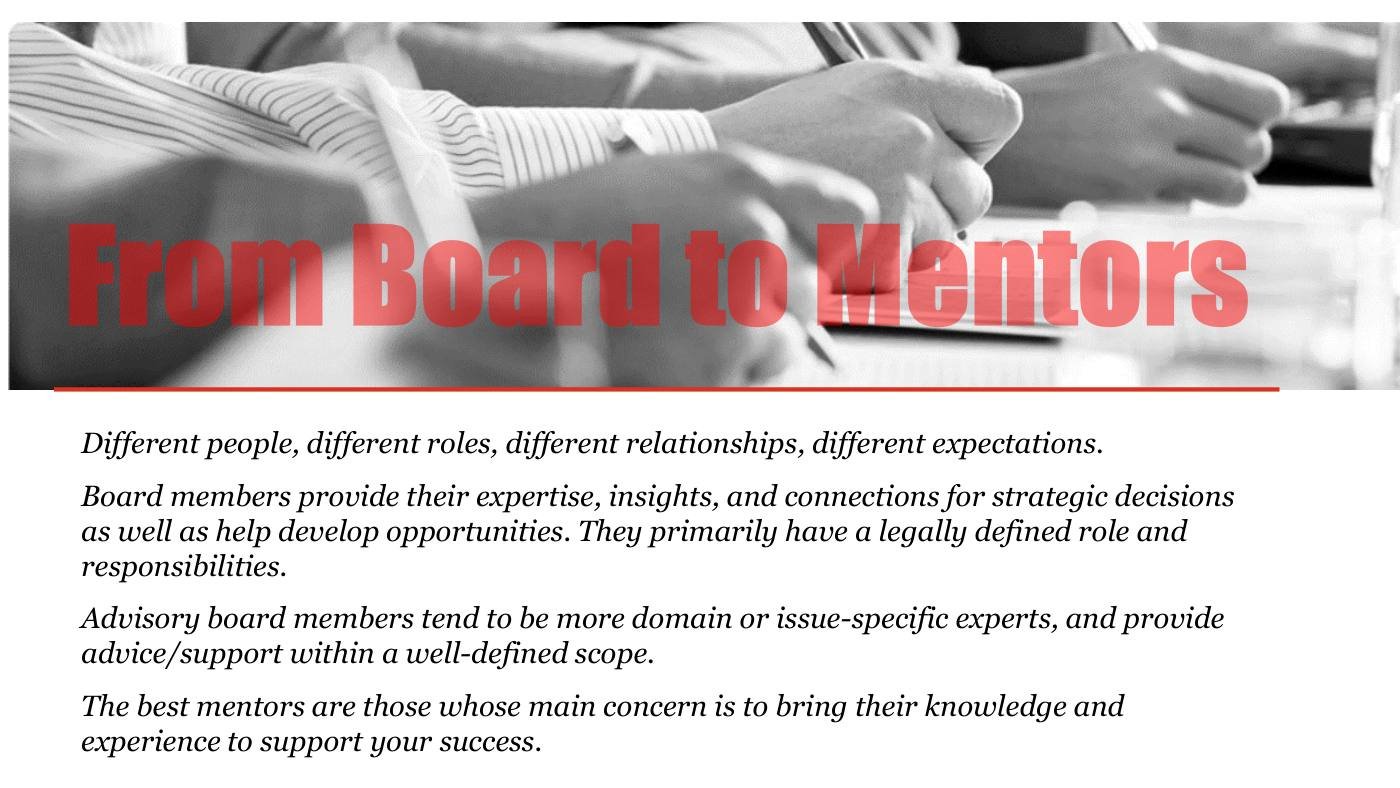
Advice and defined services, not automatic decision power.
16
25 / Deep diveCompany formation & governance questions
Relay's control map: pre-seed, post-seed, post-Series A
Board seats, voting stock and investor vetoes are three separate sources of control.
Voting percentages count issued shares only; unexercised options and the unallocated pool do not vote. That is why founders' voting power is higher than their fully diluted ownership.
After the seed the founders hold 2 of 3 board seats and 66.7% of issued votes, but the seed preferred typically has class votes on a sale, new senior stock and charter amendments. After the Series A the founders hold 51.9% of issued votes; if the board grows to five, they may control only two seats.
Board sizes and protective provisions here are illustrative and are negotiated in each round's term sheet. Their legal effect depends on the actual charter, bylaws and current Delaware law.
Stage
Board (illustrative)
Founders' share of issued votes
Founders' fully diluted %
Pre-seed (SAFE outstanding)
Maya, Daniel
100% (SAFE has no vote)
90.9% of 11,000,000 (pool included)
Post-seed
Maya, Daniel, seed lead
10,000,000 / 14,991,837 = 66.7%
58.47%
Post-Series A
e.g., 2 founders, seed lead, A lead, 1 independent
10,000,000 / 19,267,347 = 51.9%
46.78%
Series A shares = 20% of the post-A fully diluted count: 17,102,041 / 0.8 x 0.2 = 4,275,510. Issued votes post-A = 14,991,837 + 4,275,510 = 19,267,347 if no options are exercised.
Company formation organizes ownership, authority and obligations around the business the founders intend to run. Use the sequence to prepare a concrete professional-review brief.
01
Describe the business
State who owns and operates the venture, where it acts, how it earns money and whether outside investment is expected. These facts determine which comparisons are relevant.
02
Map the choices
Separate legal form, tax treatment, governance and financing needs. Record constraints and questions instead of assuming one label answers every issue.
03
Review the arrangement
Bring the facts, proposed ownership, decision rights and contribution history to appropriate advisers. Identify documents and approvals that must be consistent with one another.
04
Implement & maintain
Put the agreed arrangement into actual documents and operating routines. Assign responsibility for records and review when new owners, financing or activities change the facts.
The output is a coherent arrangement with clear responsibilities. The historical source is a framework for the questions, not a substitute for reviewing the actual situation.
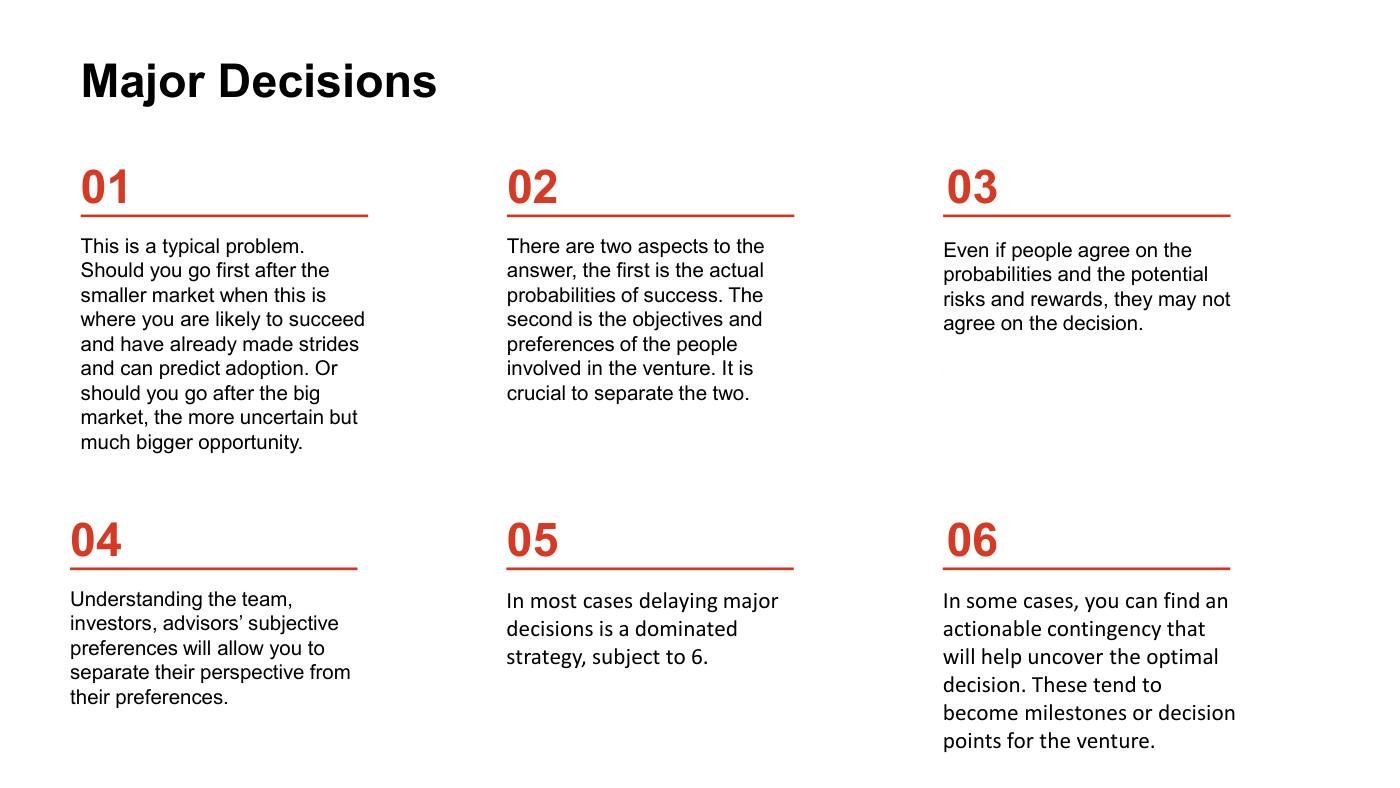
Founder, advisor and board member are not interchangeable
A fictional advisor negotiates with a supplier and promises a future ownership stake, believing that “helping the company” gives authority to commit it. The founders have not agreed who can sign or issue interests.
What authority and agreement questions must be resolved?
26
25 / Current practiceCompany formation & governance questions
Current practice: formation rules that changed in 2025-2026
No beneficial ownership reports for US companies
FinCEN's March 2025 interim final rule exempted US companies and US persons from Corporate Transparency Act beneficial ownership reporting. A final rule issued August 11, 2026 made the exemption permanent. Foreign companies registered to do business in the US must still report. Relay, a Delaware corporation, has no BOI filing, but its formation checklist should be updated rather than copied from 2024 guides.
Delaware amended its corporation law to keep companies
SB 21, signed March 25, 2025, added safe harbors for transactions with controlling stockholders and with directors and officers, defined who counts as a controller, and narrowed stockholder books-and-records demands. It responded to companies moving to Nevada and Texas. Delaware remains the default for venture-backed startups, but founders should know the rules are changing.
QSBS strengthens the C-corp case
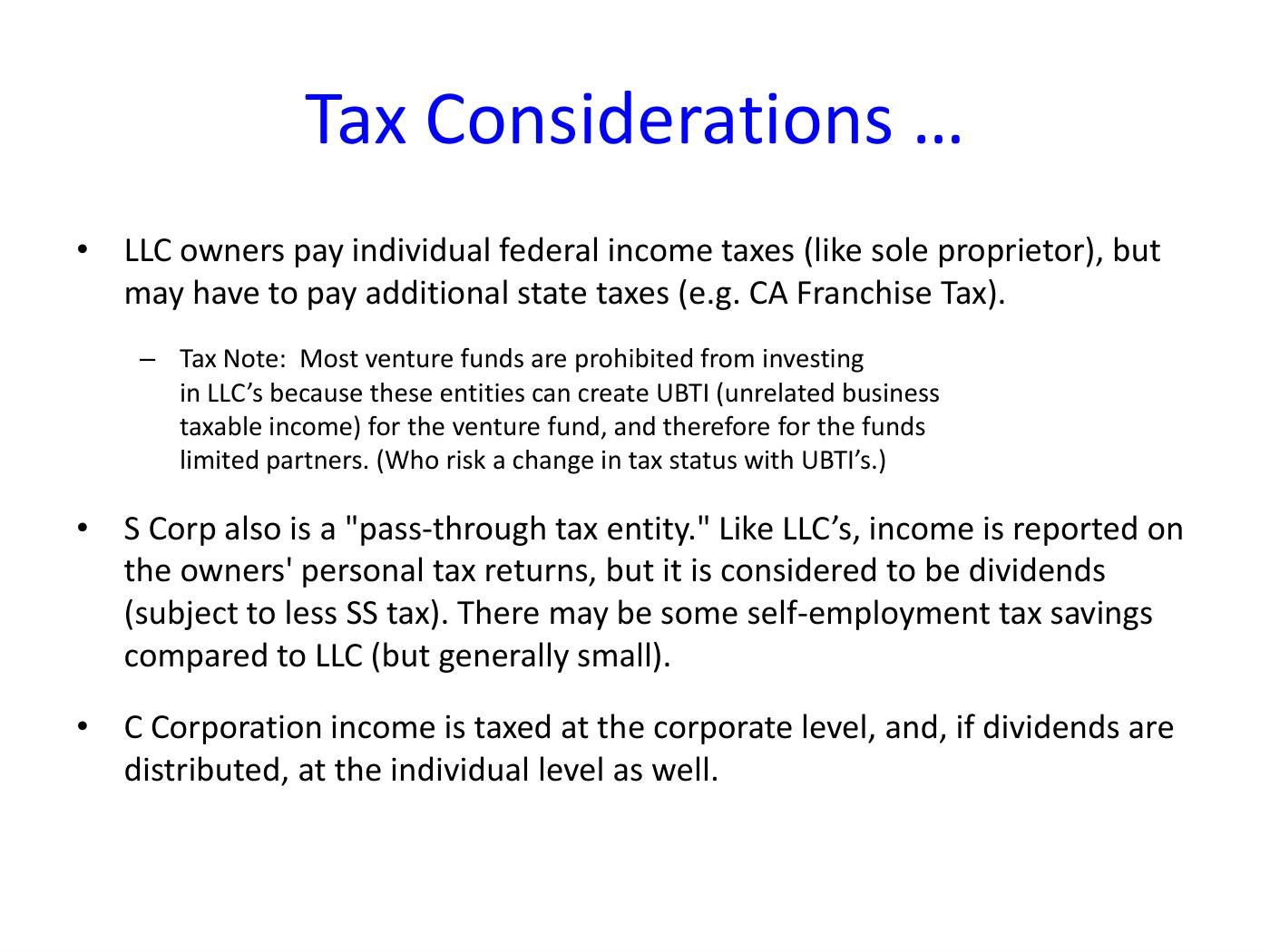
For stock acquired after July 4, 2025, Section 1202 allows partial gain exclusion after three years and a cap of the greater of $15 million or 10x basis, for domestic C-corporations with gross assets up to $75 million. Founders who form as an LLC and convert later may lose part of the benefit. Eligibility depends on current law and facts.
Delaware franchise tax figures
Delaware's minimum franchise tax is $175 under the authorized shares method and $400 under the assumed par value capital method, with a $50 annual report fee for domestic corporations and a March 1 deadline. A late filing incurs a $200 penalty plus interest.
Fictional team: two founders, a part-time advisor and a contractor building core code. A potential investor requests a clear ownership record and a person authorized to sign. No jurisdiction is specified.
Your task
Draw the authority map, identify missing documents and write a questions-for-counsel brief. Do not choose a universal legal or tax form.
Venture step: Relay's formation and governance brief
Relay · venture step 25
In month 1, before the $1,500,000 post-money SAFE, Maya and Daniel form Relay. Maya is in Austin; Daniel previously built SMS and scheduling systems at a health-tech company; three pilot clinics already send patient data under a v0 spreadsheet process. Investors expect a Delaware C-corporation with 10,000,000 founder shares and a 1,000,000-share option pool. After the $4,000,000 seed in month 16, the board grows from Maya and Daniel to three seats, adding the seed lead.
Your task
Produce a two-part brief: (1) a governance map for pre-seed and post-seed, showing who holds votes, board seats and signing authority, and (2) ten specific questions for counsel covering entity choice, IP assignment, prior-employer agreements, Texas registration, franchise tax and investor approval rights.
Form: Delaware C-corporation, because the plan is venture financing (preferred stock, an option pool, institutional funds as holders), QSBS requires C-corp stock, and standard documents assume Delaware. An LLC or S-corp would need conversion before the seed. Relay operates in Texas, so it registers there as a foreign corporation.
IP: both founders sign technology and IP assignment agreements transferring pre-formation Relay work (code, the spreadsheet process, the pilot design, the name) to the company. Daniel lists any prior inventions he excludes. Counsel reviews his former employer's invention assignment and confidentiality terms and Maya's former PT group's non-solicit terms before Relay approaches those clinics or hires their staff.
Governance map: pre-seed, founders hold 100% of issued shares and both board seats; the bylaws name Maya CEO with signing authority up to a board-approved limit. Post-seed, the board has 3 seats (Maya, Daniel, seed lead). Founders hold 10,000,000 / 14,991,837 = 66.7% of issued voting shares, but preferred protective provisions give investors a veto over new senior stock, charter changes and a sale.
Franchise tax (illustrative: 15,000,000 authorized shares, $0.0001 par, $1,500,000 gross assets, 10,000,000 issued): authorized shares method = $250 + 1,499 x $85 = $127,665. Assumed par value capital method: $1,500,000 / 10,000,000 = $0.15 assumed par; $0.15 x 15,000,000 = $2.25M, rounded up to $3M, x $400 = $1,200, plus the $50 annual report. File under the second method.
Questions for counsel include whether the board should expand to five seats at the Series A (2 common, 2 investor, 1 independent), what the CEO may sign without board approval (the Northpoint contract, BAAs, the LLM vendor agreement), and whether non-compete law in Texas affects Priya's hire. Application depends on current law and Relay's facts.
Incorporating Relay does not move Daniel's pre-formation code or Maya's pilot process into the company. Without signed assignments, the company may not own its core asset, and investors will find the gap in diligence.
Paying the authorized-shares franchise tax bill
Delaware's default calculation can bill a startup with 15,000,000 authorized shares about $127,665. Recalculating under the assumed par value capital method usually brings it to hundreds or low thousands of dollars.
Equating board control with control
Holding 2 of 3 board seats and 66.7% of the votes does not let founders sell the company or issue new preferred if the charter gives the preferred class a separate vote. Read the protective provisions before the seed closes.
Relay's formation and governance brief: entity choice with reasons, IP assignment and prior-employer checks, a pre- and post-seed governance map, a franchise tax estimate, and ten questions for counsel.
Formation creates the party that signs, owns and issues equity, so IP assignment and prior-employer checks belong in the same step.
For a venture-financed US startup, a Delaware C-corp is the default because of preferred stock, option plans, investor tax needs, QSBS and standard documents.
Control is the combination of board seats, stockholder votes and charter protective provisions; map all three, recognizing that application depends on current law and the documents.
Next lesson: IP rights & strategic protection choices
33
Current rules: IRS: business structures · USPTO: IP tools. Legal, tax and privacy examples teach concepts; application depends on current law and the actual facts.
Check your understanding
What changes when an idea becomes a legal entity?
Score
Question 1
Maya and Daniel ran Relay's paid pilots for six weeks under a shared bank account before filing anything. A clinic now sues over a scheduling error. What is the most likely legal position of that pre-formation business?
Two people carrying on a business for profit together are generally treated as a partnership even without a filing, with personal liability. An LLC or corporation exists only once filed. This is why paid work and patient data are formation triggers.
Question 2
Maya's accountant suggests forming Relay as an S corporation so early losses flow to the founders' personal returns. Which fact most directly rules that out?
S corporations cannot have entity shareholders (with narrow exceptions) and may have only one class of stock. Losses and a Texas location do not disqualify an S-corp; a two-founder team is well under the 100-shareholder cap.
Question 3
Relay (Delaware) has 15,000,000 authorized shares at $0.0001 par, 10,000,000 issued, and $1,500,000 of gross assets. What is the franchise tax under the assumed par value capital method, before the $50 annual report fee?
Assumed par = $1.5M / 10M = $0.15. $0.15 x 15M authorized = $2.25M, rounded up to the next million ($3M), x $400 = $1,200. $127,665 is the authorized shares method; $900 forgets to round up.
Question 4
After the seed, Relay has 10,000,000 founder shares, 1,571,429 SAFE conversion shares and 3,420,408 seed shares issued; 400,000 options are granted but unexercised. What share of issued voting stock do the founders hold?
Options do not vote until exercised. 10,000,000 / (10,000,000 + 1,571,429 + 3,420,408) = 10,000,000 / 14,991,837 = 66.7%. 58.5% is the fully diluted figure (30.41% + 28.07%), which counts the pool and options.
Question 5
Founders control 2 of 3 board seats and 66.7% of the votes after the seed. Maya wants to sell Relay to ClinicOS over the seed lead's objection. What is the most likely obstacle?
Venture charters usually add class votes for the preferred on sales, new senior securities and charter amendments. Board and common majorities are necessary but often not sufficient. Delaware has no general unanimity rule for sales.
Question 6
A part-time advisor who helped Relay sign its first clinic emails the clinic promising 1% of Relay's equity for a case study. What is the status of that promise?
Equity issuance needs board approval under the charter, bylaws and the equity plan, and advisors hold no automatic authority. The promise creates a dispute risk to resolve now, which is why governance maps state who may sign and who may promise equity.
Workbook
What changes when an idea becomes a legal entity?
Module output: A founder discussion brief, governance questions, IP map and privacy data map.
Library
Every original page used in this lesson
10 appear in the slides with notes; the rest are kept here for reference.
Section divider: what being a startup company meansTitle-only prompt asking what it means to be a startup company. Divider only; the next slide answers it.Reiss - Founder & Equity Slides · PDF page 3
1
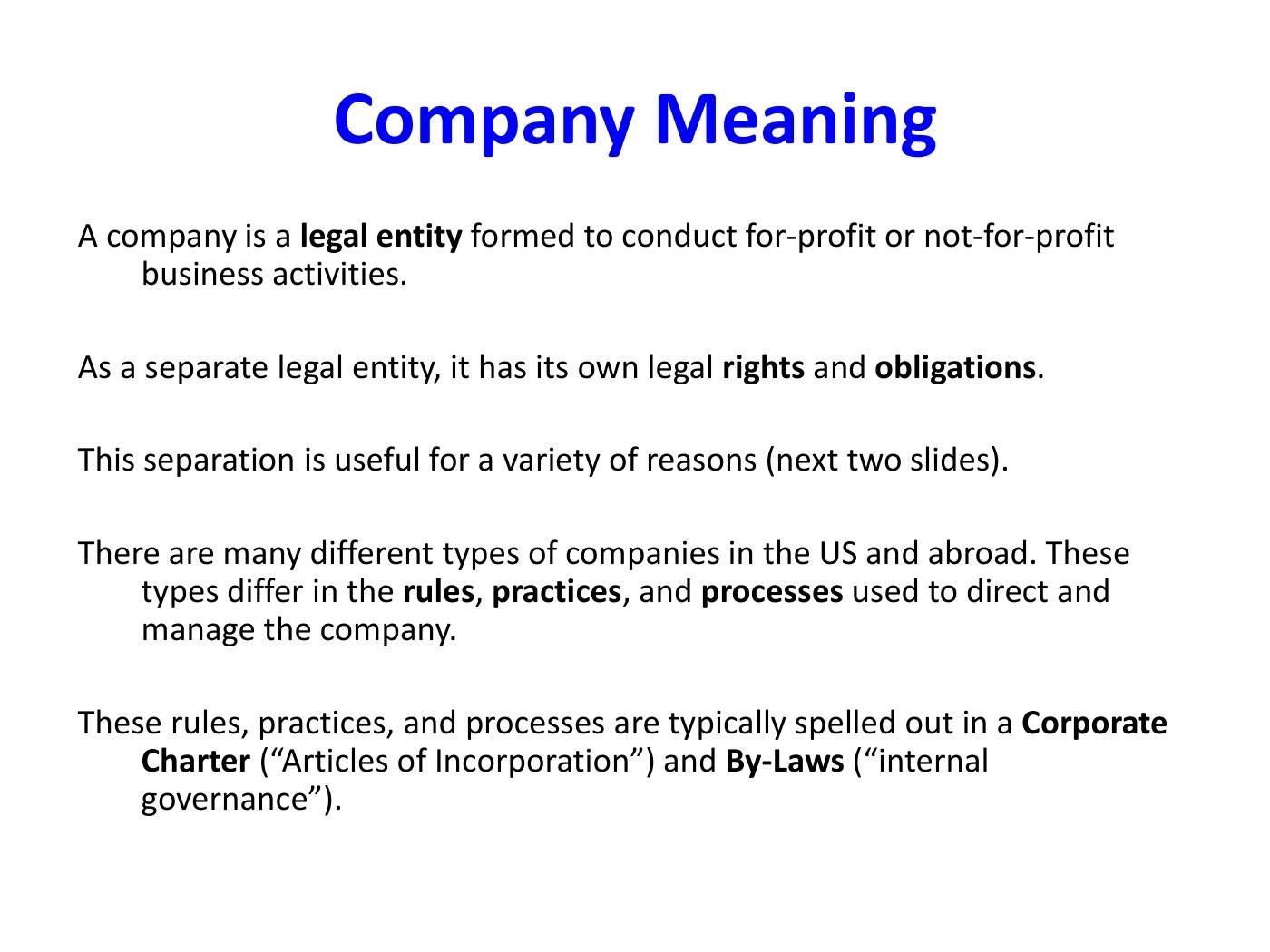
A company is a separate legal person with its own rulebookDefines a company as a legal entity, formed for profit or not for profit, with its own rights and obligations. Company types differ in the rules, practices and processes used to direct them, which are set out in the charter (certificate or articles of incorporation) and the bylaws. The separation is the point: the entity, not Maya or Daniel, signs clinic contracts and BAAs, owns the code and issues shares. The charter fixes authorized shares and share classes; the bylaws set how directors are elected and how meetings and approvals work. Every later financing amends one or both.Reiss - Founder & Equity Slides · PDF page 4 · in the slides
2
Section divider: what triggers forming a companyTitle-only prompt asking when an idea should become a company. Divider only.Reiss - Founder & Equity Slides · PDF page 5
3
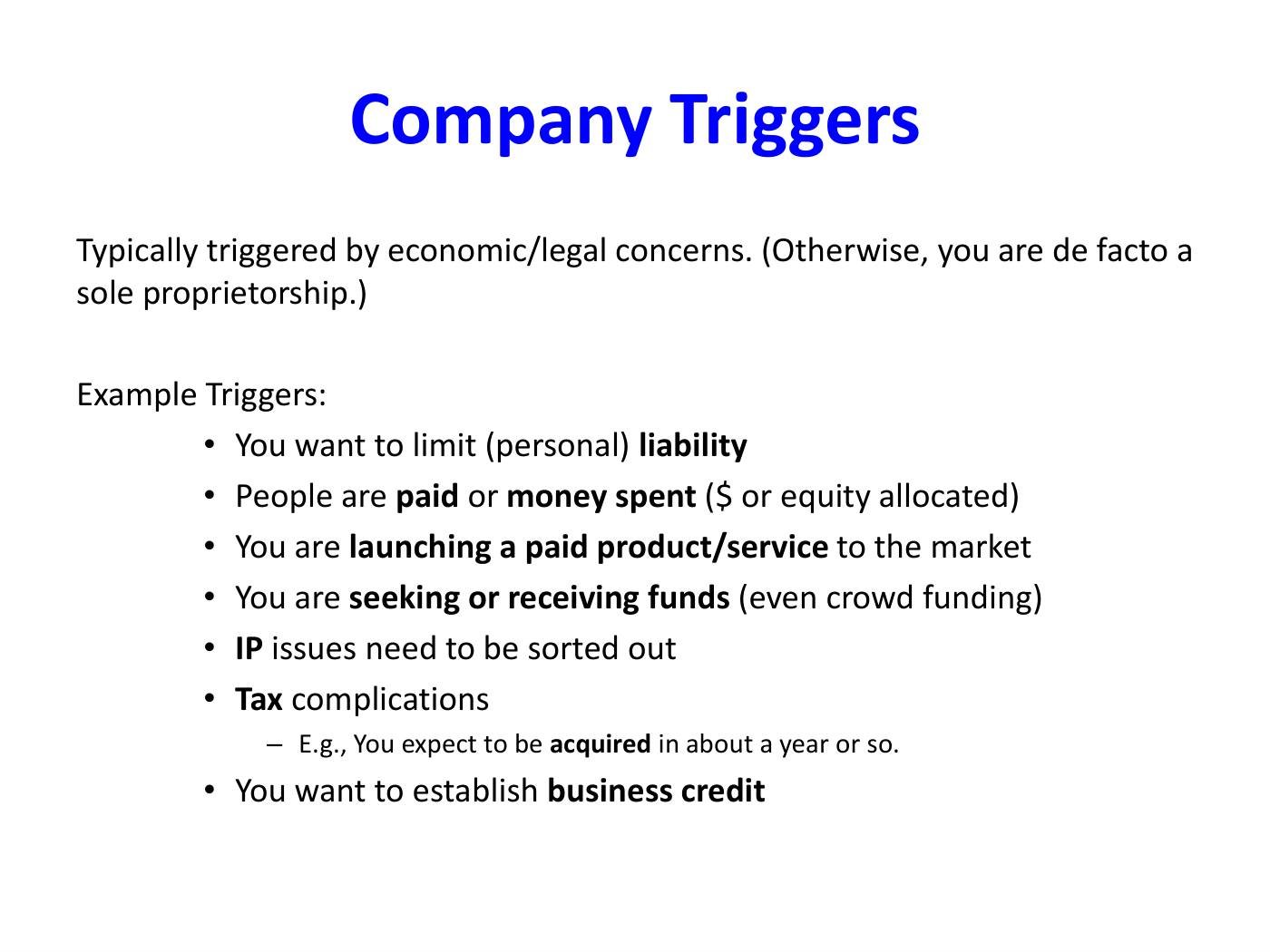
Triggers for incorporatingFormation is usually triggered by economic or legal concerns; until then founders are by default operating as a sole proprietorship (or, with two or more owners, a general partnership). Triggers include limiting personal liability, paying people or allocating equity, launching a paid product, raising money (even crowdfunding), sorting out IP, tax planning such as an expected acquisition, and building business credit. Relay crossed several triggers at once: the pre-seed SAFE in month 2, founder equity, and paid pilots handling patient data, which raises liability and makes a BAA counterparty necessary. Two founders working together without an entity may be treated as a general partnership, with personal liability. That is a reason not to delay.Reiss - Founder & Equity Slides · PDF page 6 · in the slides
4
Section divider: reasons not to form, or to delayTitle-only prompt about reasons to delay formation. Divider; the impediments slide follows.Reiss - Founder & Equity Slides · PDF page 7
5
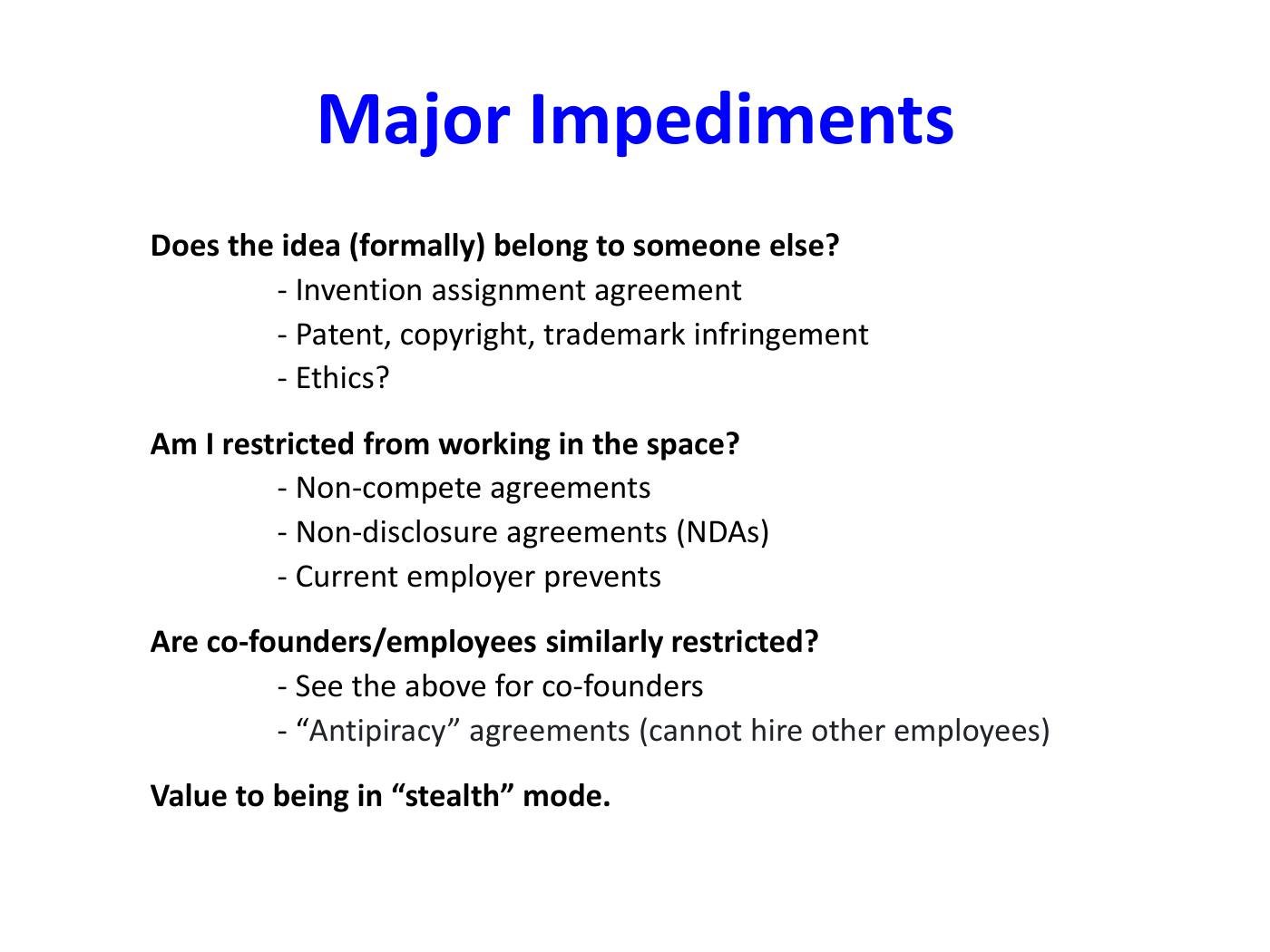
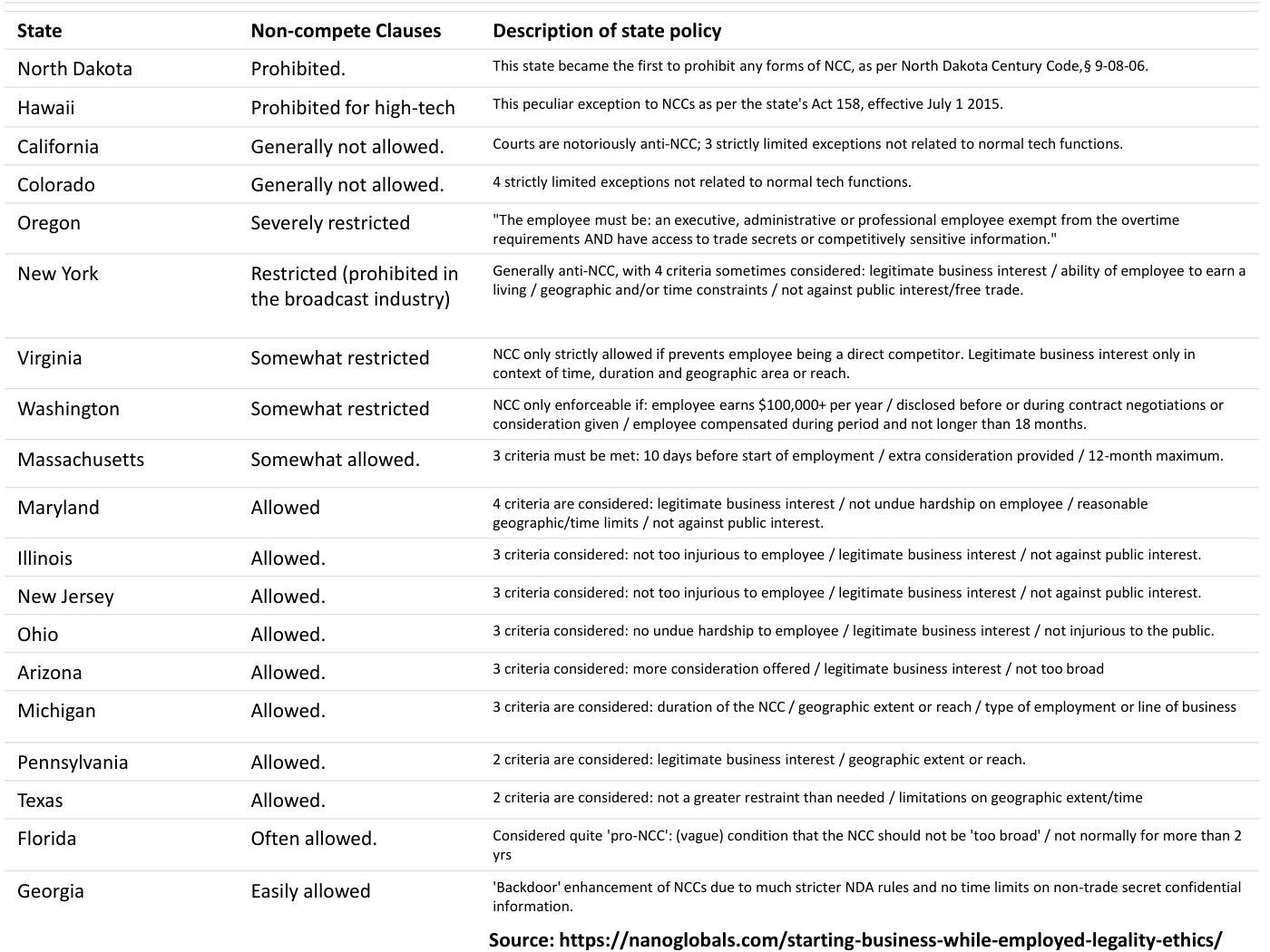
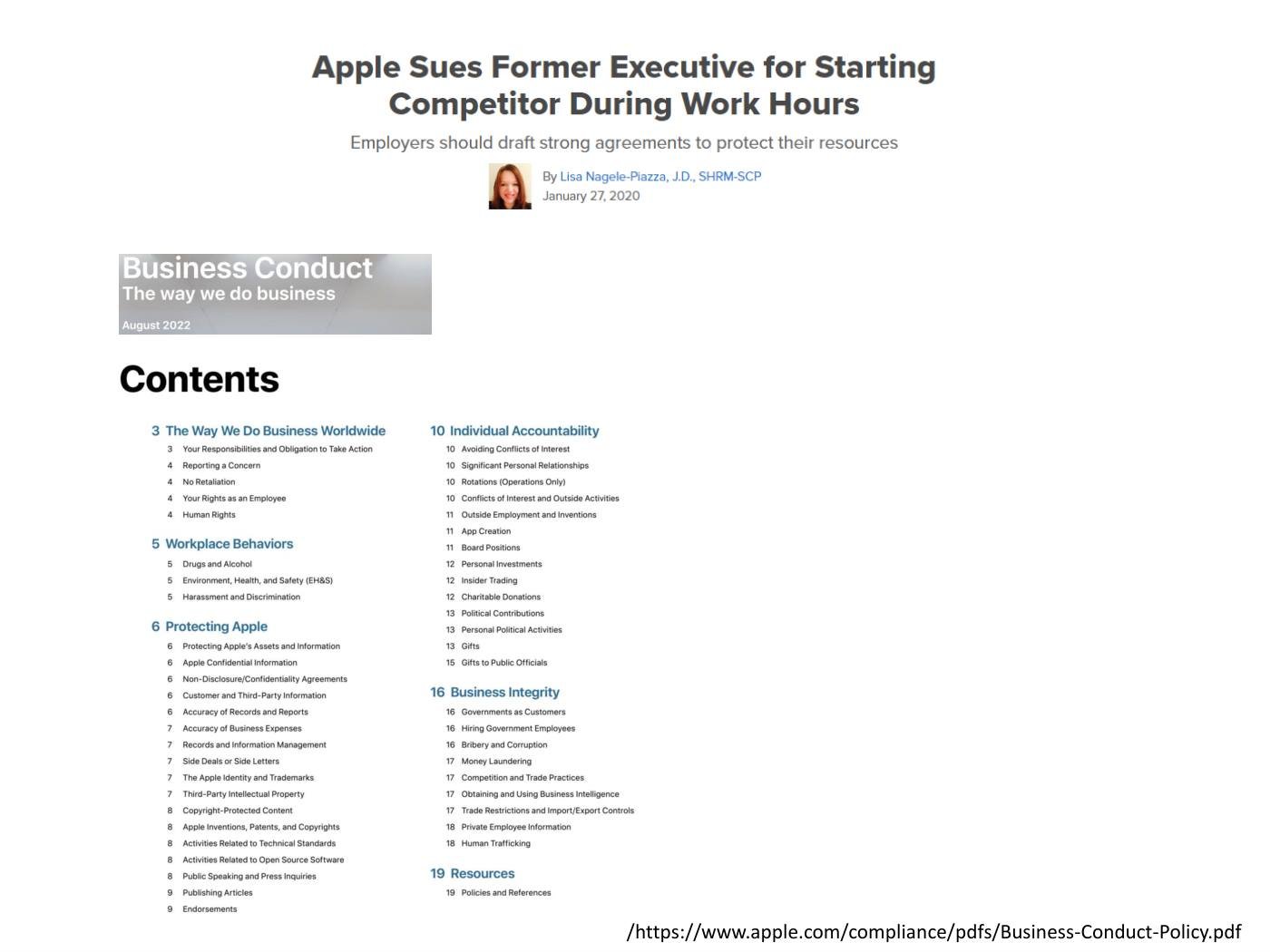
Impediments: does the idea already belong to someone else?A checklist of obstacles: an invention assignment agreement with a current or former employer, infringement of others' IP, non-compete and non-disclosure agreements, an employer that bars the work, co-founders with the same restrictions, and non-solicitation ('antipiracy') clauses that bar hiring former colleagues. It also notes the value of staying in stealth. This is Relay's diligence list. Daniel built SMS and scheduling systems at a health-tech company: his invention assignment and confidentiality terms decide whether any Relay code or design overlaps. Maya's former PT group may have non-solicit terms covering its clinics and staff. Enforceability of non-competes varies by state and changes; counsel must check current law and the actual agreements.Reiss - Founder & Equity Slides · PDF page 8 · in the slides
6
Section divider: how to start in practicePrompt asking students to describe a formation process and key considerations. Prompt only.Reiss - Founder & Equity Slides · PDF page 11
7
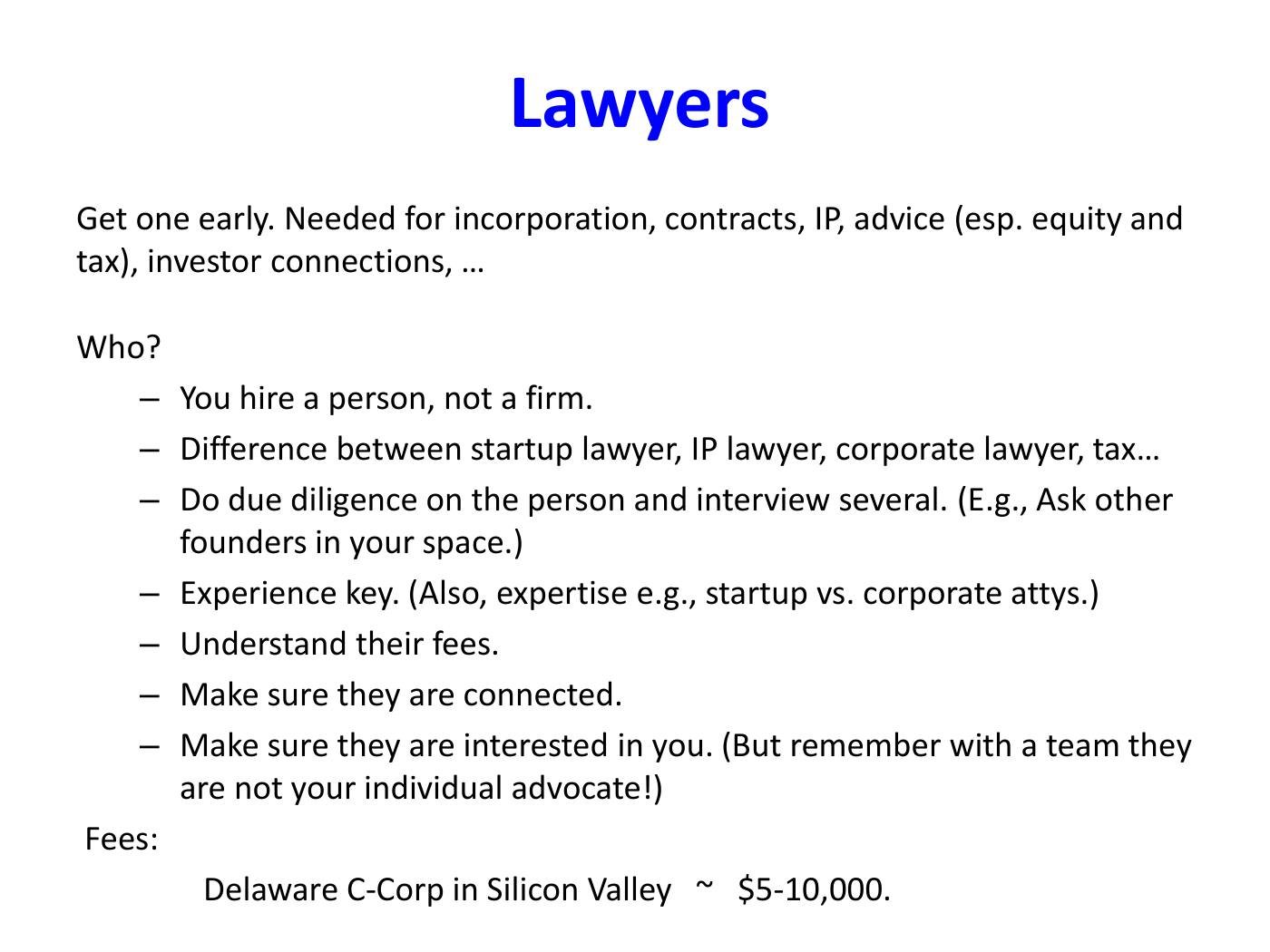
Choosing a startup lawyerAdvice to hire counsel early for incorporation, contracts, IP, equity and tax advice and investor introductions. Hire a person rather than a firm, distinguish startup, IP, corporate and tax specialists, interview several and check references with other founders, understand fees, and remember that company counsel represents the company, not any one founder. It cites about $5,000-10,000 for a Delaware C-corp formation in Silicon Valley. The point that company counsel is not each founder's advocate matters when Maya and Daniel negotiate 52/48 and vesting; either may want independent advice. The fee figure is historical; current fees vary widely, and many firms defer fees or use fixed packages.Reiss - Founder & Equity Slides · PDF page 12 · in the slides
8
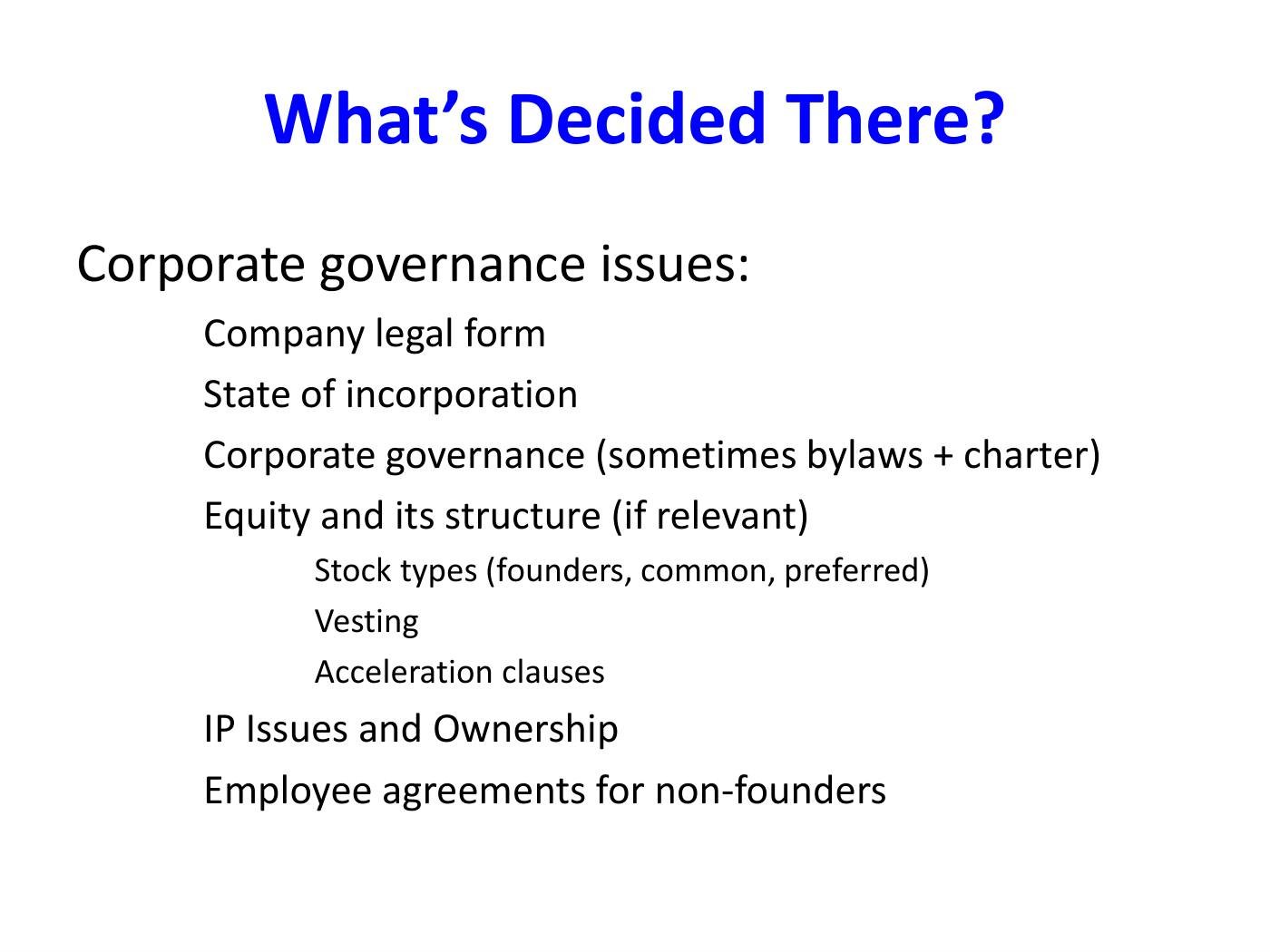
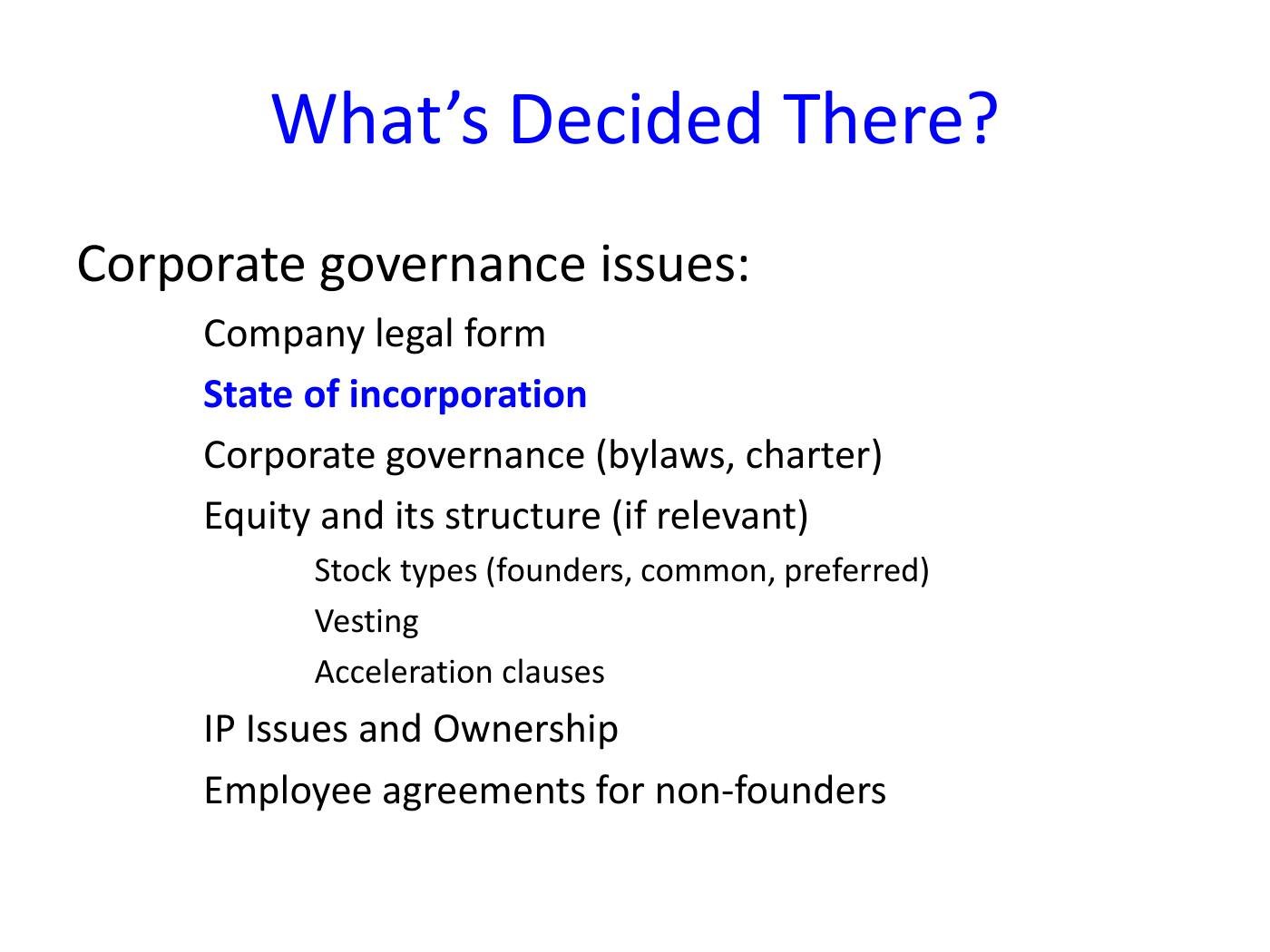
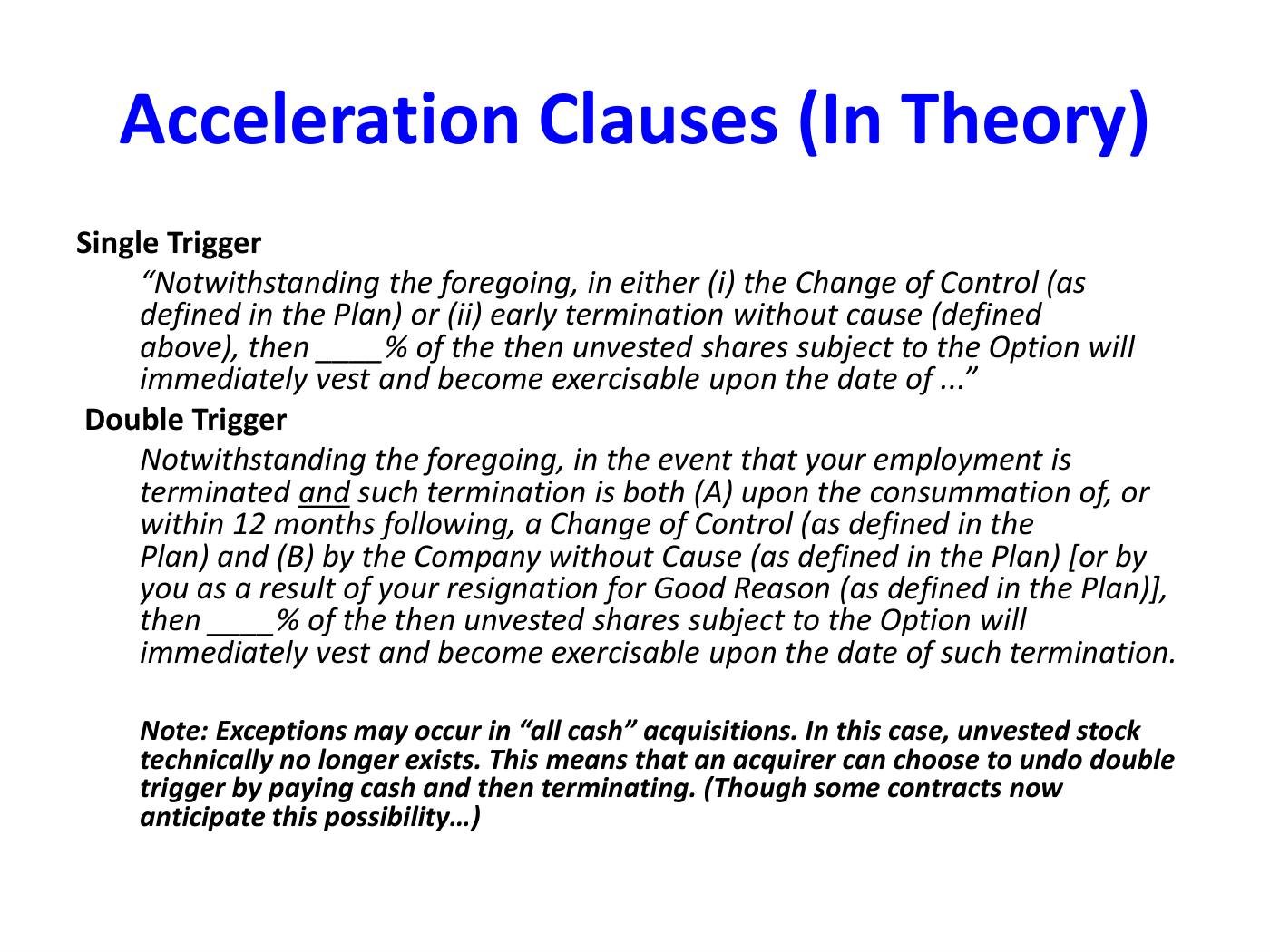
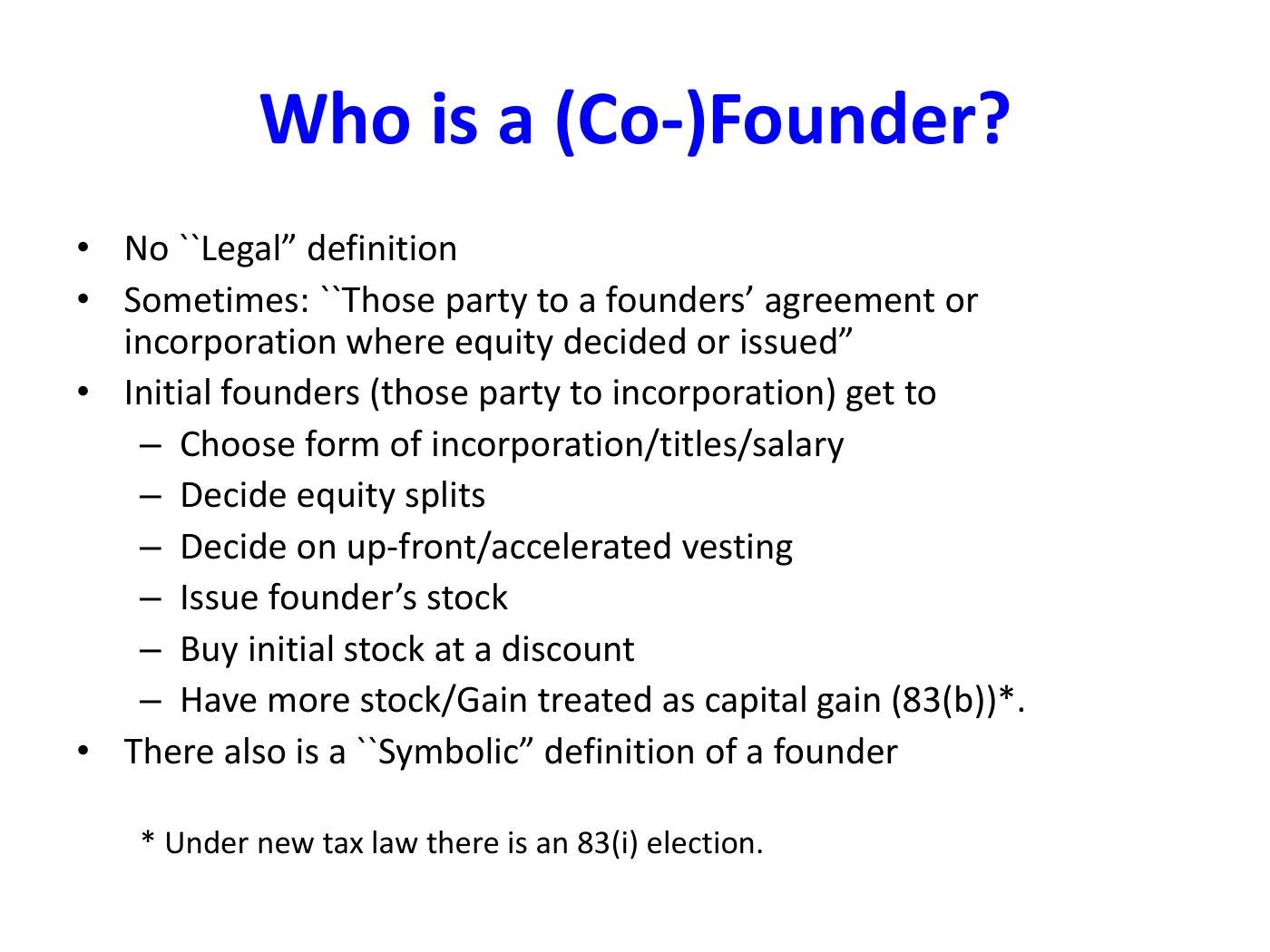
What is decided at formationThe governance agenda at incorporation: legal form, state of incorporation, charter and bylaws, equity structure (founder, common and preferred stock, vesting, acceleration), IP ownership, and agreements for non-founder employees. Use it as a checklist for Relay's formation brief. Each item connects to another lesson: vesting and acceleration (L24), IP assignment (L26), preferred stock (L30-L32).Reiss - Founder & Equity Slides · PDF page 13 · in the slides
9
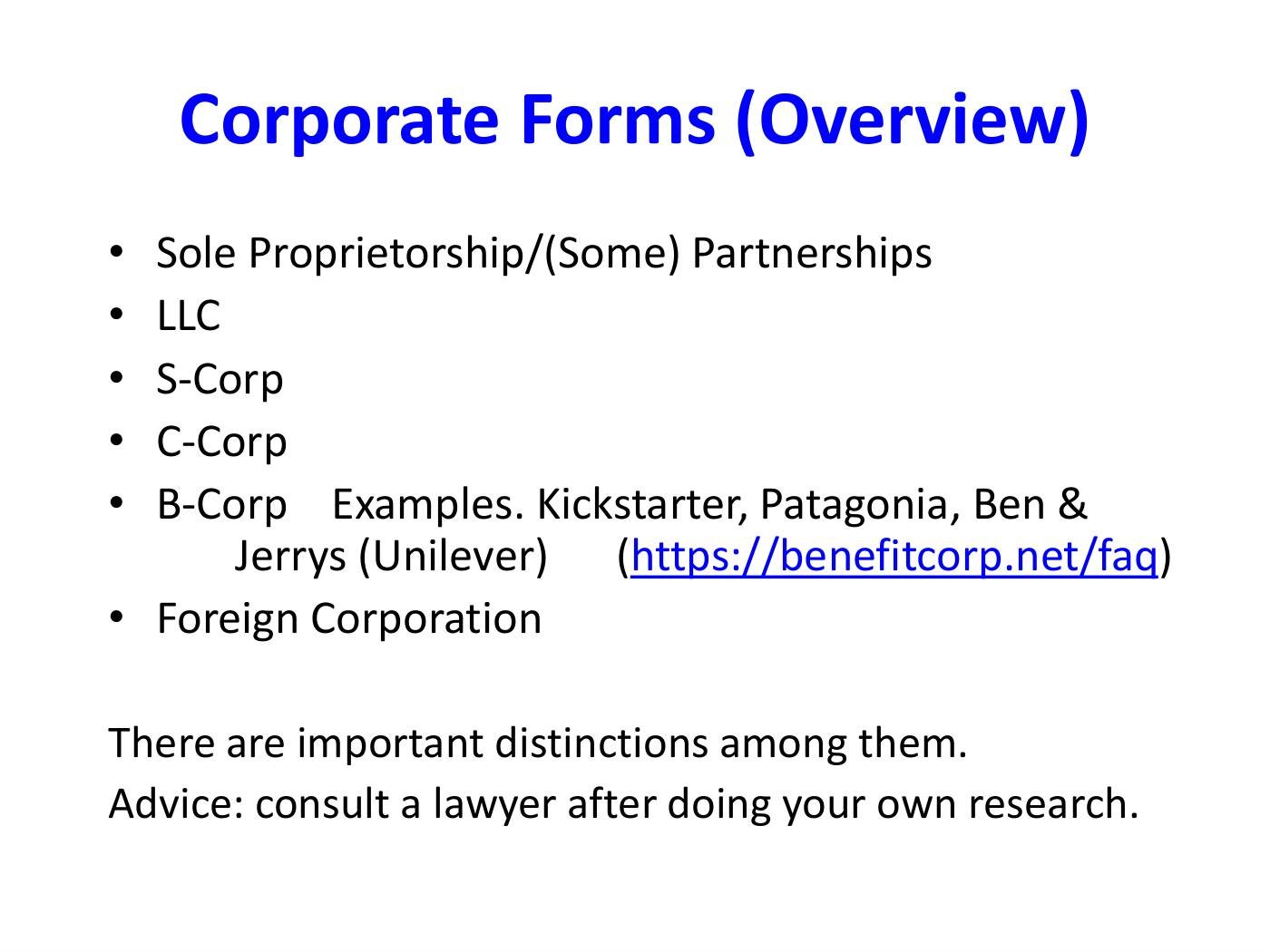
Overview of entity formsLists sole proprietorship, partnerships, LLC, S-corp, C-corp, benefit corporation (citing Kickstarter, Patagonia and Ben & Jerry's) and foreign corporation, and advises research followed by legal advice. A list without analysis; the comparison tables carry the substance. 'B-Corp' certification is a private standard, distinct from the benefit corporation legal form.Reiss - Founder & Equity Slides · PDF page 14
10
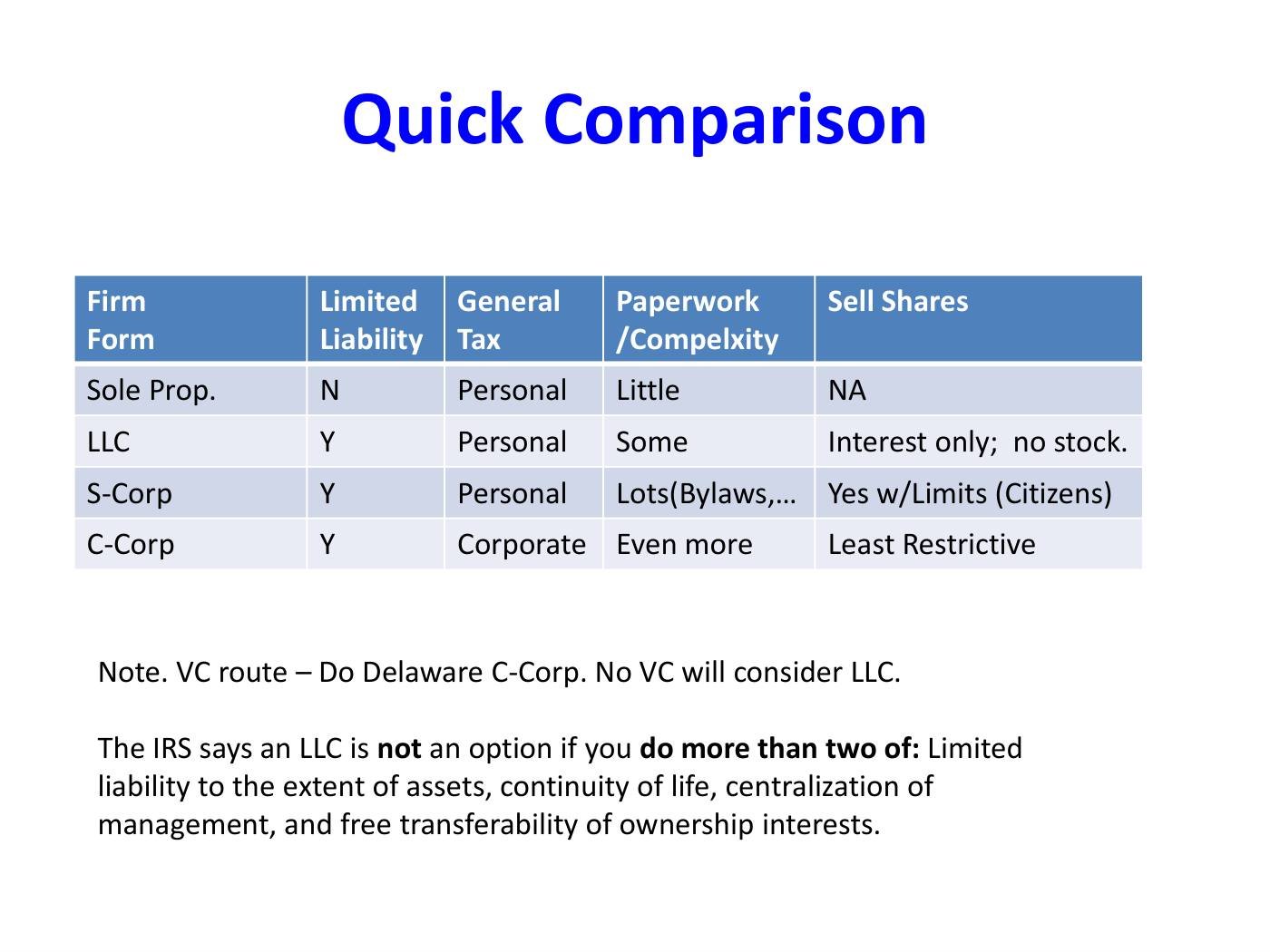
Quick comparison of entity formsA table comparing sole proprietorship, LLC, S-corp and C-corp on limited liability, tax, paperwork and share sale. A note says VC-backed companies should be Delaware C-corps and no VC will consider an LLC. It also states the IRS rule that an LLC is not available if more than two of four corporate characteristics apply. The direction is right for Relay: venture funds generally prefer C-corps because of preferred stock, option plans, QSBS and fund-investor tax issues. 'No VC will consider an LLC' overstates it. The IRS four-characteristic test is obsolete: since the 1997 check-the-box regulations, a domestic LLC defaults to partnership (or disregarded) treatment and can elect to be taxed as a corporation.Reiss - Founder & Equity Slides · PDF page 15 · in the slides
11
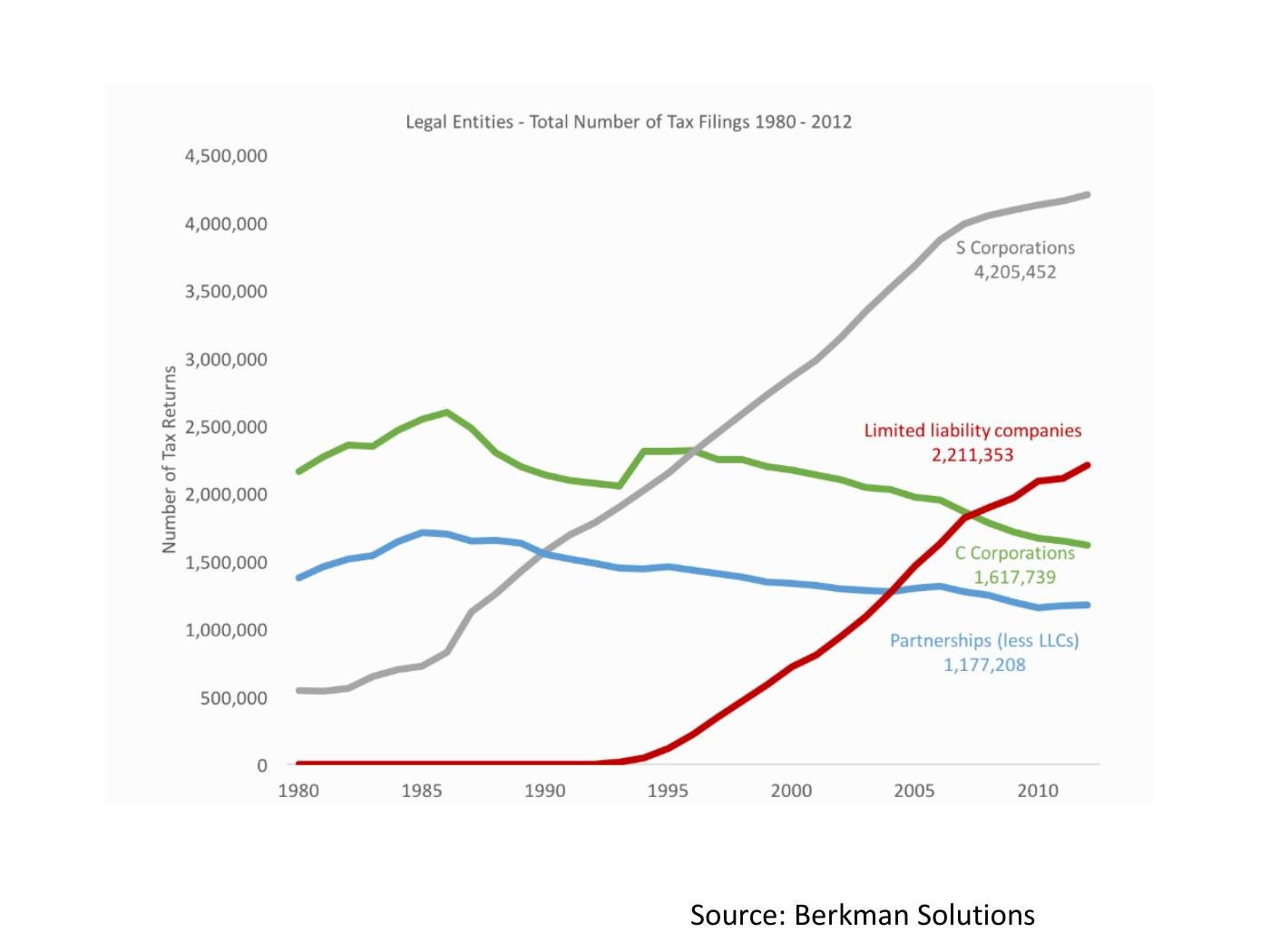
Entity tax filings, 1980-2012A line chart of tax filings by entity type: S corporations grew to about 4.2 million and LLCs to about 2.2 million, while C corporations fell to about 1.6 million by 2012. Most small businesses choose pass-through forms; venture-backed startups are the exception that chooses the C-corp.Reiss - Founder & Equity Slides · PDF page 16
12
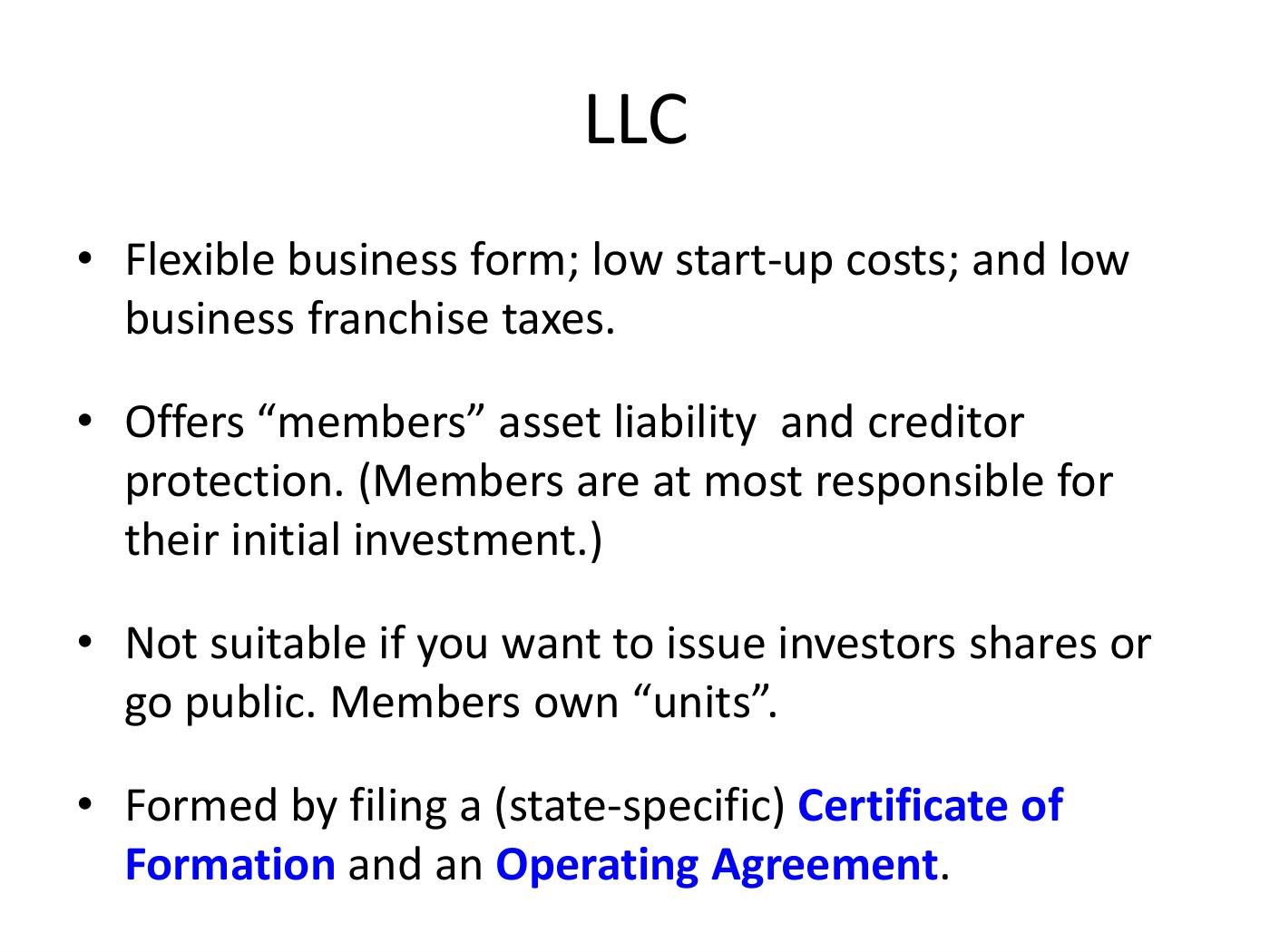
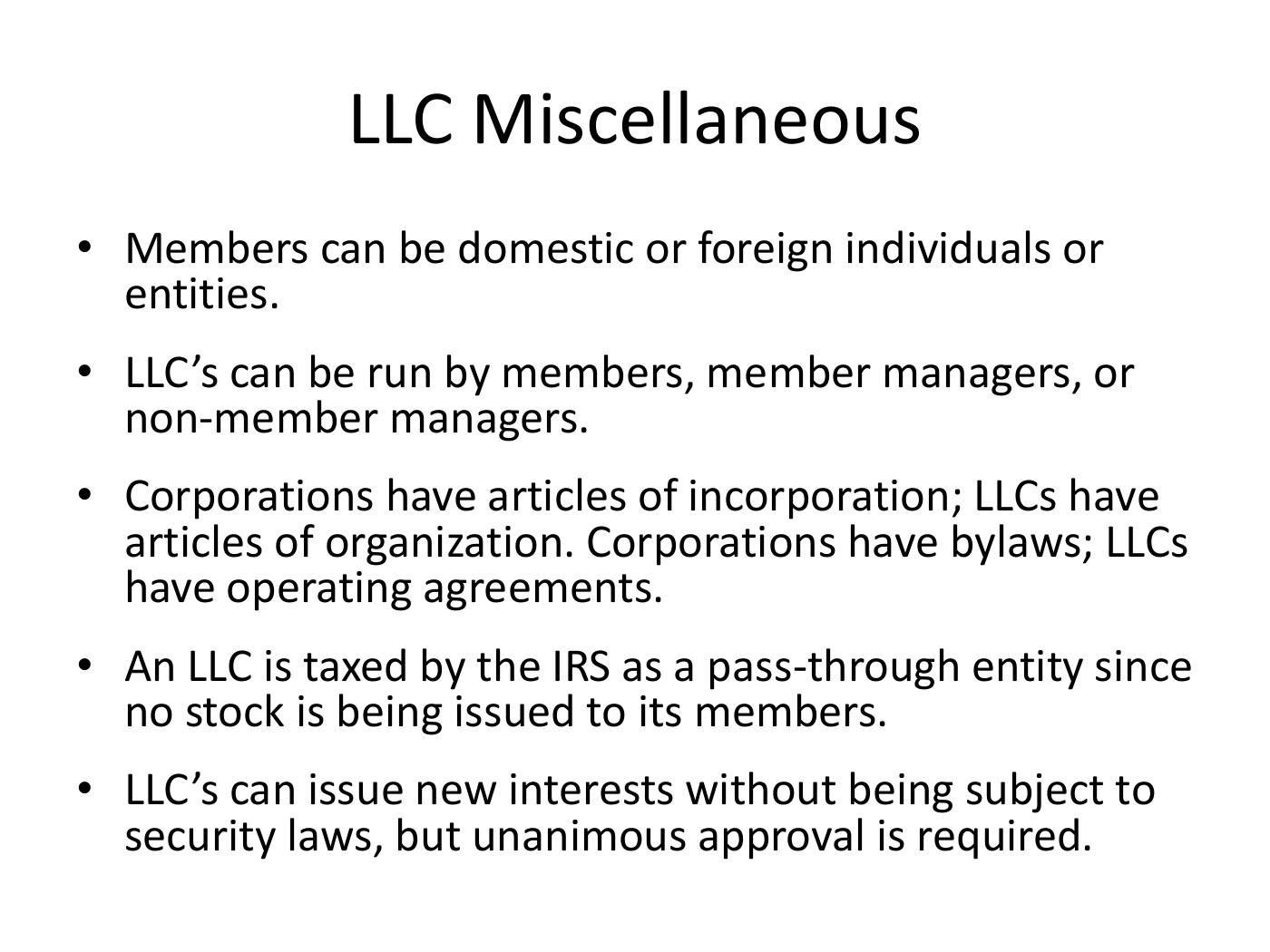
The LLC: flexible, cheap, and a poor fit for venture equityLLCs are flexible, inexpensive to form and run, and protect members from liability beyond their investment. Members hold units rather than shares, which the slide says makes LLCs unsuitable for issuing investor shares or going public. An LLC is formed by filing a certificate of formation and adopting an operating agreement. An LLC suits a cash-flowing services firm or a holding vehicle. For Relay, pass-through losses would flow to the founders, but investors would face partnership tax issues, standard option plans and preferred stock templates would not fit, and QSBS would be unavailable, since it applies only to C-corporation stock. Converting later is possible but costs time and money.Reiss - Founder & Equity Slides · PDF page 17 · in the slides
13
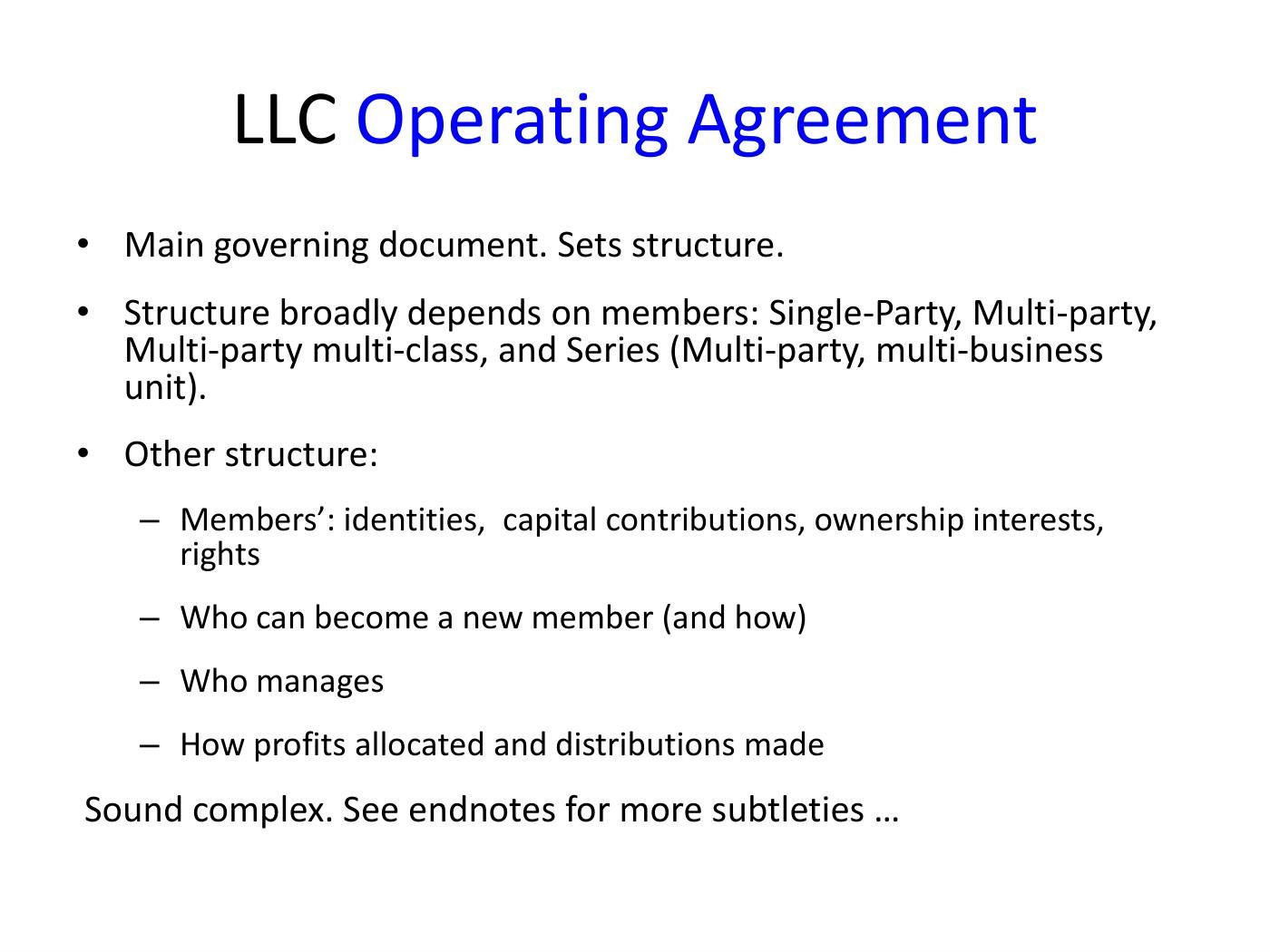
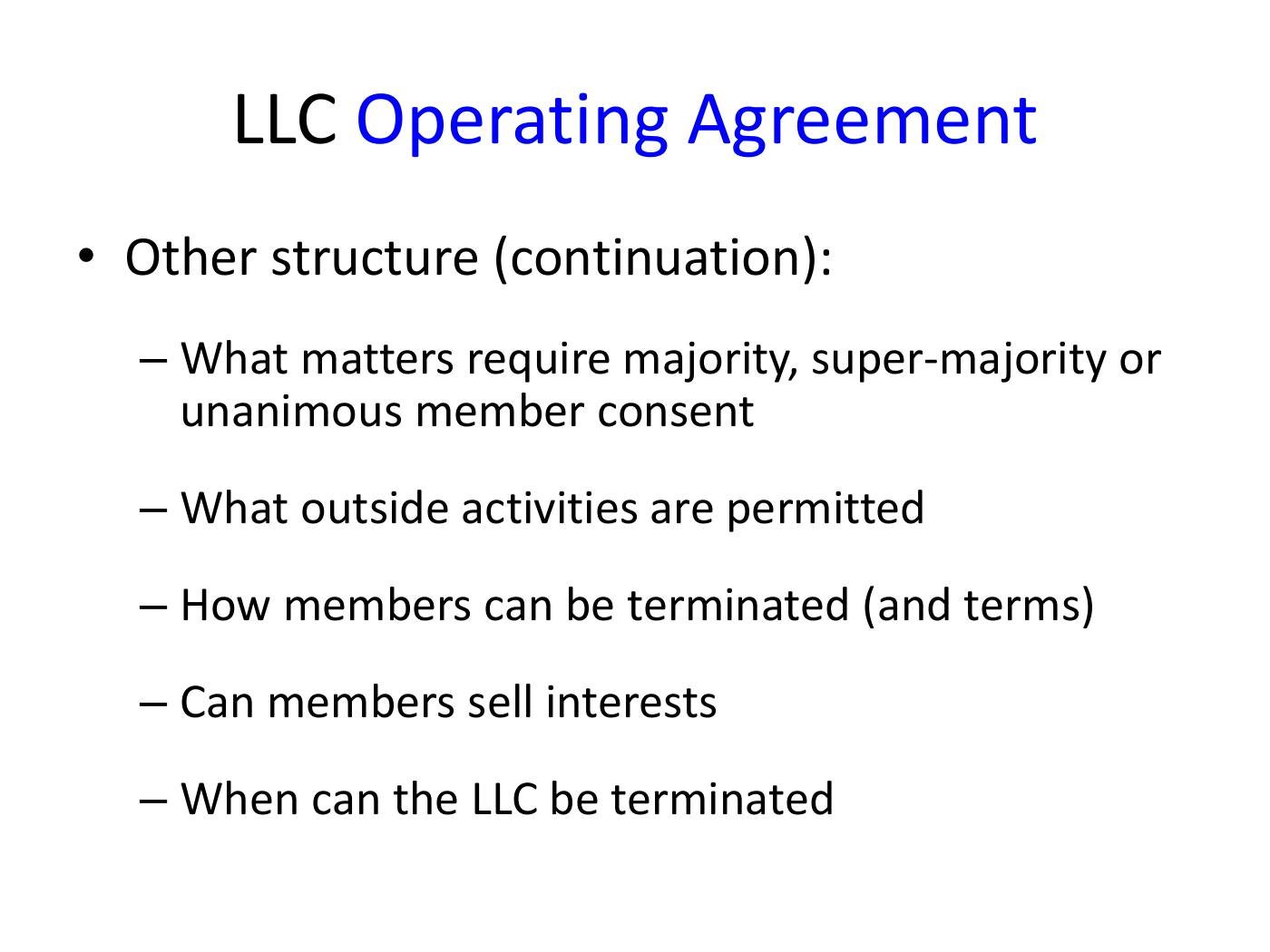
What the LLC operating agreement coversThe operating agreement sets members' identities, contributions, interests and rights, admission of new members, management, and allocation of profits and distributions, and varies for single-member, multi-member, multi-class and series LLCs. The LLC counterpart to a corporation's charter, bylaws and stockholder agreements.Reiss - Founder & Equity Slides · PDF page 18
14
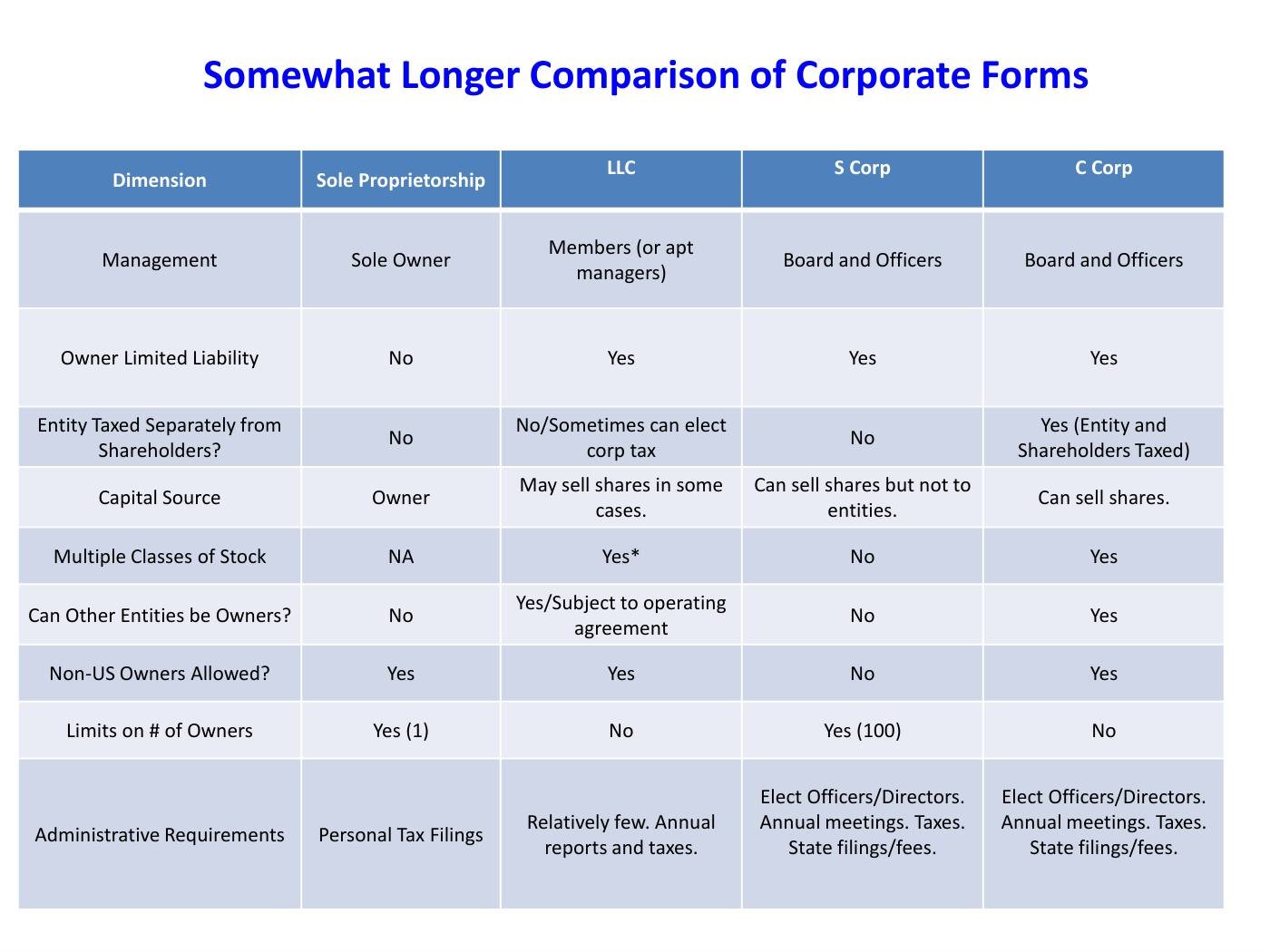
Detailed comparison: sole proprietorship, LLC, S-corp, C-corpA table across management, limited liability, separate taxation, capital sources, multiple stock classes, entity owners, non-US owners, owner limits and administration. S-corps are capped at 100 shareholders, allow one class of stock, and bar entity and non-US owners; C-corps allow all of these, but both the entity and shareholders are taxed. The S-corp rows rule it out for Relay: a venture fund (an entity) cannot hold S-corp stock, and preferred stock would be a second class. The 'double tax' on C-corps matters less for a loss-making startup that reinvests and plans an exit. Rules change; confirm the current position.Reiss - Founder & Equity Slides · PDF page 20 · in the slides
15
What is decided at formation (state of incorporation highlighted)Repeats slide 17 with 'State of incorporation' highlighted to introduce the Delaware discussion. Near-duplicate of slide 17.Reiss - Founder & Equity Slides · PDF page 21
16
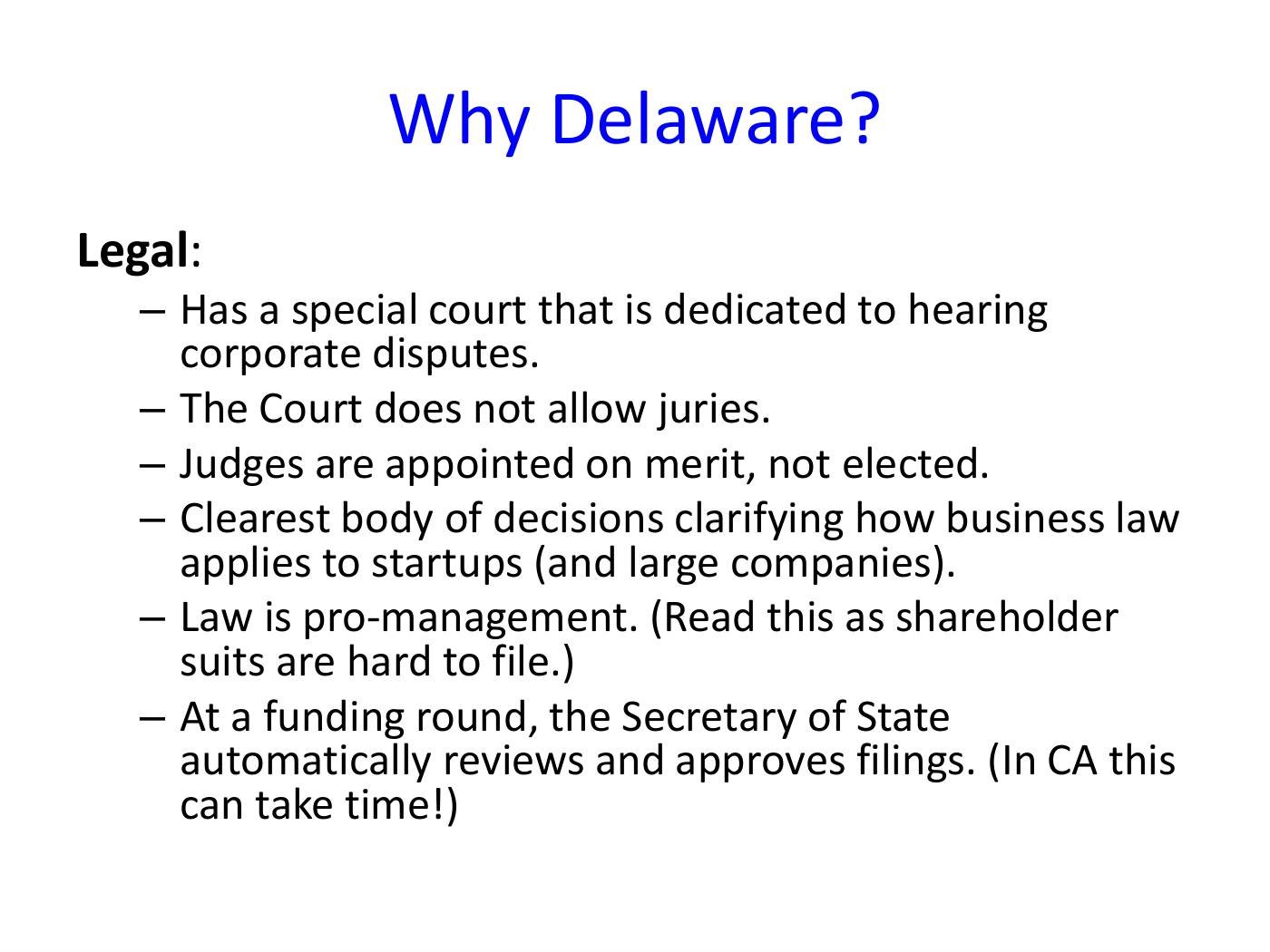
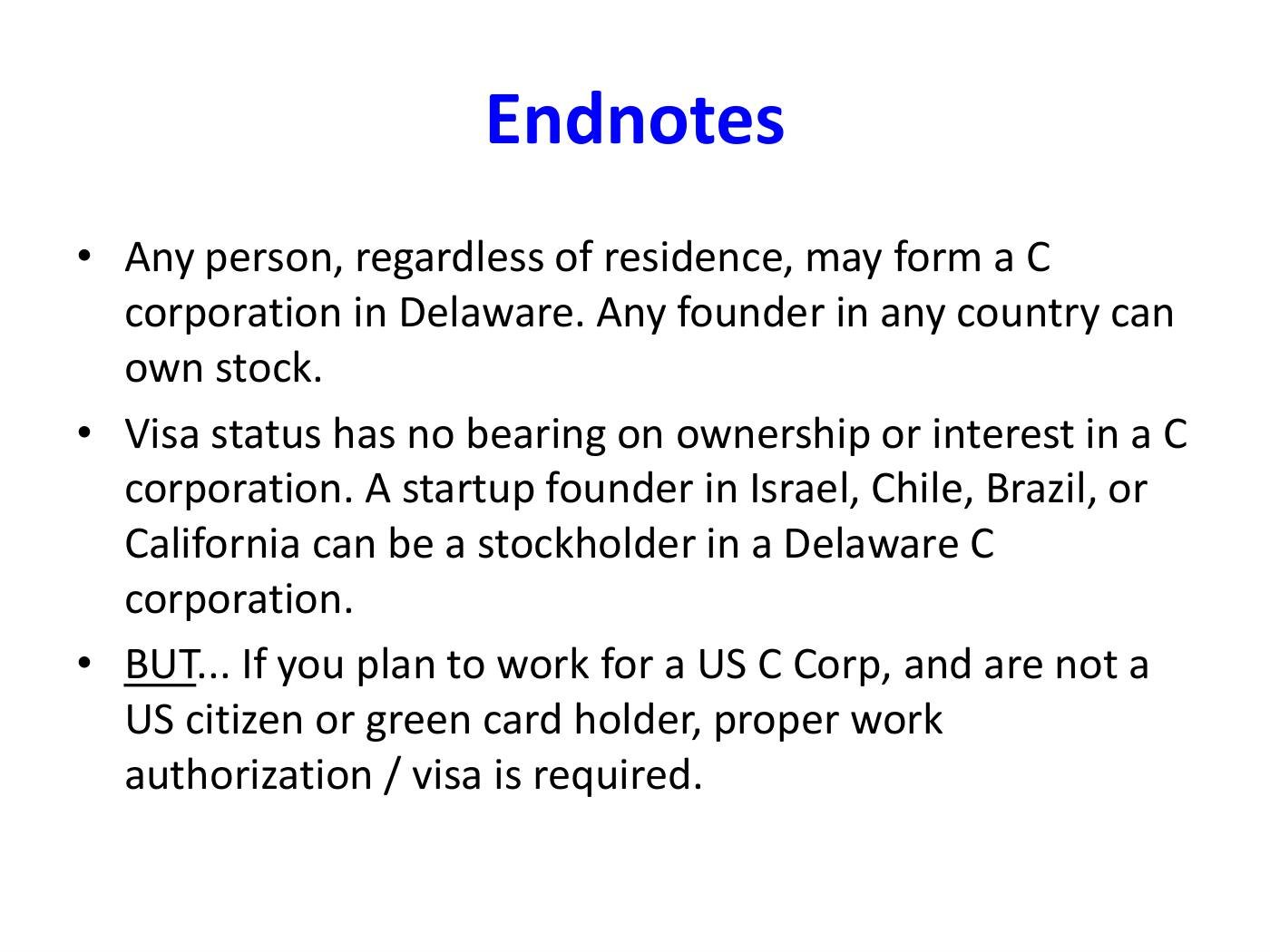
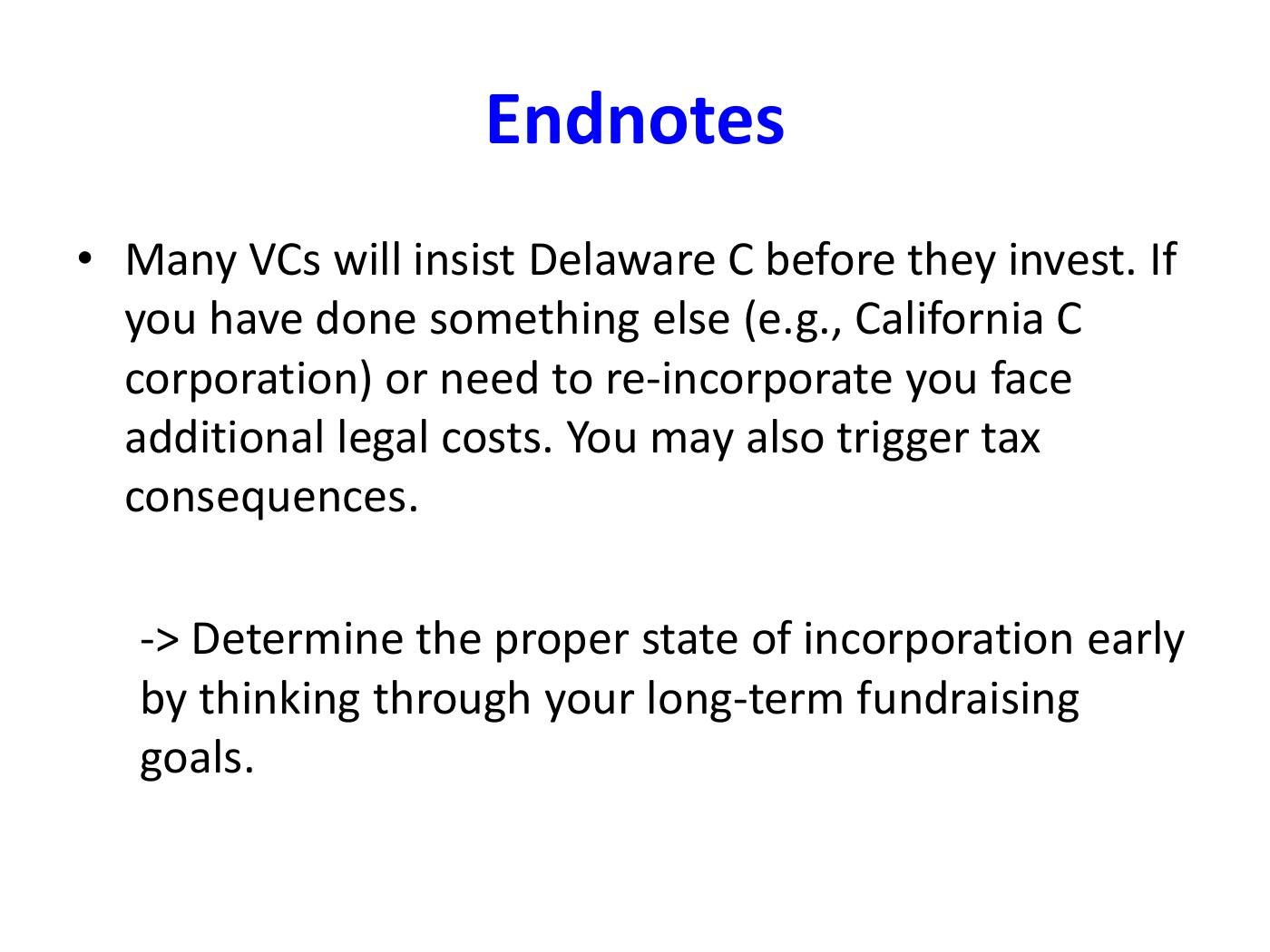
Why Delaware: the legal reasonsThe Court of Chancery specializes in corporate disputes, sits without juries, and its judges are appointed rather than elected. Delaware has the deepest body of case law on how corporate law applies to startups and large companies. The slide calls the law pro-management, making shareholder suits harder, and notes that filings at a financing are processed quickly. Investors and lawyers value predictability: standard financing documents are written for Delaware, which lowers legal cost for Relay's seed and Series A. Delaware amended its corporation law in March 2025 (SB 21) after some companies moved to Nevada or Texas; the choice is still the default for venture-backed startups, but it is not static.Reiss - Founder & Equity Slides · PDF page 22 · in the slides
17
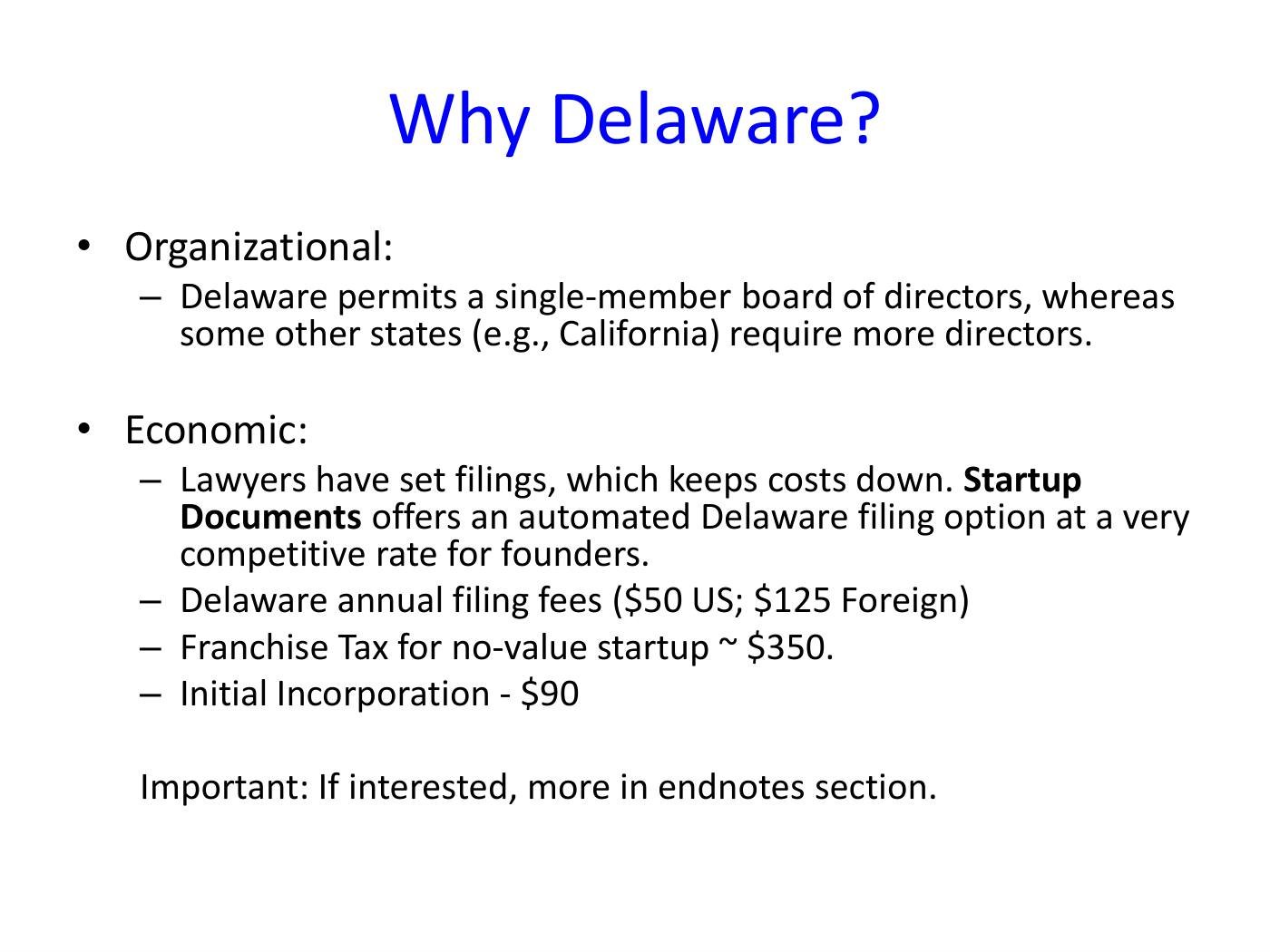
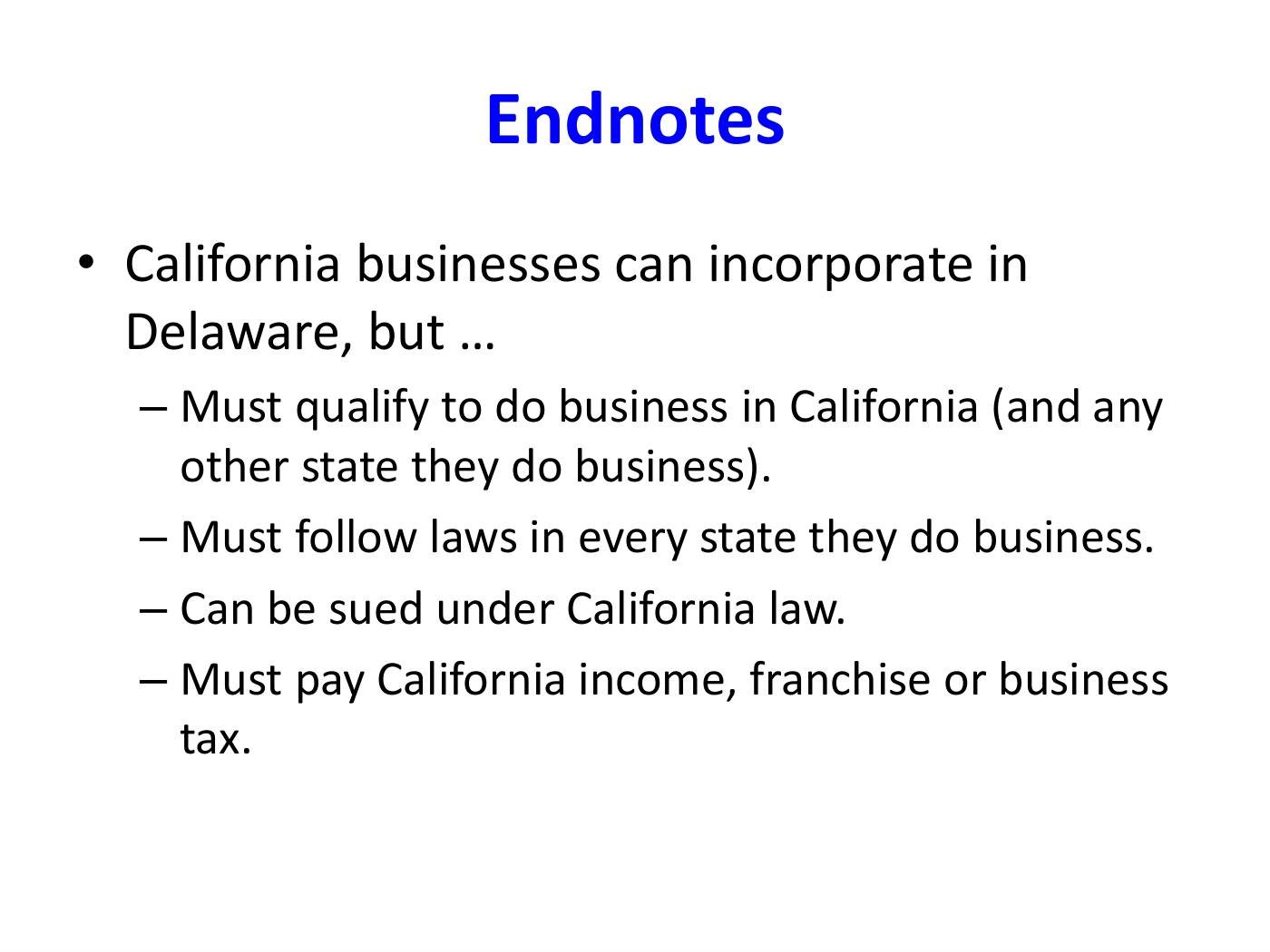
Why Delaware: organizational and cost reasonsDelaware permits a one-person board, whereas some states such as California have required more directors. The slide lists low-cost automated filings, an annual filing fee ($50 domestic, $125 foreign), a franchise tax of about $350 for a startup with no value, and $90 to incorporate. Several figures are dated. Delaware's current minimum franchise tax is $175 under the authorized shares method and $400 under the assumed par value capital method, plus the $50 annual report fee, due March 1. A startup with millions of authorized shares gets a very large bill under the default authorized shares method and must recalculate under the assumed par value capital method. Relay, operating in Austin, must also register in Texas as a foreign corporation.Reiss - Founder & Equity Slides · PDF page 23 · in the slides