IP rights & strategic protection choicesModule 05 · Founders, governance & business assets
IGNITE EXTENDED / LESSON 26
IP rights & strategic protection choices
Which rights support the company’s strategy?
An IP protection analysis tied to the business model.
1
26 / OpeningIP rights & strategic protection choices
The decision and the learning goals
Distinguish protected subject matter across IP tools.
Compare patent and trade-secret trade-offs.
Prioritize rights questions by their effect on business decisions.
90-minute workshopOpening 5 minConcepts and original examples 35 minPractice 25 minDebrief 15 minReview 10 min
2
26 / TheoryIP rights & strategic protection choices
IP protects specified rights in an asset
A physical object, a copy of a work and the underlying intellectual-property rights are different things. Buying a device or commissioning a design does not by itself explain every right to reproduce, modify, disclose or license the underlying work.
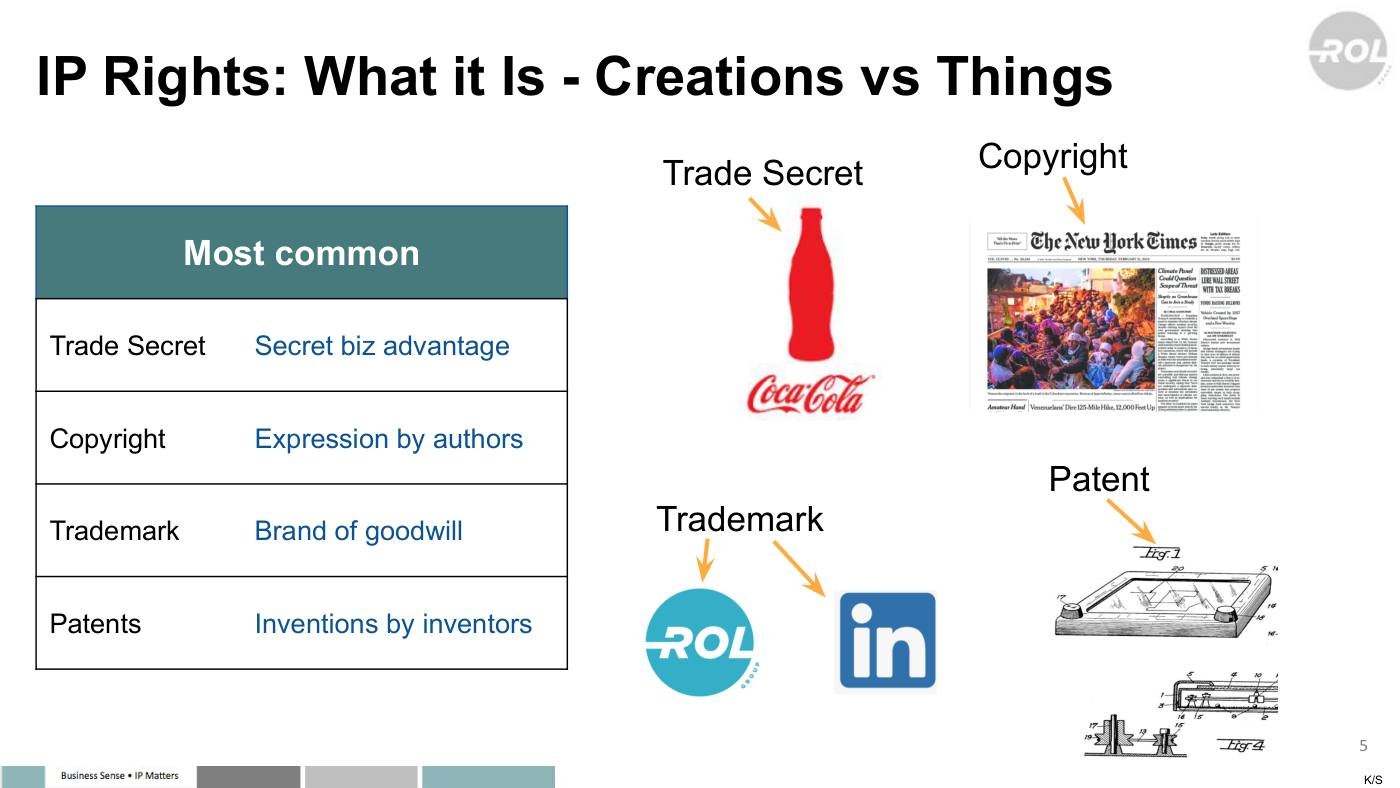
The IP material distinguishes patents, copyright, trademarks and trade secrets because they concern different subject matter and different methods of protection. An IP inventory should identify the actual asset before choosing a tool. Several tools can apply to different aspects of one product.
3
26 / TheoryIP rights & strategic protection choices
Patents and trade secrets involve different trade-offs
Patent protection involves a government-granted right defined by claims and the applicable jurisdiction. A trade secret relies on keeping valuable information confidential through appropriate measures. A published patent application and an undisclosed process therefore represent different strategies.
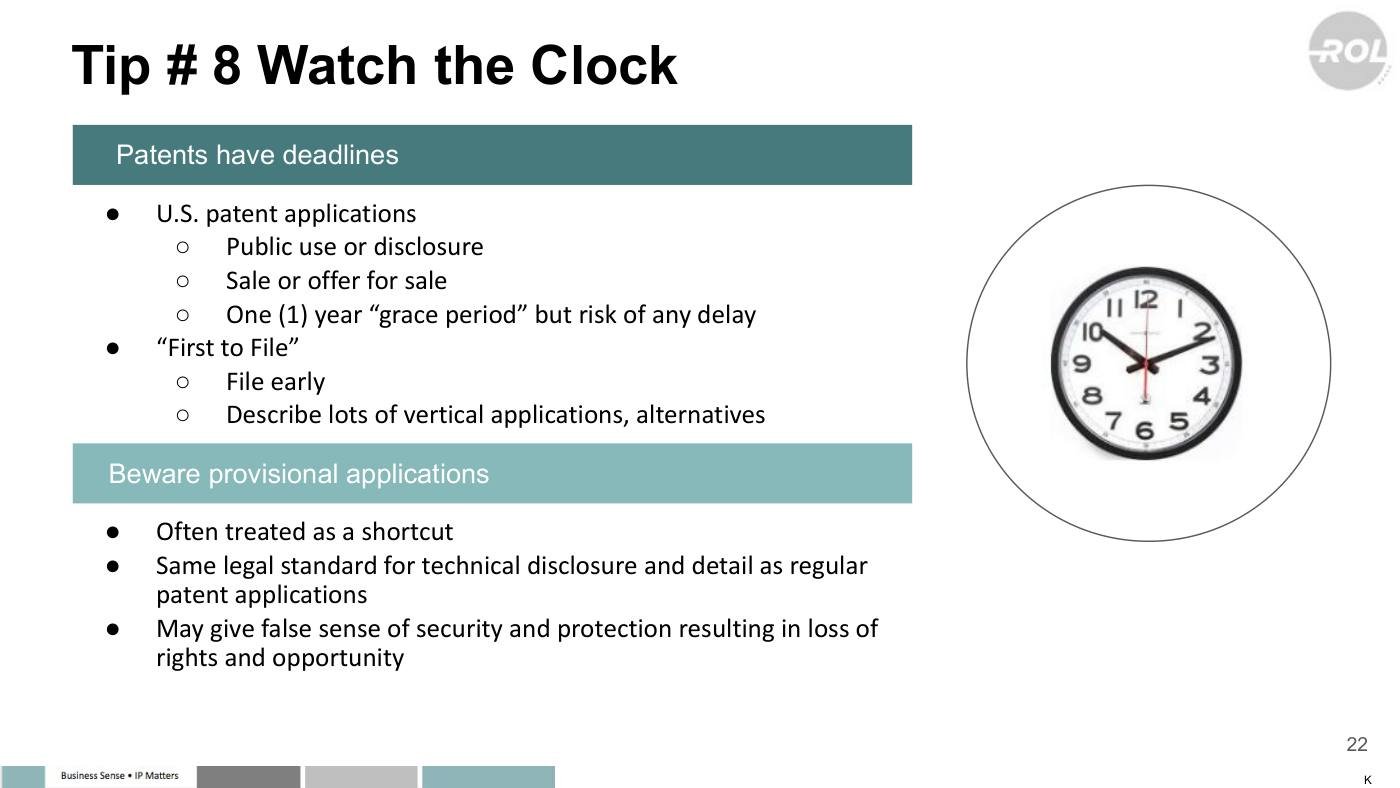
Consider what competitors can observe or reverse engineer, the expected useful life of the knowledge and the cost of pursuing and maintaining protection. Timing matters, but actual filing deadlines and disclosure consequences require current professional review. The historical slides explain the choice rather than supply a complete filing plan.
4
26 / TheoryIP rights & strategic protection choices
Different IP tools address different assets
Tool
Broad purpose
Question
Copyright
Protects qualifying expression.
Who owns the code, text or artwork?
Trademark
Identifies the source of goods or services.
Can this brand be used and distinguished?
Patent
Can protect qualifying inventions through defined rights.
What is claimed, where, and at what cost?
Trade secret
Protects valuable confidential information under relevant conditions.
How is secrecy maintained?
Conceptual overview; categories and scope depend on law and facts.
5
26 / TheoryIP rights & strategic protection choices
Owning a copy and owning rights
Possessing a file or paying for an object does not describe every permitted use of the underlying work. A business must connect its intended activity to the rights it actually holds.
A copy or a service
Receiving code, a file or a product does not by itself explain all IP rights.
Rights and permissions
Ownership and licenses determine which uses, modifications, distributions or transfers are permitted.
Worked application
Illustrative application: a team receives a contractor’s source files and pays the invoice. Before promising commercial distribution, inspect the agreement, pre-existing components and third-party licenses. The ability to open and modify a local copy does not by itself explain who may license it to customers.
Trace each contribution to the permission required for the planned customer promise.
6
26 / Source pageIP rights & strategic protection choices
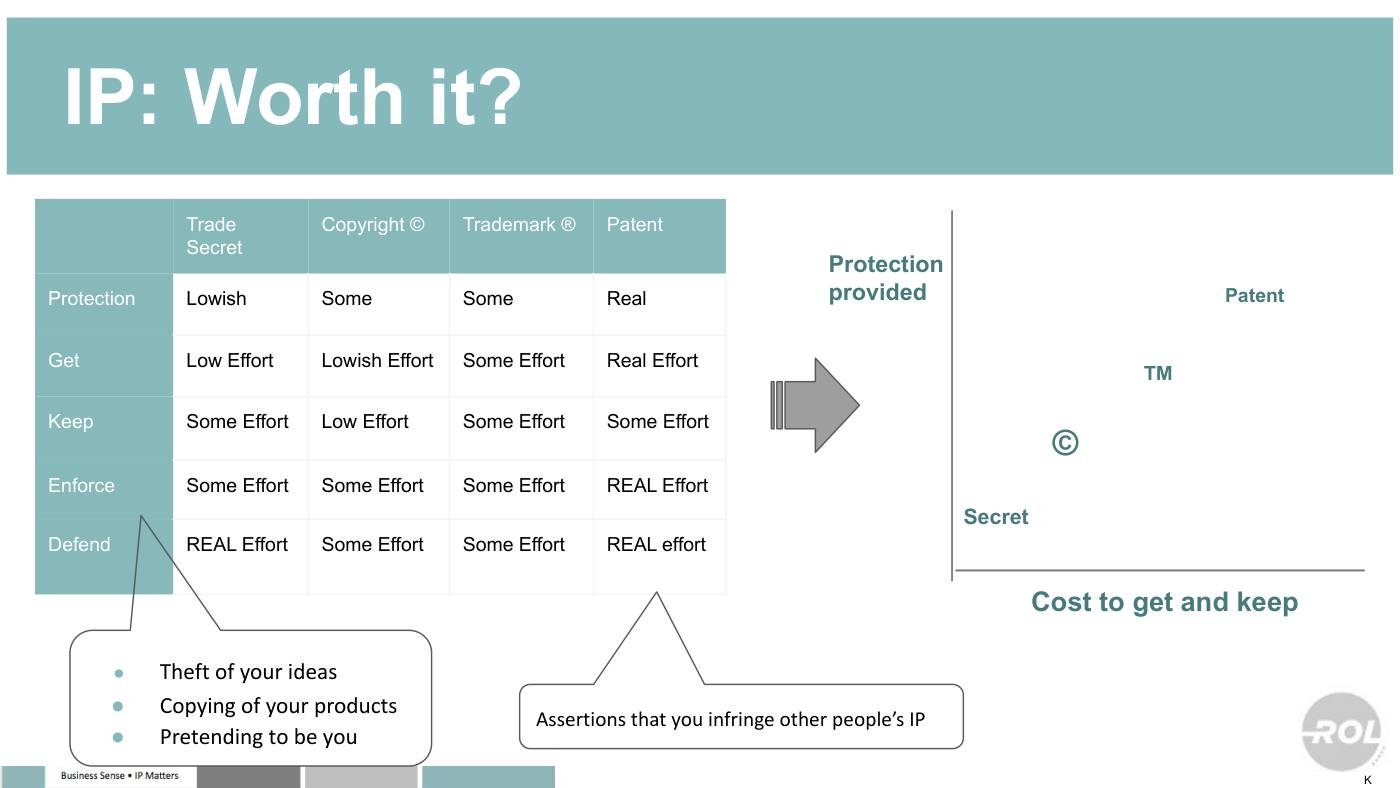
Is IP worth it? Protection versus the cost to get, keep, enforce and defend
7
26 / Source pageIP rights & strategic protection choices
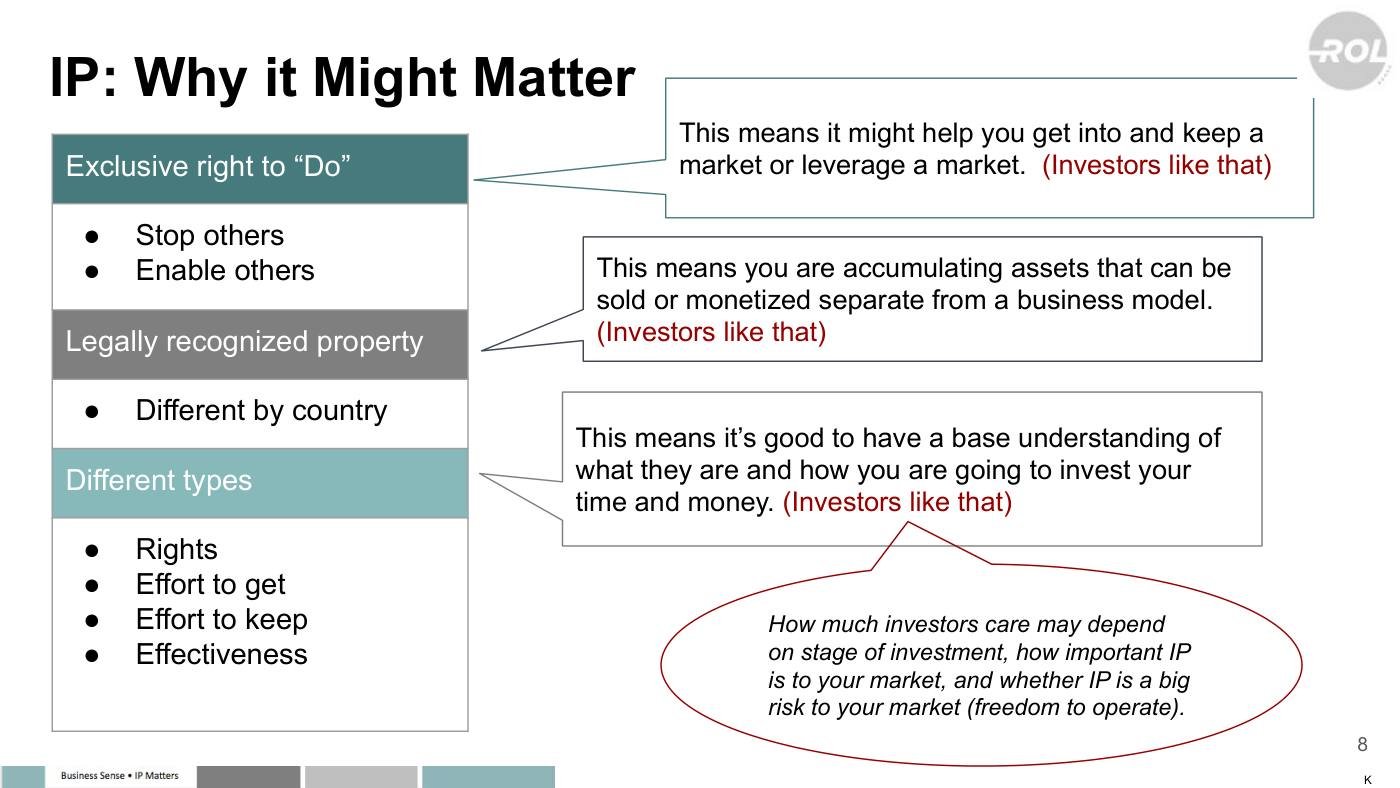
Why IP might matter: exclusivity, property and investor attention
8
26 / Source pageIP rights & strategic protection choices
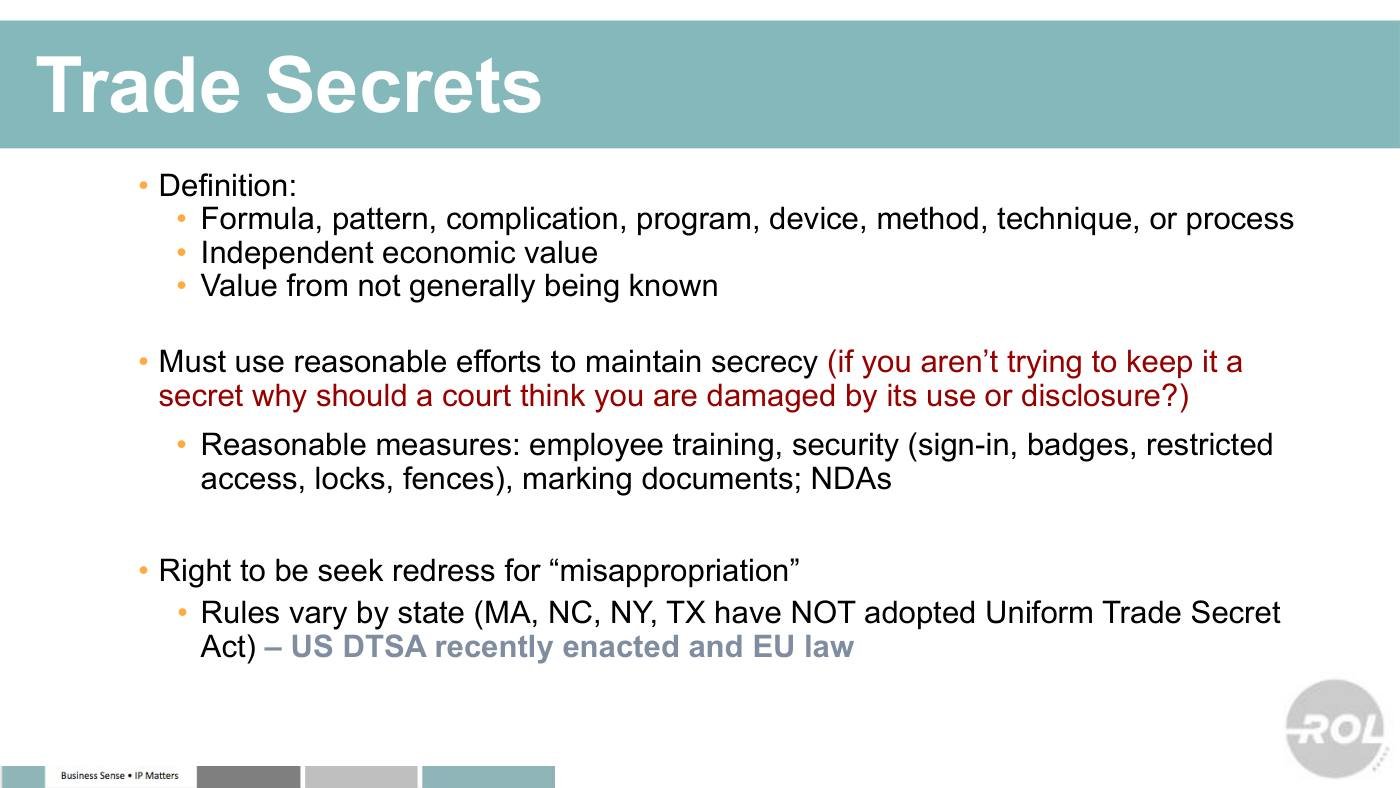
Trade secrets: definition, reasonable measures and misappropriation
9
26 / Source pageIP rights & strategic protection choices
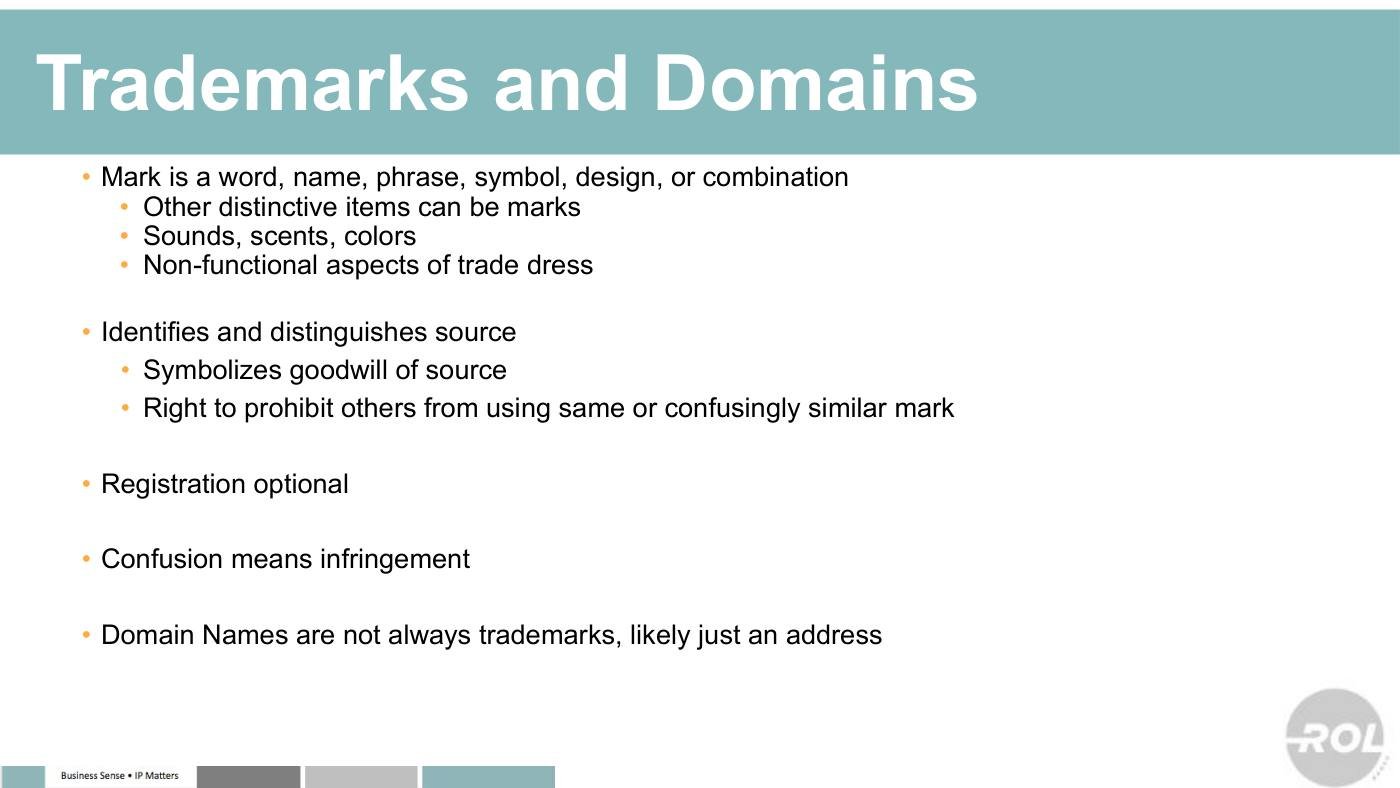
Trademarks and domain names
10
26 / TheoryIP rights & strategic protection choices
Copyright and trademarks address different business risks
Copyright concerns protected expression, such as eligible code, text or artwork. It does not grant general ownership of every underlying idea. Trademark protection concerns signs that identify the source of goods or services and the risk of confusion in the relevant context.
A startup should distinguish the right to use a brand from the right to use software or content. A registered domain name does not establish that a proposed mark avoids conflicts. Similarly, possession of a source-code file does not establish a complete chain of rights.
11
26 / TheoryIP rights & strategic protection choices
Protection strategy should support the business model
The source asks whether IP matters because protection has costs and should serve a concrete objective. The objective might concern defensible differentiation, negotiating power, licensing revenue or the ability to complete financing and an exit.
Prioritize assets that affect the operating plan. A broad inventory is useful, but a short list of consequential uncertainties helps allocate scarce attention. Explain how resolving a right changes a business decision instead of treating the number of filings as a measure of strategic strength.
12
26 / TheoryIP rights & strategic protection choices
Protection and freedom to operate
A company’s ability to protect its own asset and its ability to carry out a planned activity are separate questions. Analyze both against the actual product and market.
Protection
The rights the company can assert or license.
Freedom to operate
Whether the proposed activity conflicts with other rights or obligations. Owning an asset does not answer every permission question.
Worked application
Illustrative application: a company develops an original interface around a licensed dataset and a third-party component. Its own work may have protectable aspects while commercial distribution still depends on upstream permissions. Identify the component, right, territory and use before assuming protection resolves delivery.
An IP map should connect assets, contributors, agreements and planned uses, then identify the decision or review each gap requires.
13
26 / TheoryIP rights & strategic protection choices
An IP strategy is a business trade-off
Consideration
Question
Business use
How does the asset support value or advantage?
Protection
Which rights or controls fit the asset?
Cost
What effort is needed to acquire, maintain or enforce?
Disclosure
What is revealed, to whom, and under what terms?
Partnering
What rights must be licensed or retained?
14
26 / Deep diveIP rights & strategic protection choices
Relay's IP map, asset by asset
One product, six assets, four different protection questions.
Each row links an asset to the tool that fits it and the question that still needs an answer. The map changes when Relay Scheduler launches, because prompts, conversation design and model outputs become assets too.
Application depends on current law and Relay's actual facts; the open questions are for qualified counsel.
Asset
Fitting tool
Benefit
Limitation
Question for counsel
Product name 'Relay'
Trademark
Builds a brand clinics recognize
Common word in a crowded field; weak if descriptive
Does a search in SaaS and scheduling classes support a composite mark?
Application and integration code
Copyright plus IP assignments
Automatic protection; clean title for investors
Protects expression only; AI-generated portions may be unprotected
Are all founder, employee and contractor contributions assigned?
Acceptance-prediction model and features
Trade secret
No disclosure, no filing cost, no expiry
Lost if leaked or reverse engineered; needs reasonable measures
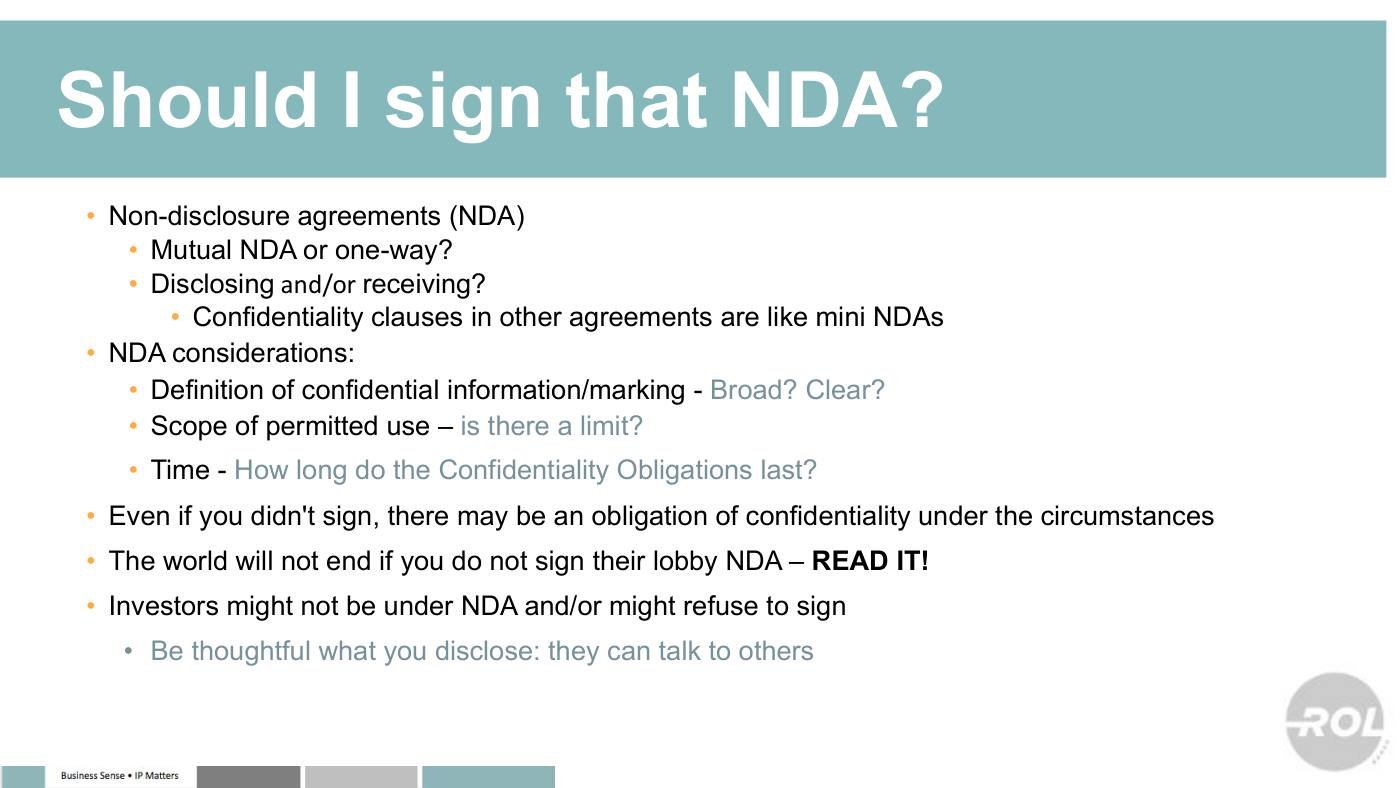
Are access controls, NDAs and an AI-tool policy adequate?
Fill and acceptance outcome data
Trade secret plus contract
Improves with scale; hard to replicate
Relay's right to use it depends on the BAA and clinic contracts
Do clinic agreements permit de-identified, cross-clinic model training?
Patient-facing SMS templates and conversation design
Copyright (thin) and trade secret
Tested wording drives acceptance rates
Short phrases get little protection; visible to every patient
Is there anything here worth more than speed of iteration?
Is there a specific technical improvement, or only applied prediction?
15
26 / Source pageIP rights & strategic protection choices
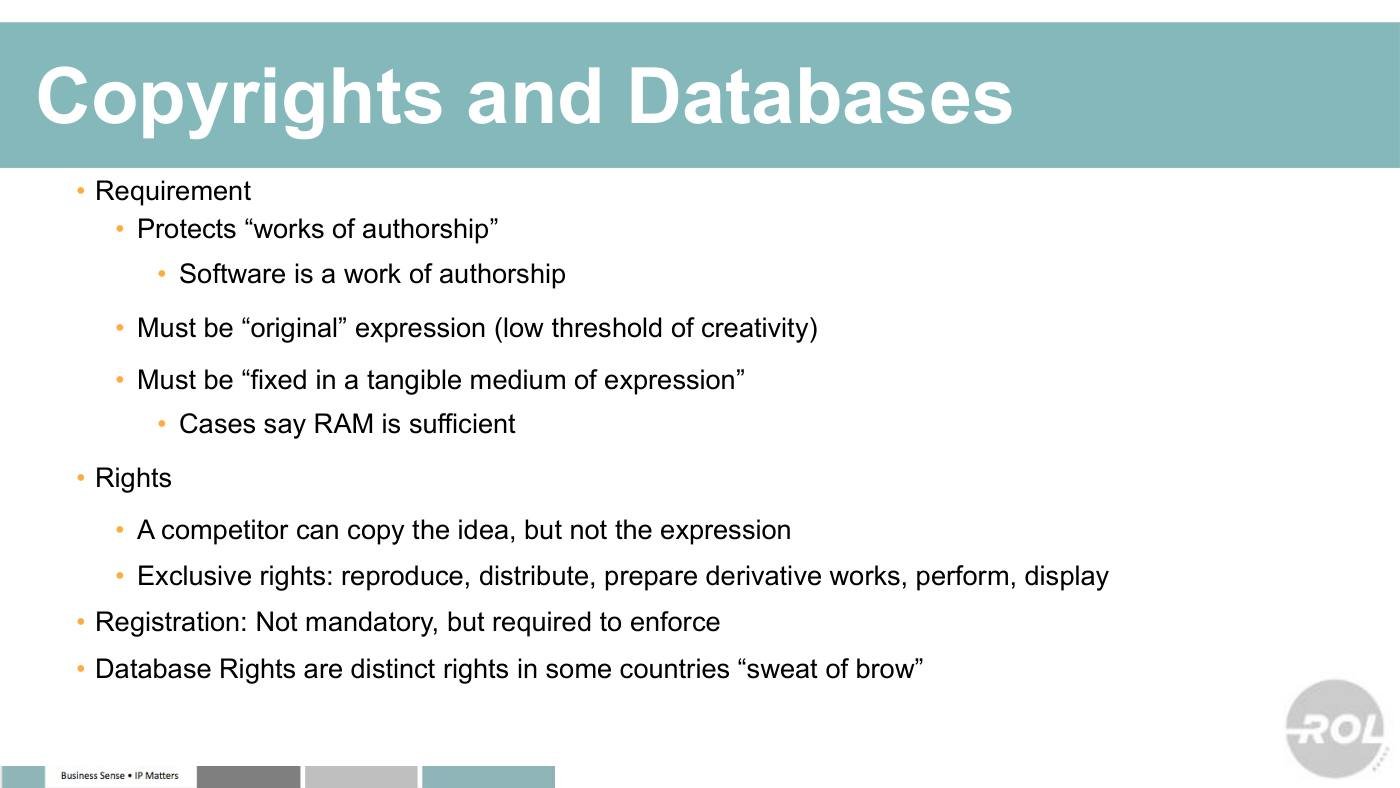
Copyright and database rights
16
26 / Source pageIP rights & strategic protection choices
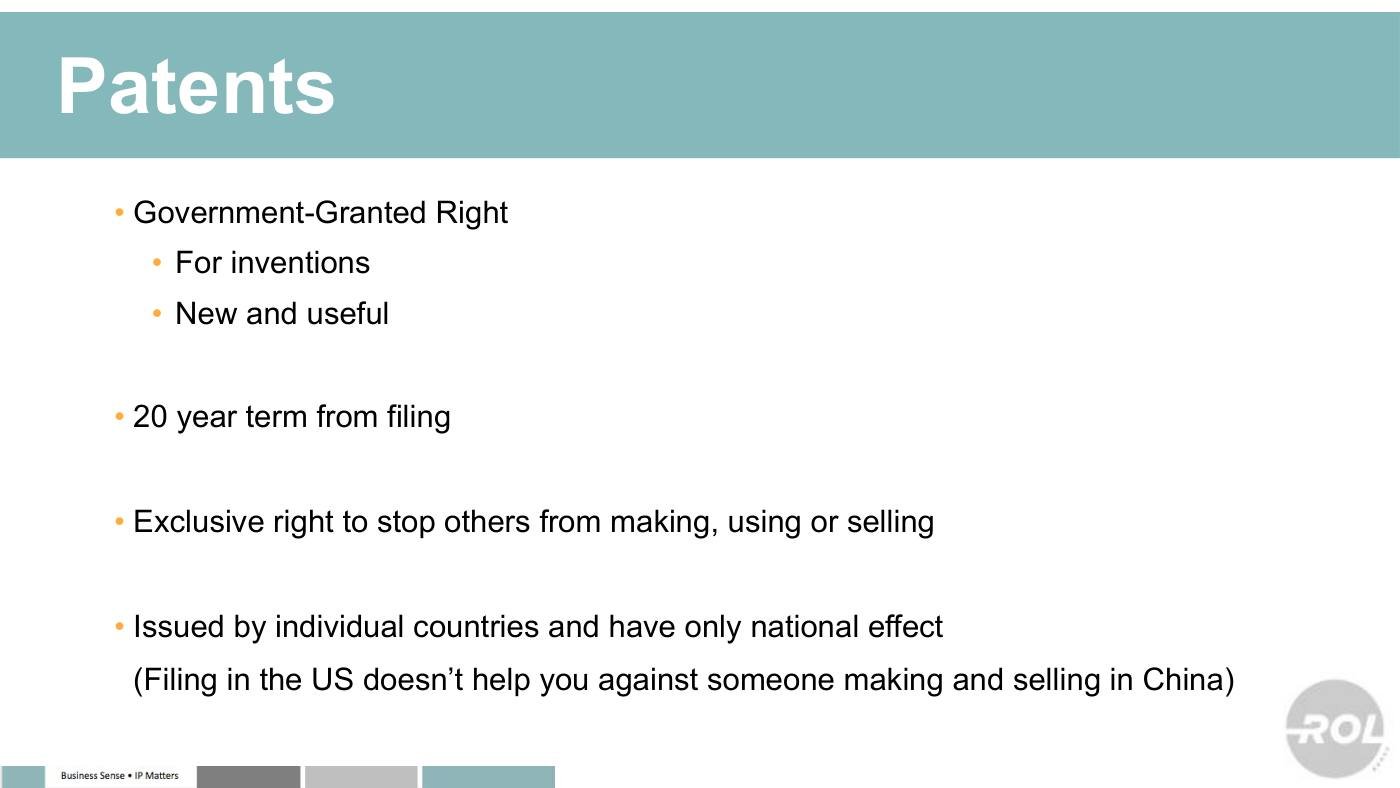
Patents: what the government grants
17
26 / Source pageIP rights & strategic protection choices
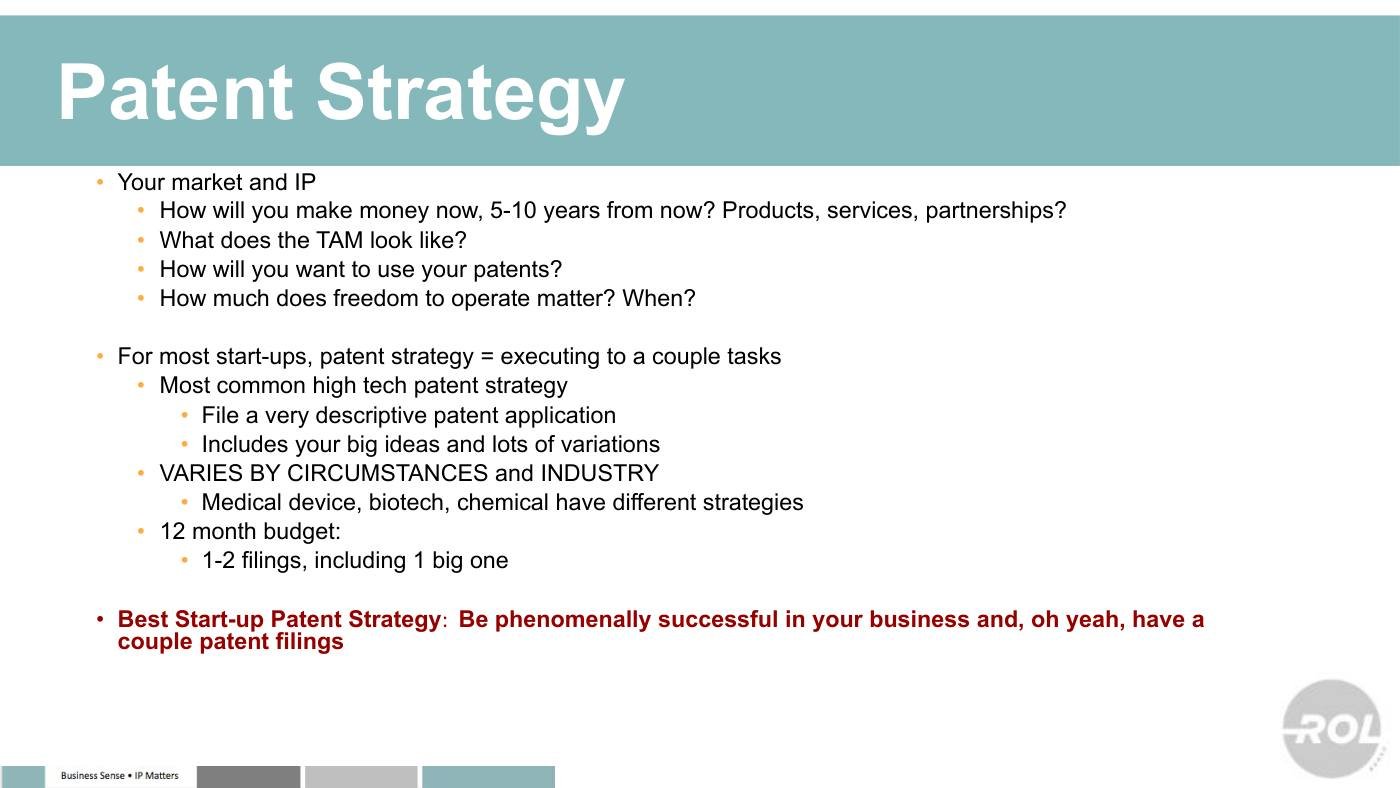
Patent strategy for a startup
18
26 / Current practiceIP rights & strategic protection choices
Current practice: AI and the boundaries of IP protection
Copyright requires a human author
The US Copyright Office's January 29, 2025 report concluded that prompts alone do not make a user an author, while human expression that is perceptible in the output, or creative selection and modification of it, remains protectable. The D.C. Circuit affirmed the human-authorship requirement in Thaler v. Perlmutter (March 18, 2025), and the Supreme Court denied review on March 2, 2026.
Only people are inventors
On November 28, 2025 the USPTO replaced its 2024 guidance on AI-assisted inventions. Only natural persons can be inventors, and the test is whether a person made a significant contribution to conception of the claimed invention; using AI as a tool does not by itself bar a patent.
Machine-learning patents face a split
In Recentive Analytics v. Fox (April 18, 2025) the Federal Circuit held claims applying generic machine learning to a new data environment ineligible. The USPTO has since taken a more permissive line at examination (an August 2025 eligibility memo and the precedential Ex parte Desjardins decision), so a patent can issue and still fail in court.
AI tools and trade-secret measures
Practitioners now treat entering confidential information into third-party AI tools as a reasonable-measures risk. In a reported January 2026 dismissal (Trinidad v. OpenAI, N.D. Cal.), a trade-secret claim failed in part because the plaintiff had disclosed the information to the AI provider. An approved-tools policy and enterprise terms are part of keeping a secret.
Clearance before branding
The USPTO recommends searching federal registrations and applications, state registers and common-law use on the internet before filing. Application to Relay depends on current law and the facts, and needs review by qualified counsel.
26 / PracticeIP rights & strategic protection choices
Protection choices for a connected product
Illustrative venture: a connected device includes original application code, a new sensing mechanism that customers can inspect after purchase, a confidential calibration process kept inside the company, and a proposed product name. The business may license the mechanism to manufacturers. No ownership or clearance review has been completed.
Your task
Map the assets to possible protection tools. Explain a strategic benefit, a limitation and the information required before choosing a path.
20
26 / DebriefIP rights & strategic protection choices
Worked answer and reasoning
Code raises copyright and licensing questions. The name raises trademark and clearance questions.
The inspectable mechanism and confidential process suggest different patent-versus-secrecy considerations. Eligibility, disclosure, timing and jurisdiction need review.
A licensing model requires rights the company can validly grant. Begin with contribution history and the intended market, rather than assuming each asset is already protected.
21
26 / Venture stepIP rights & strategic protection choices
Venture step: Relay's IP asset-and-protection map
Relay · venture step 26
Month 10. Relay v1 is live with dozens of clinics and the team is planning Relay Scheduler, an LLM-based assistant. An angel asked Maya, 'What's your moat?' and she now wants to file a patent on 'predicting which waitlisted patient will accept a slot and texting them.' Daniel's acceptance model is trained on fill outcomes from the pilot clinics. The product name 'Relay' has never been searched, and about a third of new code is drafted with an AI coding assistant. Counsel quotes roughly $20,000 (illustrative) to prepare and file a utility application.
Your task
Produce a one-page IP map for Relay: each asset, the tool that fits it, one strategic benefit, one limitation, and the specific question for counsel. End with a ranked list of three actions for the next 60 days and a recommendation on the patent filing.
22
26 / Venture stepIP rights & strategic protection choices
Venture step: worked reasoning
Name: 'Relay' is a common word already used by many software and communications marks, so run a clearance search (USPTO records, state registers, common-law web use) for SaaS and scheduling services before investing in the brand; adopt a composite mark such as 'Relay Health Scheduling' only if the search is clean, and expect descriptive words to carry little weight.
Model and data: the acceptance model, features and fill-outcome history fit trade-secret protection, which costs nothing to file but depends on reasonable measures (access controls, confidentiality agreements, an approved-AI-tools policy). Trade-secret status does not give Relay the right to use clinic data; that right comes from the BAA and customer contracts (L27, L28).
Code: human-written and human-edited code is protected by copyright automatically once the IP assignments from L25 are in place; purely AI-generated portions may not be protectable, which matters little because Relay's advantage lies in integration depth and speed, not in copying risk.
Patent: the proposed claim applies prediction to a scheduling workflow, the pattern the Federal Circuit held ineligible in Recentive v. Fox (2025). Spending about $20,000 (illustrative) for a weak, publicly disclosed right is poor value; revisit only if Daniel builds a specific technical improvement.
Ranked actions: (1) trademark clearance before the Relay Scheduler launch; (2) trade-secret controls and an AI-tool policy; (3) confirm data-use rights in clinic contracts. Answer the angel with integration depth, data rights and switching costs (L14), not filings.
23
26 / DebriefIP rights & strategic protection choices
Reasoning traps
Answering 'moat' with a filing
A patent application on an ML-assisted workflow buys disclosure and eligibility risk, not defensibility. For Relay, defensibility comes from integration depth, data rights and switching costs.
Common word, assumed clear
A free domain and a successful incorporation say nothing about conflicting marks. 'Relay' is crowded in software, so clearance must happen before the brand is built, not after a demand letter.
Data we hold is data we own
Trade-secret status protects Relay's model and datasets from misappropriation, but it does not grant the right to use clinic patient data to train them. That permission comes from the BAA and customer contracts.
24
26 / ReviewIP rights & strategic protection choices
What you can now explain
Relay's IP asset-and-protection map with a ranked 60-day action list and a reasoned recommendation not to file the proposed patent now.
Match each asset to the tool that fits it: copyright for code, trademark for the name, trade secret for the model and data, patents only where an inspectable, eligible invention justifies the cost.
Protection costs arise across acquisition, maintenance, enforcement and defense, so filings should follow from a specific business use.
AI changes the inventory: purely AI-generated output may not be protectable, and pasting secrets into third-party tools can erode trade-secret status.
Next lesson: Ownership, licensing & freedom to operate
25
Current rules: IRS: business structures · USPTO: IP tools. Legal, tax and privacy examples teach concepts; application depends on current law and the actual facts.
Check your understanding
Which rights support the company’s strategy?
Score
Question 1
An angel asks Relay about its moat. Maya proposes patenting 'using machine learning to predict which waitlisted patient will accept an open slot, then texting that patient.' Which response best fits Relay's position?
Claims that apply generic machine learning to a new data setting have been held ineligible (Recentive v. Fox, 2025), and filing discloses the approach. Copyright protects expression, not methods. Publishing defensively blocks others' patents but gives Relay no exclusivity.
Question 2
Relay has incorporated as 'Relay Health, Inc.' in Delaware and registered a matching domain. Priya says the brand is therefore secure. What is the most accurate response?
Trademark rights turn on use and likelihood of confusion with marks for the same or related goods and services. A state corporate filing and a domain registration are administrative records and do not clear a mark, as the Trademarks and Domains page notes.
Question 3
Daniel drafts about a third of Relay's SMS-handling module with an AI coding assistant, then restructures and edits it heavily. Under the US Copyright Office's 2025 guidance, what is protectable?
The Copyright Office concluded that AI assistance does not bar protection, but prompts alone do not make a user the author. Human-authored and human-modified expression is protectable. A vendor's assignment can transfer only the rights that exist.
Question 4
A Relay engineer pastes the acceptance model's feature list and weights into a free consumer chatbot to debug a bug. What is the main IP concern?
Trade-secret protection depends on secrecy and reasonable efforts to keep it. Sharing with a third party under consumer terms is the kind of disclosure that courts and commentators now treat as a measures problem. Copyright does not transfer by pasting.
Question 5
A hardware startup sells a device whose clever hinge is visible once the case is opened, and it uses a calibration process that never leaves its factory. Which protection mapping fits best?
A mechanism that buyers can inspect cannot stay secret after sale, so patenting is the realistic path to exclusivity. A process kept inside a controlled facility can stay secret indefinitely without disclosure. Copyright does not cover functional designs.
Question 6
A Relay board member argues that a US patent would stop a Canadian startup from launching a copycat service for Canadian clinics. Is that right?
Patents are territorial, as the Patents page states. Protecting a foreign market requires filings in that jurisdiction, which multiplies cost and is one more reason patents rarely fit an early SaaS company's budget.
Workbook
Which rights support the company’s strategy?
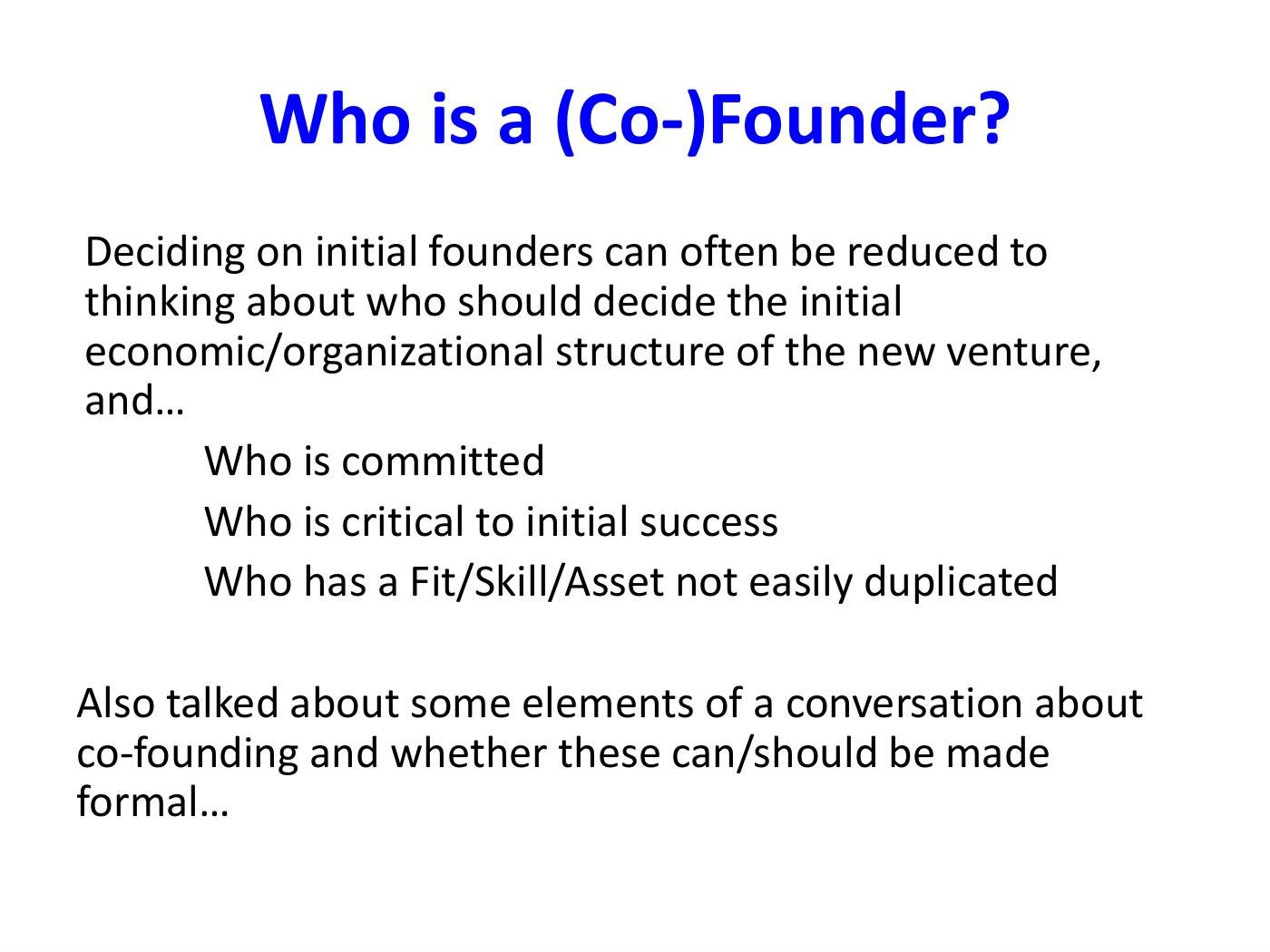
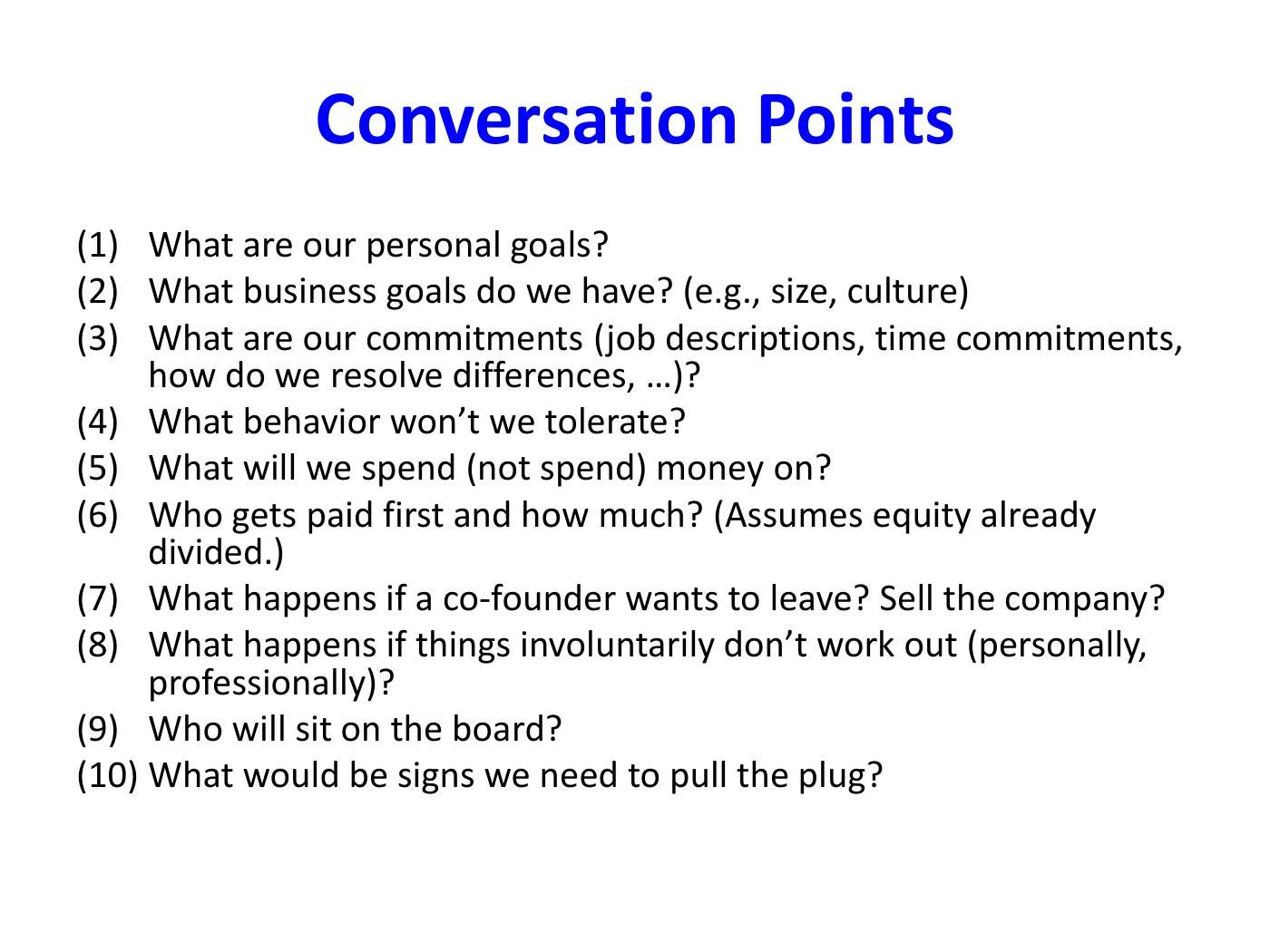
Module output: A founder discussion brief, governance questions, IP map and privacy data map.
Library
Every original page used in this lesson
7 appear in the slides with notes; the rest are kept here for reference.
Four IP tools matched to familiar examplesA table pairs trade secrets with secret business advantage, copyright with authors' expression, trademarks with brand goodwill and patents with inventions, illustrated by a soft-drink formula, a newspaper page, two logos and a patent drawing. Duplicates the native comparison table on slide 5; the images add recognition, not analysis.Richardson - Intellectual Property and Data Privacy Slides · PDF page 5
1
Is IP worth it? Protection versus the cost to get, keep, enforce and defendA grid rates trade secrets, copyright, trademarks and patents on protection and on the effort to obtain, maintain, enforce and defend each, then plots them on a protection-versus-cost chart with secrets at the low end and patents at the high end. Callouts separate enforcement (theft, copying, impersonation) from defense against others' claims that you infringe. Patents buy the strongest right at the highest cost at every stage; trade secrets are cheap to acquire but offer weak protection once information leaks. For Relay, the matching model and acceptance data sit at the cheap end, so the real cost is operating discipline, not filing fees.Richardson - Intellectual Property and Data Privacy Slides · PDF page 7 · in the slides
2
Why IP might matter: exclusivity, property and investor attentionThree features of IP (an exclusive right to stop or enable others, legally recognized property that varies by country, and different types with different effort and effectiveness) are each linked to why investors value them. A closing note says how much investors care depends on stage, how central IP is to the market and whether IP is a large freedom-to-operate risk. The closing note is the practical test. A seed investor in a SaaS company like Relay will probe clean ownership and dependence on third-party rights (EHR API, LLM terms) far more than the number of filings.Richardson - Intellectual Property and Data Privacy Slides · PDF page 8 · in the slides
3
Trade secrets: definition, reasonable measures and misappropriationDefines a trade secret as information (formula, program, method, process and so on) with independent economic value from not being generally known, protected only if the owner uses reasonable efforts to keep it secret, and enforced through a claim for misappropriation. It lists typical measures: training, sign-in and badges, restricted access, marked documents and NDAs. The court's question in red is the core logic: if you did not try to keep it secret, you cannot claim harm from its disclosure. The state list is outdated: Texas (2013) and Massachusetts (2018) have since adopted versions of the Uniform Trade Secrets Act, New York still relies on common law, and the federal Defend Trade Secrets Act (2016) provides a federal claim.Richardson - Intellectual Property and Data Privacy Slides · PDF page 31 · in the slides
4
Trademarks and domain namesA mark can be a word, name, symbol, design, sound, scent, color or non-functional trade dress that identifies the source of goods or services and carries goodwill. Registration is optional, likelihood of confusion is the infringement test, and a domain name is usually just an address, not a trademark. Confusion is judged against marks for the same or related goods and services, which is why a common word such as 'Relay' needs a clearance search in software and healthcare-scheduling classes. Owning a domain or a corporate name does not clear a mark.Richardson - Intellectual Property and Data Privacy Slides · PDF page 32 · in the slides
5
Copyright and database rightsCopyright protects original works of authorship, including software, once fixed in a tangible medium (cases have treated RAM copies as fixed). It grants exclusive rights to reproduce, distribute, adapt, perform and display; a competitor may copy the idea but not the expression. Registration is not mandatory but is needed to sue, and some countries add a separate 'sweat of the brow' database right. Relay's code is protected expression, but a rival can legally build its own waitlist-texting product. Two limits matter now: copyright requires human authorship, so purely AI-generated code or text may be unprotected, and the US has no general database right, unlike the EU.Richardson - Intellectual Property and Data Privacy Slides · PDF page 33 · in the slides
6
Patents: what the government grantsA patent is a government-granted right for new and useful inventions, lasting 20 years from filing, that lets the owner stop others from making, using or selling the invention, with effect only in the issuing country. The slide omits two hurdles that decide most software and machine-learning cases: non-obviousness and patent-eligible subject matter. Territoriality is concrete: a US patent does nothing against a competitor operating only in another country.Richardson - Intellectual Property and Data Privacy Slides · PDF page 34 · in the slides
7
Patent strategy for a startupStarts from business questions (how you will make money now and in 5 to 10 years, market size, how you would use patents, when freedom to operate matters), then describes the common high-tech approach: one very descriptive application covering the big idea and many variations, with 1 to 2 filings in a 12-month budget, varying by industry. The closing line ranks business success above filings. For Relay, 'how will you use your patents?' has a weak answer, because claims on applying prediction to scheduling face eligibility risk, so the budget is better spent on trademark clearance and trade-secret controls.Richardson - Intellectual Property and Data Privacy Slides · PDF page 35 · in the slides
8
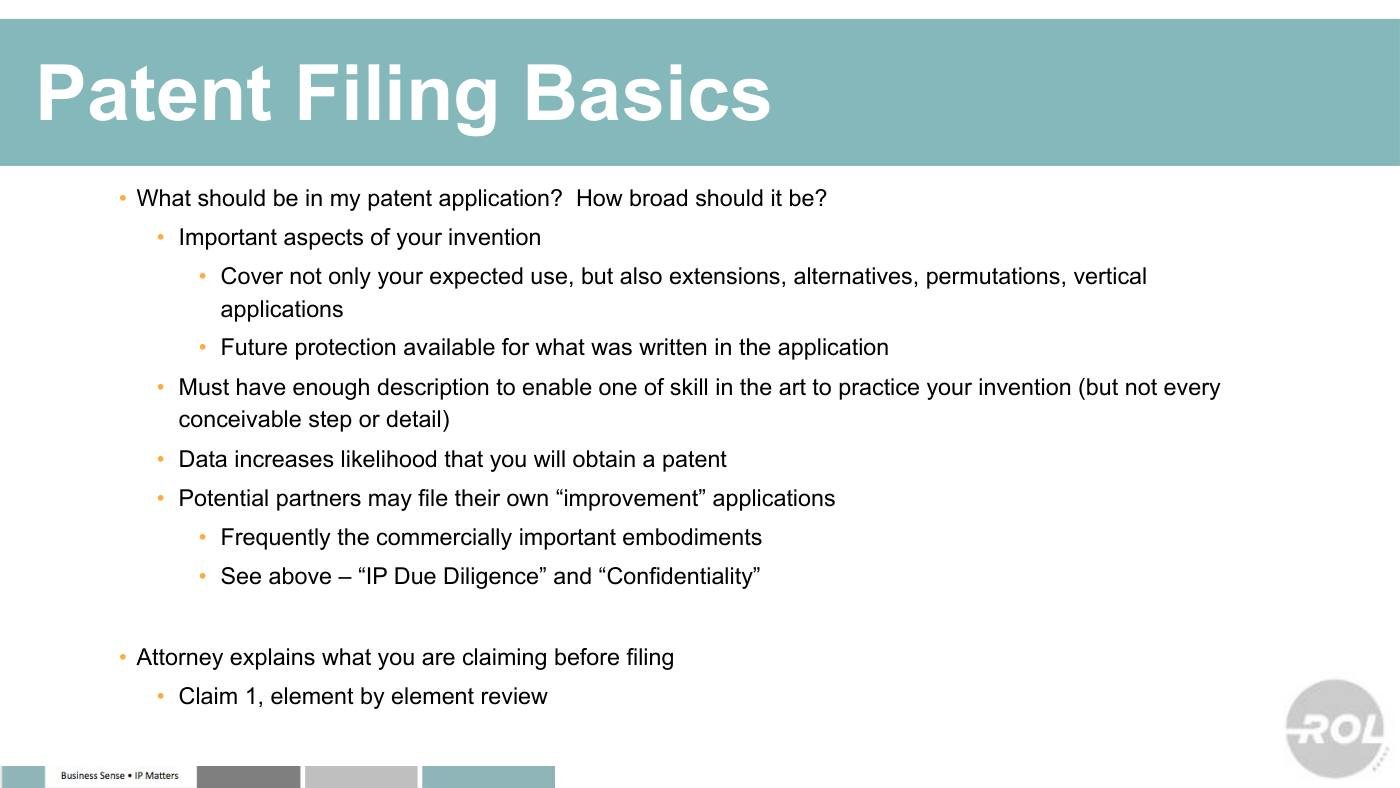
Patent filing basics: scope, enablement and claim reviewAdvises describing the invention broadly (extensions, alternatives, vertical applications), giving enough detail to enable a skilled person, using data to support the application, watching partners' 'improvement' filings, and reviewing claim 1 element by element with the attorney before filing. Useful filing hygiene for companies that do patent; Relay's plan does not rely on patents, so the filing details are secondary here.Richardson - Intellectual Property and Data Privacy Slides · PDF page 36