OpenAI: when the governance structure decides who runs the company
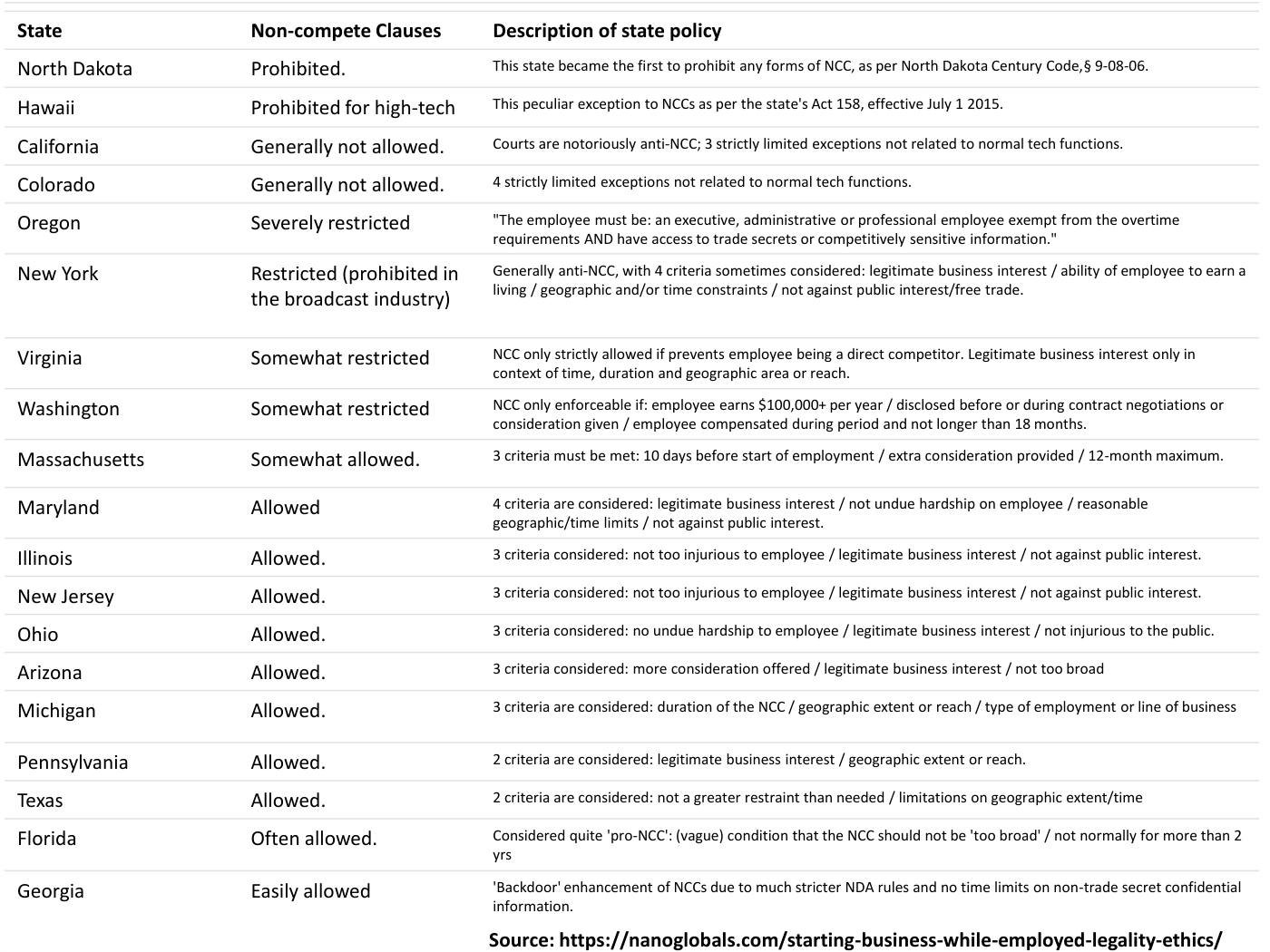
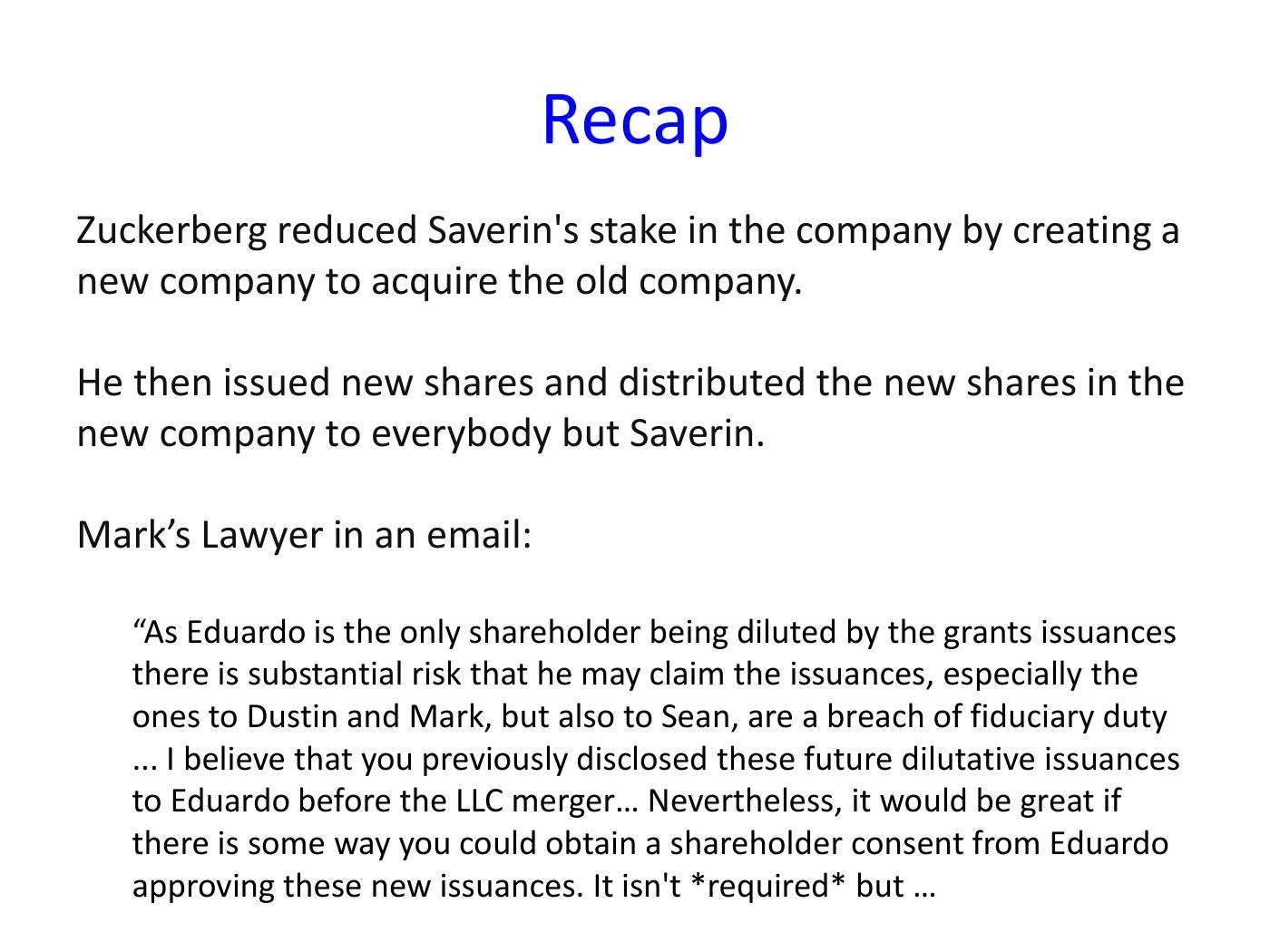
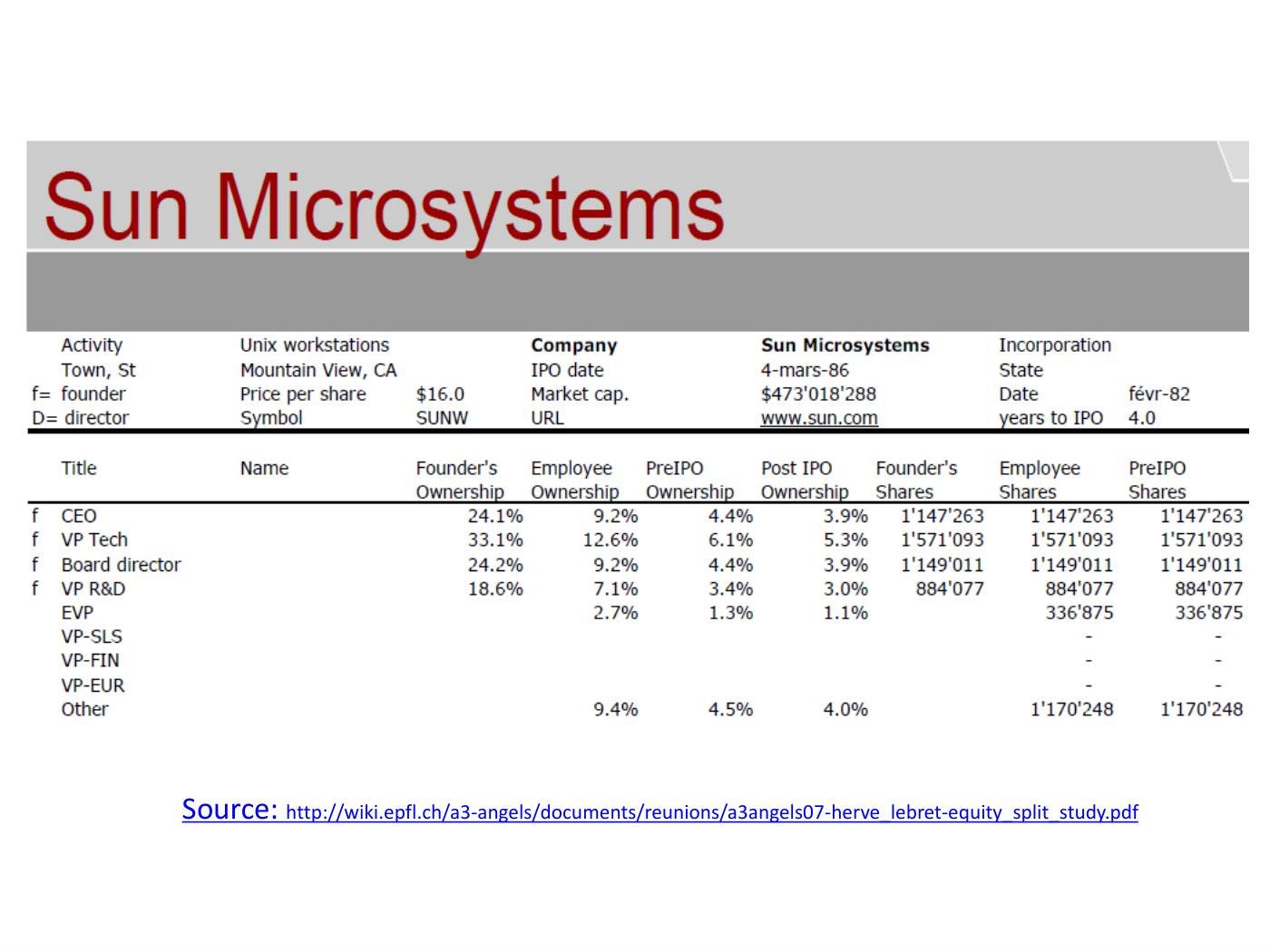
OpenAI began as a nonprofit research lab and later added a capped-profit subsidiary that took billions in outside investment, while the nonprofit board kept control. On Friday, November 17, 2023, that board removed CEO Sam Altman. Investors, including Microsoft, had no board seat and no vote. Over the next four days Microsoft announced it would hire Altman, and roughly 97% of employees signed a letter threatening to leave unless the board resigned and reinstated him. On November 21 OpenAI announced Altman's return and a new initial board of Bret Taylor (chair), Larry Summers and Adam D'Angelo. Two years later, on October 28, 2025, OpenAI completed a recapitalization after nearly a year of dialogue with the California and Delaware attorneys general. The for-profit became OpenAI Group PBC, a public benefit corporation. The nonprofit, renamed the OpenAI Foundation, kept control and holds equity valued at about $130 billion; Microsoft holds about 27%. The episode separates economic ownership from control: who could fire the CEO, whose consent mattered in practice, and how the structure was redesigned afterward.
In November 2023, who held formal authority over OpenAI's CEO, and who held practical leverage? What would you write into a startup's founder agreement, charter and board composition so that formal authority and practical leverage are not this far apart?
3
24 / TheoryFounders, equity splits & compensation
Founder contributions extend beyond the original idea
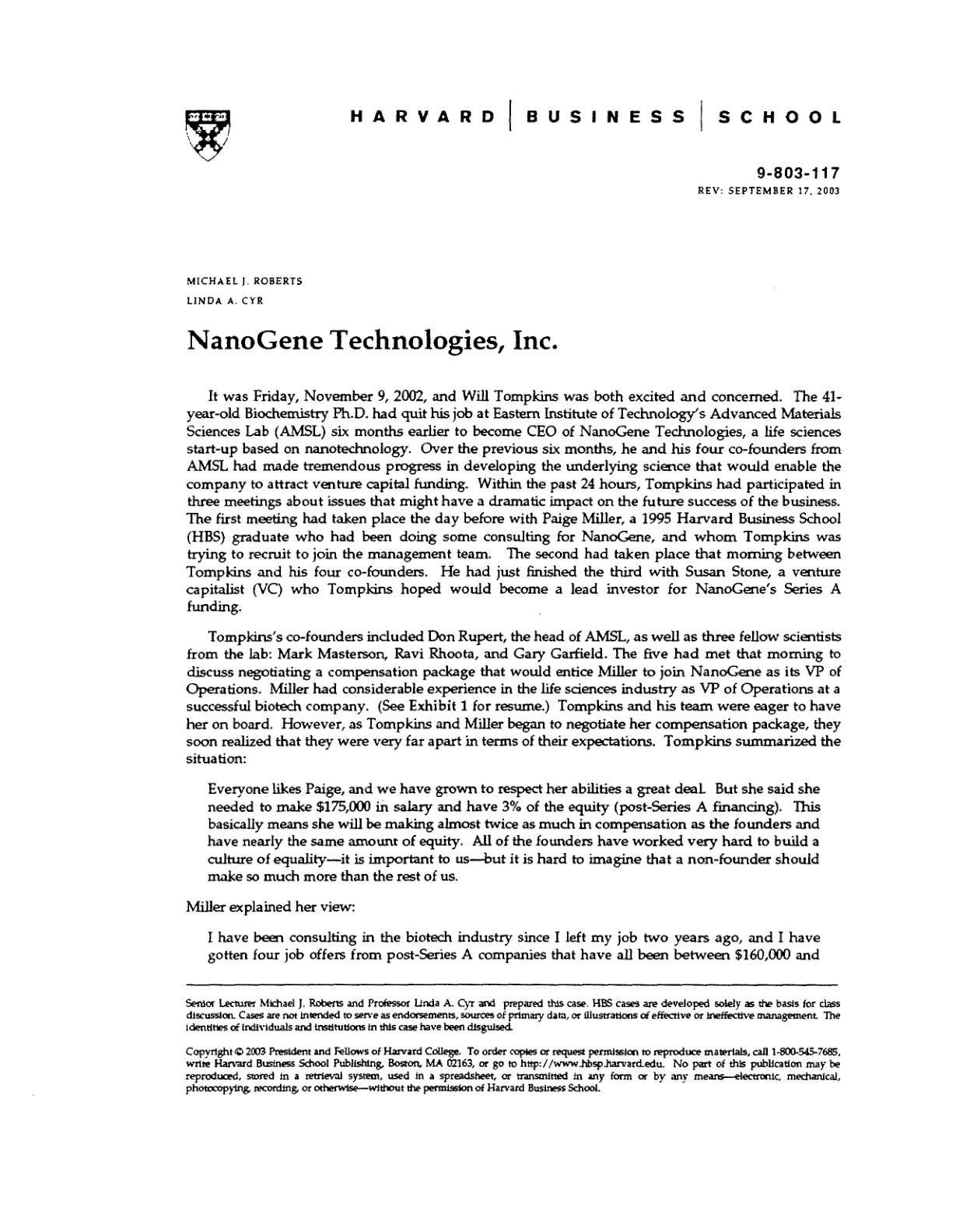
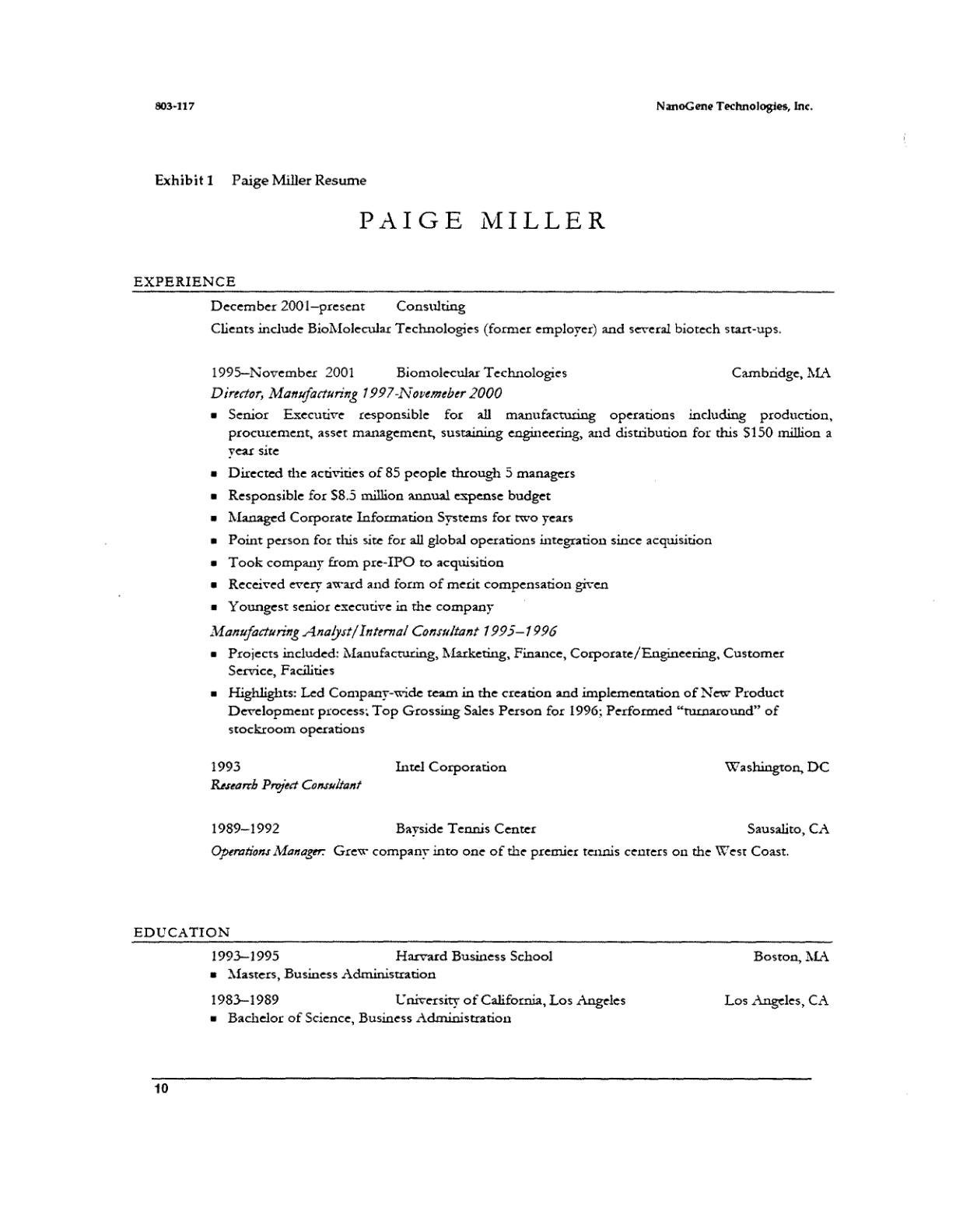
The founder material examines the people who supply the early work, capital, access and capabilities of a company. A founder title can carry expectations without resolving ownership, authority or future commitment. The NanoGene case makes these expectations concrete through differences in roles and contributions.
An equity discussion should distinguish past contributions from expected future work. The rationale needs to remain understandable if a person’s role changes. A split chosen only to end an uncomfortable conversation can preserve a conflict that later becomes more expensive.
4
24 / TheoryFounders, equity splits & compensation
Vesting addresses the passage of time
Equity granted for future work creates a problem when the work does not continue as expected. Vesting and departure provisions can connect ownership consequences to time or specified conditions. Their actual effect depends on the governing agreement and applicable rules.
Discuss departures before they become urgent. Consider voluntary departure, termination, disability and a change of control as distinct events. Acceleration provisions can change the consequences of an acquisition. The historical slides provide concepts for discussion, while current documents require situation-specific review.
5
24 / TheoryFounders, equity splits & compensation
A founder title and a founder contribution
An ownership discussion needs the actual contributions and expected commitments. A title does not specify time, resources, rights or future responsibility.
Title
A label with symbolic and organizational meaning.
Contribution
The work, commitment, assets and capabilities that the venture needs now and later.
Worked application
Illustrative application: one person contributes an early idea and works part time; another supplies critical licensed technology and joins full time; a third funds initial operations. A reasoned allocation considers what is contributed, whether it is transferable and what remains to be delivered.
Make the rationale explicit and examine how vesting and governance address uncertainty about future contribution.
6
24 / TheoryFounders, equity splits & compensation
Questions before dividing ownership
Dimension
Conversation
Goals
What does each person want to build and achieve?
Commitment
Who will contribute time, capital and specific work?
Scarcity
Which capabilities or assets are difficult to replace?
Change
What happens when roles, availability or goals change?
Exit or conflict
How will departures and unresolved disagreements be handled?
7
24 / TheoryFounders, equity splits & compensation
Current pay and long-term equity
Cash compensation supports current work and consumes current cash. Equity links economic outcomes to future value and carries rights, dilution and uncertainty that need definition.
Salary
Can compensate for current work and living constraints, subject to the company’s resources.
Equity
Creates exposure to future value and incentives over time; its economic effect depends on terms and dilution.
Worked application
Illustrative application: a cash-constrained venture may offer lower salary and an equity award. Comparing that package with a salary-only job requires more than multiplying a headline percentage by a hoped-for exit. Examine the instrument, vesting, financing dilution and potential payout rules.
Separate affordability for the company from attractiveness to the person. The same package can be evaluated differently by each.
8
24 / TheoryFounders, equity splits & compensation
A split should have an explicit rationale
Equal shares can express equal expected contribution, but equality does not prove that assumption.
A differentiated split needs explainable criteria rather than bargaining power alone.
Future work can matter more than the original idea.
Cash compensation and equity create different constraints
Cash compensation consumes current runway. Equity can preserve cash while transferring a share of future value and potentially other rights. Neither is costless. The appropriate comparison considers the role, the company’s resources and the person’s alternatives.
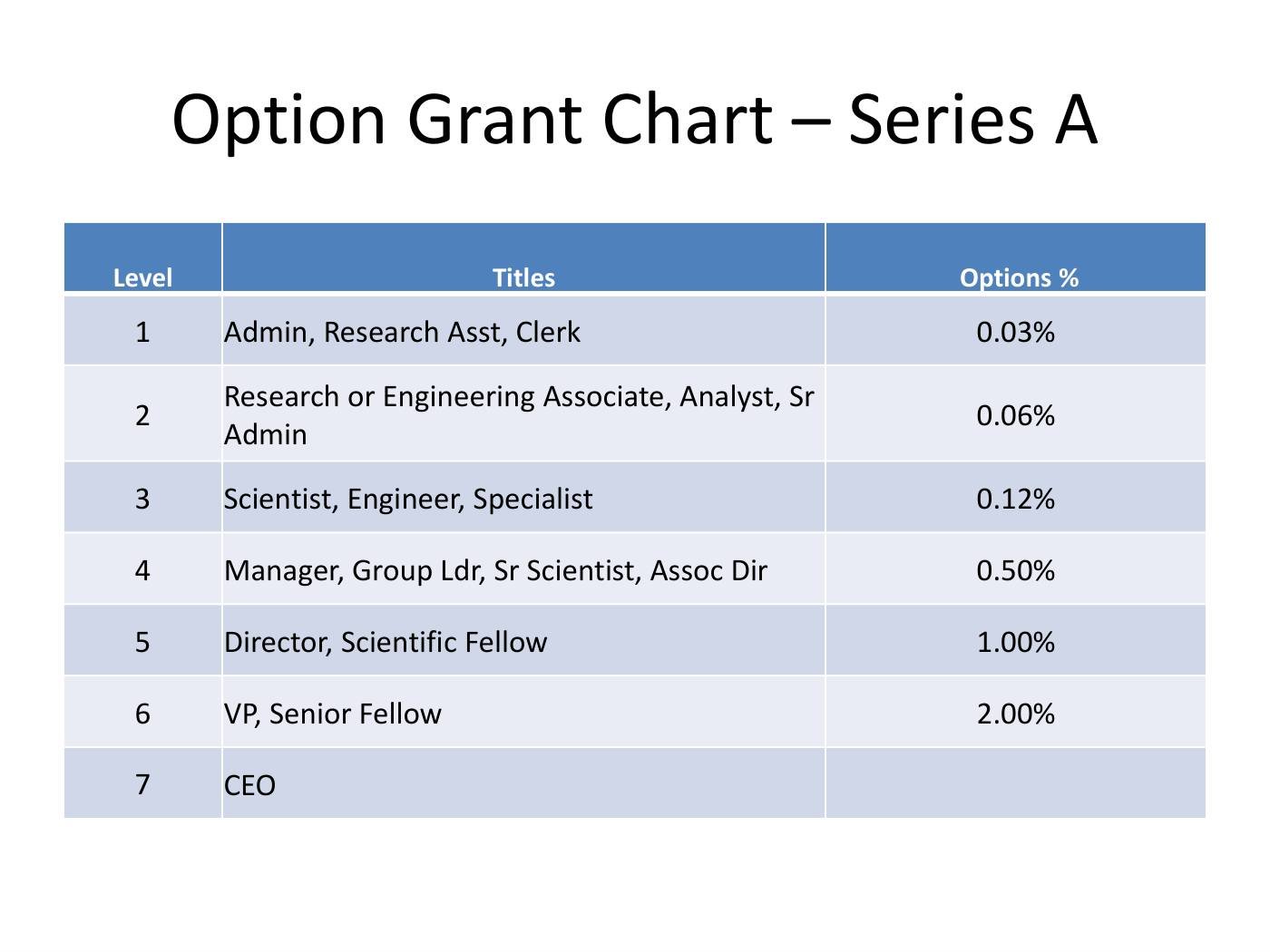
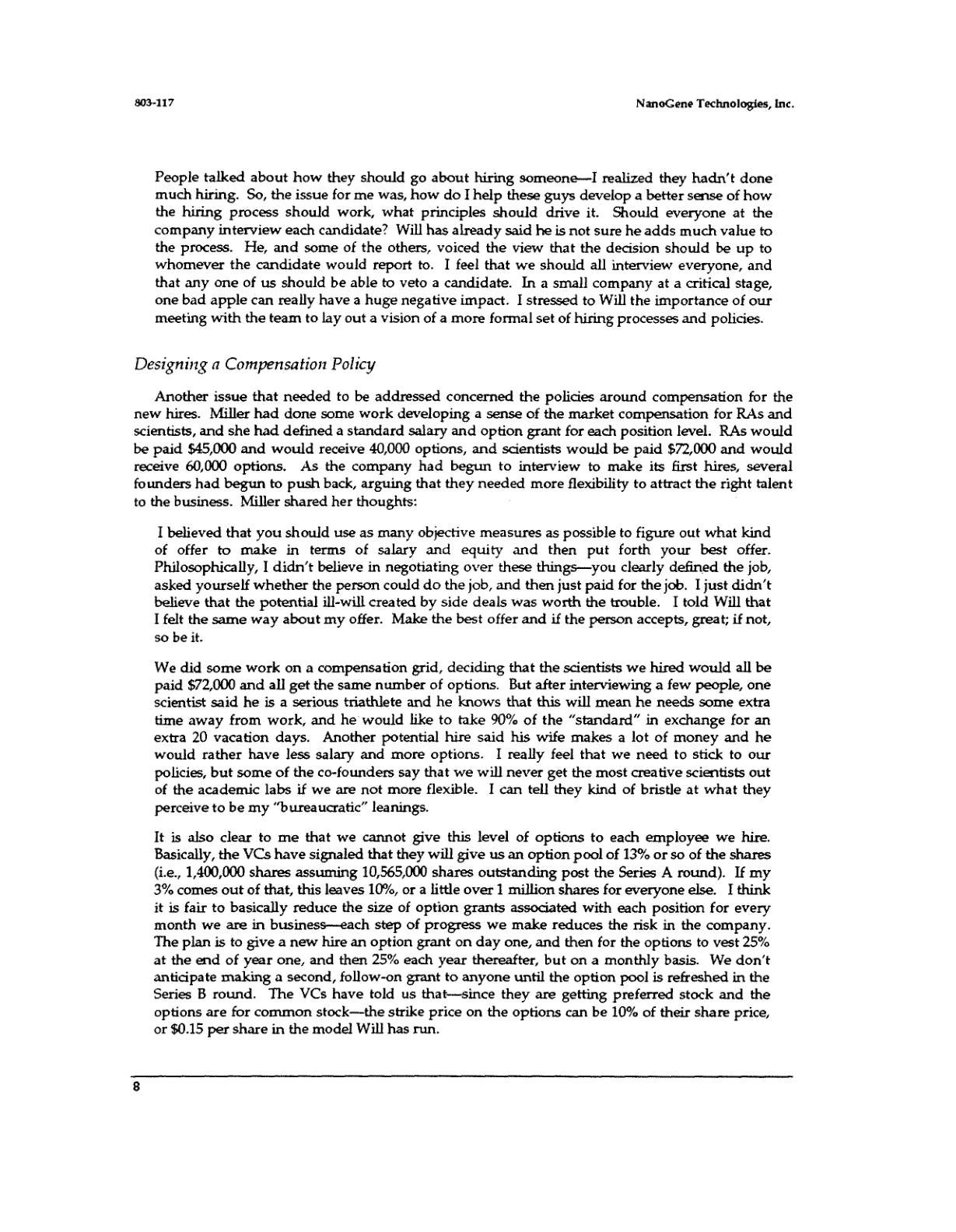
Early compensation also creates expectations for future hires and founders. Explain why roles differ and which contribution each arrangement is intended to support. Historical option-grant tables are examples of the period shown, not a universal schedule for current hiring.
17
24 / TheoryFounders, equity splits & compensation
A founder discussion needs a process for future disagreement
Initial agreement does not eliminate future differences about effort, strategy or fairness. A useful founder discussion covers decision rights, expected time commitment, personal goals and how the team will revisit a changed situation.
Separate ownership arithmetic from the underlying relationship. A mathematically correct percentage can still reflect an assumption about future work that the participants understand differently. Record those assumptions and establish a review process with appropriate professional documentation.
18
24 / TheoryFounders, equity splits & compensation
Vesting connects ownership and time
Vesting addresses what happens to an equity award as a person continues contributing or leaves. This is a conceptual sequence, and actual outcomes depend on the agreement.
01
Grant & terms
Specify the award, relevant dates and conditions. A headline percentage leaves the instrument, denominator, service requirements and departure treatment unclear.
02
Continued contribution
Rights become vested under the agreed schedule or conditions. Distinguish the economic expectation from the legal mechanism and from any separate performance or exercise requirements.
03
Departure
Inspect the actual provisions for vested and unvested interests, exercise and repurchase. Departure is precisely where assumptions about “my shares” can produce incompatible expectations.
04
Review the arrangement
Check whether the documents reflect the intended contribution and governance. When circumstances change, seek appropriate review rather than assuming a prior informal discussion settles every right.
Vesting is one element of a wider founder arrangement involving contribution, control, pay and future financing. A fair rationale needs all of these in view.
19
24 / Deep diveFounders, equity splits & compensation
Relay's founder vesting and the 83(b) decision in numbers
Both founders: 4-year monthly vesting, 1-year cliff, purchase at an illustrative $0.0001 per share.
Unvested shares are owned but subject to the company's right to repurchase them at the original price if the founder leaves. The cliff means a departure before month 12 forfeits everything; after it, vesting accrues monthly.
With an 83(b) election filed within 30 days of the stock transfer, the founder recognizes income at purchase equal to fair market value minus the price paid, about $0 here. Later appreciation is generally capital gain, and the holding period starts at purchase. Without it, each tranche is ordinary income at its value when it vests.
Illustrative cost of skipping the election: if common stock is valued at $0.30 when Maya's cliff tranche of 1,300,000 shares vests, she recognizes 1,300,000 x ($0.30 - $0.0001) = $389,870 of ordinary income without having sold anything. Application depends on current tax law and each founder's facts; counsel and a tax adviser must confirm.
Maya
Daniel
Shares (split)
5,200,000 (52%)
4,800,000 (48%)
Monthly vesting after cliff
108,333
100,000
Vested if leaves at month 11
0
0
Vested at month 12 (cliff)
1,300,000
1,200,000
Vested if leaves at month 18
1,950,000
1,800,000
Repurchasable at month 18
3,250,000
3,000,000
Post-seed fully diluted %
30.41%
28.07%
Priya's 300,000 options are not founder stock: she receives the right to buy at an exercise price set at grant, with different tax timing. Her grant is 1.75% post-seed and 1.40% post-Series A.
20
24 / TheoryFounders, equity splits & compensation
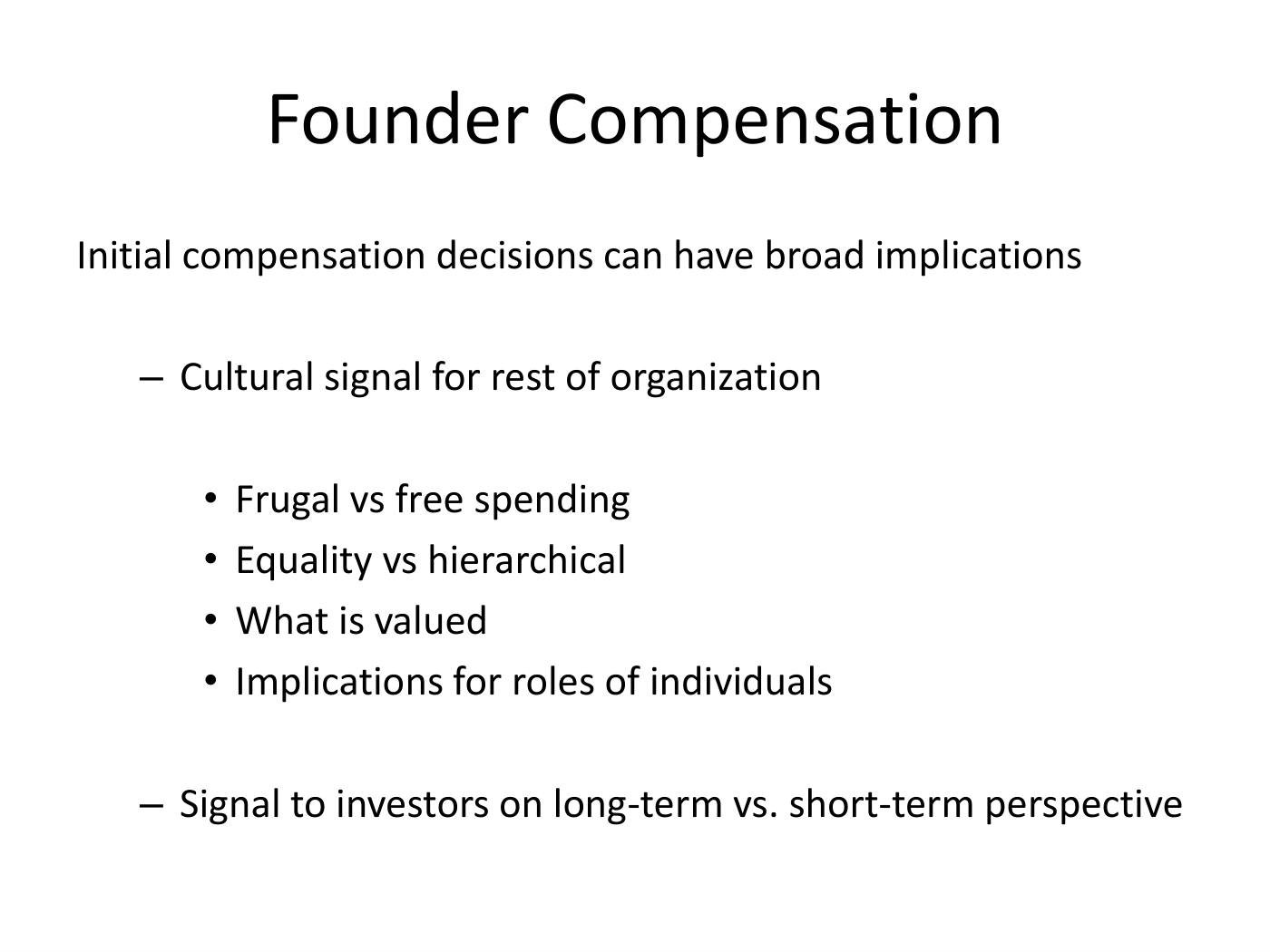
Compensation also sends an organizational signal
Who is paid first and why?
How are role differences explained?
What can the company afford?
What expectations will future hires and investors infer?
21
24 / TheoryFounders, equity splits & compensation
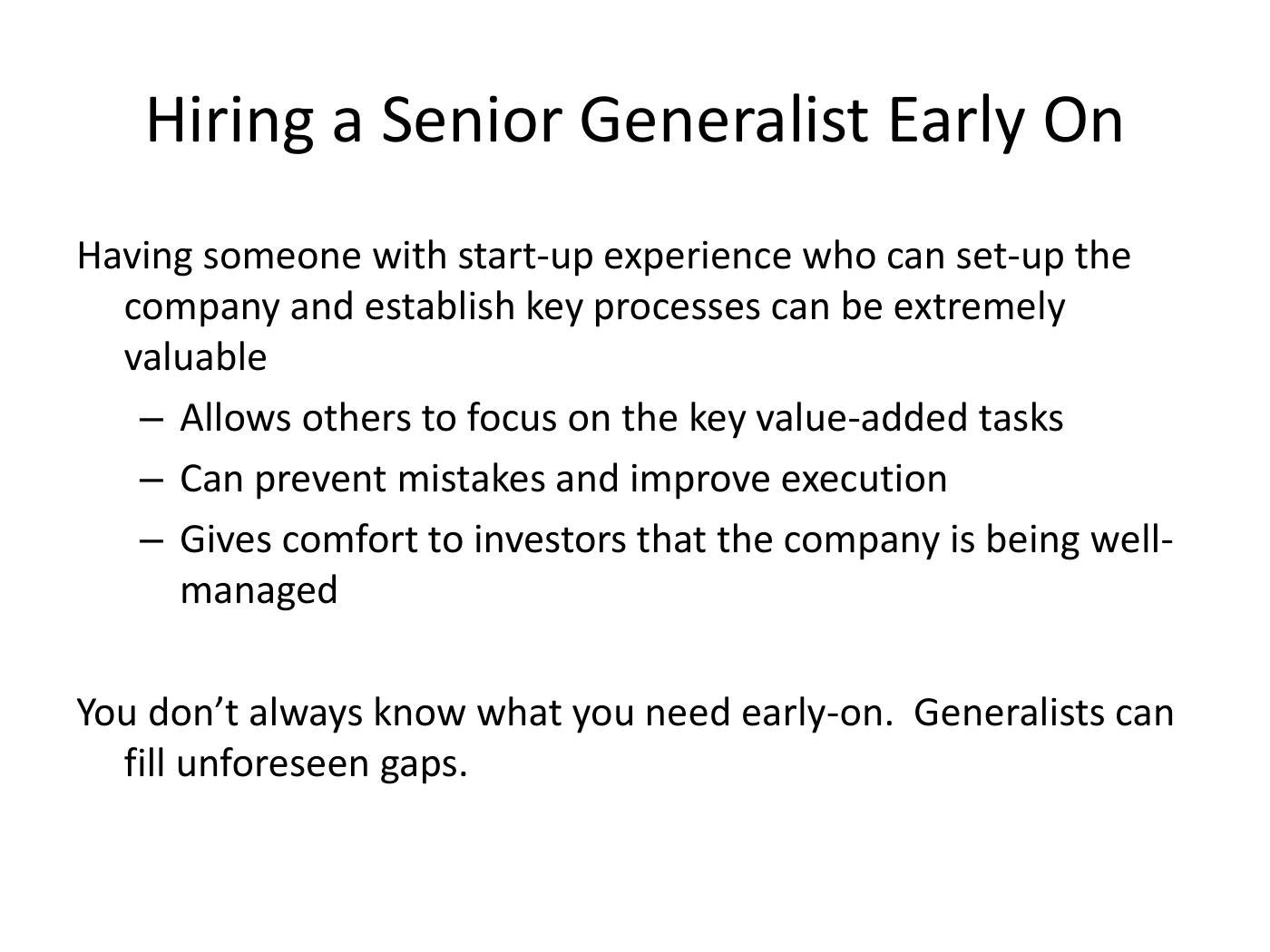
Hire a senior generalist?
Hiring a senior executive makes sense when a defined operating problem requires the relevant capability. A prestigious title does not establish fit with the company’s stage.
Potential benefit
Establishes processes, fills unknown gaps and frees specialists for essential technical work.
Potential cost
Consumes scarce cash and equity; creates role and compensation comparisons the founders must explain.
Worked application
Illustrative application: a small engineering team might need a leader who can personally establish the first sales process. A manager skilled at operating a large established department may require systems and specialists the venture cannot yet support. Examine the work to be done and the resources available.
Tie the role, decision authority and compensation to observable responsibilities and the next operating milestone.
22
24 / TheoryFounders, equity splits & compensation
A founder agreement is a continuing governance tool
Roles and contributions can change.
Define how changes are discussed and documented.
Separate fairness judgments from the arithmetic of share counts.
Make difficult departure conversations possible before they are urgent.
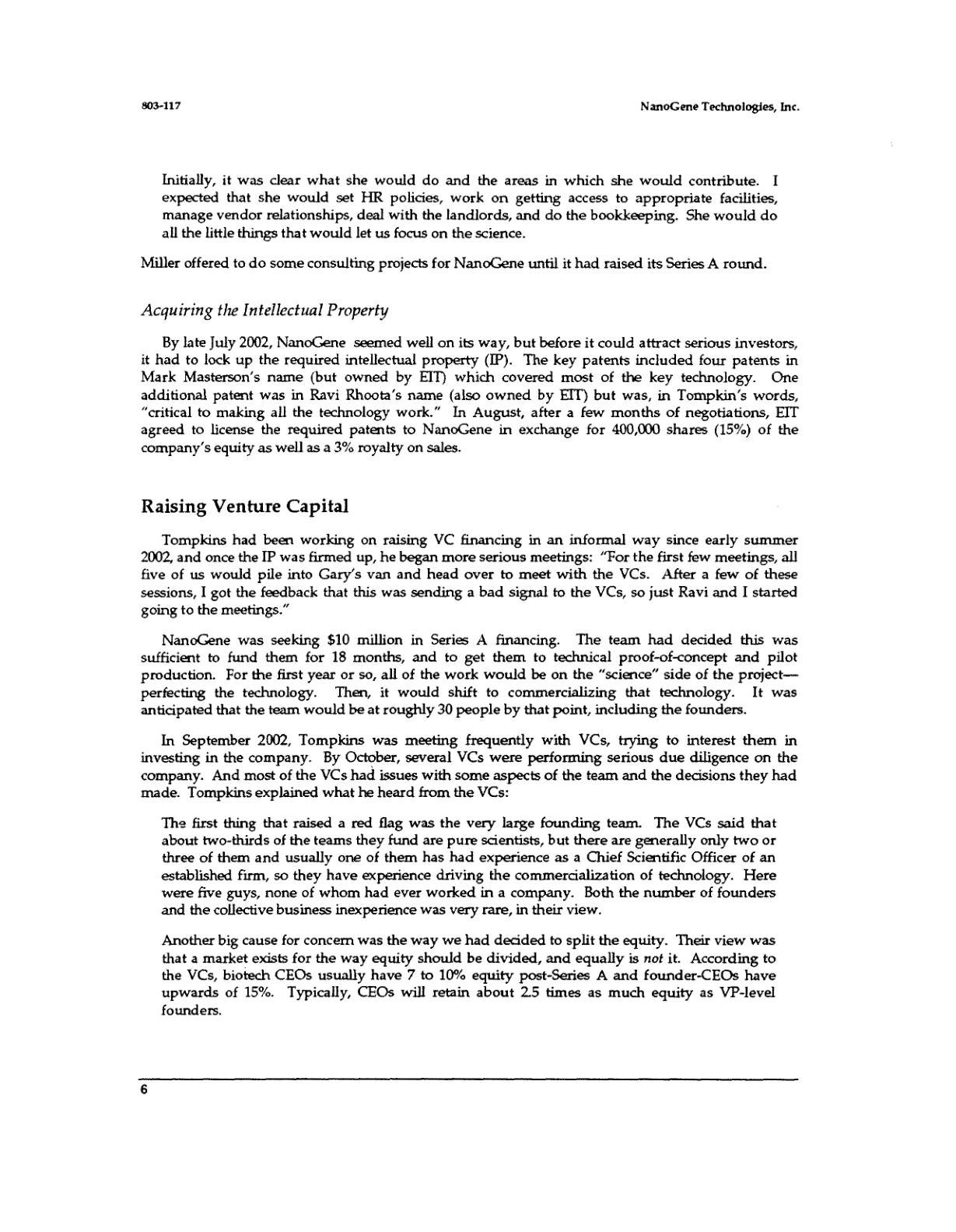
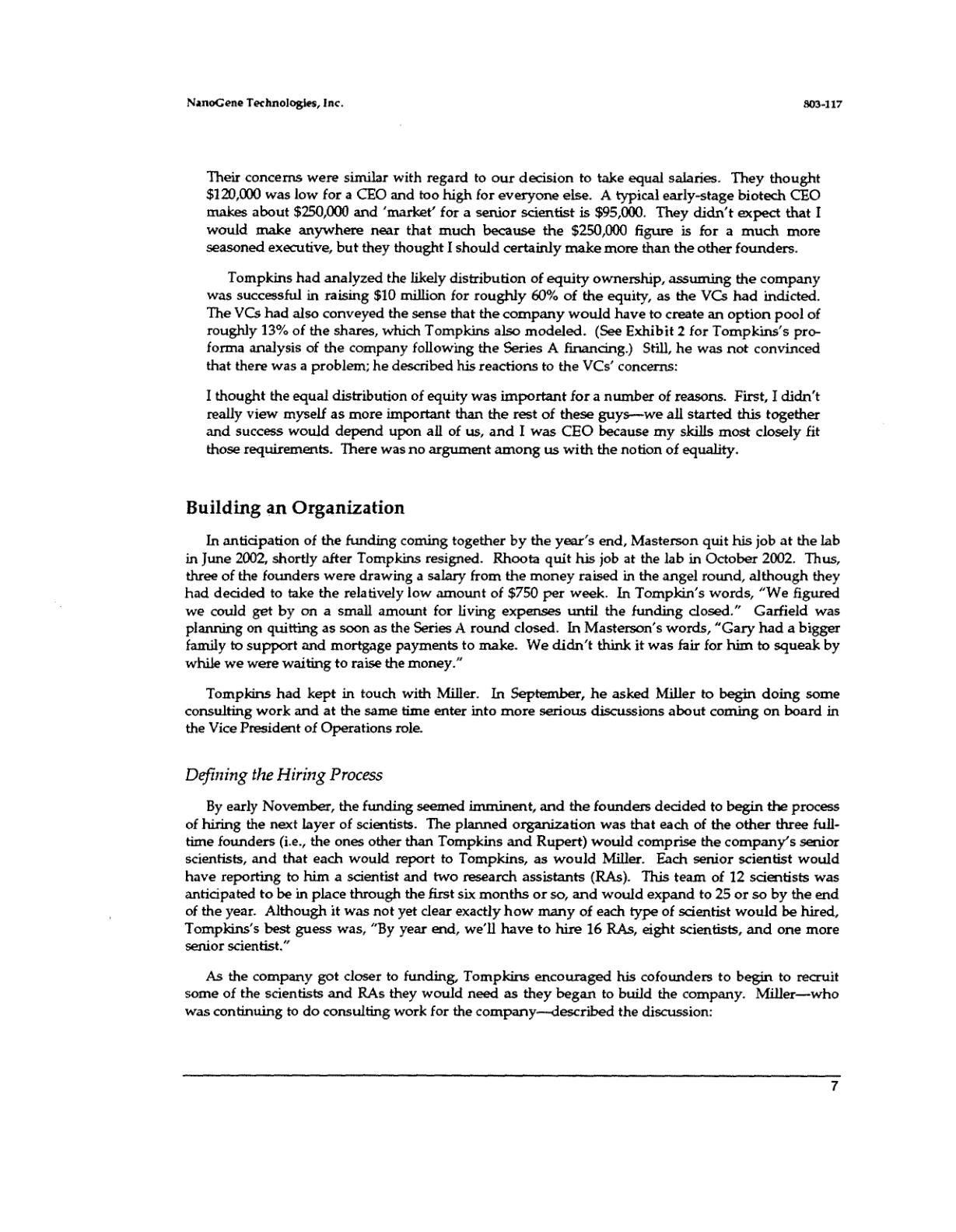
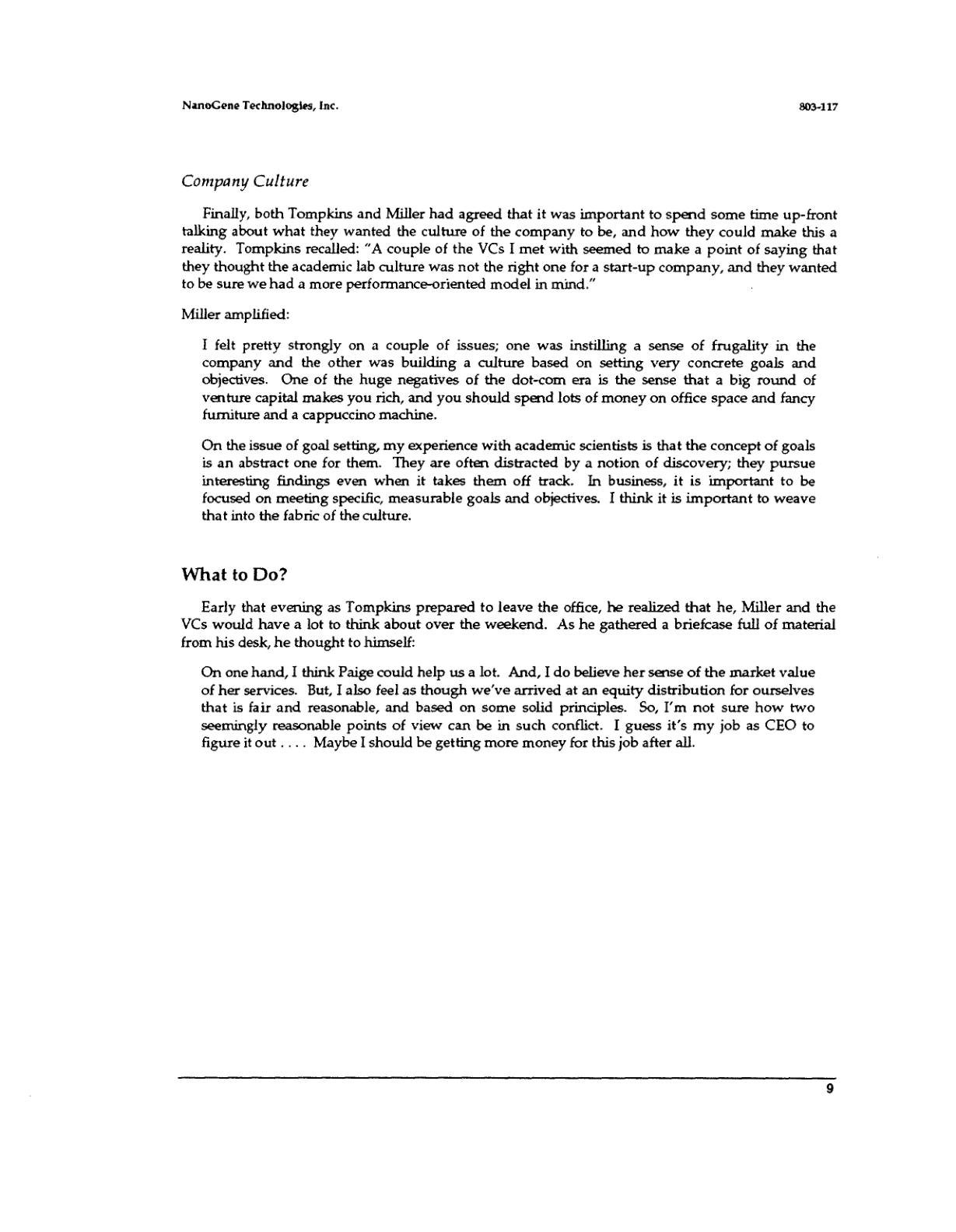
NanoGene: contributions and expectations / summary
Selected reading: PDF pages 2, 3, 4, 5, 6, 7
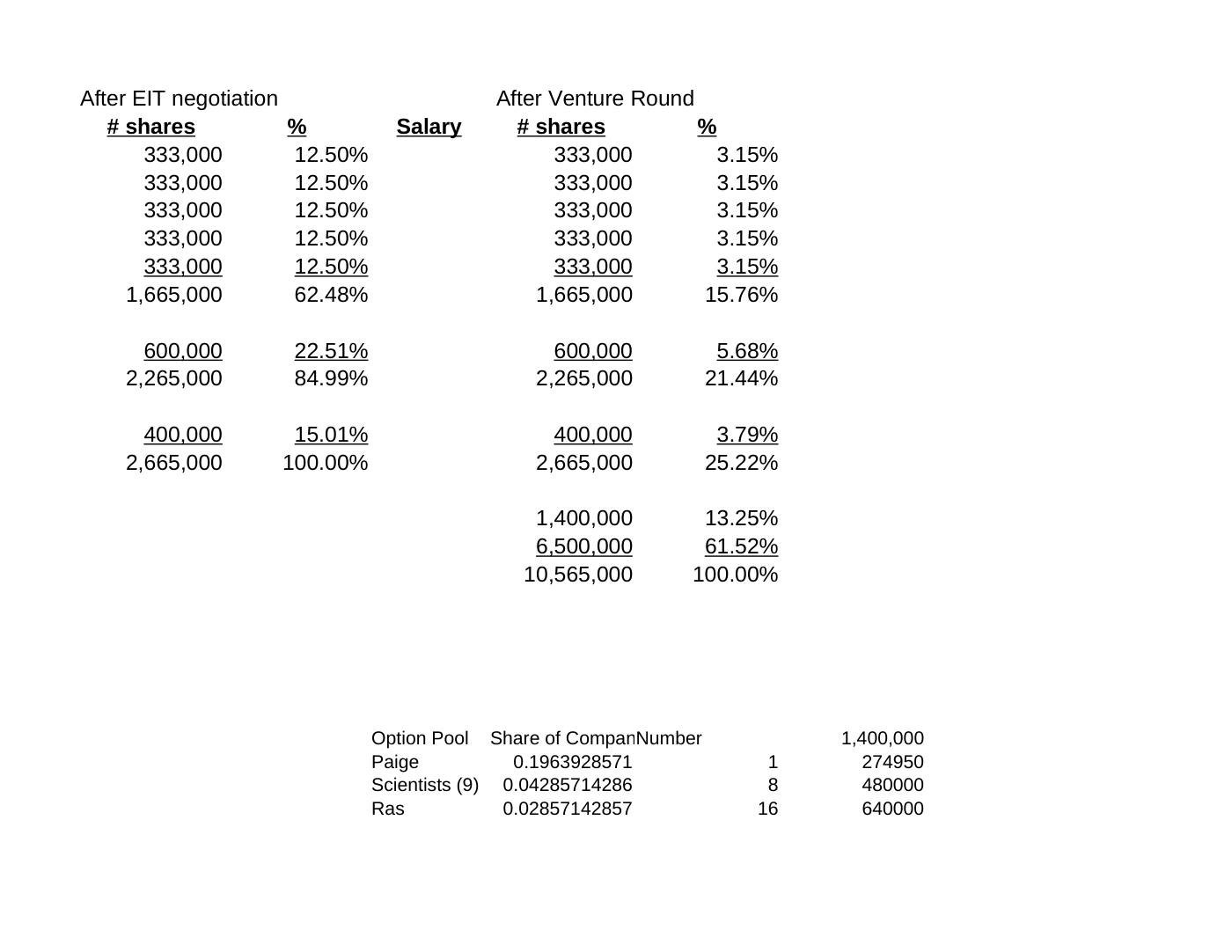
The selected case pages place an academically trained founding team in a negotiation over ownership, compensation and missing operating capability. Several reasonable definitions of fairness produce different proposed arrangements.
A founding rationale
The team chooses equal ownership and intended equal pay to recognize a shared beginning and protect cohesion.
An operating gap
Paige Miller brings experience in manufacturing and other company functions. The founders want help with work that allows them to concentrate on the science.
External expectations
Prospective investors question the size and business experience of the founding team and the relationship between roles, equity and salary.
Financing changes the allocation
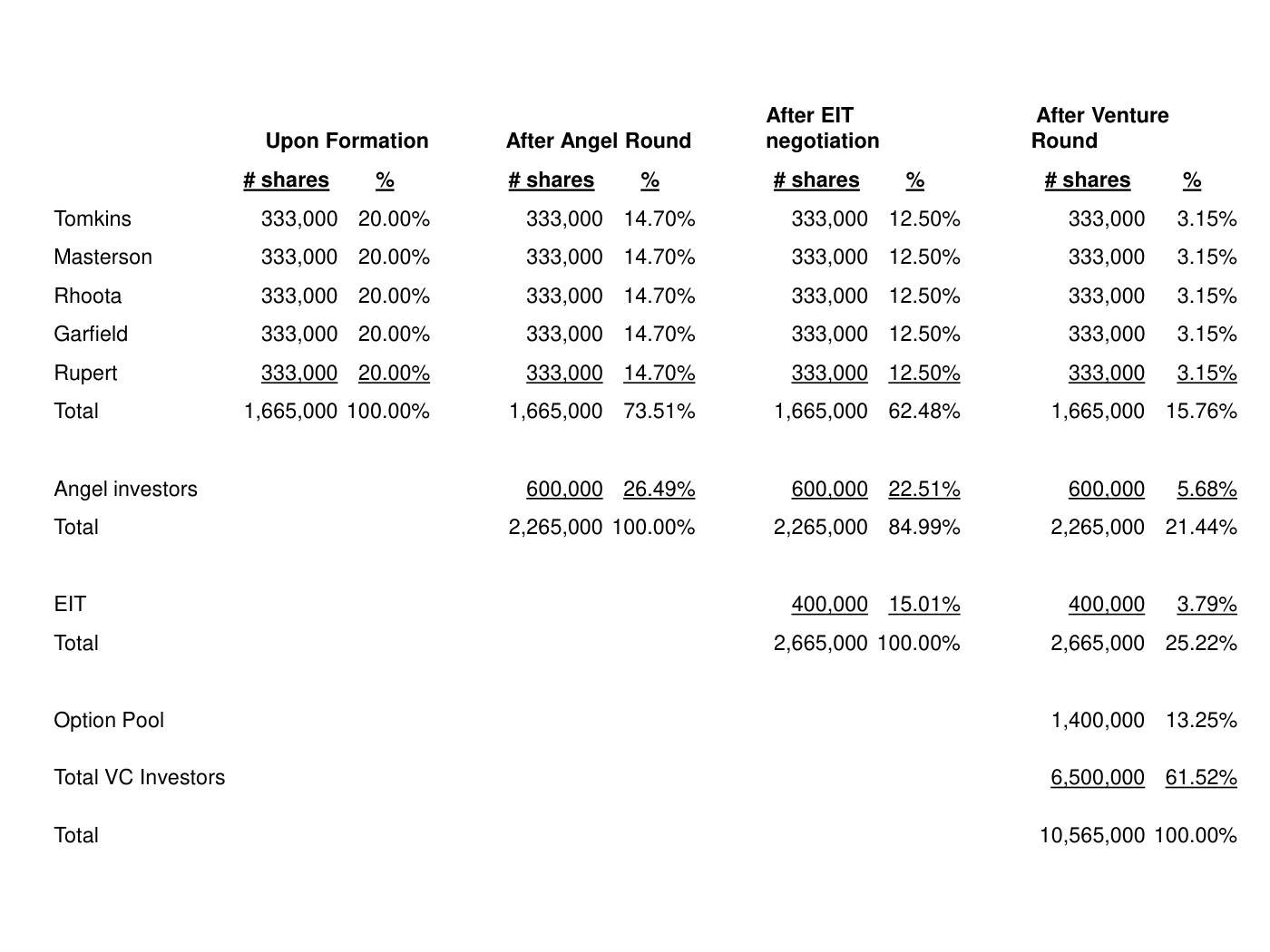
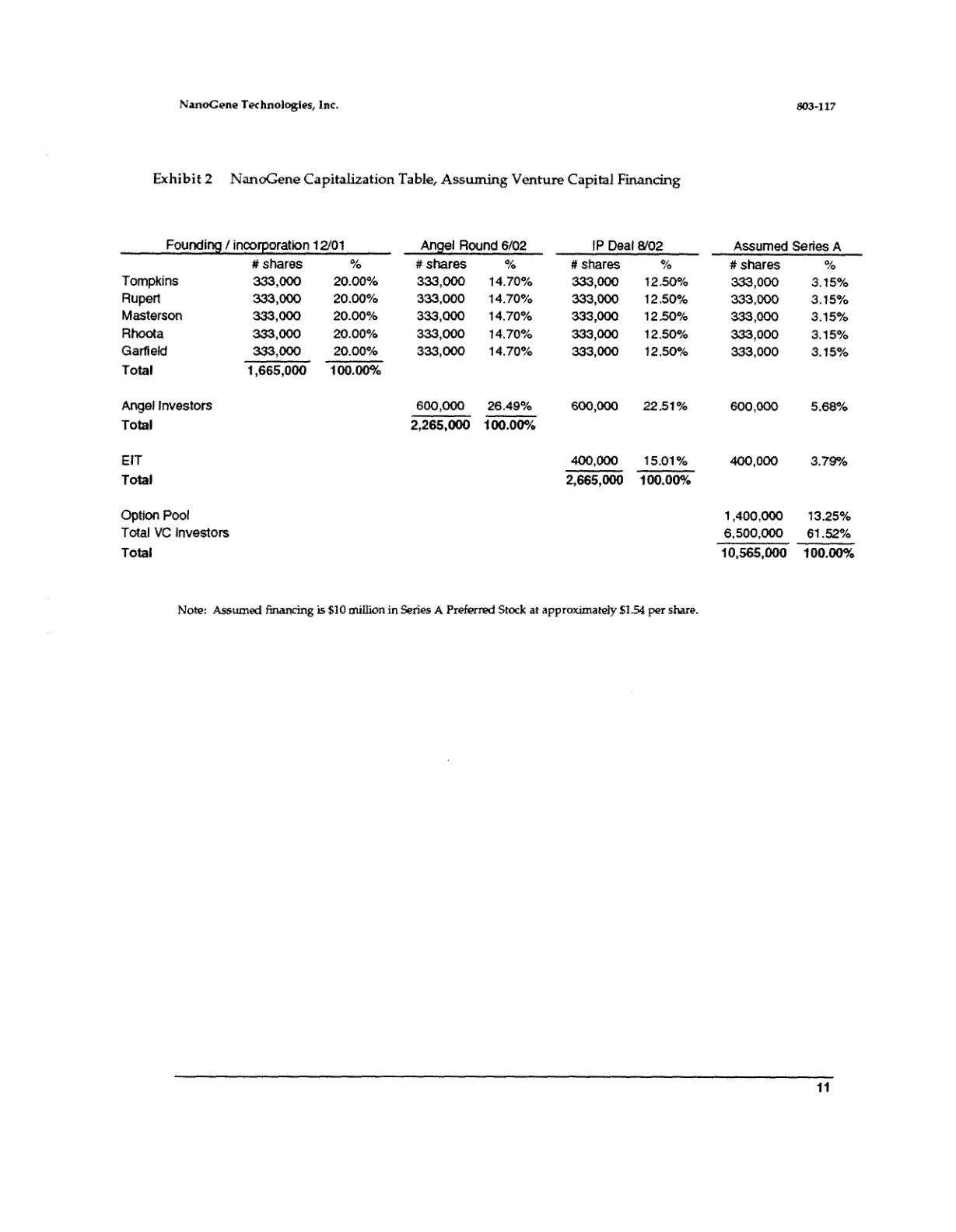
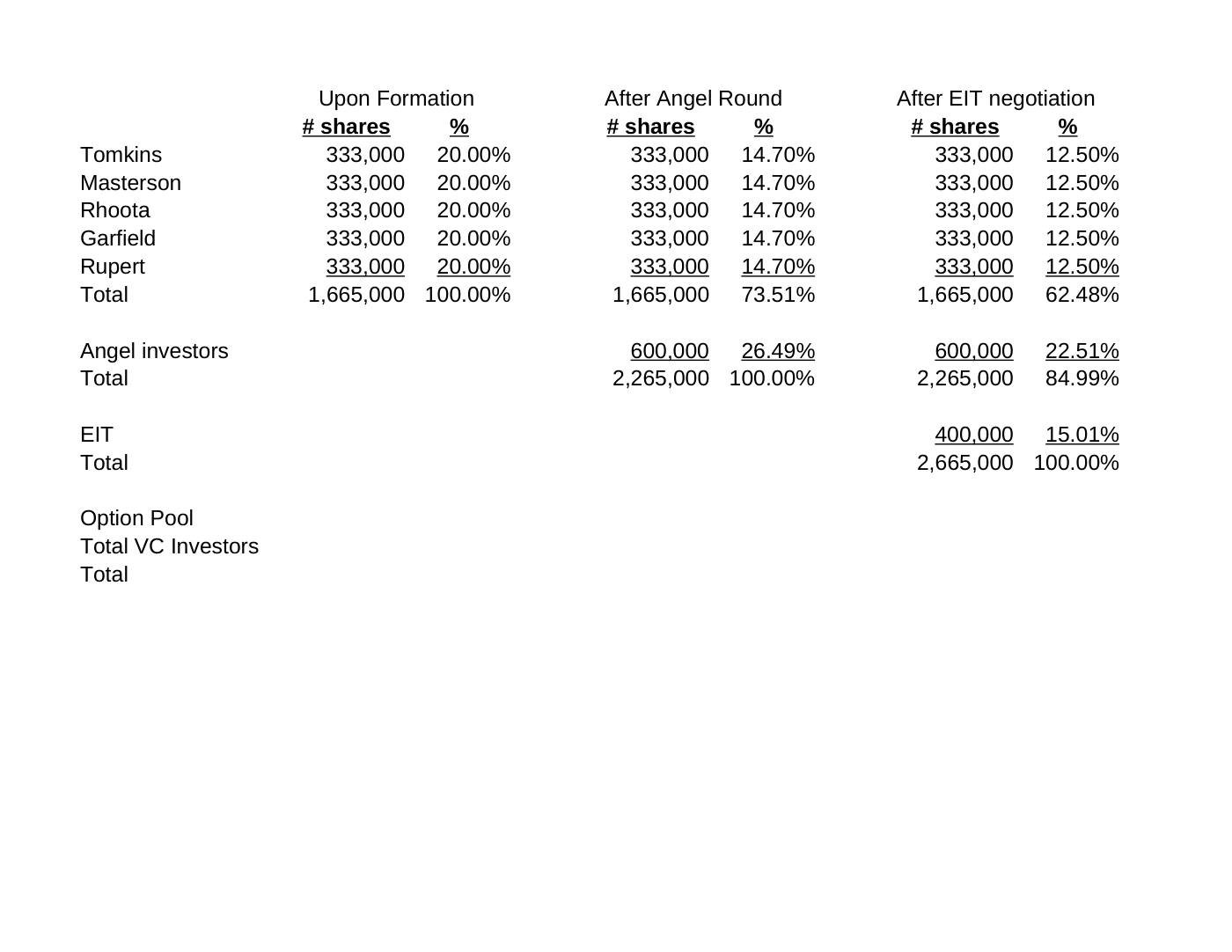
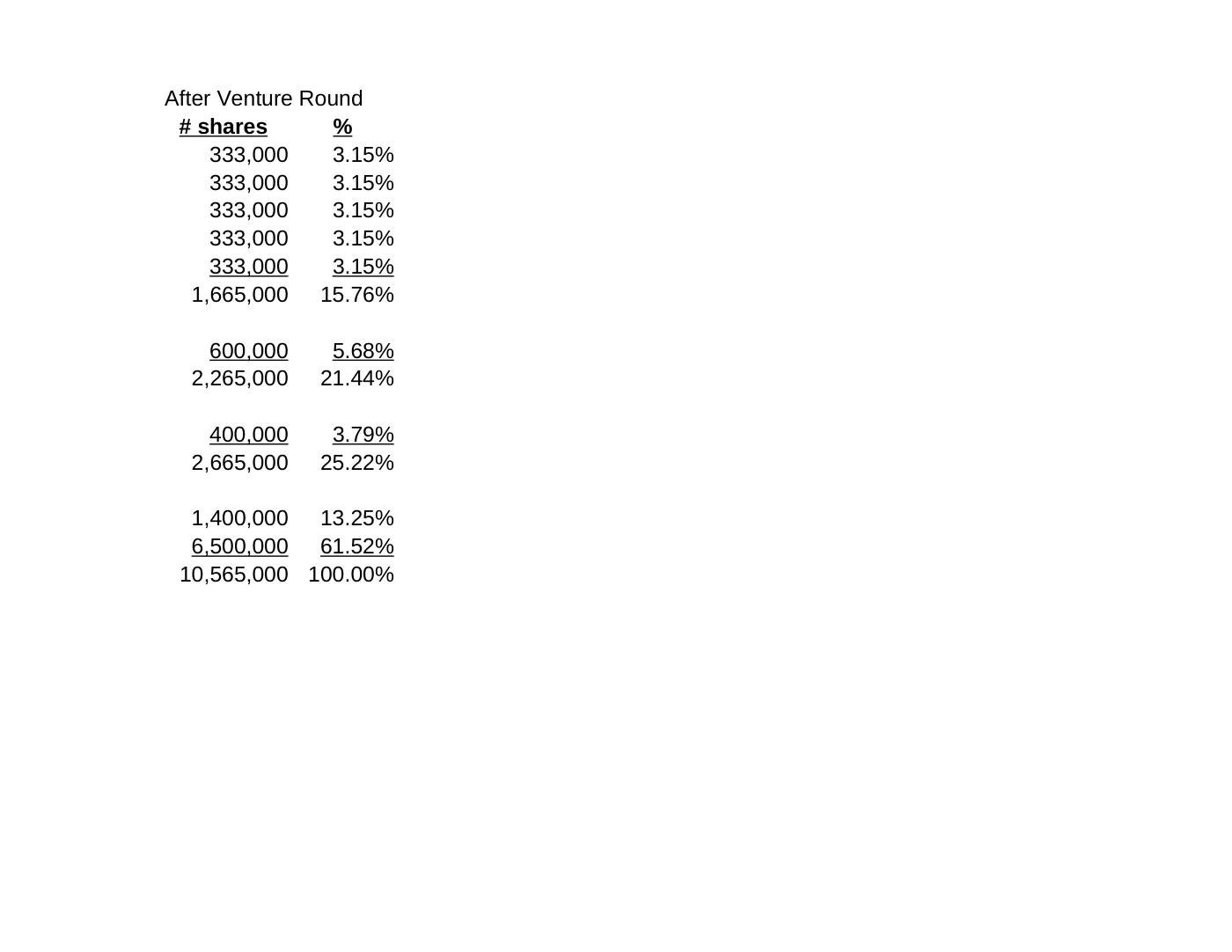
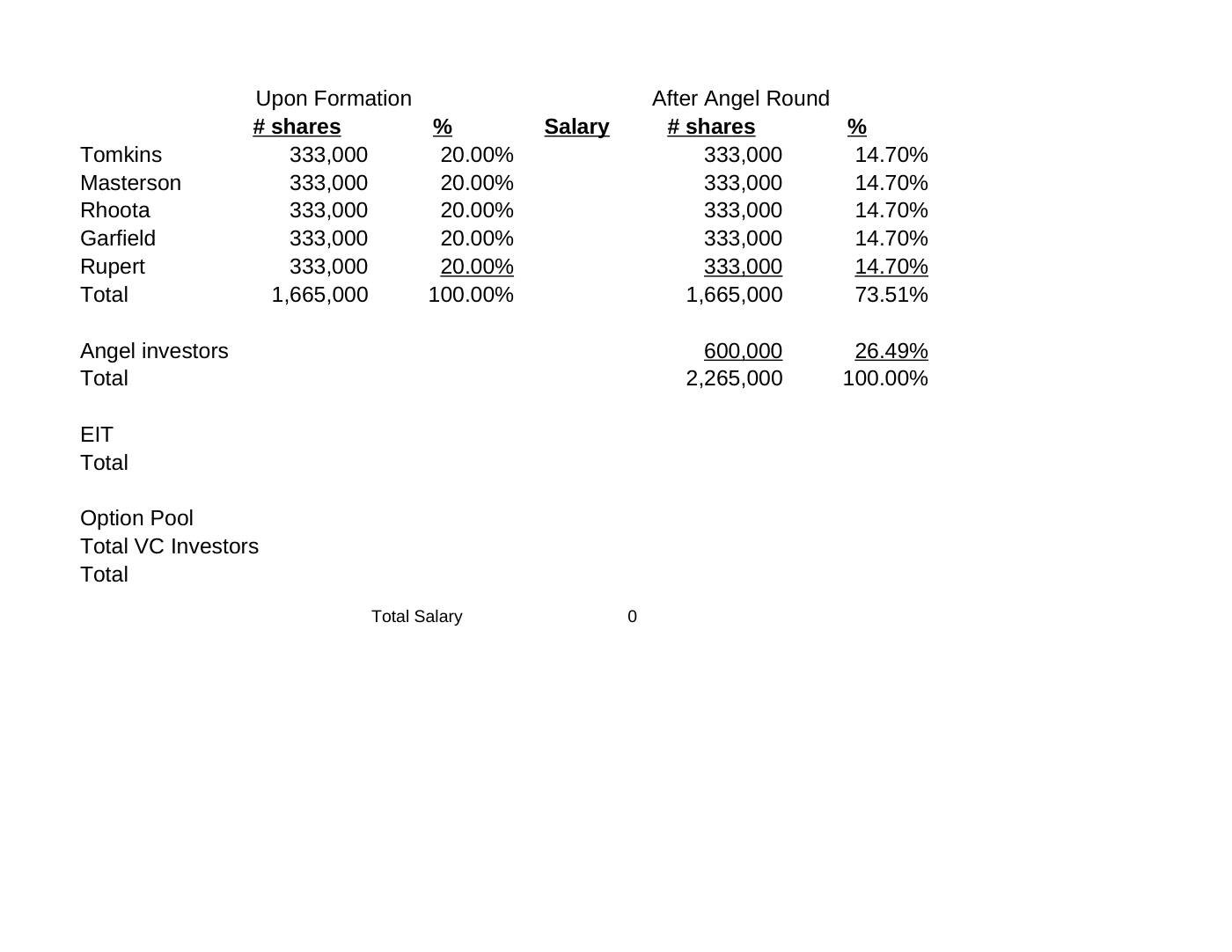
New money, licensed IP and an option pool affect the ownership available to founders and recruits. Each percentage needs a defined stage and denominator.
NanoGene: contributions and expectations / discussion
Selected reading: PDF pages 2, 3, 4, 5, 6, 7
Critical points
Several fairness criteria
Equality, prior contribution, market alternatives and future responsibility are different principles. Identify the principle behind each position before negotiating a number.
Historical compensation
The case reports period-specific salary and equity views. Use them to analyze the disagreement rather than present them as current hiring benchmarks.
A complete arrangement
Ownership, pay, authority and continued contribution interact. Settling one headline percentage can leave the most important expectation unresolved.
The archived case describes a scientific founding team with different roles and time commitments. Recruiting an experienced operations executive raises questions about salary, post-financing equity and how those choices fit the founders’ expectations.
Which criteria should govern founder ownership and the new hire’s package?
32
24 / Current practiceFounders, equity splits & compensation
Current practice: founder stock elections and tax rules (2024-2026)
A standard 83(b) form and online filing
The IRS released Form 15620 in late 2024 as a standardized Section 83(b) election, and in 2025 enabled electronic submission through an IRS online account. The 30-day deadline from the stock transfer is unchanged, and a copy still goes to the company. Choose one filing method and keep proof of timely filing.
QSBS is more generous for stock acquired after July 4, 2025
The One Big Beautiful Bill Act changed Section 1202 for qualified small business stock acquired after July 4, 2025. Partial gain exclusion now starts after three years (50%), rising to 75% after four and 100% after five. The per-issuer cap rose to the greater of $15 million or 10x basis, and the corporation's gross-asset limit rose to $75 million. QSBS applies only to stock of a domestic C corporation, which links this lesson to L25's entity choice. Eligibility depends on current law and facts.
Equal splits are becoming more common
Carta's 2025 founder ownership report found that 45.9% of two-founder startups split equity equally in 2024, up from 31.5% in 2015. Among three-founder teams the share rose from 12.1% to 26.9%. An equal split is now common, but it still needs a reason.
Fictional adaptation: one founder is full-time CEO, one is a full-time scientist, and one is an advisor one day a week. All contributed to the idea. The company wants an experienced operations hire but has limited cash.
Your task
Propose allocation criteria, distinguish salary from equity, and list the questions needed before setting percentages. Do not assume there is one correct split.
Venture step: Relay's founder split, vesting and Priya's grant
Relay · venture step 24
Relay incorporates with 10,000,000 common shares: Maya 5,200,000 (52%), Daniel 4,800,000 (48%). Maya lived the problem, recruited the 3 pilot clinics and went full-time two months before Daniel. Both take 4-year vesting with a 1-year cliff and file 83(b) elections. A 1,000,000-share option pool is reserved at the pre-seed SAFE. In month 9 Priya Raman joins as Head of Growth with a 300,000-share option grant; two engineers receive 50,000 each, so 400,000 are granted before the seed.
Your task
Write a one-page founder allocation brief: the rationale for 52/48, the vesting schedule with numbers, what happens if either founder leaves at month 11 or month 18, the 83(b) decision, and Priya's grant expressed as a percentage after the seed and Series A.
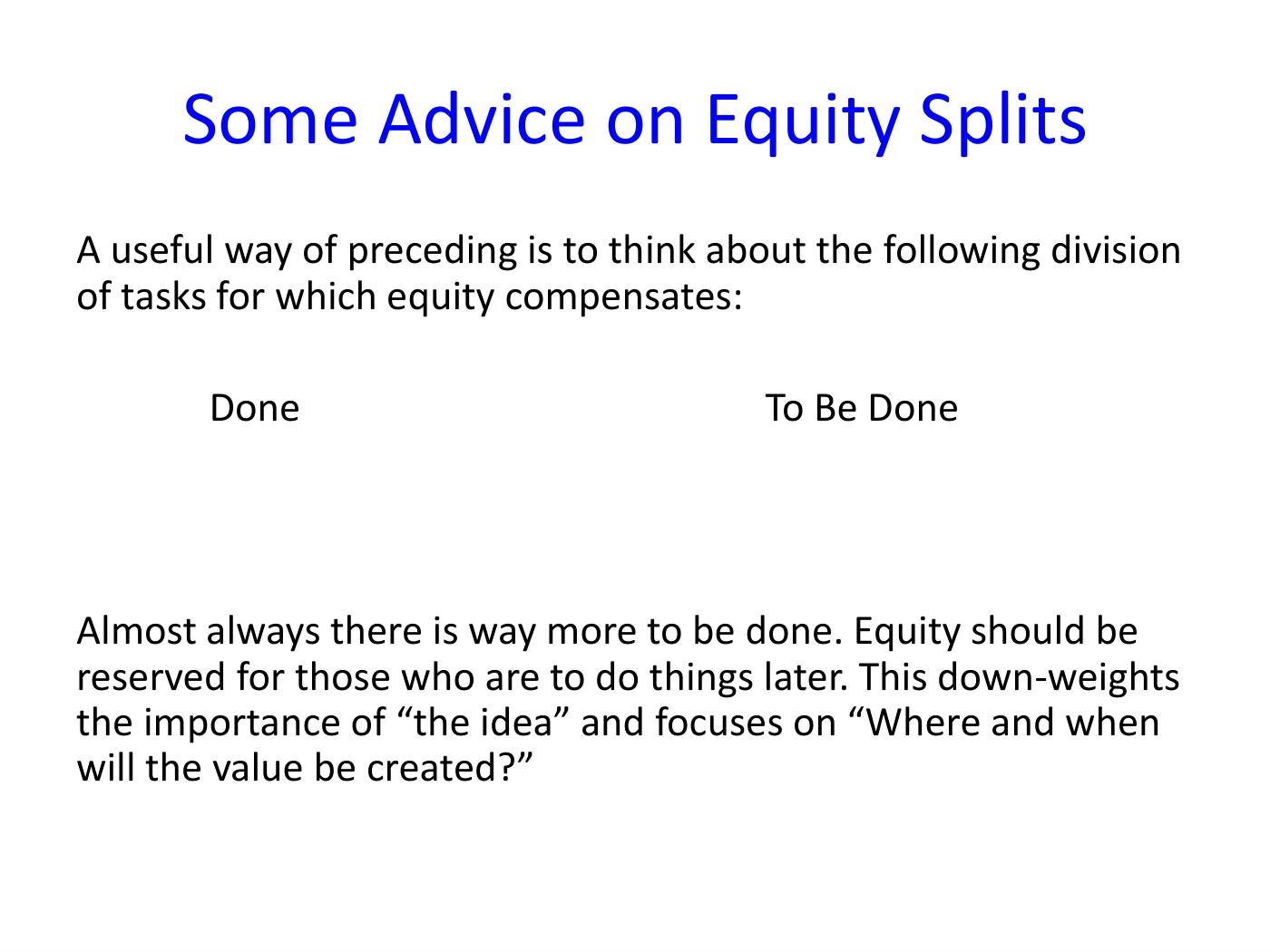
Rationale: the 4-point premium pays for done work (customer insight, pilot clinics, two months' head start). The other 96% of the split pays for work still to be done, where both founders are full-time and roughly equally hard to replace. The gap is small enough that neither founder reads it as a senior/junior partnership.
Vesting: Daniel vests 4,800,000 / 48 = 100,000 shares a month, Maya 5,200,000 / 48 = 108,333. With a 1-year cliff, nothing vests until month 12, when 25% vests at once (Daniel 1,200,000; Maya 1,300,000). If Daniel leaves at month 11, the company can repurchase all 4,800,000 at his original price. At month 18 he keeps 18/48 = 1,800,000 vested shares and the company can repurchase 3,000,000.
83(b): founders buy at a near-zero fair market value, so electing within 30 days of the stock transfer means about $0 of ordinary income now, and later appreciation is generally taxed as capital gain. Without the election, each vesting tranche is ordinary income at its value on that date. At an illustrative $0.30 per share at Maya's cliff, that is 1,300,000 x ($0.30 - $0.0001) = $389,870 of income with no cash to pay the tax.
Priya: 300,000 options are 300,000 / 17,102,041 = 1.75% of the post-seed fully diluted count and 1.40% after the Series A (x 0.8). All 400,000 granted options are 2.34% post-seed. Her grant is an option with an exercise price, not founder stock, and her title is Head of Growth, not co-founder.
Departure and acceleration: specify double-trigger acceleration (change of control plus termination without cause within 12 months) for both founders, the repurchase price for unvested shares, and a review of roles at the seed. Legal and tax application depends on current law and the facts, so counsel must review the documents.
The election must reach the IRS within 30 days of the stock transfer, and late elections are not accepted. Missing it can turn every vesting tranche into ordinary income at a value no founder can pay tax on.
Granting percentages instead of shares
Promising Priya '2%' leaves the denominator undefined. Grant a fixed share count (300,000) and show what it means after the seed (1.75%) and the A (1.40%).
Treating the split as the protection
Arguing over 50/50 versus 52/48 while leaving out the cliff, repurchase price or acceleration terms protects no one. Vesting and departure terms decide what happens when commitment changes; the split does not.
38
24 / ReviewFounders, equity splits & compensation
What you can now explain
Relay's founder allocation brief: the 52/48 rationale, both vesting schedules with month-11 and month-18 departure outcomes, the 83(b) decision, and Priya's grant in shares and as a percentage after the seed and Series A.
A split needs a stated rationale that weighs work done against work still to be done, which is almost always the larger share.
Vesting, the cliff and acceleration terms, not the headline percentage, govern what happens when a founder's commitment changes.
Founder stock with a timely 83(b) election and employee options differ sharply in tax timing; application depends on current law and individual facts.
Next lesson: Company formation & governance questions
39
Check your understanding
How should ownership and pay reflect future contribution and commitment?
Score
Question 1
Daniel holds 4,800,000 founder shares on 4-year monthly vesting with a 1-year cliff. He resigns at the end of month 18. How many shares can the company repurchase at his original price?
Vested = 4,800,000 x 18/48 = 1,800,000. Unvested = 4,800,000 - 1,800,000 = 3,000,000, which the company can repurchase. The cliff matters only before month 12; after it, vesting is cumulative from the start date.
Question 2
Same terms (4,800,000 shares, 4-year monthly vesting, 1-year cliff), but Daniel leaves at the end of month 11. How many shares does he keep?
Before the 1-year cliff nothing has vested, so the company can repurchase all 4,800,000 shares. 1,100,000 (11/48) is the tempting answer if you forget the cliff; 1,200,000 is what vests on the cliff date itself.
Question 3
Maya does not file an 83(b) election. At her 12-month cliff, 1,300,000 shares vest when the common stock's fair market value is an illustrative $0.30. She paid $0.0001 per share. Roughly how much ordinary income does she recognize at that date?
Without 83(b), income is recognized as shares vest: 1,300,000 x ($0.30 - $0.0001) = $389,870, with no sale to fund the tax. $1,520,350 wrongly uses the seed preferred price of $1.1695; common is normally valued below preferred.
Question 4
Priya's 300,000-share option grant: what percentage of Relay's fully diluted capitalization is it after the seed (17,102,041 shares) and after the Series A, which dilutes all prior holders by 20%?
300,000 / 17,102,041 = 1.75%; x 0.8 = 1.40% after the A. 2.34%/1.87% is all 400,000 granted options combined. A grant expressed as a percentage keeps shrinking with each round; the share count is what stays fixed.
Question 5
A founder who joined a startup two months after his co-founder says he should receive exactly 50% because 'we are both founders.' Which response best fits the evidence and reasoning in this lesson?
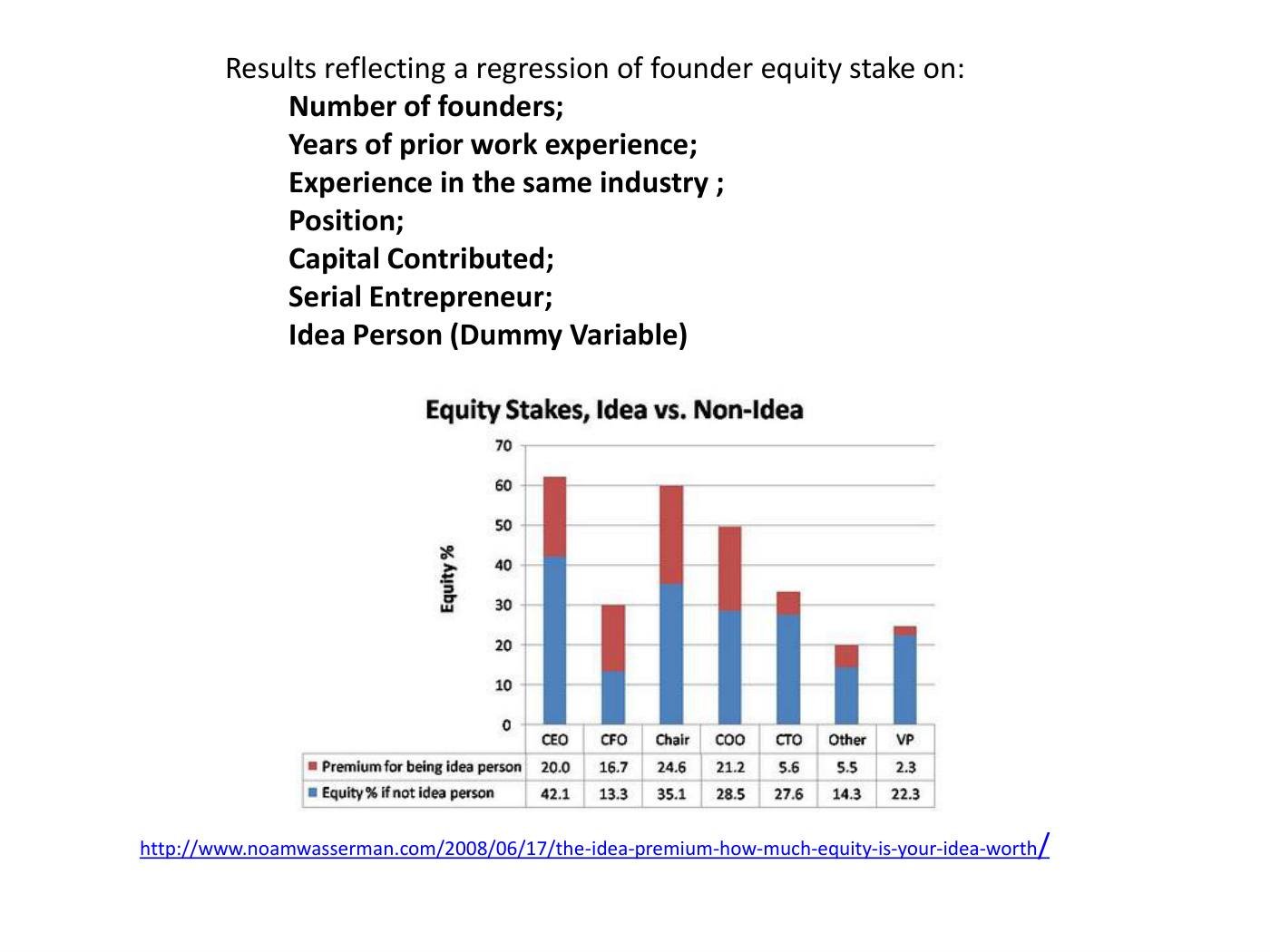
Founder is a title, not an allocation rule. Wasserman's 20-point CEO idea premium describes what teams did, not a norm. Most teams split unequally, and investors care more about a clear rationale and vesting than about equality.
Question 6
Relay's acquirer offers cash in year 3 and intends to dismiss Daniel. His agreement has double-trigger acceleration. When does acceleration apply?
Double trigger needs both events: the change of control and a qualifying termination. Single trigger would vest at closing. Agreements should also address an acquirer that cancels unvested awards in a cash deal before the second trigger can occur.
Workbook
How should ownership and pay reflect future contribution and commitment?
Module output: A founder discussion brief, governance questions, IP map and privacy data map.
Library
Every original page used in this lesson
10 appear in the slides with notes; the rest are kept here for reference.
Stock and vesting: the opening questionsA prompt slide that asks what stock is, why companies issue it, and what vesting is and why it exists. Questions only; the answers appear on the native vesting slides.Reiss - Founder & Equity Slides · PDF page 24
1
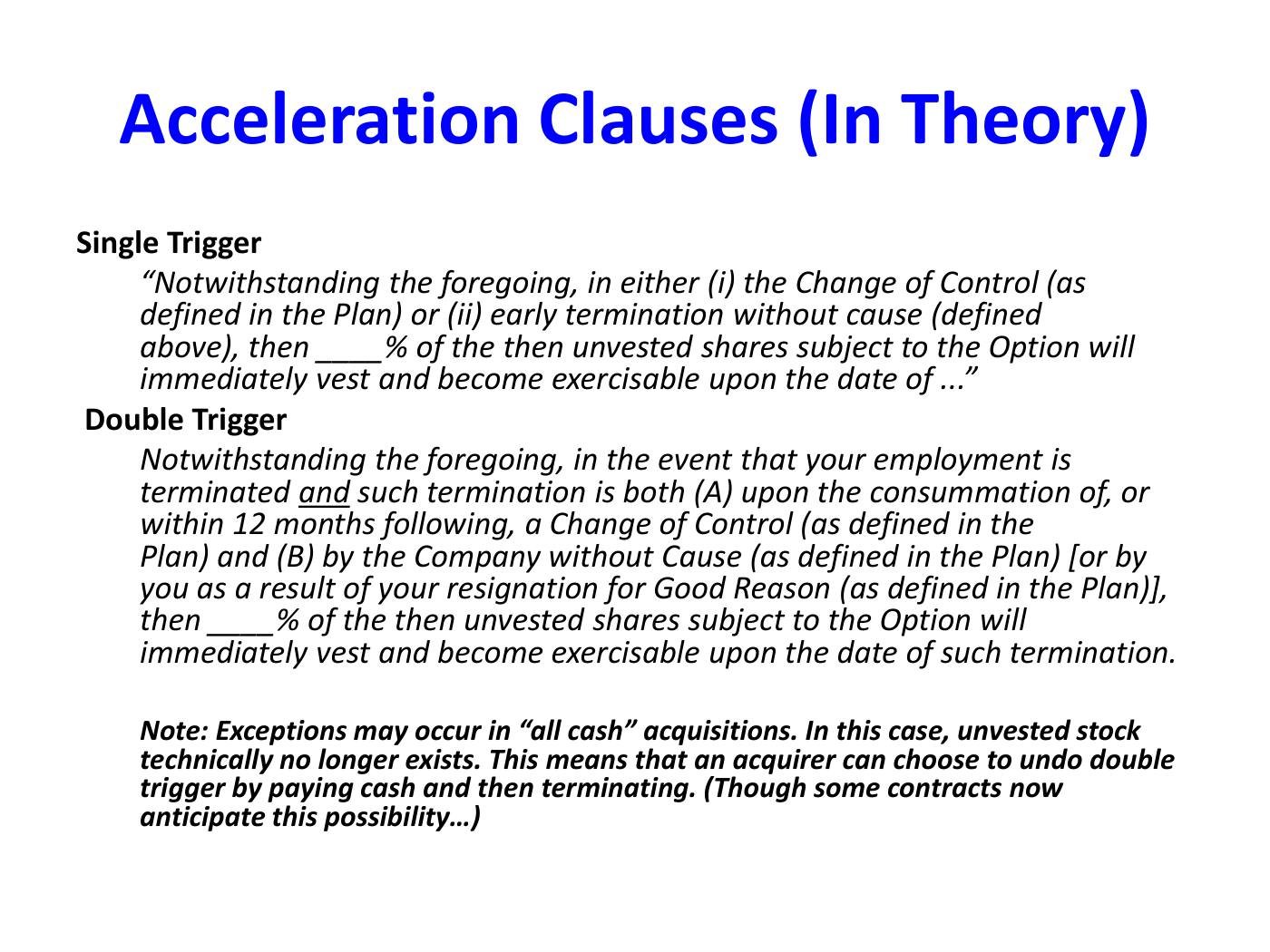
Single-trigger versus double-trigger accelerationSample option-agreement language. Single trigger accelerates a stated percentage of unvested shares on a change of control or on termination without cause. Double trigger requires both a change of control and a termination without cause, or a resignation for good reason, within 12 months. A note warns that in all-cash deals an acquirer may cancel unvested awards, which defeats double trigger unless the contract anticipates it. Single trigger rewards the founder at sale but makes the company harder to sell, because the buyer must re-incentivize a team that is already vested. Double trigger is the common investor-acceptable compromise. The percentage blanks are the negotiation, and the treatment of unvested awards in a cash deal needs explicit drafting.Reiss - Founder & Equity Slides · PDF page 25 · in the slides
2
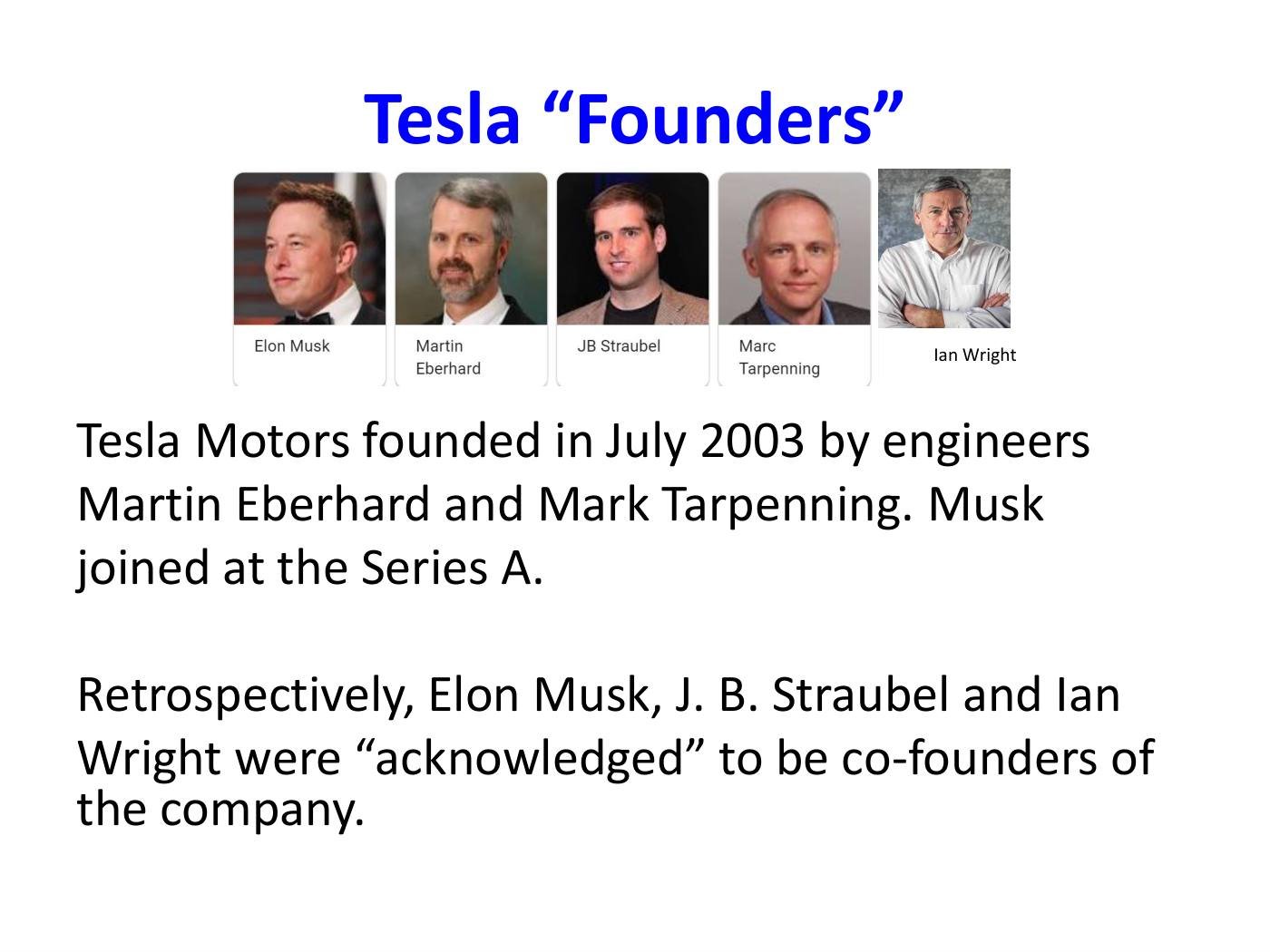
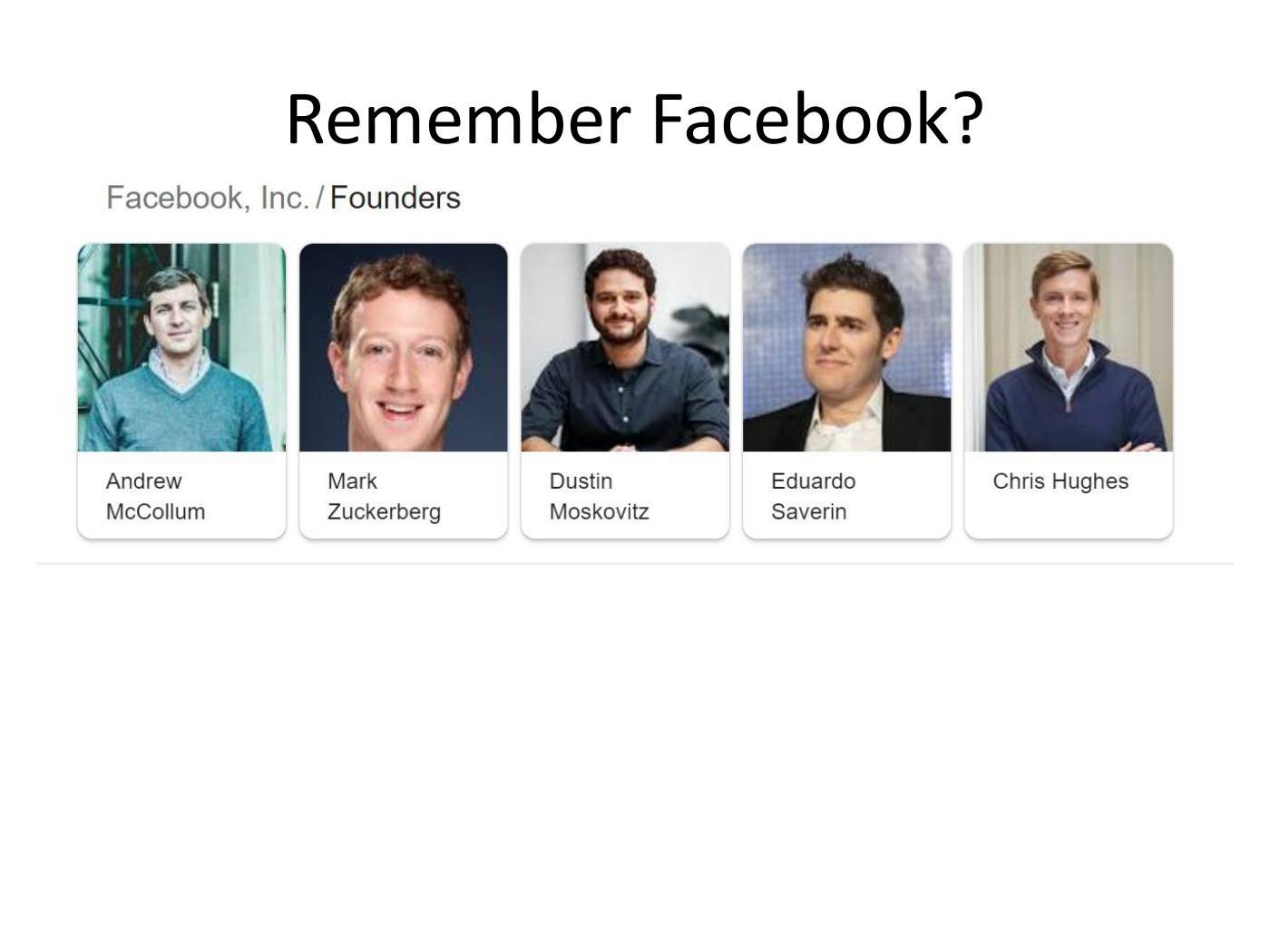
Tesla's retroactive co-foundersTesla was founded in July 2003 by Martin Eberhard and Marc Tarpenning; Elon Musk joined at the Series A, and Musk, J.B. Straubel and Ian Wright were later acknowledged as co-founders. The founder title can be negotiated after the fact, which is why it should not stand in for an ownership rationale.Reiss - Founder & Equity Slides · PDF page 27
3
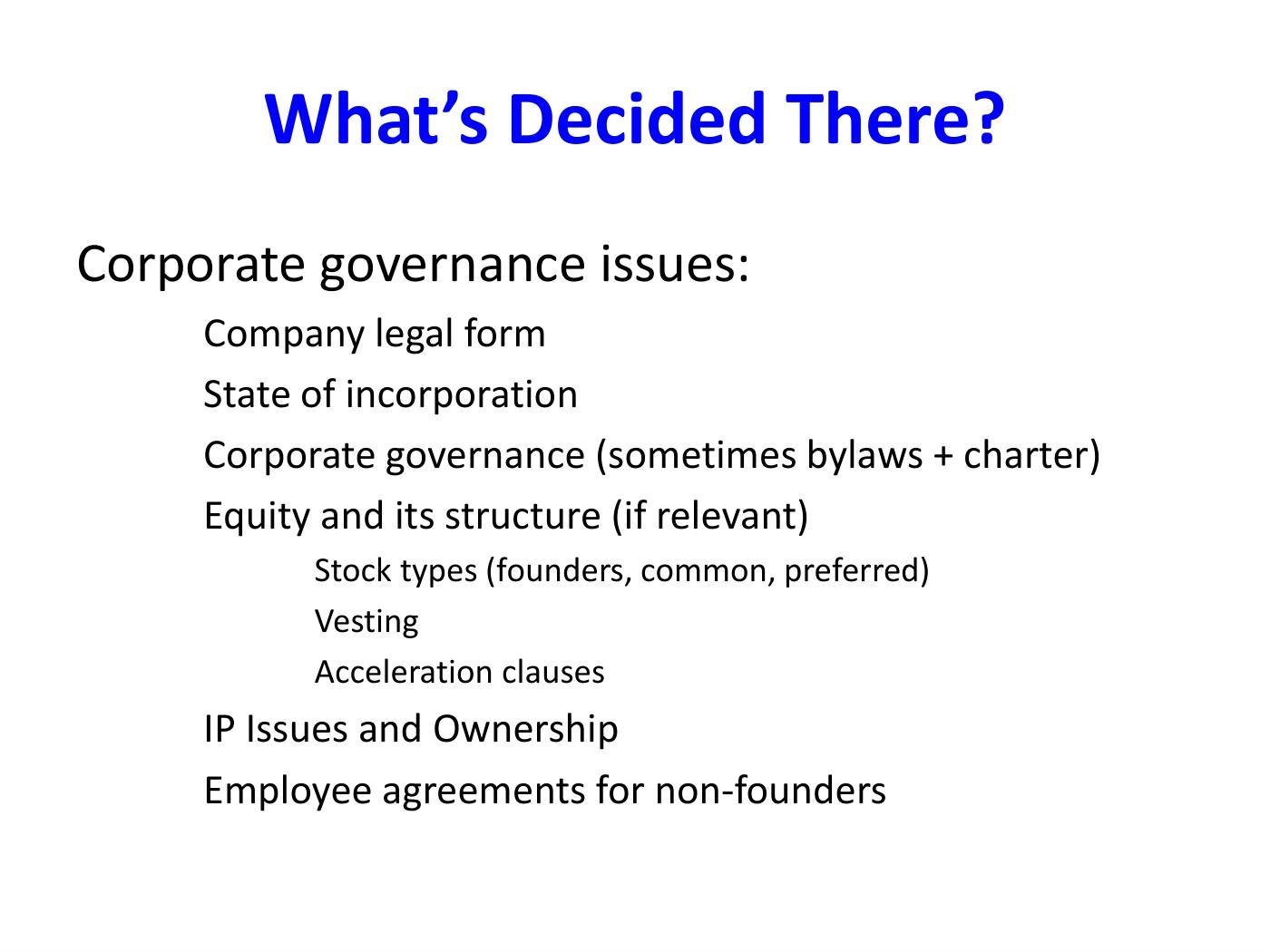
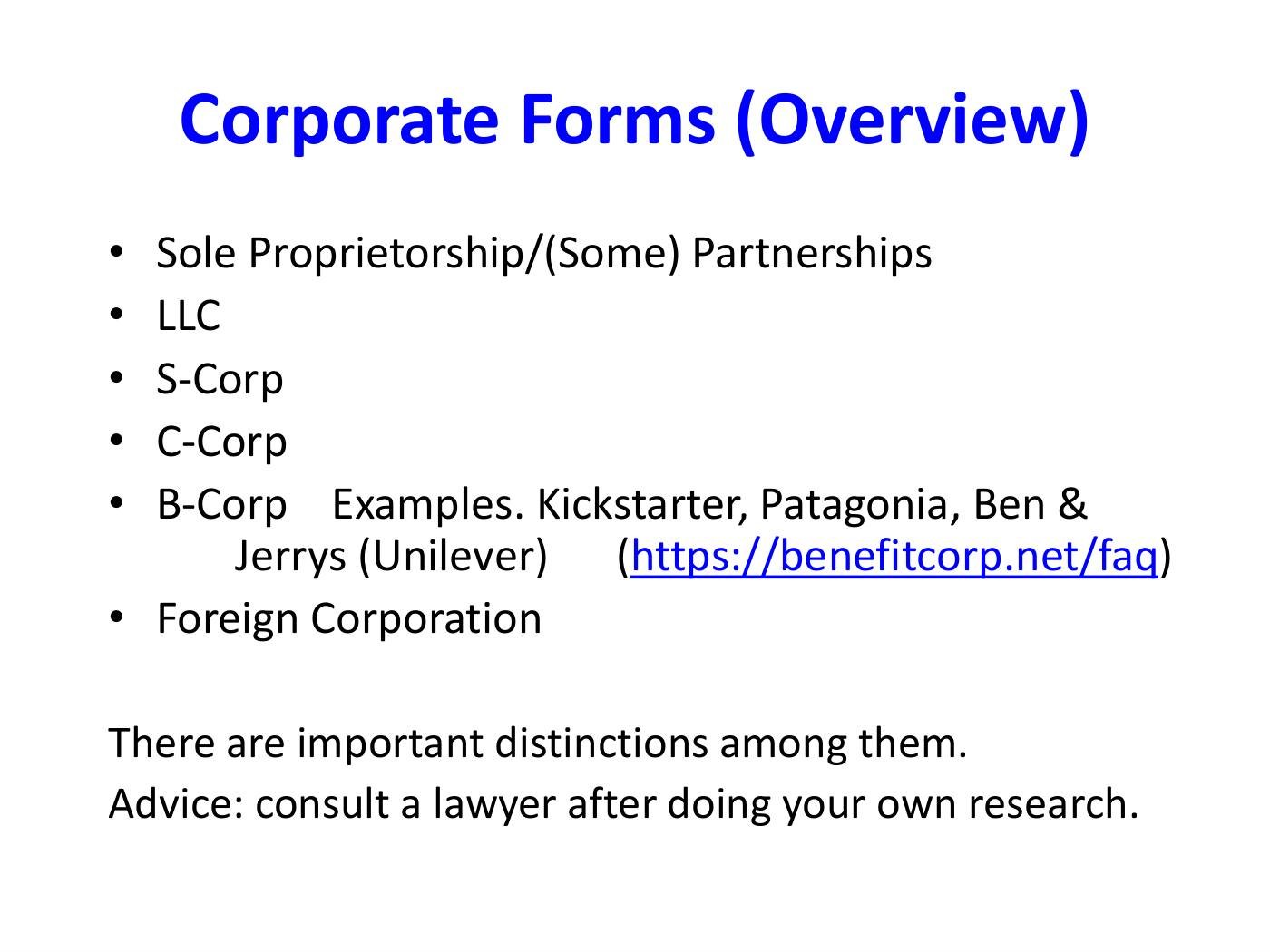
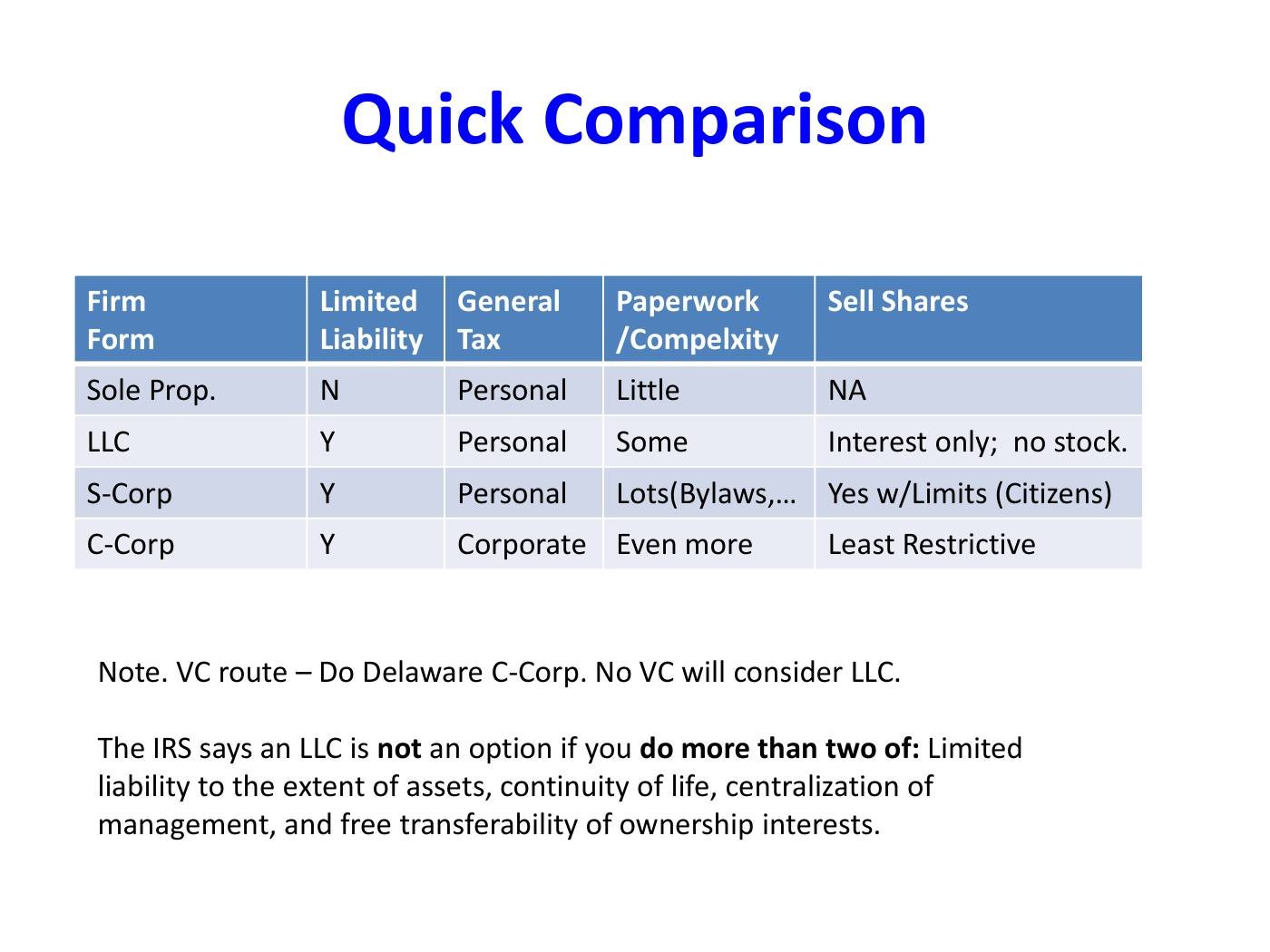
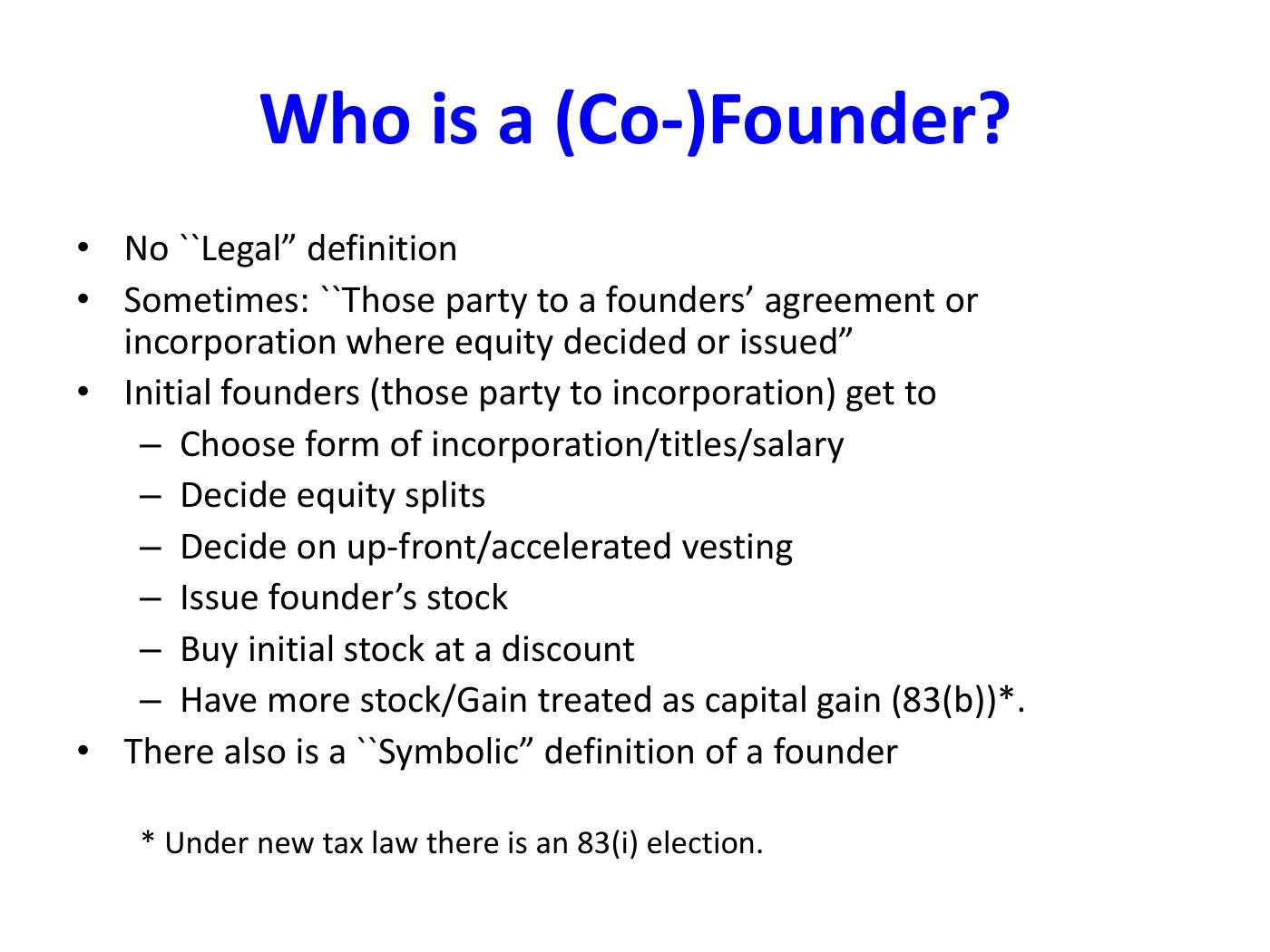
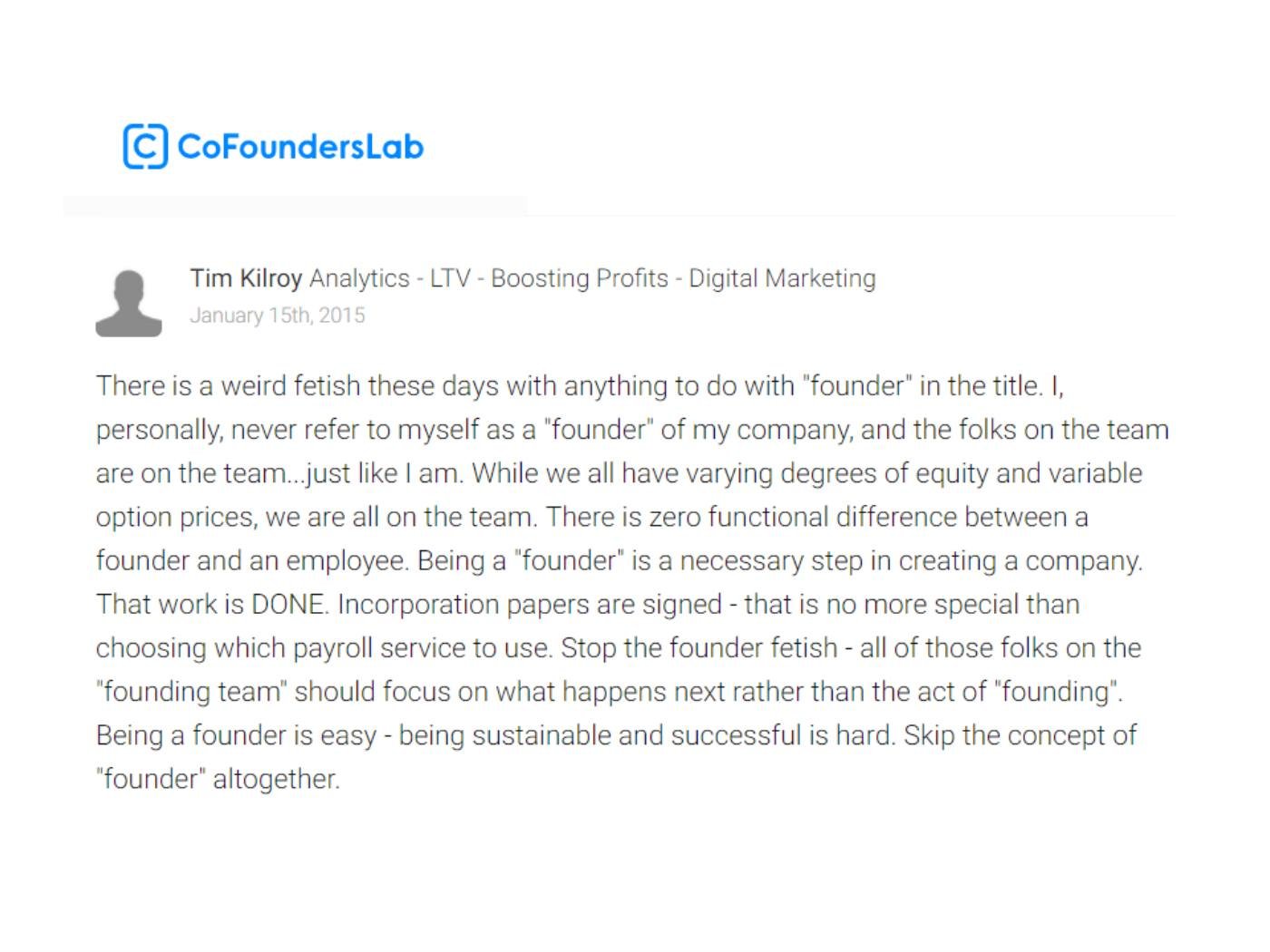
Who is a co-founder, and what the people at incorporation decideThere is no legal definition of founder. Those who are party to incorporation choose the entity form, titles and salaries, set the equity split and vesting, issue founder stock at a low price, and can file an 83(b) election so later appreciation can be taxed as capital gain. A footnote mentions the newer 83(i) election. Founder status is economic and organizational, not legal: whoever is at the table at incorporation sets the terms everyone later inherits. The 'buy at a discount' bullet is loose. Founders buy at a low fair market value because the company is worth little; buying below fair market value creates taxable income. Section 83(i) is a narrow deferral for certain employee grants, not a founder tool. Tax treatment depends on current law and individual facts.Reiss - Founder & Equity Slides · PDF page 28 · in the slides
4
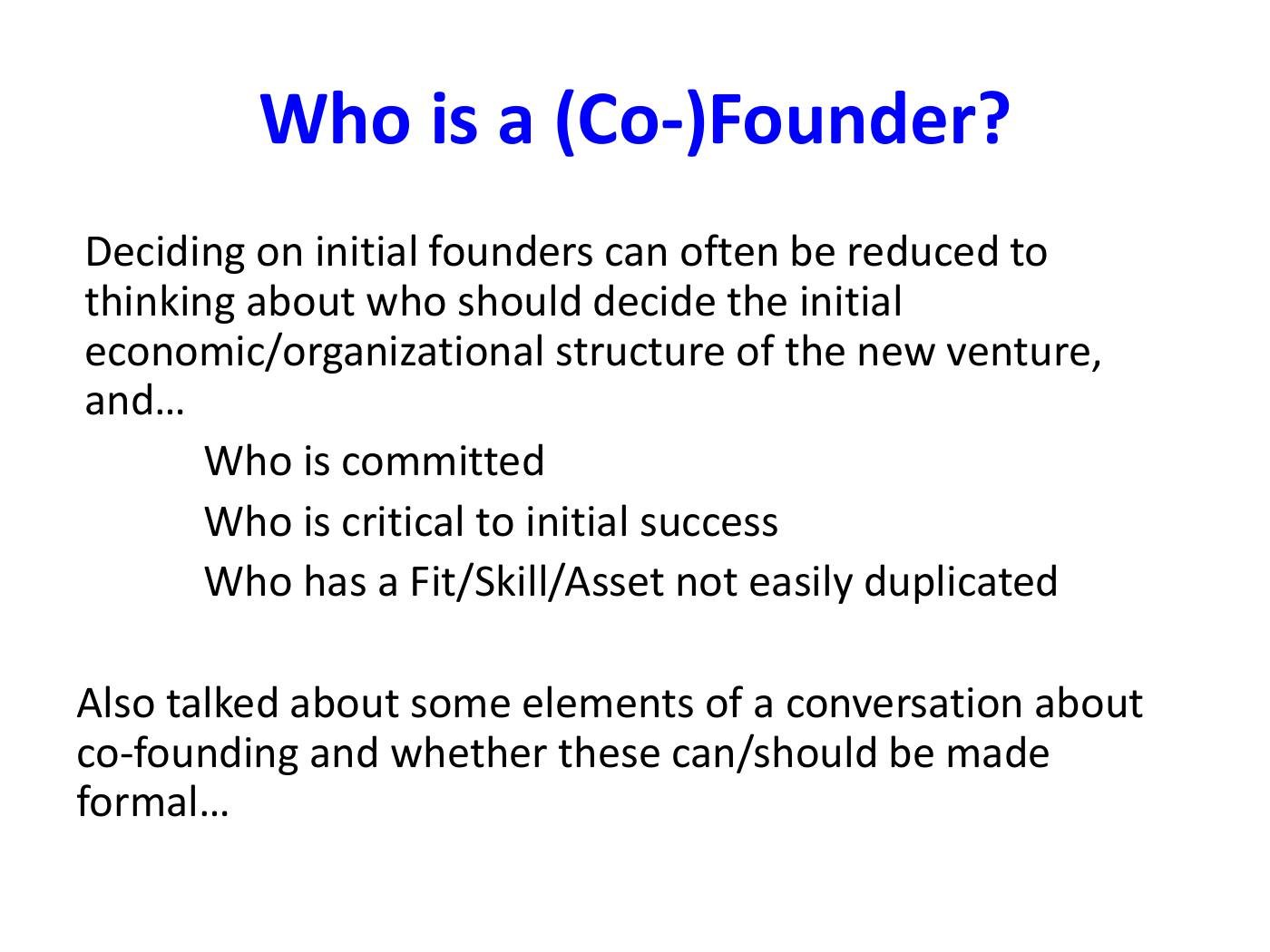
Co-founder criteria: commitment, criticality, scarcityChoosing founders reduces to deciding who sets the initial structure: who is committed, who is critical to early success, and who has a fit, skill or asset that is hard to duplicate. The three criteria reappear in the conversation points and the NanoGene table.Reiss - Founder & Equity Slides · PDF page 30
5
Section divider: what co-founders should discussTitle slide with no content. Divider only.Reiss - Founder & Equity Slides · PDF page 31
6
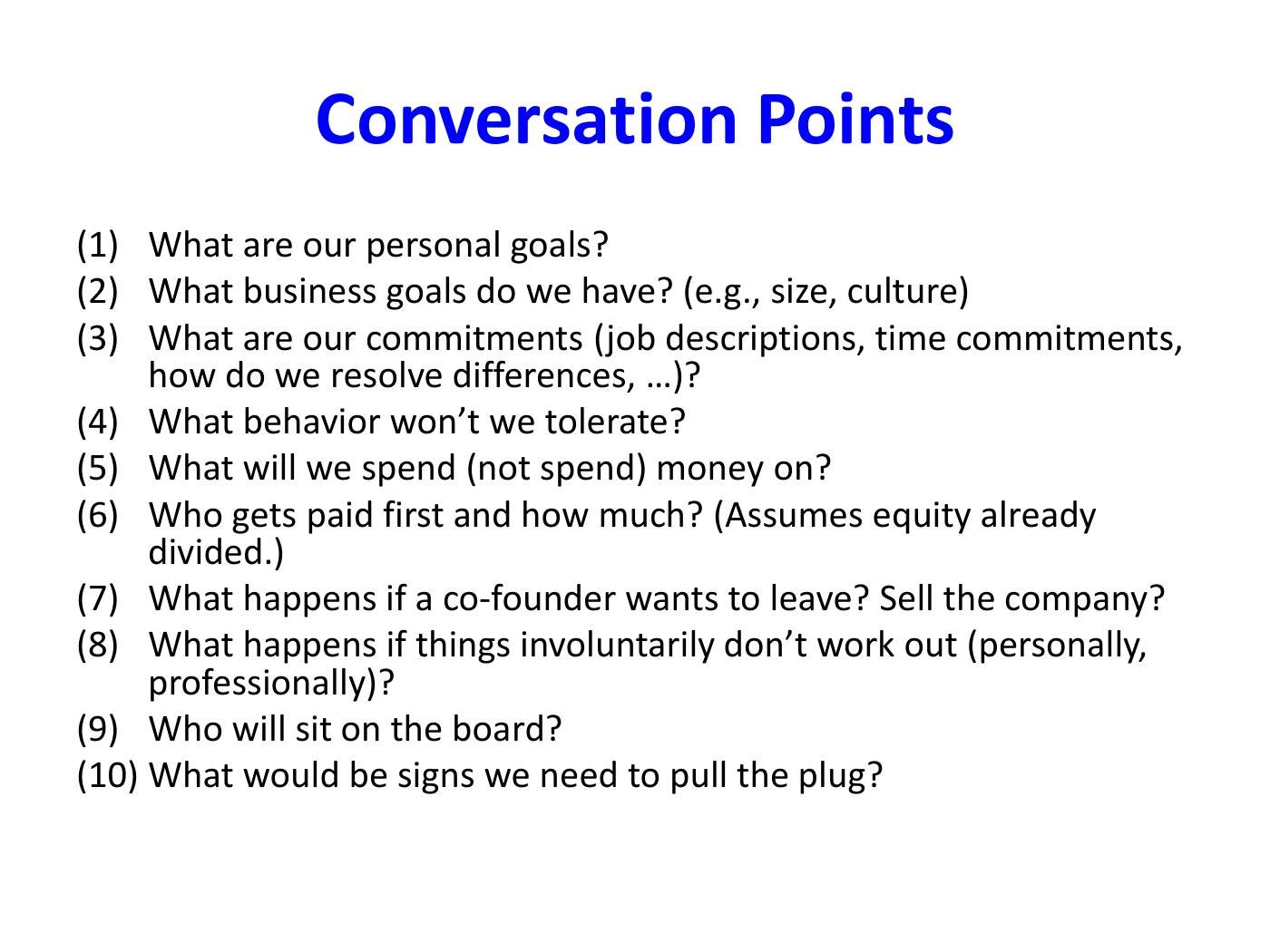
Ten conversation points before the split is finalA list of questions co-founders should answer: personal and business goals, commitments and how differences are resolved, behavior they will not tolerate, spending, who gets paid first and how much, what happens if someone leaves or wants to sell, involuntary failure, board seats, and the signs that would mean shutting down. Only one of the ten questions is about percentages. Questions 7, 8 and 10 cover departure and failure, the topics founders avoid and later litigate. Relay's founders should answer all ten before signing stock purchase agreements.Reiss - Founder & Equity Slides · PDF page 32 · in the slides
7
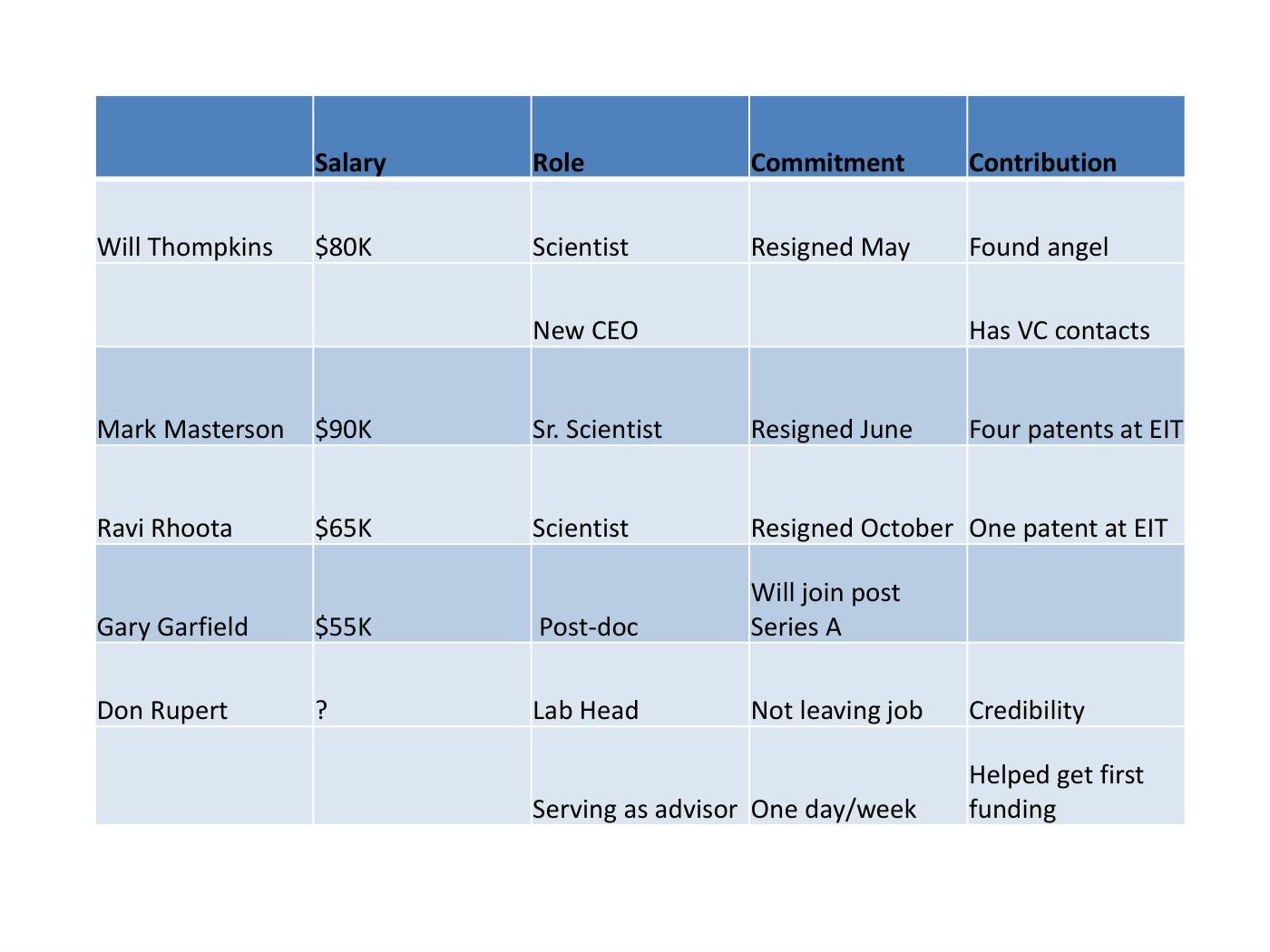
NanoGene: one team, very different commitmentsA table of the NanoGene founders with salary, role, commitment and contribution. Three scientists resigned in May, June and October and earn $65K-$90K; one has four patents and another one patent at their former institute (EIT); a post-doc joins only after the Series A; the lab head keeps his job and brings credibility; one advisor gives one day a week; a new CEO brings VC contacts. An equal split across this table would pay identical shares for full-time, part-time, future and advisory commitments. Notice also that the patents sit at EIT, the former institute, so they must be licensed or assigned before they count as a contribution to the company.Reiss - Founder & Equity Slides · PDF page 34 · in the slides
8
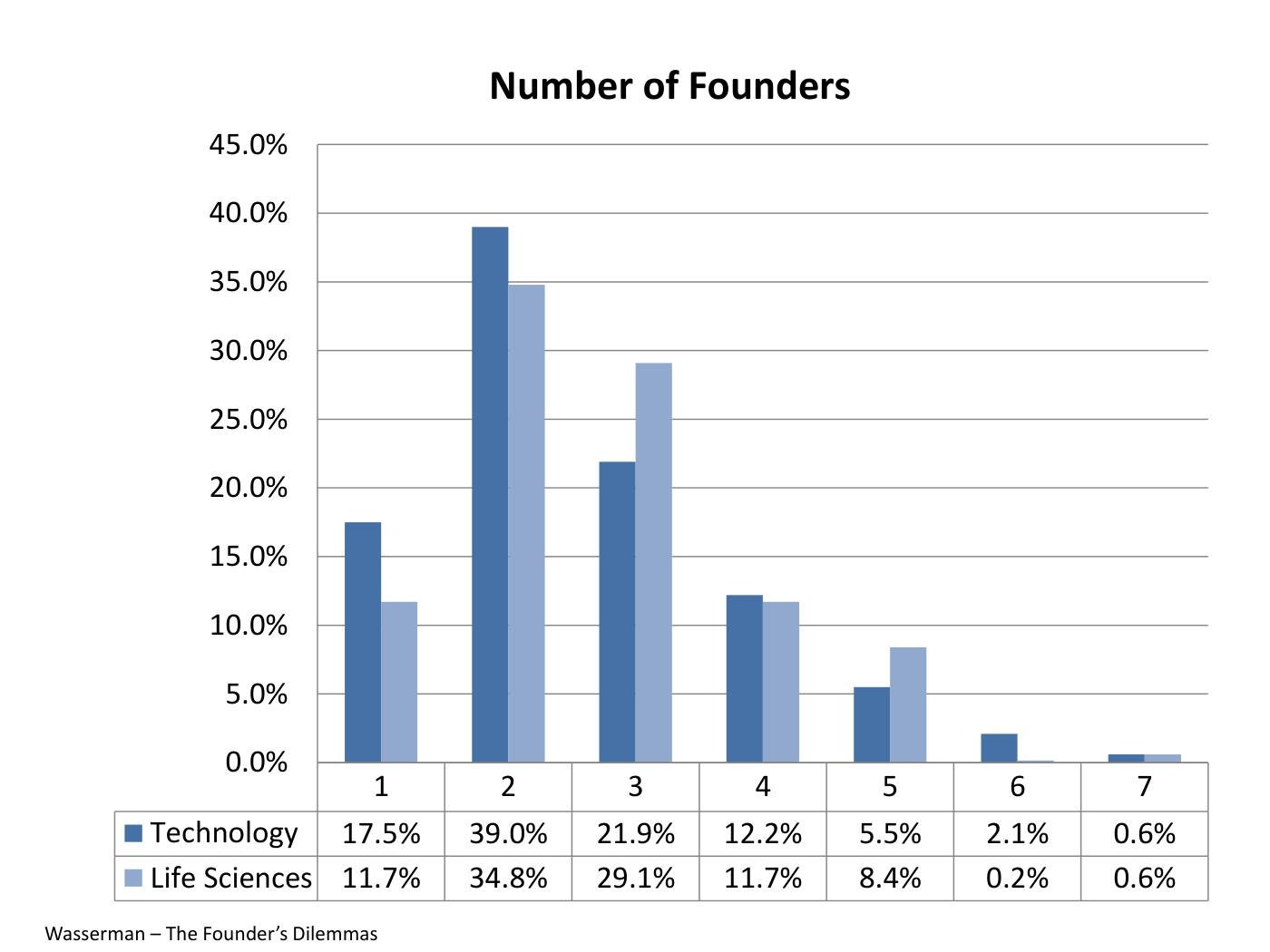
How many founders do startups have?Wasserman's data on founding-team size for technology and life-sciences startups. Two founders is the mode (39.0% tech, 34.8% life sciences); solo founders are 17.5% of tech and 11.7% of life sciences; three founders are more common in life sciences (29.1% vs 21.9%). Relay's two-founder team is the most common configuration. Larger teams, frequent in life sciences, multiply the allocation and departure questions the rest of the deck addresses.Reiss - Founder & Equity Slides · PDF page 35 · in the slides
9
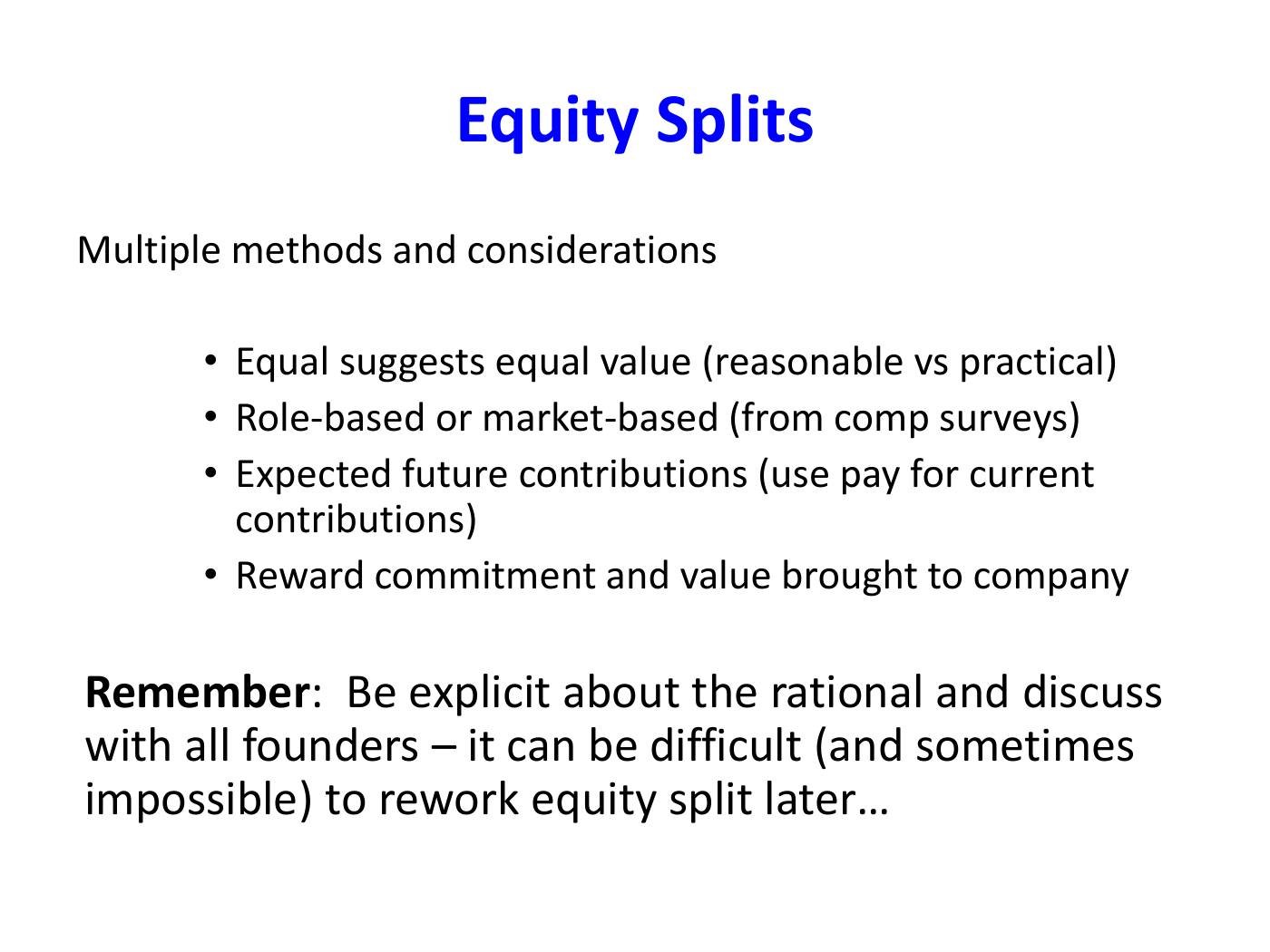
Four bases for an equity splitLists equal, role or market-based, expected future contribution (with pay for current work), and reward for commitment and value brought, and urges founders to make the rationale explicit because splits are hard to rework. Covered in more depth by the native rationale slides.Reiss - Founder & Equity Slides · PDF page 36
10
Done versus to be doneDivides the work equity compensates into what has been done and what remains to be done, and argues that almost all value lies in work still ahead, so equity should be reserved for those who will do it. This down-weights the idea. For Relay, Maya's insight and pilot clinics justify a premium, but most of the 10,000,000 shares pay for years of future work, which is why vesting, not the split, does most of the protective work.Reiss - Founder & Equity Slides · PDF page 40 · in the slides
11
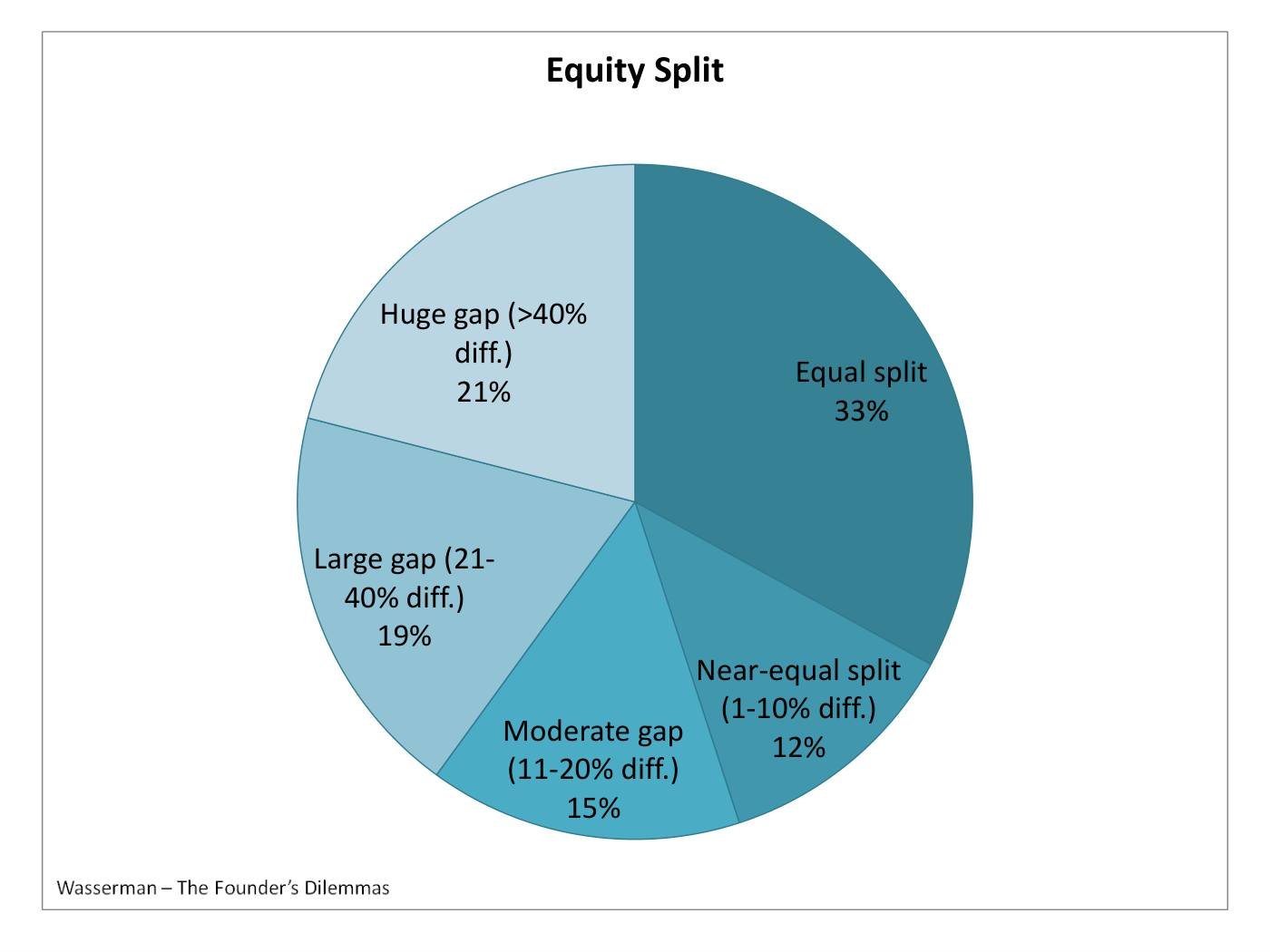
How founding teams actually split equityWasserman's pie chart of split gaps between founders: 33% equal, 12% near-equal (1-10 points), 15% moderate (11-20), 19% large (21-40) and 21% huge (over 40 points). Unequal splits are the majority (67%). Relay's 52/48 is a near-equal split: a 4-point gap that recognizes Maya's head start without signaling unequal partnership. Carta's 2025 data shows equal splits among two-founder teams rising from 31.5% in 2015 to 45.9% in 2024.Reiss - Founder & Equity Slides · PDF page 41 · in the slides
12
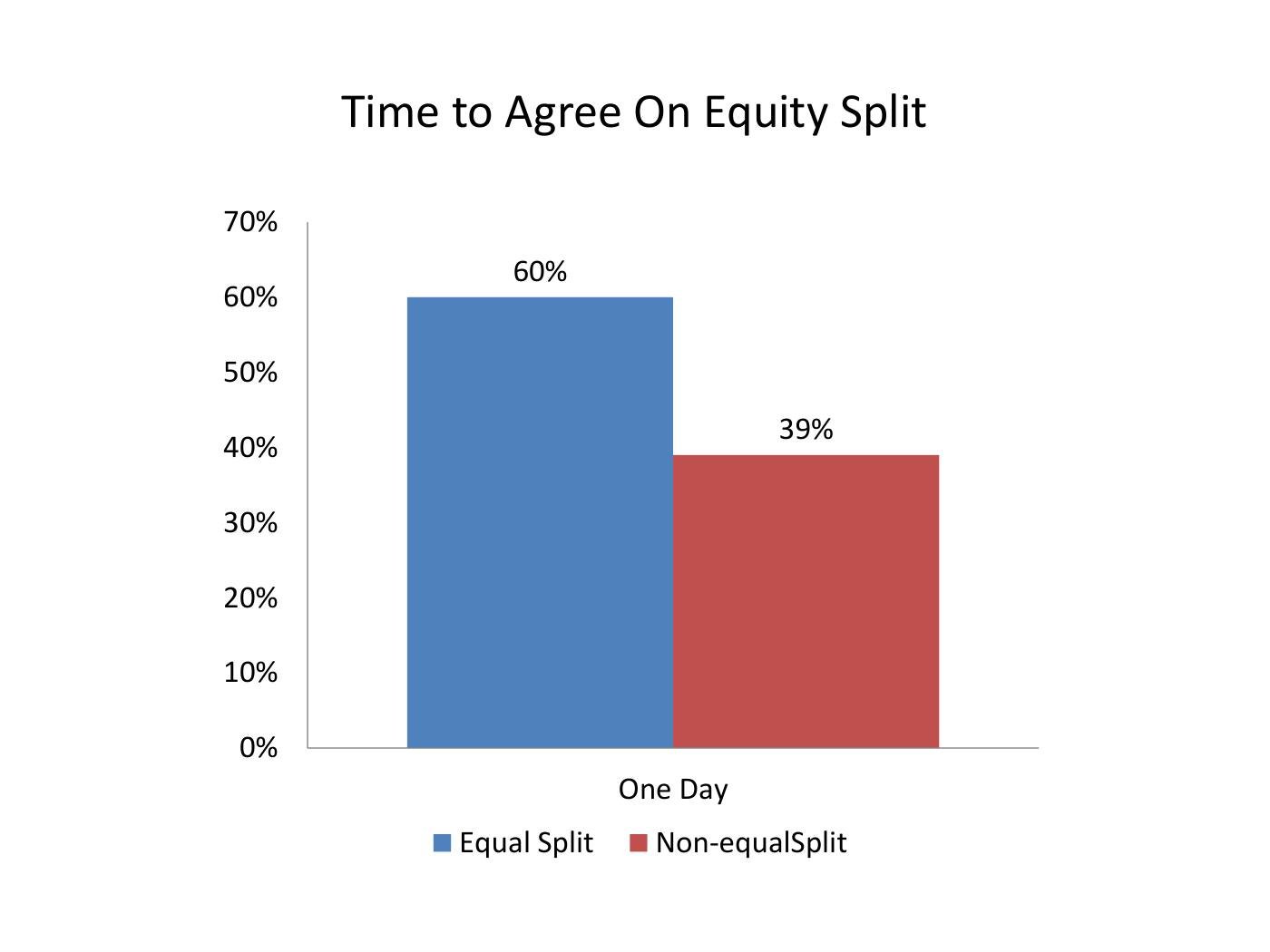
Equal splits are often decided in a dayA bar chart: 60% of equal-split teams agreed their split within one day, versus 39% of non-equal teams. Speed suggests the equal split is often a default chosen to avoid a hard conversation.Reiss - Founder & Equity Slides · PDF page 42
13
The idea premium: what being the idea person is worthRegression results from Wasserman: controlling for team size, experience, position, capital and serial-entrepreneur status, the idea person receives more equity in every role. The premium is 20.0 points for a CEO (62.1% vs 42.1%), 24.6 for a chair, 21.2 for a COO, but only 5.6 for a CTO and 2.3 for a VP. Being the idea person is associated with a large premium in leadership roles. This describes what teams did, not what they should do, and it sits in tension with the 'to be done' argument. Relay's 4-point gap is far smaller than the typical CEO idea premium.Reiss - Founder & Equity Slides · PDF page 43 · in the slides
14
Section divider: criteria for pay and equityTitle slide with no content. Divider only.Reiss - Founder & Equity Slides · PDF page 46
15
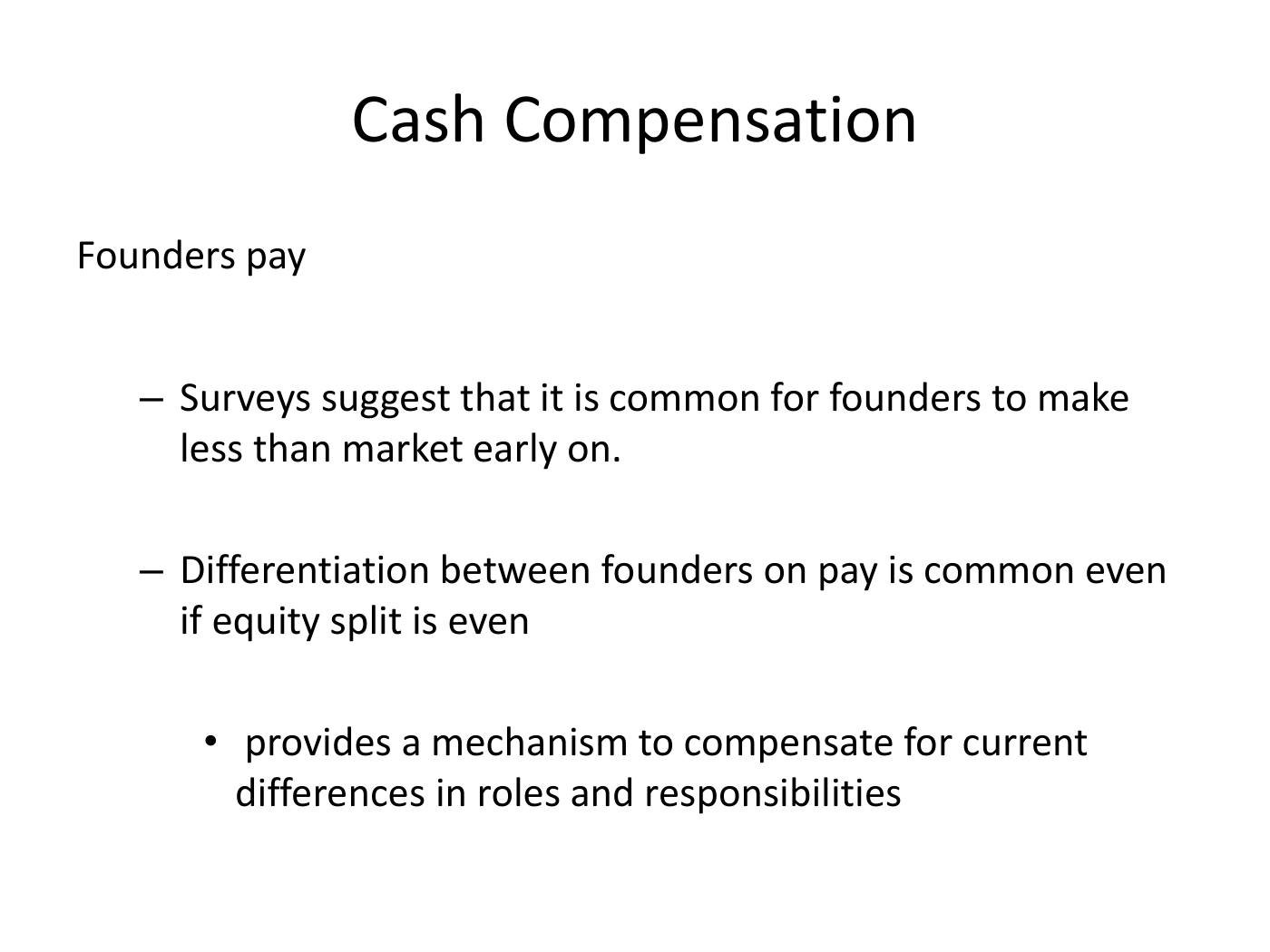
Founder cash pay: below market and often unequalSurveys indicate founders commonly take below-market pay early, and pay often differs between founders even when equity is equal, as a way to compensate current differences in role and responsibility. Salary and equity are separate levers. Equity pays for future value; salary can reflect present role and personal constraints. At Relay, with about $60,000 monthly net burn late in FY1, each founder salary dollar shortens runway, so the pay decision is a runway decision too.Reiss - Founder & Equity Slides · PDF page 47 · in the slides
16
Compensation as a cultural and investor signalInitial pay choices signal frugality or free spending, equality or hierarchy, and what the company values. They also show investors whether founders take a long-term view. Echoed by the native slide on compensation as an organizational signal.Reiss - Founder & Equity Slides · PDF page 48
17
Discussion prompt: should NanoGene hire Paige?Title-only discussion prompt for the NanoGene case. Prompt only; the case pages supply the facts.Reiss - Founder & Equity Slides · PDF page 49
18
Hiring a senior generalist earlyAn experienced generalist can set up the company and key processes, let specialists focus, prevent mistakes and reassure investors; early on founders may not know which gaps they have. The native 'Hire a senior generalist?' slide develops both sides.Reiss - Founder & Equity Slides · PDF page 50
19
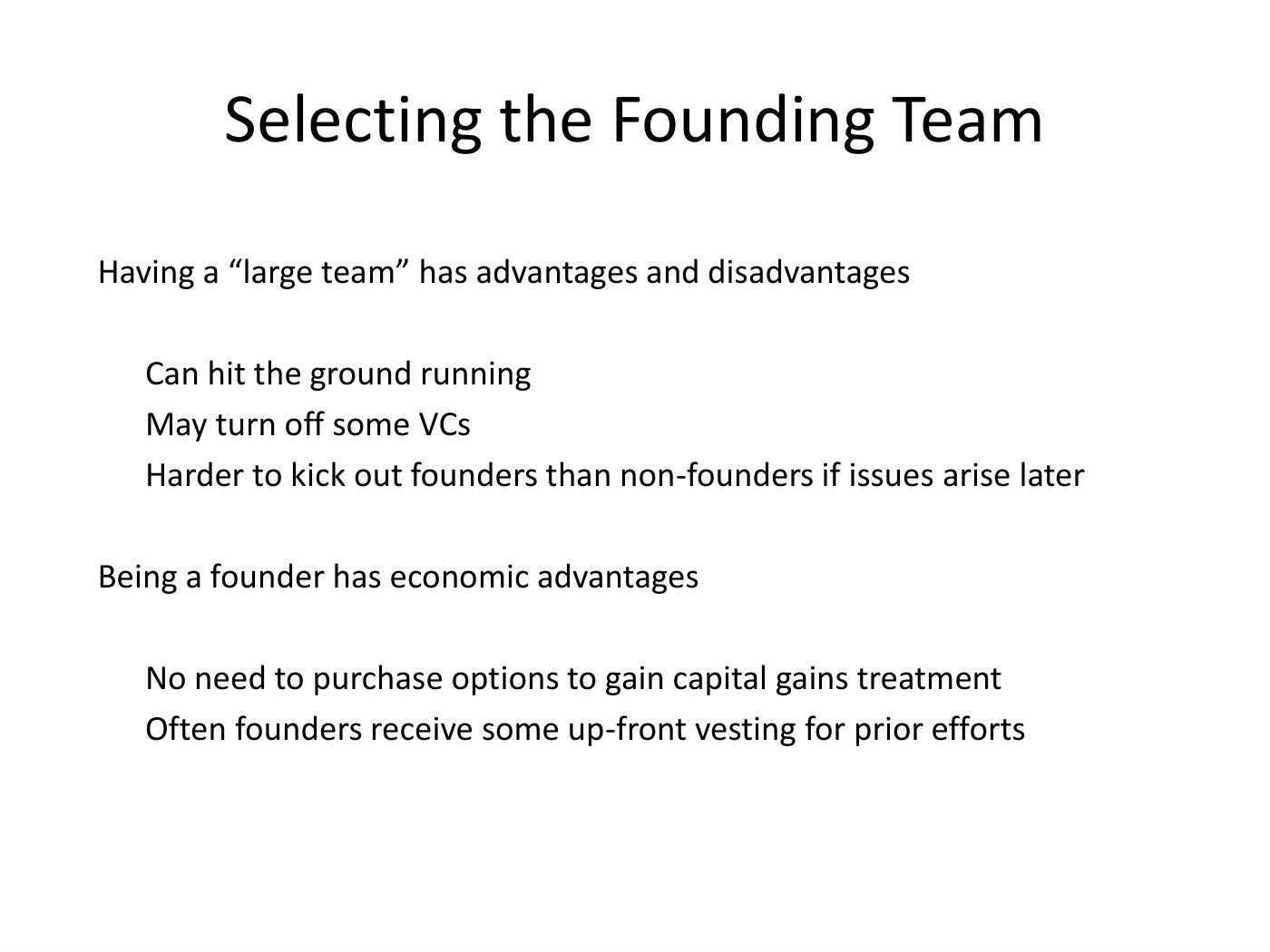
Large founding teams and the economic advantages of founder statusA larger founding team can move quickly but may deter some VCs and makes it harder to remove a founder than an employee. Founder status has economic advantages: founders buy stock directly instead of options, and often receive some up-front vesting for prior work. Founders buy common stock at a near-zero price and, with an 83(b) election, start their capital-gains holding period at once; employees like Priya receive options with an exercise price and different tax timing. Up-front vesting credit is one way to recognize Maya's earlier start. The tax result depends on current law and the individual's facts.Reiss - Founder & Equity Slides · PDF page 51 · in the slides
20
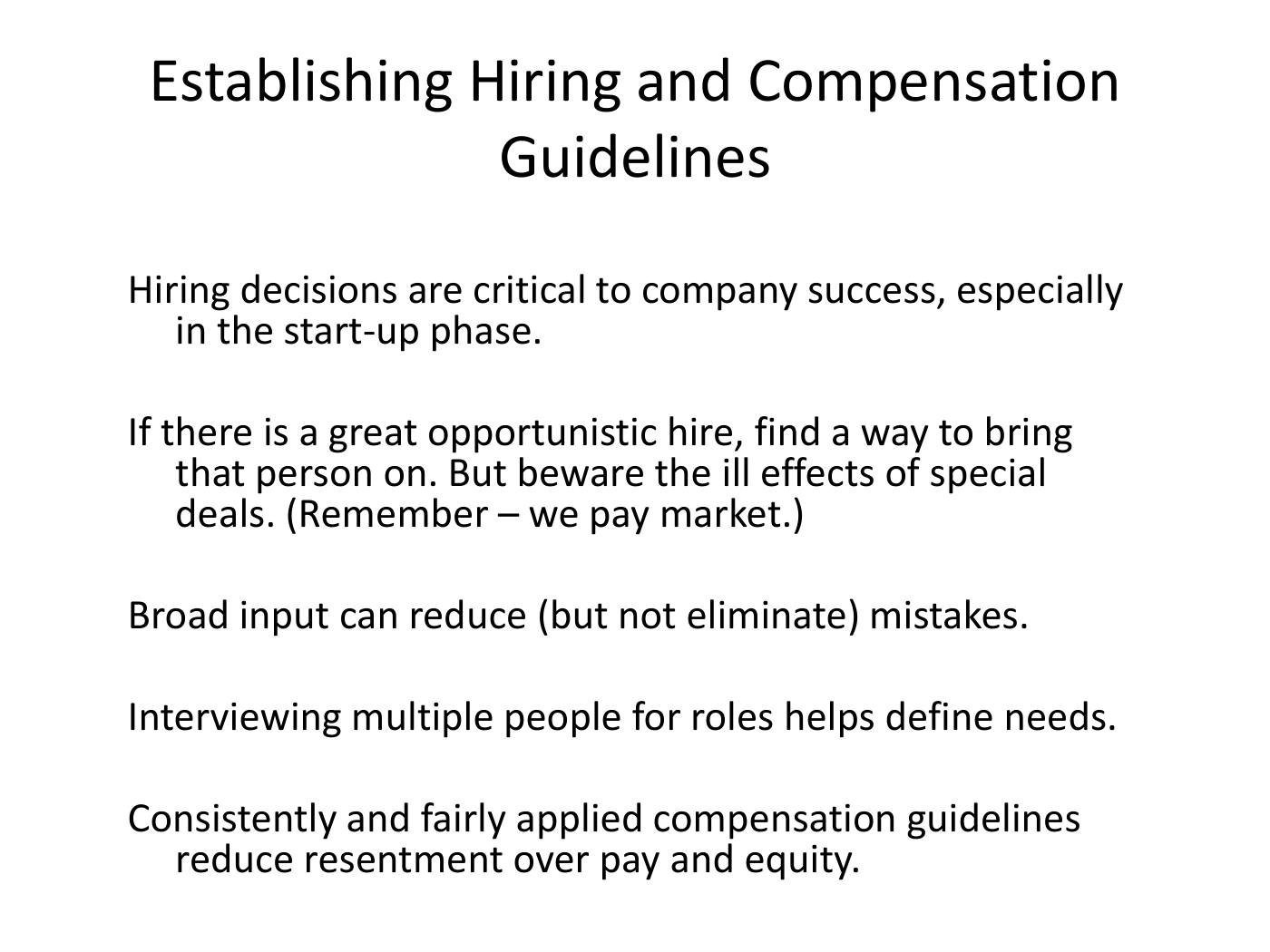
Hiring and compensation guidelinesAdvice to take great opportunistic hires but avoid special deals, use broad input and several interviews to define roles, and apply compensation guidelines consistently to reduce resentment. Consistency matters for Relay once it grants Priya and two engineers options from the same pool.Reiss - Founder & Equity Slides · PDF page 52