Synthesis groups observations into patterns and proposes an explanation for them. The explanation remains a hypothesis. A useful problem frame identifies a specific user, a need and the insight that makes the need consequential in that situation.
The user–need–insight structure prevents a team from presenting an interface idea as though it were a discovered need. A frame should be narrow enough to guide a test while leaving room for several solutions. Keep the observations that support it visible so that another person can challenge the interpretation.
The design material contrasts a slow elevator with the experience of waiting for an elevator. If the problem is defined as motor speed, the solution set centers on engineering and capital investment. If the problem concerns the waiting experience, information and the surrounding environment also become possible interventions.
Reframing does not prove that the cheaper alternative is sufficient. The team must test whether the new explanation fits the complaints. A genuine capacity constraint at peak hours or a persistent accessibility issue cannot be resolved simply by making waiting feel shorter.
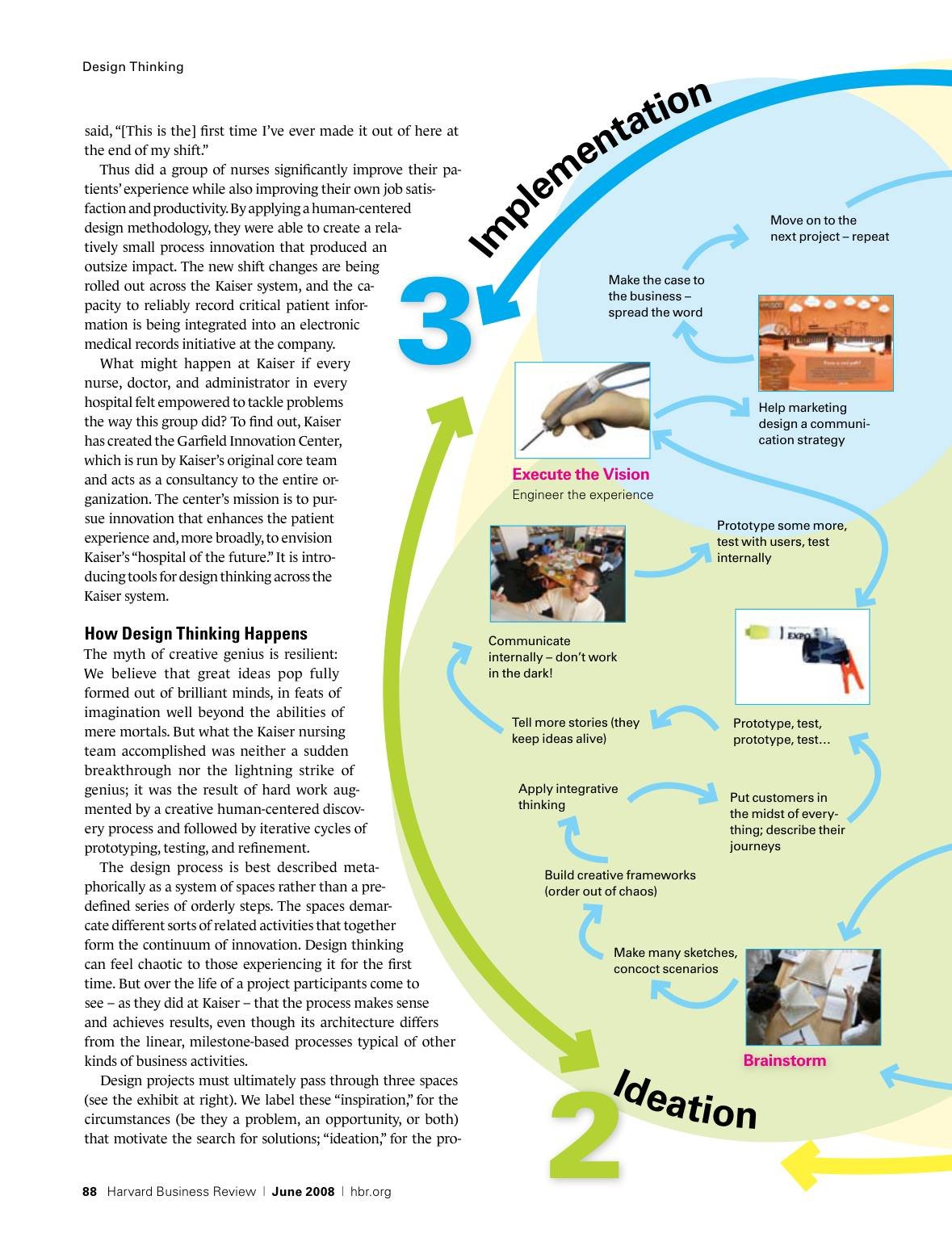
This cycle connects customer evidence to a testable response. It is iterative: a prototype can reveal that the original problem was framed incorrectly.
01
Empathize
Investigate a real situation through observation and recent episodes. For a hospital handoff, watch how staff find the current instruction and record where uncertainty or repeated work occurs.
02
Define
State the user, need and evidence-backed insight. Example: a shift supervisor needs confidence that the next team has the current instruction because updates arrive through several conflicting channels.
03
Ideate
Explore more than one response to that need. Compare a shared record, a confirmation routine and a change to who owns updates. Avoid assuming a notification feature is the only solution.
04
Prototype & test
Make the uncertain part inspectable. Let another person complete a realistic handoff using a rough version. Observe errors and clarification requests, then revise the frame or solution.
The cycle is a learning process. A polished prototype can still answer the wrong question if the user and need remain vague.
A frame determines which solutions appear relevant. Reframing changes the question when evidence suggests that the first formulation assumes a solution too early.
Narrow
“How can we add a message notification?”
Reframed
“How can the next person know which instructions are current?”
Worked application
Illustrative application: “add a message notification” already chooses an interface intervention. “Help the next shift identify the current instruction” admits notifications, a shared authoritative record and a new handoff routine. Test which obstacle actually causes the confusion before selecting among them.
A broader frame is useful when it preserves the concrete user and task while opening plausible responses.
A prototype is a tool for learning. A rough representation can test whether a sequence makes sense, while a functional prototype may be necessary to test performance or reliability. More polish increases cost and can make participants reluctant to criticize the idea.
Choose the smallest representation that exposes the uncertain part of the experience. Tell the participant what task to attempt without demonstrating the answer. Observe the attempt, then ask about confusing points. A successful task with extensive coaching provides weaker evidence of usability than an unaided completion.
A test rarely validates an entire business. It supplies evidence about the conditions represented in that test. A participant may understand the prototype but lack authority to buy, or may want the benefit without accepting the price.
After each test, state what became more credible, what became less credible and what remains unresolved. Distinguish a problem with the implementation from a problem with the underlying need. The next iteration should target the uncertainty that matters most to the next commitment of resources.
A repeatable economic model without further evidence.
15
05 / Deep diveProblem framing, prototyping & learning
Service prototypes: Wizard of Oz and concierge
Before building software, a person can deliver the service by hand to test whether it creates value.
In a Wizard-of-Oz test, a person performs the work behind an interface that looks automated, and the customer experiences the intended service. In a concierge test, the customer knows a person is doing the work. Both test whether the outcome matters to customers, and both are cheap enough to run before writing code.
Both share one limitation: the human operator adds judgment, care and relationships that software won't copy. Write the operator's rules down in advance and log every exception. Otherwise you'll learn about the founder, not the product.
Prototype
Question it can answer
What it cannot establish
Paper flow or flip-book
Do users understand the order of steps?
Whether they will act on it in real conditions
Journey map shown to users
Have we understood where the experience breaks?
Whether a proposed fix works
Wizard of Oz (Relay v0)
Do patients take short-notice slots when offered by text, and how many?
Automated reliability, unit cost or performance at scale
Working prototype
Can a coordinator use it during a real check-in rush?
“Users liked it” gives little direction for the next version. Analyze an observable attempt against a prediction made before the test.
01
Observe
Describe the task and behavior. A supervisor finds the latest instruction but sends a separate message to confirm that it is authoritative. Record the extra step and the reason given.
02
Compare
State what you expected. The prototype was intended to make the current instruction unambiguous. Completion with a confirmation call therefore provides weaker evidence than an unaided handoff.
03
Explain
Identify the assumption challenged by the attempt. Perhaps staff understand the screen but do not trust who can update it. That points to authority and process, rather than screen readability.
04
Revise
Change the next test accordingly. Add a visible owner and update history, then test whether the supervisor can accept the instruction without contacting another person.
One test narrows a question. It does not validate every part of adoption, willingness to pay or delivery at scale.
Fidelity is how closely a prototype resembles the eventual experience. Choose the detail required to expose the uncertain mechanism.
More detail
Useful when appearance, interaction timing or realistic constraints are the question.
Less detail
Useful when a cheap sketch can expose a misunderstanding before the team invests heavily.
Worked application
Illustrative application: paper screens can reveal whether a customer understands the order of a booking process. They cannot show whether a payment integration will complete reliably. A working integration answers that second question but costs more and may be unnecessary for the first.
Specify the question first, then select the representation and the result that would change the next design decision.
19
05 / Deep diveProblem framing, prototyping & learning
Write the prediction before the test
A test teaches you something only if you could have been wrong.
Before the test, write down the uncertainty, the metric, the denominator, the expected result and the threshold for each decision: continue, revise or stop. After the test, compare the result with the prediction and say which assumption the result challenged.
Relay example (illustrative): "Of fillable cancellations reported by 3 pilot clinics over 4 weeks, we expect 30–40% to be rebooked by text, against an estimated 10–15% by phone. At or above 30% we build v1 automation. Between 15% and 30% we change lead-time cutoffs and message wording and rerun. Below 15% we reconsider the matching frame."
The selected pages describe innovation as a human-centered process that connects observed needs with a feasible and viable response. Rough prototypes make an emerging idea concrete enough to learn from.
Observation precedes a response
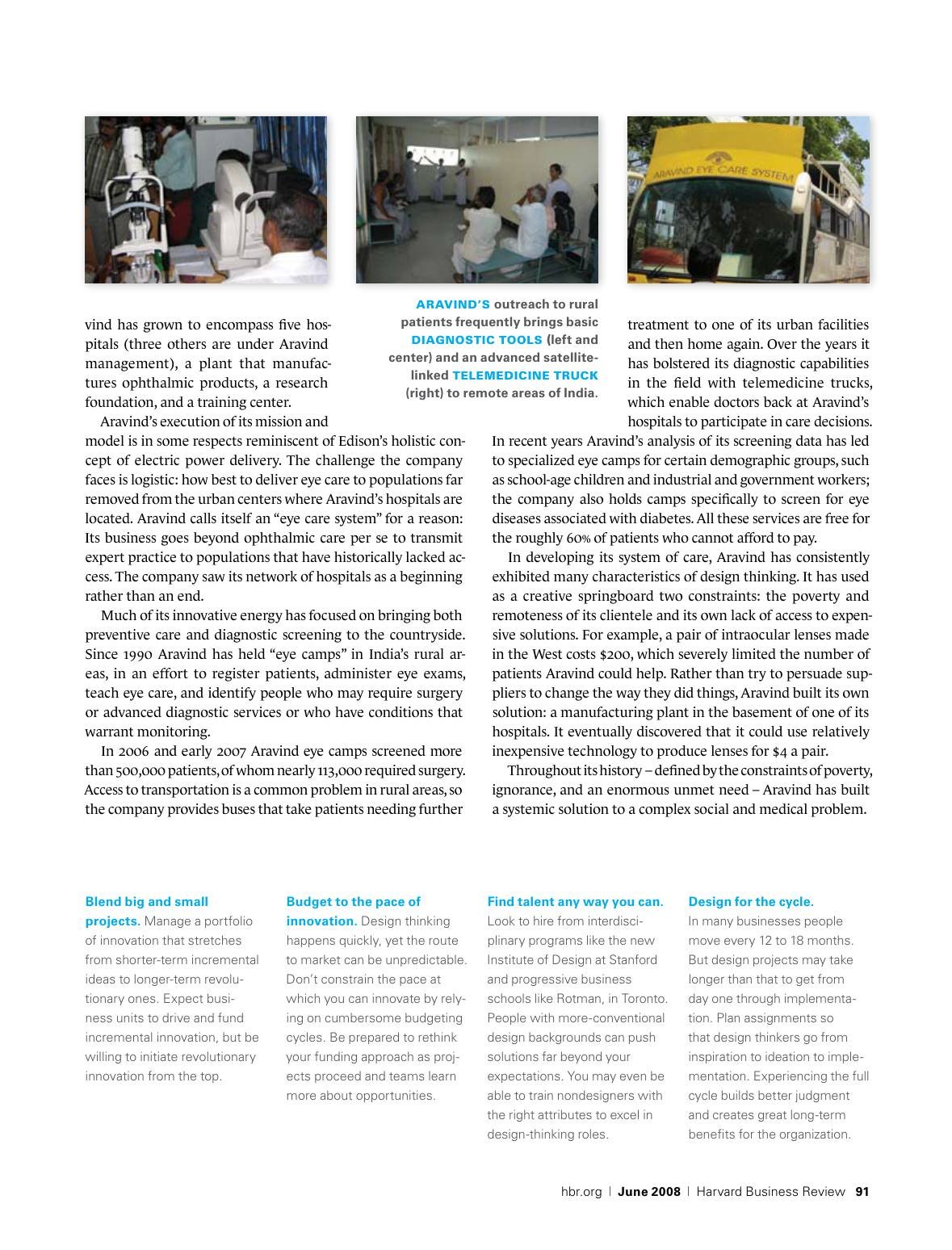
The Kaiser example begins with how nurses exchange information and what patients experience during shift changes.
The system matters
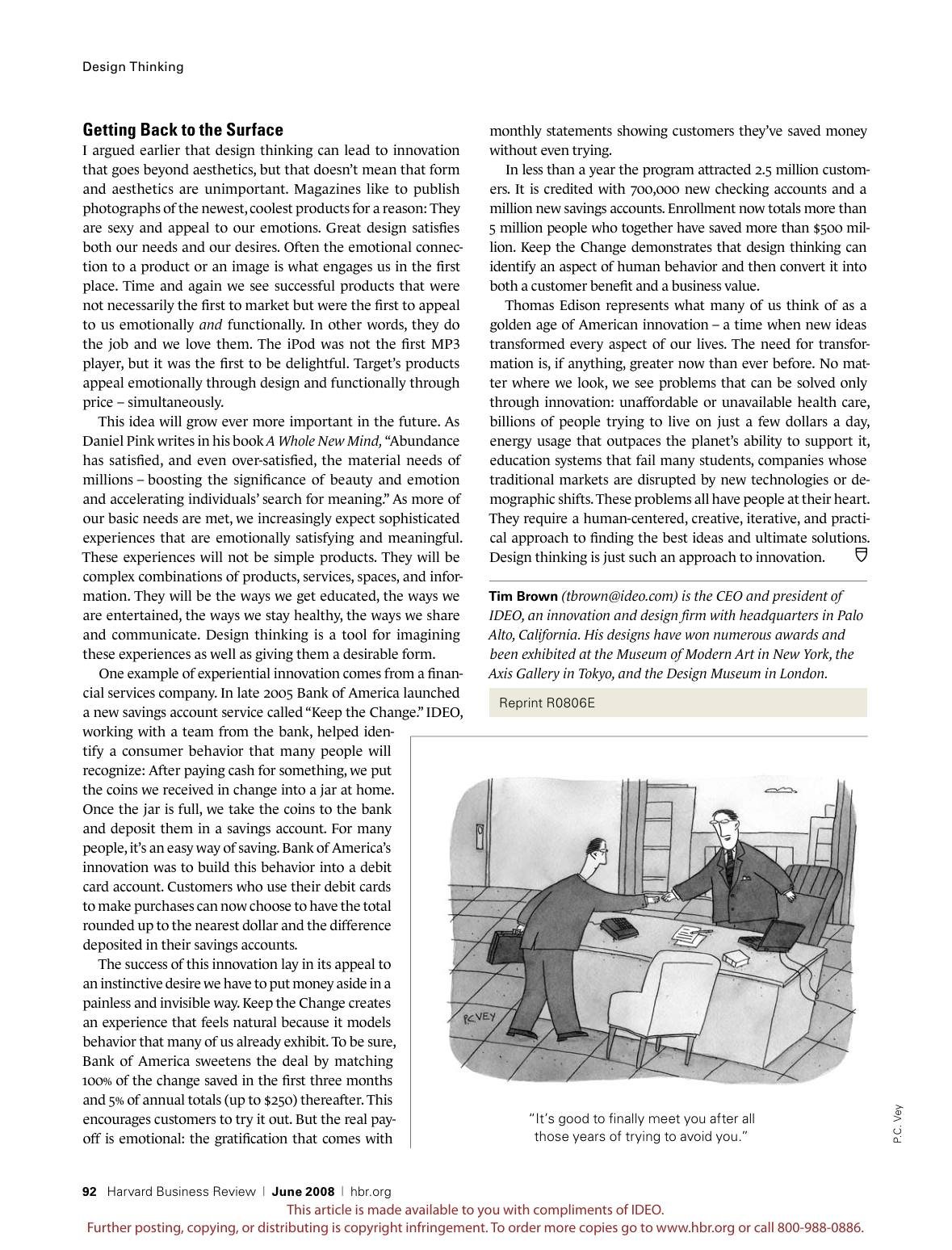
Edison’s example connects an invention to the infrastructure that makes it useful. Service delivery and surrounding activities belong in the design problem.
A prototype clarifies a question
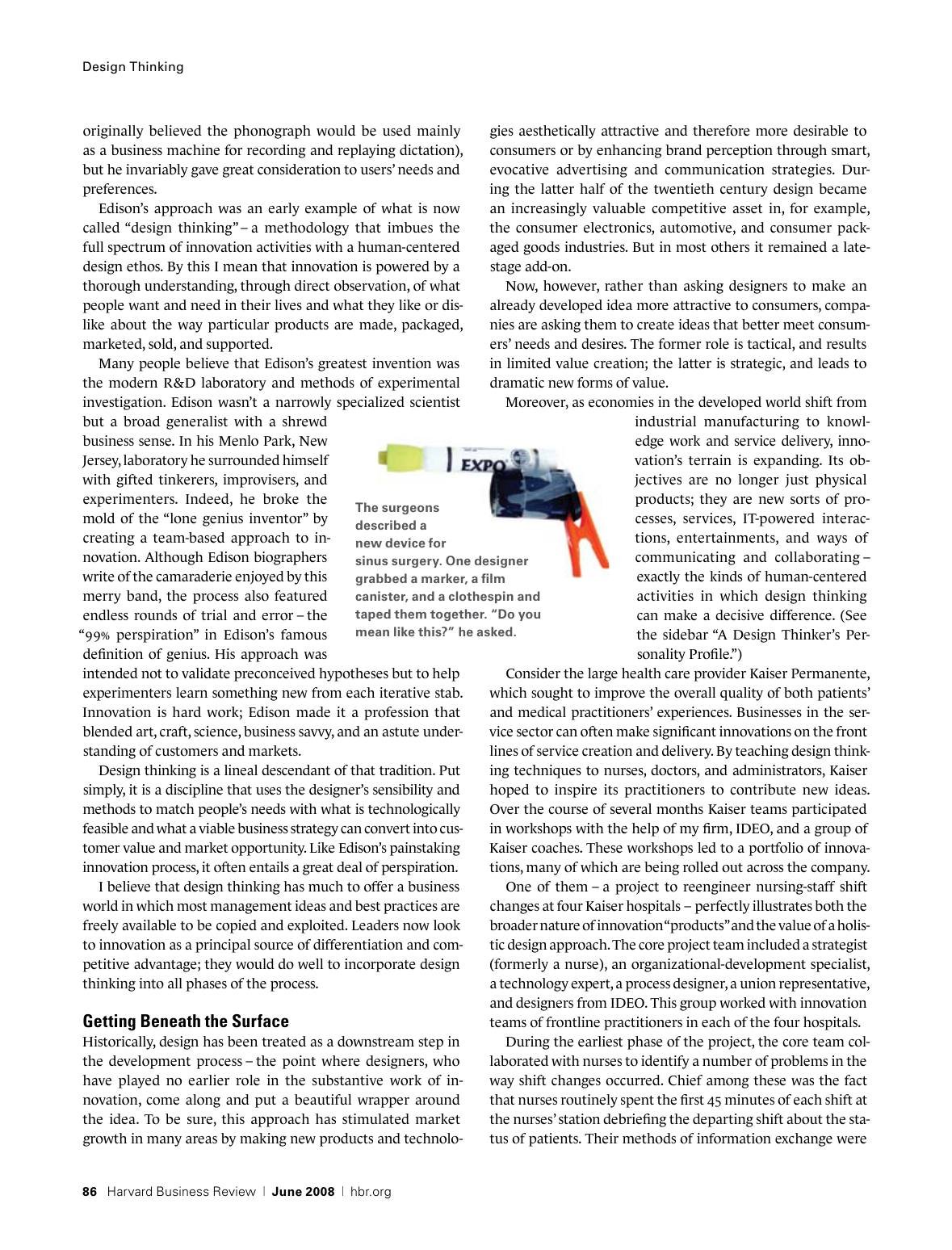
A simple assembled surgical-tool mockup helps practitioners specify what the device must do. The representation supports a more precise conversation.
Iteration changes the design
Teams try alternatives, observe feedback and revise. The reading emphasizes learning from attempts rather than protecting a finished-looking idea.
A repeated handoff failure can support several explanations. Preserve the observed episode while examining which need or constraint best explains it.
A prototype’s reach
A rough service enactment can test a sequence or interpretation. Different evidence is needed for reliability, adoption and operational performance over time.
A case and a general rule
The reported improvements illustrate a particular intervention. Transferring the approach requires understanding the new setting and its constraints.
A version-control problem disguised as notifications
The fictional delivery handoff from L04 might be addressed with another alert. It might also be addressed by a shared current record, a clear owner or a process that requires acknowledgement. These responses solve different parts of the situation.
Which uncertainty should the first prototype examine?
31
05 / Current practiceProblem framing, prototyping & learning
Current practice: AI-generated prototypes
High fidelity now costs very little
Prompt-to-prototype tools turn a sentence or a design file into a working, coded prototype. Figma launched Figma Make in beta at Config in May 2025 and released it to all users on July 24, 2025. The cost difference between a paper sketch and a clickable app, a key reason to start low-fidelity, has become much smaller.
The case for low fidelity still holds
Cheap polish doesn't change how people react to it. A finished-looking prototype still draws compliments instead of criticism, and it hides which part is uncertain. Decide the fidelity from the question you are testing, even if a polished version costs almost nothing to make.
Use generated prototypes for behavior questions
Use generated working prototypes for questions that need real interaction, such as whether a coordinator can find the open-slot list during check-in. Keep paper, scripts or a human "wizard" for value questions. A realistic interface can't tell you whether patients will come in on 90 minutes' notice.
Known packet: delivery instructions change during the day; email and text can disagree; the driver and office need the current destination. No evidence yet shows that people will check another application.
Your task
Write two problem frames, sketch two different responses and choose a prototype that tests the riskiest assumption. State a task and an observable learning signal.
Venture step: Reframe the problem and design the Wizard-of-Oz pilot
Relay · venture step 05
Lesson 4 interviews keep coming back to one episode. A slot opens at 7:50 a.m., the coordinator calls the waitlist and the slot stays empty. Daniel's first idea is better automated reminders. Most clinics already send reminders through their EHR, though, and the gaps remain. Maya has 3 pilot clinics willing to try something. At about 42 empty slots per clinic per week, that is roughly 126 slots a week. Phone calls fill an estimated 10–15% of them (illustrative). No software exists yet.
Your task
Write two problem frames, "reminders" and "matching," as user–need–insight statements. Then specify a 4-week Wizard-of-Oz pilot: what Maya does by hand, the single learning metric and its denominator, the prediction made in advance, and the results that would mean continue, revise or stop.
Frame A (reminders): a clinic owner needs fewer no-shows because empty slots lose about $110 each (illustrative). This assumes patients forget, which existing reminders already address. Frame B (matching): a front-desk coordinator at a busy 8 a.m. check-in needs to get a just-opened slot to a patient who can come at short notice, because the patients most eager for earlier visits are often not the ones free on 90 minutes' notice. B allows texting, short-notice opt-in lists, lead-time rules and policy changes, and it keeps reminders as one option.
Wizard-of-Oz design: each clinic messages Maya when a cancellation comes in. Maya texts opted-in waitlisted patients from a shared phone with a minimal message ("A 3:30pm slot opened at your clinic tomorrow — reply YES"), books the first YES through the clinic and logs everything in a spreadsheet. Before the first message: sign a BAA with each clinic and confirm patients have agreed to receive texts. Applying HIPAA and texting rules depends on current law and needs legal review.
Learning metric: fill rate = slots rebooked ÷ cancellations reported to Relay. Break it down by notice lead time, because no-shows discovered after the start time can't be refilled. Supporting measures are the time from cancellation to booking and the minutes of Maya's work per fill. These matter for whether v1 can be delivered.
Prediction and arithmetic (illustrative): suppose the clinics report 300 fillable cancellations over 4 weeks. At the 10–15% phone baseline that is 30–45 fills. At the 40% target it is 120 fills, which is 120 ÷ 3 clinics ÷ 20 working days = 2 fills per clinic per day, against a phone baseline of 0.5–0.75. That makes about 1.25–1.5 extra visits per clinic per day. Decision rule: 30% or more and falling minutes per fill means build v1 automation. 15–30% means revise (change lead-time cutoffs, waitlist size or message wording) and run again. Under 15% means the matching frame isn't supported, so reconsider.
What the pilot cannot show: whether clinics will pay $399 a month, whether the result holds outside these 3 clinics, or how the work performs when automated at scale. Record these as open questions.
Like Rise Science's team at first, Relay can frame the problem around what the team is good at, which here is automation and SMS. Check whether interviews show automation to be the bottleneck. The real constraint may be the waitlist itself: who is on it and how much notice they need.
No denominator, no learning
"We filled 40 slots" means nothing until you know how many slots opened, how much notice each one had and what the phone method would have filled. Define the metric and its denominator before the pilot starts, not after the results come in.
The wizard who flatters the result
If Maya hand-picks which patients to text and uses her personal relationships with the clinics, the pilot measures Maya and not Relay. Write down the rules she follows so that software could repeat them, and log every exception.
Two Relay problem frames, reminders and matching, as user–need–insight statements, plus a Wizard-of-Oz pilot specification: manual procedure, fill-rate metric and denominator, prediction, decision thresholds and open questions.
A frame determines which solutions seem relevant, and reframing from the symptom (complaints, empty slots) to the mechanism (perceived wait, poor matching) widens the set while keeping the obvious options.
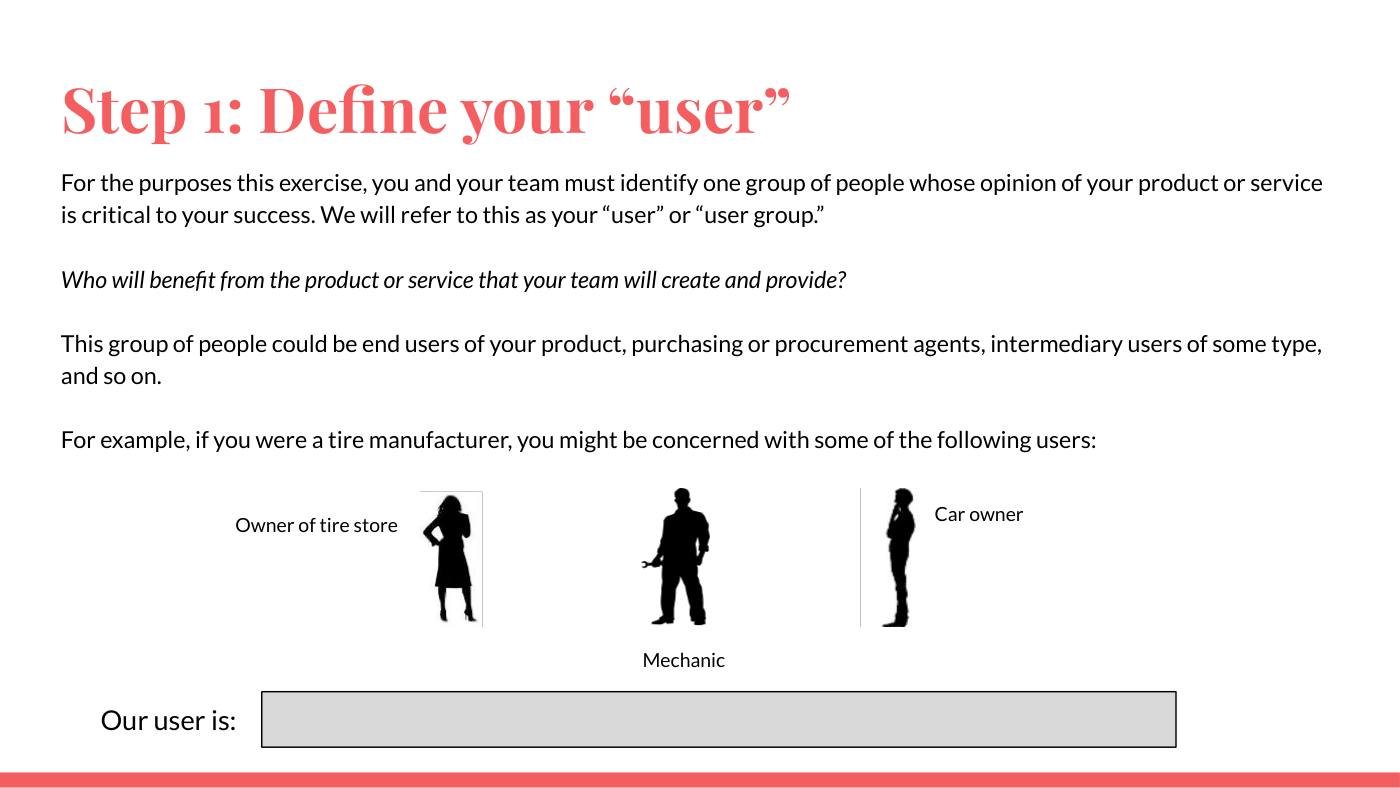
A strong frame names a specific user, a need from that user's point of view and an insight the team wouldn't have reached without the evidence.
Choose the prototype to fit the uncertainty, and before running it, state the prediction, the metric with its denominator and the result that would change your next step.
Next lesson: Systematic ideation: thinking inside the box
38
Check your understanding
How can reframing a need lead to a more useful prototype?
Score
Question 1
A building manager hears complaints about a slow elevator. After reframing the problem as "the wait feels longer," what should the manager do before installing mirrors?
A reframe is a hypothesis. If waits have grown because of real capacity limits at peak hours, mirrors won't fix it. Measuring separates the perception explanation from the capacity explanation. Asking tenants whether they like mirrors gets an opinion about a solution, not evidence about the cause.
Question 2
Lesson 4 interviews showed coordinators failing to fill 7:50 a.m. gaps from the waitlist. Which problem frame for Relay best meets the user–need–insight standard?
The third option names a specific user in a specific situation, a need from their point of view and a non-obvious insight that explains why current methods fail. The first is a solution. The second and fourth are generic and obvious, like the "teenager needs a healthy diet" example.
Question 3
Relay's 4-week Wizard-of-Oz pilot logs 300 fillable cancellations and 96 rebookings. The phone baseline is 10–15%. What is the fill rate, and what does the illustrative decision rule (≥30% build, 15–30% revise, <15% reconsider) imply?
96 ÷ 300 = 32%, above the 30% threshold and more than twice the phone baseline. A control group would strengthen the causal claim (lesson 12), but the rule was set in advance so a result like this leads to a decision. Refusing to decide defeats the reason for the pilot.
Question 4
A team shows clinic owners a polished, clickable Relay dashboard. Every owner says it looks great. What is the main weakness of this evidence?
Compliments on a polished artifact predict little. The test had no task, no prediction made beforehand and no commitment asked for, and high fidelity makes people hold back criticism. Sample size and user role also matter, but they aren't the main problem. With more owners, or with coordinators, the same test would still produce only reactions.
Question 5
Maya plans to run Relay v0 by texting waitlisted patients herself from a shared phone. Which statement about this kind of Wizard-of-Oz prototype is a misconception?
A Wizard-of-Oz pilot tests whether the service creates value under hand-run conditions. It says nothing about automated reliability, unit costs or performance at scale. A founder may also add judgment that software won't copy. For example, Maya might pick the patients most likely to accept, which raises fill rate in a way the automated product can't reproduce.
Question 6
A meal-kit startup sees subscribers cancel after three weeks. The team's frame is "our recipes are too complicated." Exit interviews show customers often skipped cooking on busy nights and let ingredients spoil. Which reframe best opens the solution space while staying anchored in evidence?
The third option comes from the observed behavior: skipped nights and spoiled food. It allows flexible skipping, longer-lasting ingredients, quicker meals and simpler recipes too. The first keeps the original frame, the second is a retention tactic that ignores the cause, and the fourth is a solution.
Workbook
How can reframing a need lead to a more useful prototype?
Module output: An evidence log, problem frame, prototype, segment choice, positioning and route to market.
Library
Every original page used in this lesson
10 appear in the slides with notes; the rest are kept here for reference.
Section divider: synthesis, between empathize and defineA title slide reading "Synthesis" with the five-hexagon design-thinking diagram. An arrow points to the space between Empathize and Define. This divider places synthesis as the step that turns interview notes into a problem definition.Soule - Design Thinking · PDF page 21 · top slide
1
Getting comfortable with feeling uncomfortableA woman stands in front of a wall covered in hundreds of sticky notes, under the caption "Getting comfortable with feeling uncomfortable." This sets the mood for synthesis. Too much unsorted evidence is a normal stage of the work. It doesn't mean the research failed.Soule - Design Thinking · PDF page 21 · bottom slide
2
What synthesis is: sense-making between empathy and defineBullets describe synthesis as unpacking what empathy work produced, wrangling many observations into a framework and asking "what does this all mean?" It warns that the step may feel unsettling. The definition is useful, but scan 12 shows the same idea as a diagram.Soule - Design Thinking · PDF page 22 · top slide
3
IDEO's "mood meter": the dip from concrete research into abstract synthesisA U-shaped curve. It starts at Research and Observe, which are concrete, then dips into an abstract zone for Synthesis. There the team works through insights, design principles, a strategic framework and opportunity areas. It climbs back to concrete work through Ideation, Prototyping and Test + Iterate, and ends at Solutions. To find a better frame, you have to leave the concrete details for a while and come back with a new abstraction. That is why the reframe from "send reminders" to "match open slots to available patients" feels unclear before it feels obvious. Teams that skip the dip tend to go straight from observations to the first solution they thought of.Soule - Design Thinking · PDF page 22 · bottom slide · in the slides
4
Learning and disequilibriumBullets describe disequilibrium, meeting something you can't yet fit into existing mental models, as useful for learning and creativity. An image of balanced stones sits beside them. This repeats the point of scans 10–12 using learning theory.Soule - Design Thinking · PDF page 23 · top slide
5
Team exercise: share one interview and capture said, did, feltInstructions: each pair presents one interview. Teammates note what the interviewee said, did and felt. The group discusses who was most interesting, what surprised them and what that implies for the product. The said/did/felt split is a quick way to keep reported speech apart from observed behavior.Soule - Design Thinking · PDF page 23 · bottom slide
6
Blank slideAn empty slide frame. This page has no content.Soule - Design Thinking · PDF page 24 · top slide
7
Section divider: defining and reframing problemsA title slide reading "Defining & Reframing problems" with the Define hexagon highlighted. This divider opens the reframing section.Soule - Design Thinking · PDF page 24 · bottom slide
8
Einstein on formulating a problemA portrait of Einstein with a quotation from The Evolution of Physics (Einstein and Infeld, 1938): formulating a problem is often more essential than solving it, and asking new questions takes creative imagination. Context for the elevator example. The quotation supports the lesson's claim but adds no method.Soule - Design Thinking · PDF page 25 · top slide
9
Elevator case setup: complaints that the elevator is too slowSilhouettes of people waiting at an elevator, captioned "Building manager hears complaints about the elevator being too slow." This sets up the case. The complaint is the raw evidence, and the slides that follow show two ways to frame it.Soule - Design Thinking · PDF page 25 · bottom slide
10
First frame: the problem is the elevator's speedThe same image, captioned "The problem is the speed of the elevator." This first frame takes the complaint at face value.Soule - Design Thinking · PDF page 26 · top slide
11
Obvious solutions to the speed frameThe problem is stated as fixing the elevator's speed and efficiency. A small circle of obvious solutions lists a new motor, a new control algorithm and a new elevator. Every solution here is capital-intensive engineering, because the frame has already decided that the elevator is what needs fixing.Soule - Design Thinking · PDF page 26 · bottom slide
12
The cost trap of the speed frameA quoted manager worries that there is no budget, so rents would have to rise, and that this could lead to an arms race of always needing the fastest elevator. This shows a frame's second-order costs. Under the speed frame, the fix carries a price that lands on tenants and has no end point.Soule - Design Thinking · PDF page 27 · top slide
13
The reframing question: what is causing the complaints?One question on a blank slide: "What's causing people to complain about the elevator?" This pivot question is answered on scan 23.Soule - Design Thinking · PDF page 27 · bottom slide
14
Root cause: other elevators got faster, so the wait feels longerThe question is answered: elevators in other buildings are getting faster, so the wait for this one now feels longer. The cause is a comparison and a perception. The elevator's measured performance hasn't changed. Scan 24 states the resulting frame.Soule - Design Thinking · PDF page 28 · top slide
15
The reframe: the wait feels longerThe elevator scene, now captioned "The problem is that the wait for our elevator feels longer." The evidence is the same complaint. Moving from "speed" to "perceived wait" changes which interventions count as solutions. Like the lesson's DEEP slide says, the new frame is a hypothesis. Measure actual wait times before you assume perception is the only issue.Soule - Design Thinking · PDF page 28 · bottom slide · in the slides
16
Elevator lobby before the interventionThe plain elevator lobby with people waiting. This is the before image for scan 26.Soule - Design Thinking · PDF page 29 · top slide
17
Elevator lobby with mirrors installedThe same lobby with mirror panels on each side of the elevator doors. Mirrors give people something to look at, which is meant to make the wait feel shorter. The intervention costs far less than replacing the elevator.Soule - Design Thinking · PDF page 29 · bottom slide
18
Reframing problems maximizes the potential solution setA large circle of "less obvious solutions," including mirrors around the doors, contains a small circle of "obvious solutions": new motor, new control algorithm, new elevator. The obvious solutions sit inside the larger set. Reframing adds options and keeps the old ones, so the team can still choose the motor if the evidence calls for it. For Relay, "reminders" belongs in the small circle. "Matching" opens the larger one.Soule - Design Thinking · PDF page 30 · top slide · in the slides
19
"Who knows the right problem?"A classroom of children raising their hands, captioned "Who knows the right problem?" A rhetorical setup. Schools reward right answers, not good questions.Soule - Design Thinking · PDF page 30 · bottom slide
20
We have been patterned on "one problem, one solution"A text slide: "We have been patterned on 'one problem, one solution.'" This explains why teams stop at the first frame.Soule - Design Thinking · PDF page 31 · top slide
21
"Who has a good problem?"A manager in a meeting is quoted: "I'm tired of hearing about solutions. Who has a good problem?" This turns the point into a norm a leader can enforce in meetings.Soule - Design Thinking · PDF page 31 · bottom slide
22
We are incentivized to design brilliant solutionsA text slide: "We are incentivized to design brilliant solutions." Organizations reward visible solutions over careful problem definition.Soule - Design Thinking · PDF page 32 · top slide
23
HBR article: data scientists and designers working togetherThe header of a March 2018 HBR article, "What Happens When Data Scientists and Designers Work Together," by Jon Wettersten and Dean Malmgren. This is the source for the Rise Science example on scans 33–36.Soule - Design Thinking · PDF page 32 · bottom slide
24
Rise Science: researcher with a college athleteA researcher talks with a college football player sitting on a hotel bed with a sleep mask pushed up on his forehead. This is the field research behind the Rise reframe on scan 34.Soule - Design Thinking · PDF page 33 · top slide
25
Rise Science: not a data-visualization problem but a user-experience problemA quotation, "Rise didn't have a data visualization problem. They had a user experience problem," beside two phone screens. Before: dense charts of heart rate and sleep trends. After: a simple nightly sleep target with one coaching prompt. The team first framed the problem around its strength, data, and responded with more charts. Fieldwork with athletes showed that they needed to know what to do tonight. Relay faces the same temptation, since Daniel's strength is automation, and a full SMS engine is the obvious response whether or not automation is the bottleneck.Soule - Design Thinking · PDF page 33 · bottom slide · in the slides
26
Rise Science: a conversational sleep coachA phone shows a chat-style "Sleep Coaching" thread in which a coach asks about the athlete's schedule to set realistic goals. The redesigned experience turns data into a short conversation that leads to an action. The format is close to what Relay Scheduler becomes in year 2.Soule - Design Thinking · PDF page 34 · top slide
27
Rise Science sleep kitProduct photo of a Rise Science kit: a sleep sensor strip, orange-tinted glasses, a sleep mask and packaging. The physical product. It adds nothing to the reframing point.Soule - Design Thinking · PDF page 34 · bottom slide
28
Antony Jay on wrong questionsA quotation attributed to Sir Antony Jay: an uncreative mind can spot wrong answers, but it takes a creative mind to spot wrong questions. This restates the reframing argument as a quotation.Soule - Design Thinking · PDF page 35 · top slide
29
Le Mans thought experiment: how would you win?A race-car illustration with the prompt: imagine you are a car designer who wants to win Le Mans. What would you do? An exercise prompt. The obvious frame is "go faster." The slide doesn't reveal the alternative frame.Soule - Design Thinking · PDF page 35 · bottom slide
30
Section divider: defining user needA title slide reading "Defining User Need" with the Define hexagon highlighted. This divider opens the user–need–insight section.Soule - Design Thinking · PDF page 37 · top slide
31
Specificity is keyThe same slide as lesson 4's scan 20: an oversized Swiss Army knife and a warning that serving too many user groups produces something no one wants. It suggests personas. This repeats lesson 4. The point here is that a frame must name a specific user.Soule - Design Thinking · PDF page 37 · bottom slide
32
The User, Need and Insight toolA template. User: something interesting, unique and specific about the person. Need: what the interview shows they need. Insight: why they need it. These are the bare template fields. Scan 53 shows a worked version with good and bad examples.Soule - Design Thinking · PDF page 38 · top slide
33
First draft: teenager / healthy diet / diet matters for growthA photo of a teenager at breakfast beside a filled template. User: teenager. Need: to eat a healthy diet. Insight: a good diet is essential for adolescent growth. This is the weak version, critiqued on the next slide.Soule - Design Thinking · PDF page 38 · bottom slide
34
Critique of the first draftThe same template with annotations: the user is "super vague," the need is "your need, not hers," and the insight is labeled "obviously." Scan 53 sets these critiques beside the strong version.Soule - Design Thinking · PDF page 39 · top slide
35
Second draft: 14-year-old at a new schoolThe revised template. User: a 14-year-old girl at a new school. Need: to feel socially accepted when she eats healthy food. Insight: in her school, a social risk is more dangerous than a health risk. This is the strong version, shown with commentary on scans 51 and 53.Soule - Design Thinking · PDF page 39 · bottom slide
36
Annotated second draftThe strong version annotated: a vivid user, her need not yours, and a surprising insight. The annotations are repeated in the side-by-side comparison on scan 53.Soule - Design Thinking · PDF page 40 · top slide
37
Team exercise: define user, need and insightInstructions to pick the team's most interesting interviewee and fill in user, need and insight. This exercise is covered by the lesson's practice slide and the Relay venture step.Soule - Design Thinking · PDF page 40 · bottom slide
38
User–need–insight: a strong frame beside a weak oneTwo filled templates side by side. Strong: a 14-year-old girl at a new school (vivid user) needs to feel socially accepted when she eats healthy food (her need, not yours), because at her school a social risk is more dangerous than a health risk (surprising learning). Weak: a teenager (super vague) needs a healthy diet (your need, not hers), because diet matters for growth (obviously). Each part of the weak frame fails a different test. The user is too vague to design for, the need belongs to the designer, and the insight tells no one anything new. Only the strong frame suggests solutions the team wouldn't otherwise consider, such as changing what healthy food looks like in a cafeteria. Apply the same three tests to Relay's frame.Soule - Design Thinking · PDF page 41 · top slide · in the slides
39
Blank slideAn empty slide frame. This page has no content.Soule - Design Thinking · PDF page 41 · bottom slide
40
Section divider: ideationA title slide reading "Ideation" with the Ideate hexagon highlighted. This divider opens the ideation section, which lesson 6 develops.Soule - Design Thinking · PDF page 42 · top slide
41
What ideation is forIdeation generates a large set of potential solutions quickly and raises the chance of innovative ones. Brainstorming is one type. A definition. The point that brainstorming is only one method leads into the next slides.Soule - Design Thinking · PDF page 42 · bottom slide
42
Leigh Thompson, Creative ConspiracyThe cover of Leigh Thompson's book Creative Conspiracy: The New Rules of Breakthrough Collaboration (Harvard Business Review Press). This is the source for the brainstorming challenges on scans 58–61.Soule - Design Thinking · PDF page 43 · top slide
43
Brainstorming challenge 1: groups dwell on shared knowledgeTeams focus on knowledge everyone already shares, even when one person's unique information is more valuable. This is the first item of the list that scan 61 shows in full.Soule - Design Thinking · PDF page 43 · bottom slide
44
Brainstorming challenge 2: high-status comments are overvaluedThe list adds that comments from high-status people are overvalued, even when they lack on-the-ground information. This builds toward scan 61.Soule - Design Thinking · PDF page 44 · top slide
45
Brainstorming challenge 3: low-status people are ignoredThe list adds that lower-status people are more likely to be ignored or questioned and less likely to speak. This builds toward scan 61.Soule - Design Thinking · PDF page 44 · bottom slide
46
Why group brainstorming underperformsThe complete list of four challenges: groups dwell on shared knowledge, high-status comments are overvalued, low-status members are ignored and speak less, and a few extraverts dominate. The slide says that in teams of 8, 3 people speak 67% of the time. In a Relay brainstorm, the person whose information matters most is a front-desk coordinator or a junior hire, not a founder. Collect ideas in writing before discussion. The exact figure is uncertain: Thompson is quoted elsewhere as saying that in a four-person group two people do 62% of the talking, and in a six-person group three people do 70%. Cite the direction of the effect, not the slide's number.Soule - Design Thinking · PDF page 45 · top slide · in the slides
47
The arc of a good brainstormA four-stage timeline: preparation before the meeting (goal, questions), everyone shares (facilitator, turn-taking, leaders go last, listen, no cross-talk), modify and combine (defer judgment, build on ideas, go for volume), and select (voting rubric, democratic vote, a named decider). A practical facilitation sequence. It fits lesson 6 better, so it isn't kept here.Soule - Design Thinking · PDF page 45 · bottom slide
48
Prioritizing ideas by expected impact and costA 3×3 grid with expected impact (high to low) across the top and cost (low to high) down the side. Cells run from "Yes!" for high impact at low cost to "No!" for low impact at high cost. A simple screen. Relay's prototype choice in this lesson depends on which uncertainty matters most, so impact and cost alone aren't enough to decide it.Soule - Design Thinking · PDF page 47 · top slide
49
Selecting ideas by dot votingIf the team is still split after prioritizing, each person gets three votes to spend however they like, including all three on one idea. Dot voting cuts down discussion time, but it adds up opinions, not evidence.Soule - Design Thinking · PDF page 47 · bottom slide
50
Section divider: prototypingA title slide reading "Prototyping" with the Prototype hexagon highlighted. This divider opens the prototyping section.Soule - Design Thinking · PDF page 49 · top slide
51
Why prototype: six purposesA list of reasons to prototype: to answer a question, to get an idea out of your head by "building to think," to start a conversation, to communicate an idea, to allow new insight from the user and to build deeper empathy. Only the first purpose, answering a question, produces evidence you can act on. The others help you think and communicate. Before you build, write down which purpose the prototype serves. If it is the first, write the question and the result that would change your plan.Soule - Design Thinking · PDF page 49 · bottom slide · in the slides
52
A role-play prototype: campus bike-traffic signsVolunteers in bright vests hold handmade SLOW and YIELD signs at a busy campus intersection, with smaller photos of them talking to cyclists. This is a service prototype built from people and cardboard. Scan 70 makes the same low-cost point more clearly.Soule - Design Thinking · PDF page 50 · top slide
53
Prototyping a service space in an RVA facilitator leads a session inside an RV whose walls are covered in sticky notes. This is an environment prototype. It adds no method beyond the other examples.Soule - Design Thinking · PDF page 50 · bottom slide
54
A decorated wheelchair as a physical prototypeA smiling woman in a wheelchair decorated with colorful tubes, streamers and attachments. A playful physical mock-up. Without a stated question, it is hard to tell what it tested.Soule - Design Thinking · PDF page 51 · top slide
55
A user journey map used as a prototypeA hand-drawn emotion line runs from Beginning to End above and below a neutral axis, with deep dips early and recovery later. A caption reads "User journey map as a prototype: trace emotions over the course of the experience." A prototype doesn't have to be a product. A journey map can test whether you've understood the experience if you show it to users and ask where it is wrong. For Relay, map the patient's side, from the text arriving to the decision to the trip to the clinic. The lowest point may be the 90-minute notice, not the message itself.Soule - Design Thinking · PDF page 51 · bottom slide · in the slides
56
Sticky-note flip-book prototype of an app flowFour sticky notes held in a hand, each a screen of a car-buying feedback app: take a picture, send it to friends, done, and you'll be notified when friends comment. A very low-cost way to test whether the order of steps makes sense. It can't test whether anyone would use the app.Soule - Design Thinking · PDF page 52 · top slide
57
Conceptualization questionsQuestions: will this be a product, a service, a human or an interface? What might it look like? How will a user interact with it? "Human" is listed as a valid form for a solution. Relay's Wizard-of-Oz pilot is a human acting as the product.Soule - Design Thinking · PDF page 52 · bottom slide
58
Concept sketch: school communication appA hand-drawn poster for a school communication app. The problem is ineffective communication between school management and parents, and branches show child page, teachers' page, gallery, PTA, payments and calendar. A conceptual prototype. It shows the scope of an idea but not whether parents would use it.Soule - Design Thinking · PDF page 53 · top slide
59
Paper-and-sticky-note app layout on a whiteboardA whiteboard mock-up of the same school app made with green sticky notes for each feature: daily progress, gallery, teacher page, PTA, calendar and payments. A slightly higher-fidelity version of scan 73, showing how a sketch develops.Soule - Design Thinking · PDF page 53 · bottom slide
60
Move from low to high fidelity with each iterationFive versions of a login screen side by side: a pencil sketch on lined paper, a gray wireframe, a simple black-and-white mock-up and two polished, colored screens. Each step adds cost and makes the idea look more finished, and the more finished it looks, the less people criticize it. Raise fidelity only when the next question needs it. A paper sketch can show whether coordinators understand a waitlist flow. It can't show whether patients reply to a text at 7:45 a.m.Soule - Design Thinking · PDF page 54 · top slide · in the slides
61
Team exercise: very low-fidelity prototypeInstructions: work together to sketch your idea. The deliverable is a one-page sketch or slide of the prototype. Course logistics. The lesson's practice slide replaces it.Soule - Design Thinking · PDF page 54 · bottom slide
62
Blank slideAn empty slide frame. This page has no content.Soule - Design Thinking · PDF page 55 · top slide
63
Section divider: testingA title slide reading "Testing" with the Test hexagon highlighted. This divider opens the testing section.Soule - Design Thinking · PDF page 55 · bottom slide
64
Testing objectivesObjectives: communicate an idea to get feedback, build deeper empathy with users and optimize for the success of new opportunities. The list leaves out the objective this lesson stresses most, which is to test a stated uncertainty against a prediction made before the test.Soule - Design Thinking · PDF page 56 · top slide
65
Test as an anthropologist, not a salespersonA woman working at a table covered in prototype materials, with the text: your mindset should be that of an anthropologist in the field, watching how users interact with a prototype to judge whether its concept and design fit their needs. The anthropologist watches what people do with the prototype. The salesperson (scan 82) and the protective parent (scan 81) try to win approval. For Relay's pilot, that means recording which patients replied and came in, and not asking clinics whether they like the service.Soule - Design Thinking · PDF page 56 · bottom slide · in the slides
66
Not protecting your idea babyA photo of a smiling baby beside the text: your mindset is not one of protecting your "idea baby" at all costs. This is the first of two counter-examples to scan 80.Soule - Design Thinking · PDF page 57 · top slide
67
Not selling your ideaA used-car salesman pointing at a car marked "Like New!" beside the text: your mindset is not one of selling your idea. This is the second counter-example to scan 80.Soule - Design Thinking · PDF page 57 · bottom slide