How can you uncover a need without pitching your solution?
An empathy log and two evidence-backed needs.
1
04 / OpeningEmpathy & customer evidence
The decision and the learning goals
Write questions about actual behavior
Separate an observation from your interpretation
Identify a need that deserves further investigation
90-minute workshopOpening 5 minConcepts and original examples 35 minPractice 25 minDebrief 15 minReview 10 min
2
04 / Module caseEmpathy & customer evidence
Stanley's Quencher: the customer the company was not looking at
For decades Stanley sold vacuum bottles and thermoses to tradespeople and outdoor customers. Its 40-ounce Quencher tumbler got little attention, and by 2019 it was not a priority. In 2017 three women in Utah had started The Buy Guide, a shopping blog and Instagram account whose audience was 97.7% women, and they made the Quencher their main recommended product. When they heard it might be dropped, they told followers to buy whatever stock was left. Stanley had no affiliate program, so it asked them to place a wholesale order. The first 5,000 cups sold in about four days and the next 5,000 in about an hour. The founders then told Stanley executives that the cup was being marketed to the wrong people. In 2020 Terence Reilly, formerly of Crocs, became Stanley's president. He made the hydration category a priority, partnered with The Buy Guide on new colors and moved to limited-edition releases. Stanley's sales grew from $73 million in 2019 to $402 million in 2022, and CNBC reported a projection above $750 million for 2023.
Stanley's sales data said the Quencher was a weak product. What would an empathy-led team have watched for and asked about, and which of Stanley's assumptions about who its user is did that evidence overturn?
3
04 / TheoryEmpathy & customer evidence
Observed behavior, interpretation and unmet need
An observation records what a person did or said in a specific situation. An interpretation proposes why it happened. A need describes something the person is trying to accomplish. Keeping these separate makes it possible to revise an explanation without losing the original evidence.
The empathy material emphasizes implicit needs because customers often describe a familiar solution rather than the underlying purpose. A request for a larger calendar may express a need to coordinate several people with confidence. The underlying need admits more possible solutions than the requested interface.
4
04 / TheoryEmpathy & customer evidence
The need ladder moves between purpose and behavior
Moving upward on the ladder asks why a requested feature matters. Moving downward asks how the person currently accomplishes the task and what a concrete episode looked like. Both movements are necessary. Purpose without behavior becomes vague, while behavior without purpose can lead to a narrow feature fix.
Use the person’s account to test each step. Avoid asking “why” in a way that pressures them to invent a rational explanation. Questions about the last occurrence, the surrounding circumstances and the consequence of failure often provide stronger evidence.
5
04 / TheoryEmpathy & customer evidence
A customer-evidence loop
Use the loop to turn a surprising customer episode into a testable explanation. The example follows a coordinator checking availability across several calendars.
01
Observe
Record what happened before interpreting it: the coordinator opened three calendars, messaged two colleagues and postponed confirmation. Keep the setting, sequence and tools in the evidence log.
02
Ask
Explore that recent episode: what triggered the check, which information was missing and what would happen if the meeting conflicted? Ask for behavior and consequences before requesting opinions about a proposed app.
03
Interpret
Propose a need that explains the behavior: confidence that required participants can attend. This is broader than a request for a larger calendar and allows several possible solutions.
04
Check
Seek another explanation and a contrasting episode. The obstacle could be outdated records, restricted permissions or a colleague who never updates availability. Each explanation suggests a different response.
The next distinction, observation versus interpretation, protects the loop: changing your explanation must not erase the original event.
6
04 / TheoryEmpathy & customer evidence
Observation and interpretation
Preserve what happened separately from your explanation. That separation lets another researcher propose a different explanation without losing the underlying evidence.
Observation
“The customer copied the same address into three forms.”
Interpretation
“The customer needs a single shared record.” The interpretation may be useful, but it is not the observation itself.
Worked application
Illustrative application: a coordinator opens three calendars. “She distrusts the shared calendar” is one explanation. Permission restrictions or missing external participants are alternatives. Ask about the recent episode and observe another attempt before turning distrust into the problem the product must solve.
A need statement is an informed interpretation. Keep the observation that supports it and the alternatives still unresolved.
7
04 / TheoryEmpathy & customer evidence
Questions about behavior
Avoid
Ask instead
Would you use an automated tool?
Tell me about the last time you completed this task.
Do you find the process frustrating?
Where did you stop, repeat work or ask for help?
Would a faster screen be better?
What happened while you were waiting?
How much would you pay?
How do you solve this now, and what does that cost?
8
04 / TheoryEmpathy & customer evidence
Observe the surrounding situation
Look at triggers, tools, workarounds and handoffs.
Ask what the person was trying to accomplish.
Notice constraints: time, skill, permission, money and environment.
Explore extreme users when they reveal needs that are easy to miss in an average case.
9
04 / Source pageEmpathy & customer evidence
The five design-thinking stages, with empathy first
10
04 / Source pageEmpathy & customer evidence
The desire path: what customers actually need versus what we think they need
11
04 / Source pageEmpathy & customer evidence
Need-finding: explicit needs above the waterline, implicit needs below
12
04 / Source pageEmpathy & customer evidence
The need ladder: from "she needs a book" to "a way to discover her purpose"
13
04 / Source pageEmpathy & customer evidence
Implicit needs enlarge the solution set
14
04 / Source pageEmpathy & customer evidence
Define each user: one product, several people with different needs
15
04 / Source pageEmpathy & customer evidence
Observation: a kitchen knife and a child-resistant pill bottle
16
04 / TheoryEmpathy & customer evidence
Extreme users reveal constraints
An extreme user experiences a relevant condition more intensely than an average user. They may have unusual frequency of use, physical constraints or a particularly demanding environment. Their workarounds can expose needs that are difficult to see in a convenient sample.
An extreme case helps generate and refine a hypothesis. It does not estimate how common the need is in the market. After identifying the mechanism, investigate where else it appears and which customers would pay for a solution. This connects empathy research to later segmentation work.
17
04 / TheoryEmpathy & customer evidence
Interview evidence improves through specific episodes
A hypothetical question asks people to predict their future behavior. An episode question asks them to reconstruct something that happened. Prediction can be useful, but it is vulnerable to politeness, memory shortcuts and a desire to appear consistent.
The interview guidance favors short questions and listening for the person’s language. Follow a surprising detail instead of rushing through a fixed list. Record contradictions and workarounds. They often reveal the difference between a stated preference and the constraints governing actual behavior.
18
04 / TheoryEmpathy & customer evidence
A need ladder
Move up by asking why; move down to recover concrete behavior.
19
04 / TheoryEmpathy & customer evidence
A usable evidence log
Record
Example
Event
A manager rescheduled a meeting after discovering a hidden conflict.
Observed behavior
She checked three calendars and messaged two people.
Interpretation
Availability information was incomplete.
Follow-up
Was the conflict caused by visibility, permissions or late changes?
20
04 / TheoryEmpathy & customer evidence
A small sample is useful for learning, not prevalence
A vivid episode can reveal a mechanism or unmet need.
It does not establish how common the problem is.
Seek contradictory cases and distinguish who was observed from who was not.
21
04 / TheoryEmpathy & customer evidence
Write a need without smuggling in a solution
Name the person and situation.
Describe what they need to accomplish.
Keep the proposed interface or feature separate.
Retain the observation that led you to the interpretation.
22
04 / Deep diveEmpathy & customer evidence
Map every person around the problem
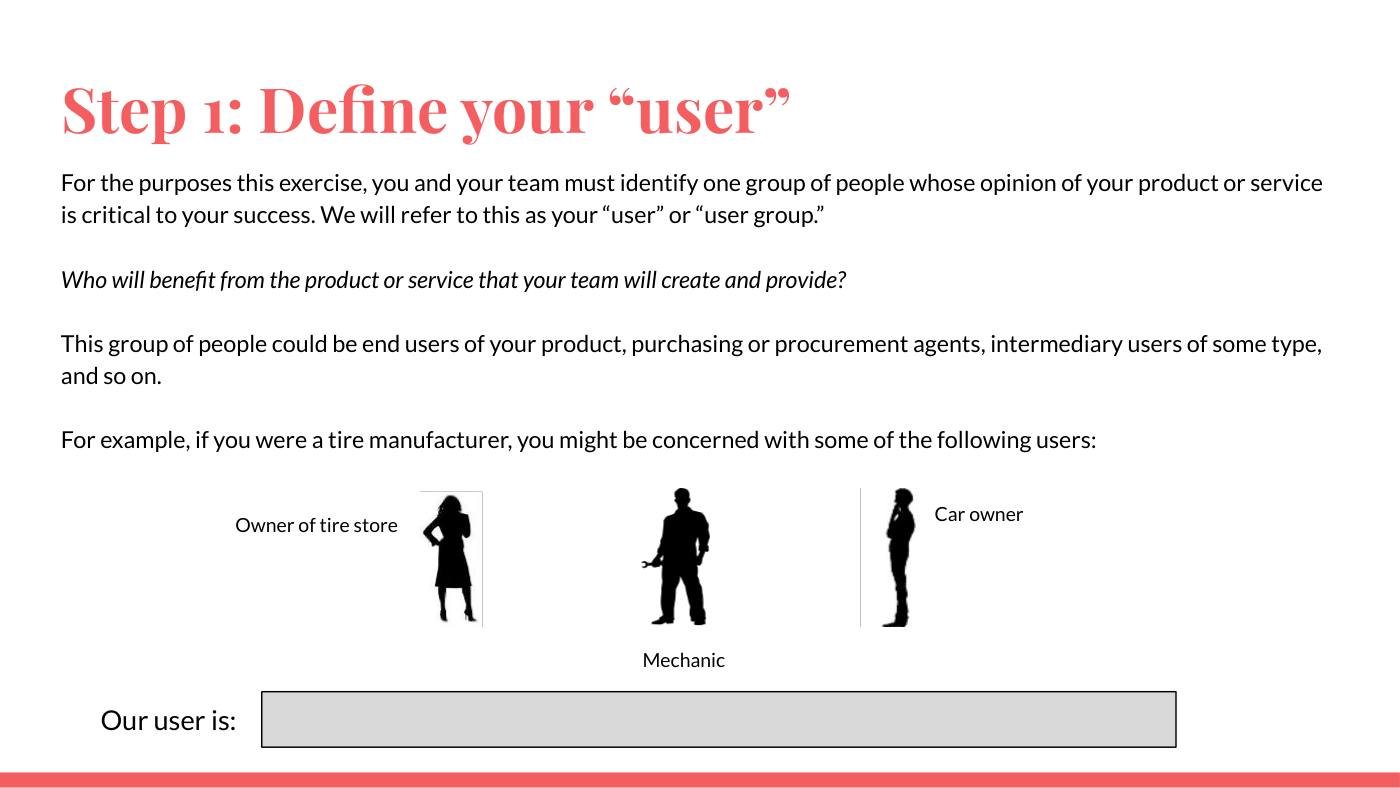
Buyer, operator and affected person often want different things. Write a separate need hypothesis for each.
Before interviewing, list each role that touches the problem and say what evidence would confirm or overturn its need. A role you leave out is a need you will discover only after launch.
Interview roles separately. In a joint interview, the senior person's account usually crowds out the operator's.
Role
Relation to an empty slot
Need hypothesis
Evidence to seek
Clinic owner or office manager
Absorbs the lost revenue (about $110 per visit, illustrative)
Predictable therapist utilization without adding staff
How gaps are tracked, if at all, and what has been tried before
Front-desk coordinator
Does the work of filling the gap
Fill a slot quickly without abandoning patients at the desk
Shadowed episodes: time spent, tools used, outcome
Physical therapist
Loses the hour or fills it with paperwork
A schedule that doesn't depend on luck
What they did with the last empty hour
Waitlisted patient
Decides whether the slot is filled
An earlier appointment that fits work and travel constraints
Last time they were offered a short-notice slot and why they said yes or no
Illustrative Relay map. Each need is a hypothesis to test, not a finding.
23
04 / Source pageEmpathy & customer evidence
OXO Good Grips: designing for the extreme user
24
04 / Source pageEmpathy & customer evidence
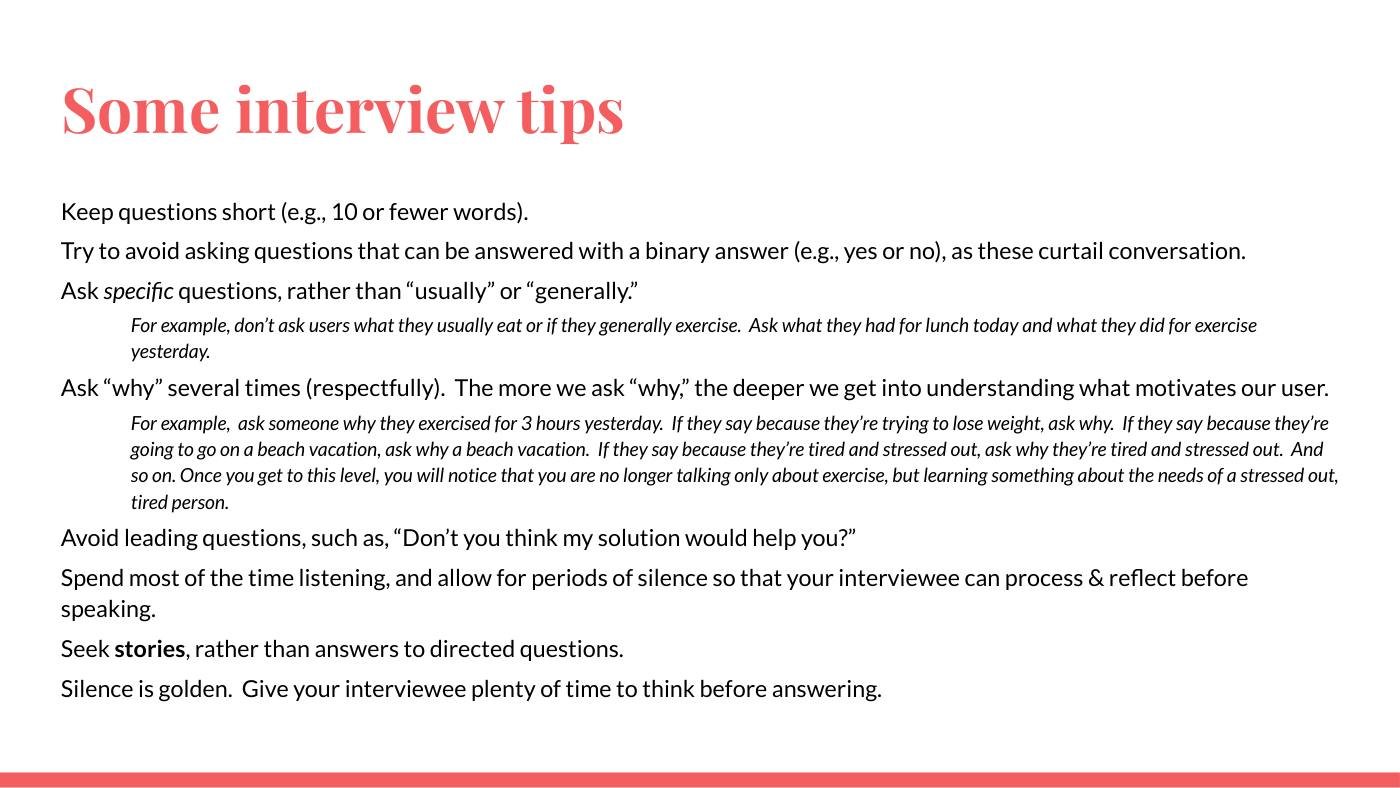
Interview technique checklist
25
04 / Source pageEmpathy & customer evidence
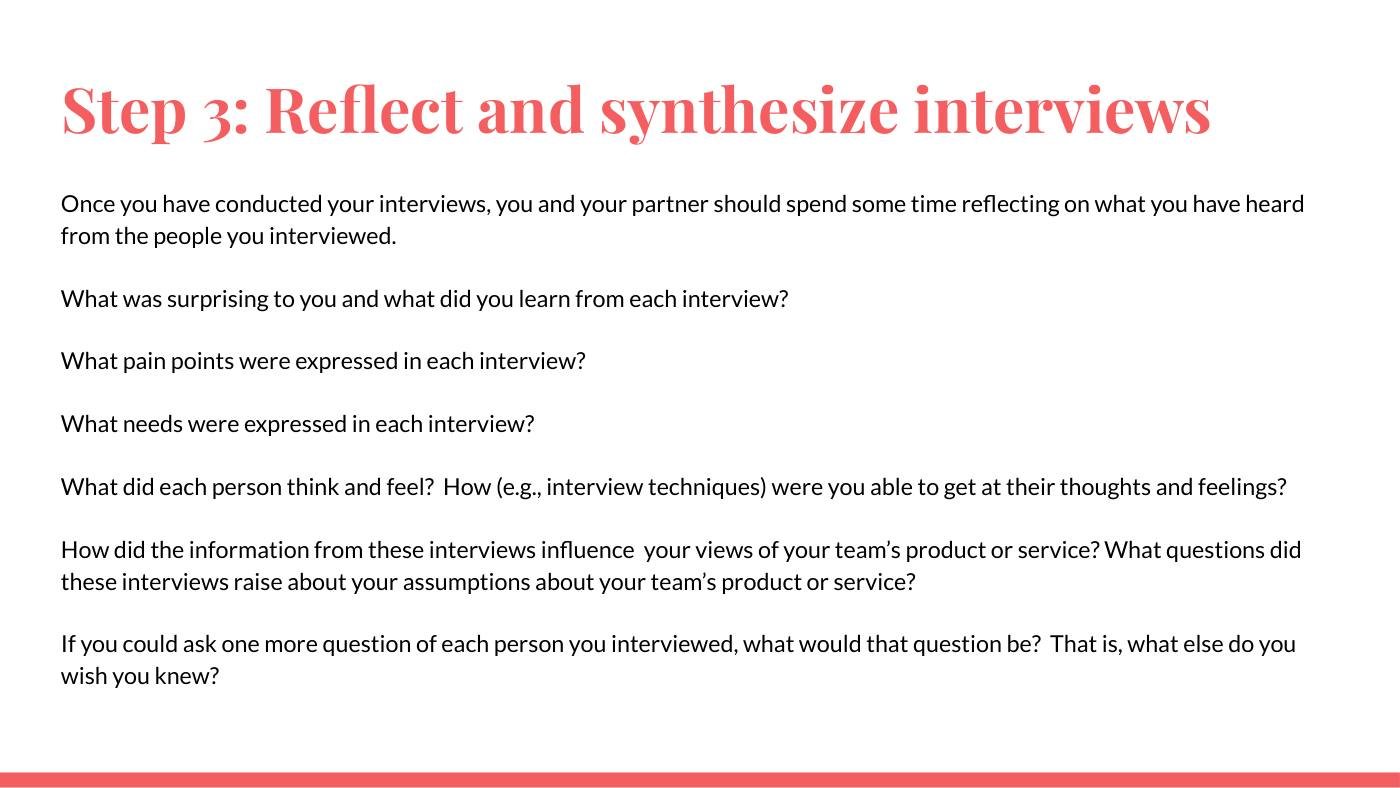
Reflect and synthesize after each interview
26
04 / Deep diveEmpathy & customer evidence
Field research in regulated settings
Shadowing a clinic's front desk puts you next to protected health information. Plan the session so you never capture it.
Write down roles, times, counts and actions, for example "called patient 3 of 5," and leave out names, phone numbers and diagnoses. Photograph tools and workarounds only after checking that no screen or list showing patient data is in the frame.
Get the clinic's permission in advance, tell staff what you will and won't record, and keep notes in a shared folder that nobody outside the team can open. Whether HIPAA or state privacy law applies to a particular visit depends on current law and the facts, so get legal review before you start.
27
04 / ApplicationEmpathy & customer evidence
Fictional interview: an unreliable handoff
“Yesterday I sent the delivery instructions by email. The driver called because he could not find them. I texted a photo, but the office later used the old address. I do not need more messages; I need to know everyone has the right version.”
What is directly reported, and which needs are still hypotheses?
28
04 / Current practiceEmpathy & customer evidence
Current practice: AI in customer research
Synthetic users can't supply episodes
Nielsen Norman Group compared AI-generated "synthetic users" with real participants. The synthetic users claimed they had finished online courses that real learners admitted abandoning. They praised discussion forums that most real learners avoided, and they treated every need as important. NN/g recommends using them only for desk research or to pilot an interview guide, never in place of real users.
Use AI to prepare and organize, not to interpret for you
An LLM can turn a question list into a draft guide, flag leading questions, or tag transcripts by theme. You still have to keep each tagged passage tied to the original episode and check which contradictions a summary has smoothed over.
Recordings in clinical settings can carry protected health information
If an interview or shadowing session captures patient details, any cloud transcription or storage vendor handling that data may be a HIPAA business associate and need a business associate agreement (BAA). Under HHS guidance, cloud providers that store or process electronic PHI are business associates. The simplest safeguard is to design the session so no patient identifiers are recorded. Whether HIPAA applies depends on current law and the facts, so get legal review.
Use the fictional interview on the preceding slide; treat it as the full available interview packet.
Your task
Record three reported events, two possible explanations, an underlying need and three follow-up questions. Do not propose an application yet.
30
04 / DebriefEmpathy & customer evidence
Worked answer and reasoning
The reported events concern scattered instructions, a driver’s call and use of an old address.
Possible explanations include inaccessible instructions and uncontrolled versions; neither is proven.
A defensible need is confidence that the people carrying out a delivery share the current instructions. Ask about the actual handoff and how updates propagate.
31
04 / Venture stepEmpathy & customer evidence
Venture step: Front-desk empathy plan and interview guide
Relay · venture step 04
Maya is sure about the problem because she lived it. As operations manager of a 6-location Austin PT group, she watched front-desk staff spend about an hour a day phoning patients to fill gaps. Daniel wants proof that this is not one group's habit. They are about to talk to clinics that might pilot Relay. A typical small clinic has 4 therapists, about 280 visits a week and about 42 empty slots from late cancellations and no-shows (illustrative). The risk is that every conversation turns into a Relay pitch.
Your task
Produce an empathy plan and an interview guide. The plan covers who to observe and interview, where and when, and which extreme users to include. The guide has 8–10 episode-based questions. Add a two-column evidence log with three sample entries that keep observation apart from interpretation.
32
04 / Venture stepEmpathy & customer evidence
Venture step: worked reasoning
Sample (illustrative): 8 front-desk coordinators across 5 clinics, none from Maya's former group. Include 2 independents, 2 sites of multi-location groups and 1 hospital outpatient department. Add 3 owners or office managers and 4 waitlisted patients as separate user groups with separate needs.
Extreme users: the clinic with the highest late-cancellation rate, and a coordinator who already fills most gaps by hand. The second shows which mechanism works today. Neither tells you how common the problem is.
Observe before asking: shadow the first two hours of a weekday, when same-day cancellations tend to come in. Log each gap: the time it opened, every action taken, the tools used and how it ended. Write down no patient names or appointment details. Record counts and roles only.
Guide questions: "Walk me through the last same-day cancellation." "Who did you contact first, and why that person?" "What happened when nobody answered?" "What did the therapist do with the empty hour?" "Where do you keep the list of people who want an earlier slot?" Leave Relay out until the final five minutes, or leave it out entirely.
Evidence-log example. Observation: "At 7:48 the coordinator called 4 patients from a paper list, left 3 voicemails, and the 9:00 slot stayed empty." Interpretation A: patients ignore clinic calls. Interpretation B: few people can come in on 70 minutes' notice. Each points to a different product, so the next interview has to tell them apart.
33
04 / DebriefEmpathy & customer evidence
Reasoning traps
The pitch in disguise
Once Relay is described, interviewees start judging the idea and stop reporting what they do. Polite approval then gets logged as evidence. Keep the product out of the conversation, or hold it back until the episode questions are finished.
The founder's memory counted as fieldwork
Maya's years at one Austin PT group are a source of hypotheses. They are not a sample. Write her beliefs down as assumptions, then interview clinics she has never worked with, including types she doubts will fit.
Interviewing only the person who pays
Owners talk about revenue, coordinators know the workflow and patients decide whether a slot gets filled. A frame built from owner interviews alone can miss the reason the product fails at the front desk.
34
04 / ReviewEmpathy & customer evidence
What you can now explain
A Relay empathy plan (who, where, when, extreme users), a front-desk interview guide of 8–10 episode questions and an evidence log template that keeps observations apart from interpretations.
Keep observations, interpretations and needs as separate records, so a new explanation can replace an old one without losing the evidence.
Questions about a recent, specific episode give more reliable evidence than predictions or opinions about a proposed product.
Extreme users and workarounds show you mechanisms. How common those mechanisms are has to be established separately and across several user roles.
Next lesson: Problem framing, prototyping & learning
35
Check your understanding
How can you uncover a need without pitching your solution?
Score
Question 1
On a shadowing visit, a Relay interviewer records four entries. Which one is an observation and not an interpretation?
Only the second entry records what happened: who acted, when, what was done and the result. The other three explain behavior. They may be right, but they need checking, and "stressful" sounds descriptive while actually guessing at a feeling no one stated.
Question 2
Maya says front-desk staff at her former group spent about an hour a day phoning patients to fill gaps. What does this evidence establish for Relay?
A vivid first-hand episode can reveal a mechanism and justify investigation, so it isn't worthless. It comes from one organization, though, and one person's recollection. It cannot estimate prevalence or market size. That needs observations across clinics of different types.
Question 3
An interview guide includes: "Would you use an app that automatically texts your waitlist when someone cancels?" Which replacement best follows the lesson's guidance?
The last option asks someone to reconstruct a real episode, which shows actual behavior, tools and outcomes. The pricing question still asks for a prediction about a pitched solution. The frustration question gets a yes/no opinion. The third is a leading question that invites polite agreement.
Question 4
After three interviews, a Relay team drafts need statements for front-desk coordinators. Which one is a need, as opposed to a disguised solution?
The first option names what the person is trying to achieve and the constraint they work under. It leaves room for texting, policy changes, standing short-notice lists or other answers. The other three each assume an interface. An interview can confirm a need. It can't confirm that a particular feature is the answer.
Question 5
A coordinator at one clinic fills nearly every same-day gap by texting a personal group of "flexible" patients she keeps on her own phone. How should the Relay team treat this interview?
Extreme users are valuable because they make a mechanism visible: here, a pre-screened short-notice group reached through a fast channel. One case can't show how common the practice is, so it doesn't measure the market. Throwing it out loses the most informative interview, and copying it ignores the privacy problem of patient data on a personal phone.
Question 6
A startup sells a medication-reminder device to nursing homes. It has interviewed 15 residents and no one else. What is the most important gap in its evidence?
As the MRI example shows, the person who buys, the person who operates and the person who is affected can have different needs. A device that residents like can still fail if aides find it adds work or administrators can't justify the cost. More resident interviews don't fix that gap.
Workbook
How can you uncover a need without pitching your solution?
Module output: An evidence log, problem frame, prototype, segment choice, positioning and route to market.
Library
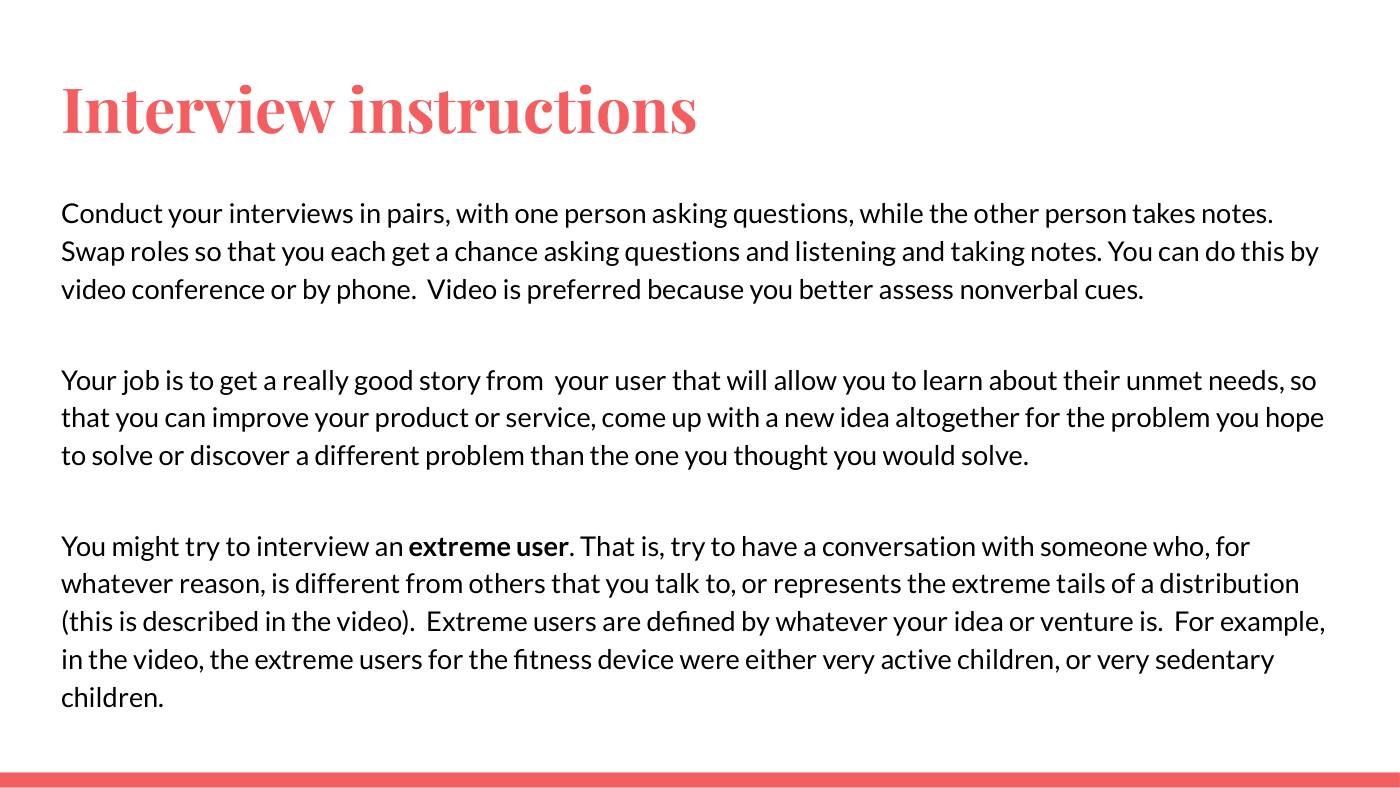
Every original page used in this lesson
10 appear in the slides with notes; the rest are kept here for reference.
Three definitions of design thinkingA text slide that defines design thinking as a human-centered approach to ill-defined problems, as a process of generating many ideas and then iterating on a few, and as a way to build confident leaders. This is an introductory framing; the five-stage diagram on the following pages makes the same point more usefully.Soule - Empathy Overview Slides · PDF page 2
1
Creative ability as a practiced skillA text slide arguing that everyone starts with creative ability, that people are discouraged from using it, and that design thinking supplies the mindsets and methods to use it again. This is motivational context with no method or evidence that the lesson's question needs.Soule - Empathy Overview Slides · PDF page 6
2
The five design-thinking stages, with empathy firstFive linked hexagons: Empathize, Define, Ideate, Prototype, Test. Each has a one-line description. Empathize means learning about the person through observation, interviews, immersion and engagement. Testing is described as "another round of empathy work." Empathy comes before Define, so the problem statement comes from evidence instead of being assumed. Testing feeds back into empathy, which makes the model a loop. Relay's interviews this week belong to the first stage, so they should not include a demo.Soule - Empathy Overview Slides · PDF page 7 · in the slides
3
Why empathy matters: design for useA text slide: to build something people will use, you must understand their lives, behaviors, goals and wishes. Slide 13 and the need-finding pages that follow make the same argument with sharper examples.Soule - Empathy Overview Slides · PDF page 8
4
Section divider: empathy work is about finding needsA title-only slide that announces the need-finding section. This is a divider with no content.Soule - Empathy Overview Slides · PDF page 9
5
The desire path: what customers actually need versus what we think they needA photo of a paved loop around a round flower bed. A worn dirt path runs straight across the bed. The paved loop is labeled "what we think our customers need" and the dirt path "what our customers actually need." The trail is evidence of behavior. No one was asked about it, and it records what people do when the designed route doesn't fit their goal. Look for Relay's equivalent: the sticky note, the personal cell phone or the side spreadsheet that front-desk staff use in place of the official waitlist.Soule - Empathy Overview Slides · PDF page 10 · in the slides
6
Need-finding: explicit needs above the waterline, implicit needs belowAn iceberg. The small tip above water is labeled EXPLICIT and the much larger mass below is labeled IMPLICIT. People can state explicit needs on request, such as "a faster way to call the waitlist." Implicit needs, such as not looking incompetent to the therapist whose afternoon has a gap, usually have to be inferred from behavior and stories. The image claims they are larger. It doesn't measure them.Soule - Empathy Overview Slides · PDF page 11 · in the slides
7
Photo: a child climbing a chair to reach a bookshelfA black-and-white photo of a girl standing on a chair and reaching for a high shelf of books. This sets up the book example on slides 17 and 18. On its own it is an unlabeled image.Soule - Empathy Overview Slides · PDF page 12
8
The need ladder: from "she needs a book" to "a way to discover her purpose"Concentric circles. The innermost ring holds the stated need, a book. The middle ring says "as a way to learn," and the outer ring says "as a way to discover her purpose." A tablet sits on the outer edge as an alternative way to meet the need. Each step outward answers "why does that matter?" and admits more solutions. A tablet only appears as an option once you leave the innermost ring. Go up the ladder only as far as your evidence supports. Without episodes behind it, "discover her purpose" is speculation.Soule - Empathy Overview Slides · PDF page 13 · in the slides
9
Implicit needs enlarge the solution setA large circle labeled "implicit needs lead to less obvious solutions" holds "a way to learn" and "a way to discover her purpose." A small circle at its edge labeled "explicit needs lead to obvious solutions" holds "ladder" and "book." If you frame the request as the need, you get the ladder. If you frame the purpose as the need, you can get many responses. For Relay, "call the waitlist faster" leads to an auto-dialer. "Keep therapists' days full without front-desk heroics" also allows overbooking rules, standing short-notice lists and changes to the cancellation policy.Soule - Empathy Overview Slides · PDF page 14 · in the slides
10
Define each user: one product, several people with different needsThe question "who will benefit?" sits above an MRI-manufacturer example with three silhouettes: the procurement officer, the MRI mechanic and the patient. The person who buys, the person who operates and the person who is affected often want different things. Relay has the same structure: a clinic owner who pays, a front-desk coordinator who works the waitlist and a patient who decides whether to take the slot. Interview each one separately.Soule - Empathy Overview Slides · PDF page 16 · in the slides
11
Designing for everyone produces a product nobody wantsA text slide with an oversized Swiss Army knife. It warns that meeting too many user groups' needs at once produces something nobody wants, and it suggests personas for specific user groups. The same slide comes back in lesson 5 (scan 40), where it supports problem framing. Here it is a short warning to define each user.Soule - Empathy Overview Slides · PDF page 17
12
Observation: a kitchen knife and a child-resistant pill bottleTwo photos. A pharmacy prescription bottle with a child-resistant cap sits on a counter, and then a serrated kitchen knife is used on the bottle on a cutting board. The workaround is evidence that no interview would produce, because few people would volunteer that they attack their medication with a knife. Record what you see: the tool, the step and the setting. Only then interpret it, for example as limited grip strength, impatience or a design that blocks the intended adult user.Soule - Empathy Overview Slides · PDF page 18 · in the slides
13
Observing one person can beat a large datasetText claims that observing someone can give more insight than a lot of data about many people. A Febreze bottle sits beside it, with a link to the widely reported story of P&G's early Febreze launch. Useful as a reminder, but slides 21 and 23 make the point with images that need no external story.Soule - Empathy Overview Slides · PDF page 19
14
Look for hacks: a clothespin on a trouser cuffA cyclist has clipped a wooden clothespin around a frayed jeans cuff to keep it out of the chain. This is one of several hack photos (slides 23, 30–32). Scan 21 stands for the set.Soule - Empathy Overview Slides · PDF page 20
15
Hack: scissors holding tea-bag strings on a pitcherA glass pitcher of brewing tea, with a pair of scissors clipped across the rim to hold the tea-bag strings. Another example of a household workaround that reveals an unmet need, here a way to keep bags retrievable.Soule - Empathy Overview Slides · PDF page 21
16
Hack: a disposable glove on a bicycle handlebarA purple disposable glove pulled over one handlebar grip of a parked bicycle. This workaround asks for interpretation, perhaps rain, hygiene or a torn grip. That makes it good practice in separating what you see from why it happened.Soule - Empathy Overview Slides · PDF page 22
17
Hack: a foam sleeve wrapped around a sink faucetA foam can cooler cut open and wrapped around the base of a kitchen faucet. This is a further hack example with no new principle.Soule - Empathy Overview Slides · PDF page 23
18
Immersion: experiencing a ticket machine with impaired visionA woman uses a street ticket machine while wearing goggles that blur her vision. The slide is labeled "Immersion." Immersion means taking on a user's constraints yourself. For Relay, that could mean working a clinic's front desk for a morning.Soule - Empathy Overview Slides · PDF page 24
19
Immersion: undergoing a painful procedure firsthandA man grimaces while a practitioner waxes his chest. A second immersion image. It says that firsthand experience exposes emotional and physical details that interviews miss.Soule - Empathy Overview Slides · PDF page 25
20
Interview: an informal conversation at workA smiling man in an office lobby holds a jar of candy. The slide is labeled "Interview." A section marker for interviewing. The interview tips on scans 42–43 carry the content.Soule - Empathy Overview Slides · PDF page 27
21
Interviewing an older adult in a care settingTwo researchers sit with an elderly man in a care facility. He holds an old photograph and one researcher takes notes. The man shares an artifact, and artifacts prompt the specific stories that this lesson prefers over general opinions.Soule - Empathy Overview Slides · PDF page 28
22
Section marker: extreme usersA close-up of kitchen utensils with the caption "Extreme Users." This introduces the OXO example on slides 38–40.Soule - Empathy Overview Slides · PDF page 29
23
An extreme user: hands affected by arthritisA close-up of an older woman's hands with visibly swollen joints. This sets up the OXO example. Grip difficulty is the condition that made ordinary utensils fail.Soule - Empathy Overview Slides · PDF page 30
24
OXO Good Grips: designing for the extreme userAn OXO Good Grips vegetable peeler with its thick, soft, ribbed handle next to the brand name. The widely told origin story is that OXO's founder designed the handle for a user with arthritis. The resulting grip was more comfortable for ordinary cooks too. The lesson is that extreme users show you a mechanism, here grip force. Market size still needs separate evidence. Relay's extreme users could be the clinic with the highest cancellation rate, or the coordinator who already fills nearly every gap by hand.Soule - Empathy Overview Slides · PDF page 31 · in the slides
25
OXO products across a retail wallA shopper walks past a store wall of OXO Good Grips kitchen tools. This shows that the extreme-user insight scaled into a broad product line. It adds no method beyond slide 39.Soule - Empathy Overview Slides · PDF page 32
26
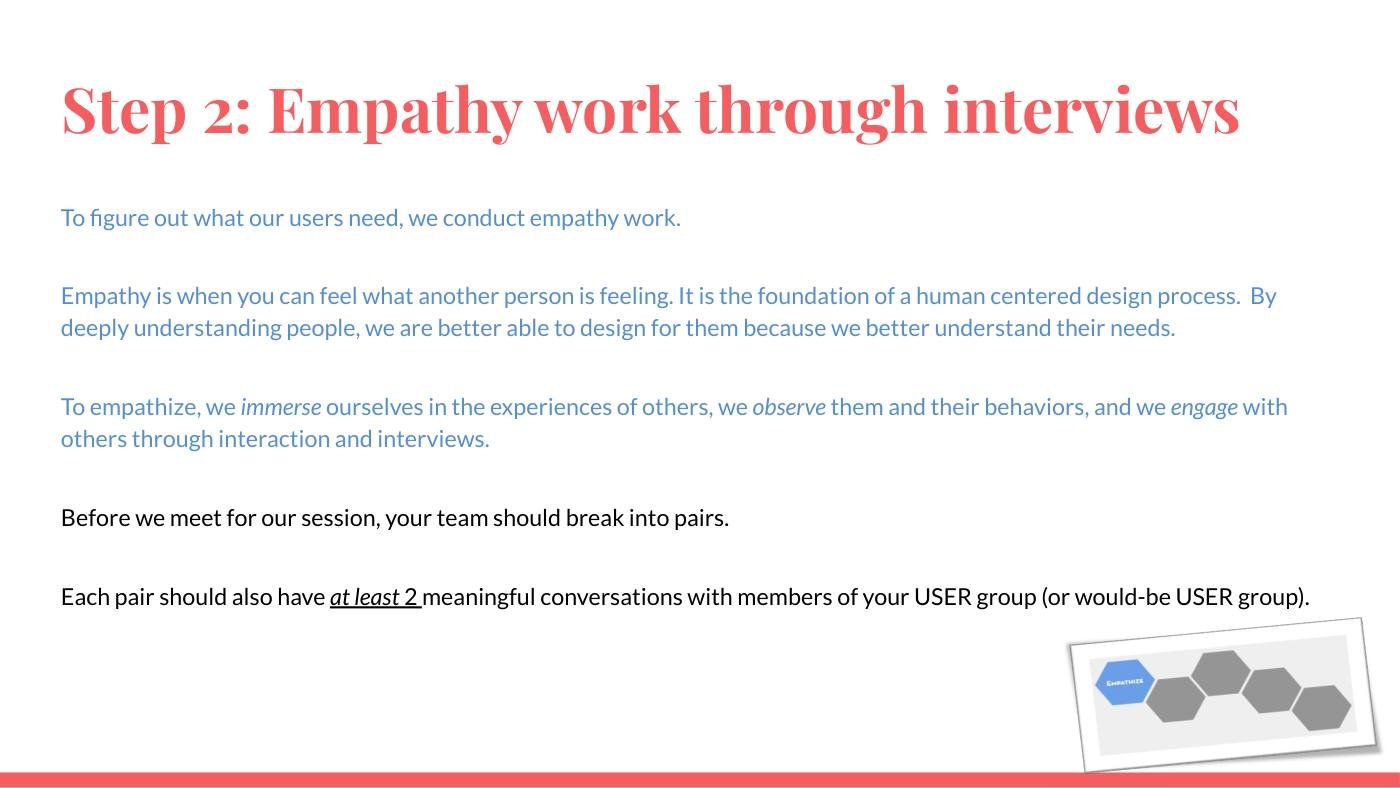
Assignment: empathy work through interviewsCourse instructions define empathy as immersing, observing and engaging. They ask teams to work in pairs and have at least two meaningful conversations with members of their user group. Logistics from the original course. The interviewing-in-pairs advice is worth keeping, because one partner listens while the other takes notes.Soule - Empathy Logbook · PDF page 4
27
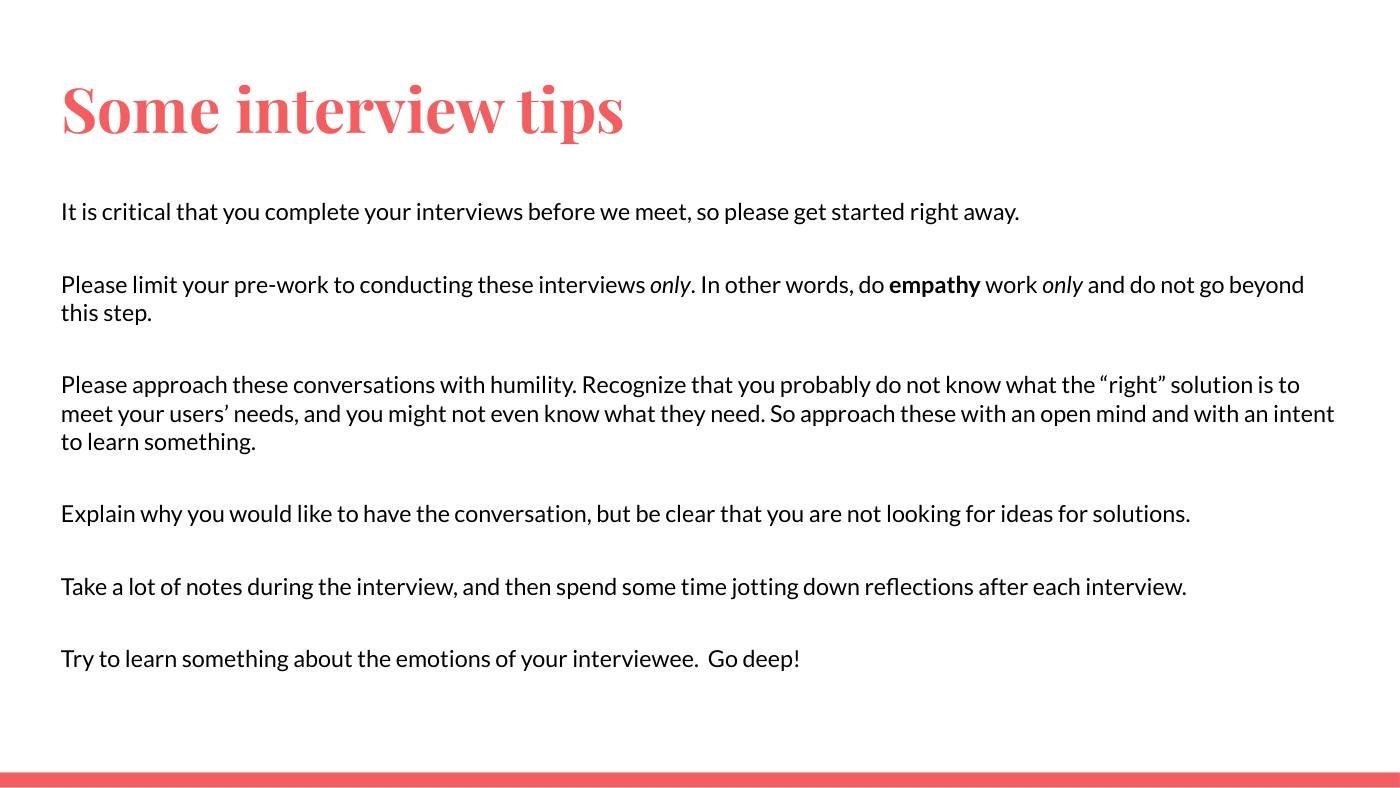
Interview stance: humility and no solution-seekingInstructions: do only empathy work, approach with humility, explain that you are not looking for solution ideas, take notes, write reflections afterward and try to learn about emotions. The key instruction is to tell interviewees that you are not asking for solution ideas. That keeps the conversation on their experience. Scan 43 has the more usable checklist.Soule - Empathy Logbook · PDF page 6
28
Interview technique checklistA list of interview rules: keep questions to about ten words, avoid yes/no questions, ask about specific occasions instead of what usually happens, ask why several times, avoid leading questions, listen most of the time, seek stories and allow silence. Examples include asking what someone ate for lunch today and following the reasons behind three hours of exercise. Each rule protects the same thing: an account of real behavior that your expectations haven't shaped. "Do you usually struggle to fill cancellations?" invites a general opinion. "What happened with the last same-day cancellation?" gets an episode you can check.Soule - Empathy Logbook · PDF page 7 · in the slides
29
Reflect and synthesize after each interviewDebrief prompts for interview pairs: what surprised you, which pain points and needs came up, what the person thought and felt, how the interviews changed your view of the product, and what one more question you would ask. The last two prompts matter most. They make you record how the evidence challenged your assumptions and what is still unknown. Answer them the same day, before memory merges several interviews into one story.Soule - Empathy Logbook · PDF page 8 · in the slides