How do hiring, rewards and leader behavior reinforce a strategy?
A culture-design logic and management-lever map.
1
36 / OpeningCulture design & management levers
The decision and the learning goals
Connect a desired behavior to a strategic requirement
Align several management levers rather than relying on slogans
Identify tensions between culture, inclusion and changing conditions
90-minute workshopOpening 5 minConcepts and original examples 35 minPractice 25 minDebrief 15 minReview 10 min
2
36 / TheoryCulture design & management levers
Culture design starts with the work required by strategy
The design-and-management lecture links strategy to key success factors and then to the behavior needed to perform the work. Cultural attributes should have a reason within that chain. Generic positive words do not explain which actions employees should take when choices conflict.
Separate alignment with strategy from the broader effects of commitment and coordination. A value can help people work together without differentiating the company’s strategy. A complete design should explain which effect each attribute is expected to produce.
3
36 / TheoryCulture design & management levers
A culture statement needs observable consequences
The source evaluates statements for authenticity, strategic alignment and their ability to connect with members. Credibility comes partly from what leaders do when following a stated value becomes costly. Employees infer priorities from those decisions.
A useful statement helps someone choose in an uncertain situation. Ask what would change if a value were removed or reversed. If no consequential behavior changes, the wording may be too generic. A statement also needs a language employees can interpret consistently.
4
36 / TheoryCulture design & management levers
The logic of cultural design
Work backward from what the strategy requires, then check whether practices produce it.
5
36 / TheoryCulture design & management levers
Choose cultural content for a reason
What must people do to deliver the strategy?
Which expectations help them coordinate and commit?
Where might the founder’s preferences help or hinder?
Which tensions and trade-offs should be made explicit?
6
36 / TheoryCulture design & management levers
Use several management levers
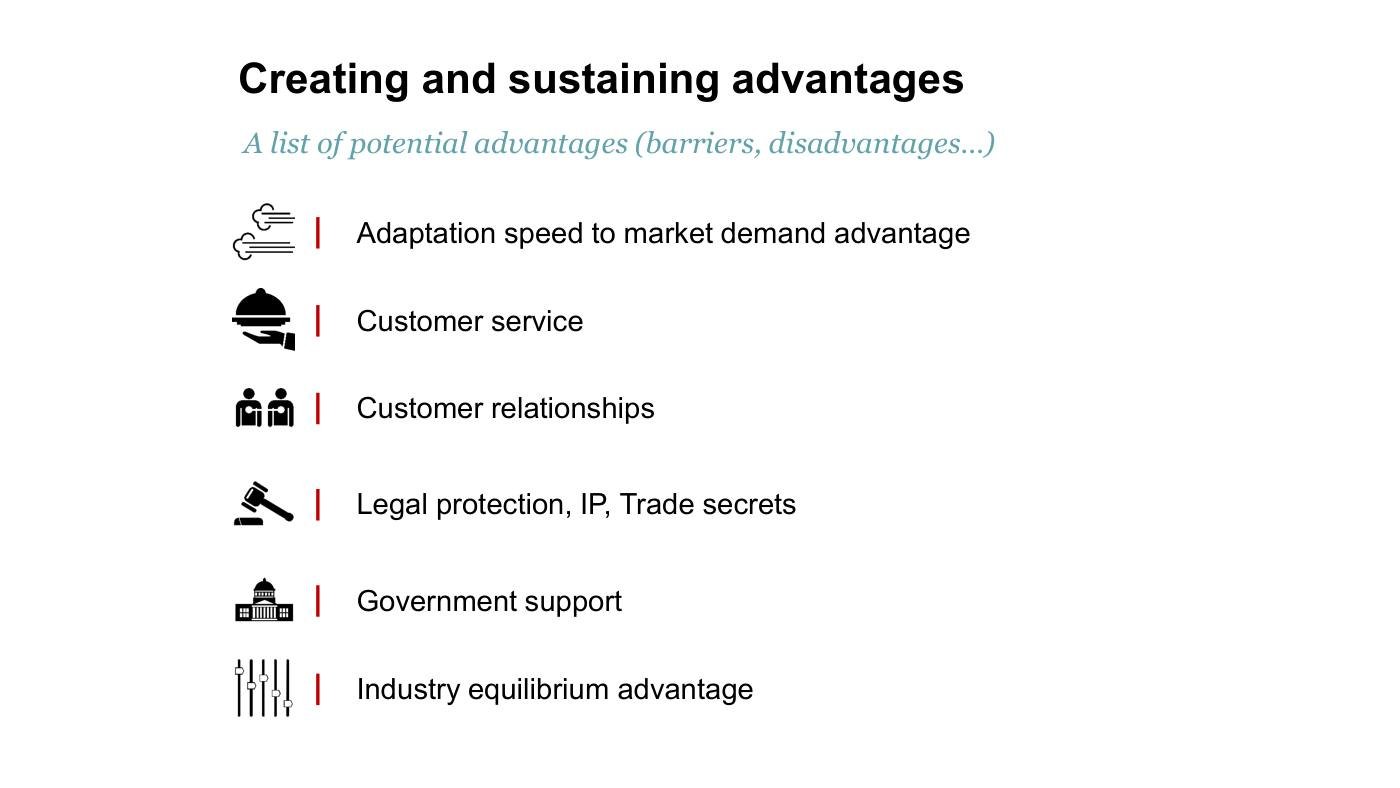
Lever
Observable design choice
Leadership
What leaders model and explain.
Selection
Relevant behaviors and capabilities sought in hiring.
Onboarding
What newcomers learn and experience.
Organization
Information, participation and decision boundaries.
Rewards
Which behavior is recognized or discouraged.
7
36 / TheoryCulture design & management levers
A slogan and a consistent system
People learn priorities from repeated consequences. A value statement becomes credible when leaders, incentives and routines support the behavior it describes.
Slogan
“We value learning.”
System
People can surface bad news, review evidence, revise a decision and receive credit for useful learning rather than hiding a failed test.
Worked application
Illustrative application: “raise problems early” conflicts with managers who penalize teams for reporting a delay. A consistent system investigates early reports, helps resolve the obstacle and distinguishes transparency from careless execution. Examine a real difficult decision to see which rule members expect to apply.
Find and repair the contradiction in the management system. Rewriting the statement alone leaves the learned expectation intact.
8
36 / Original readingCulture design & management levers
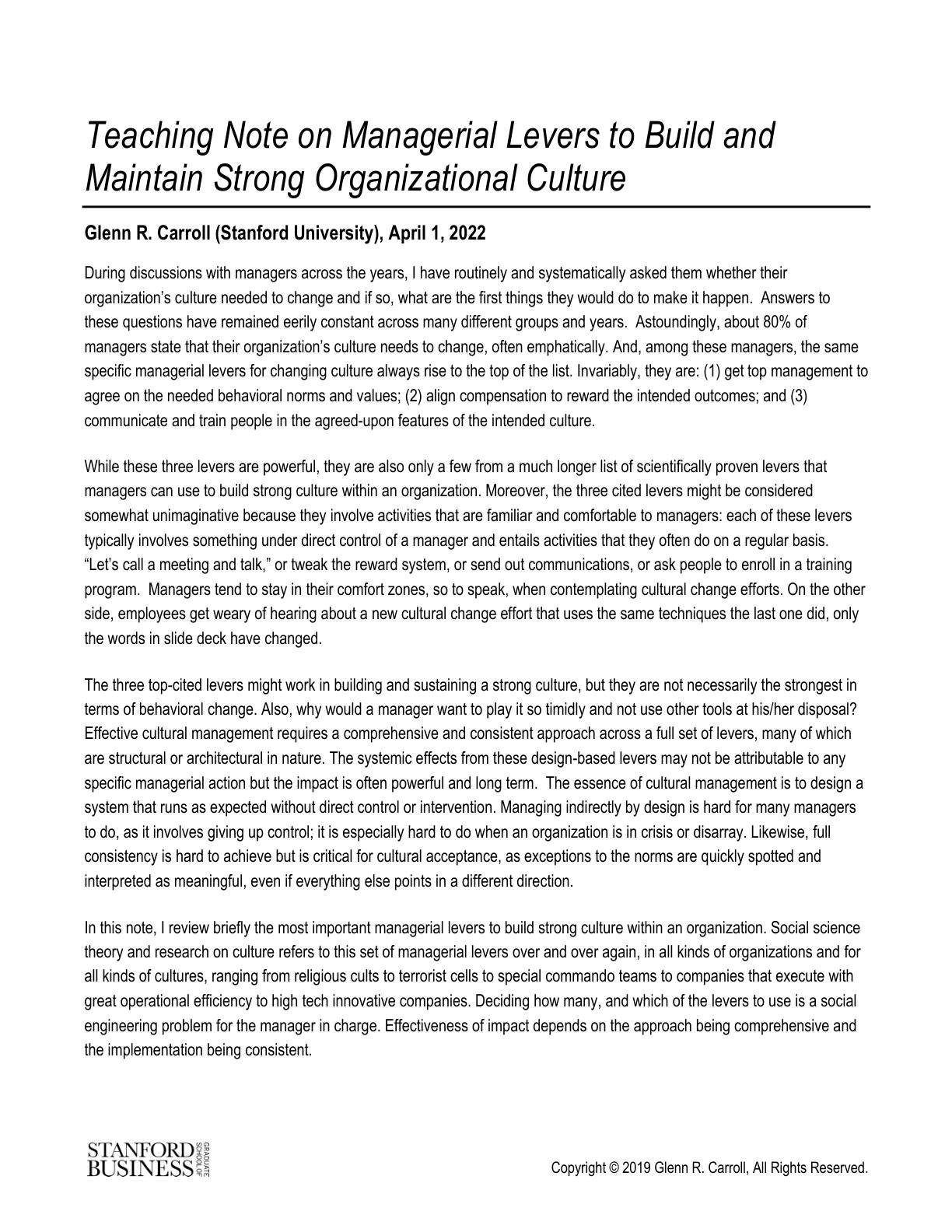
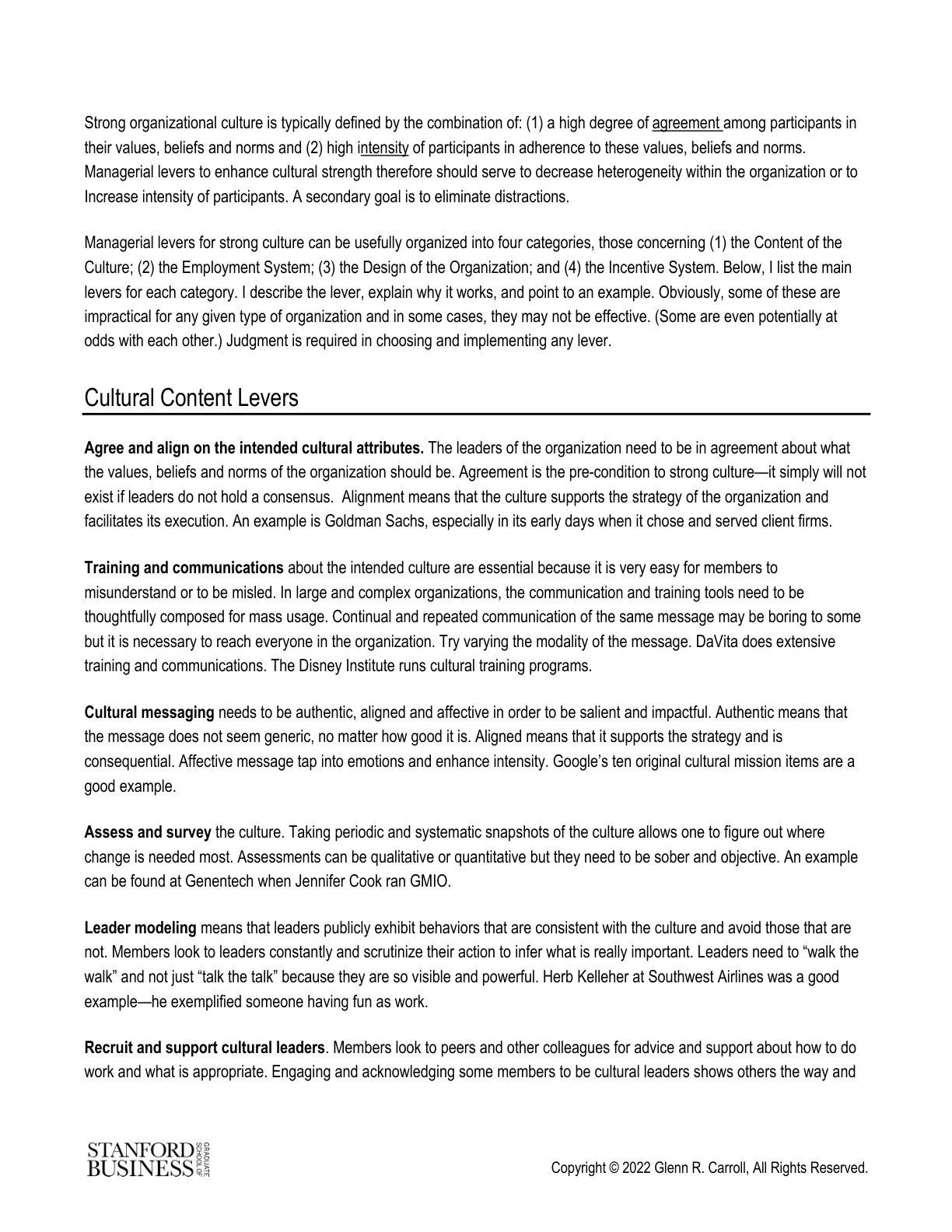
Carroll - Teaching Note on Managerial Levers to Build and Maintain Strong Organizational Culture
PDF page 1
PDF page 2
Click either page to read it at full size. In the reader, use ← → to switch between these two pages.
9
36 / Original readingCulture design & management levers
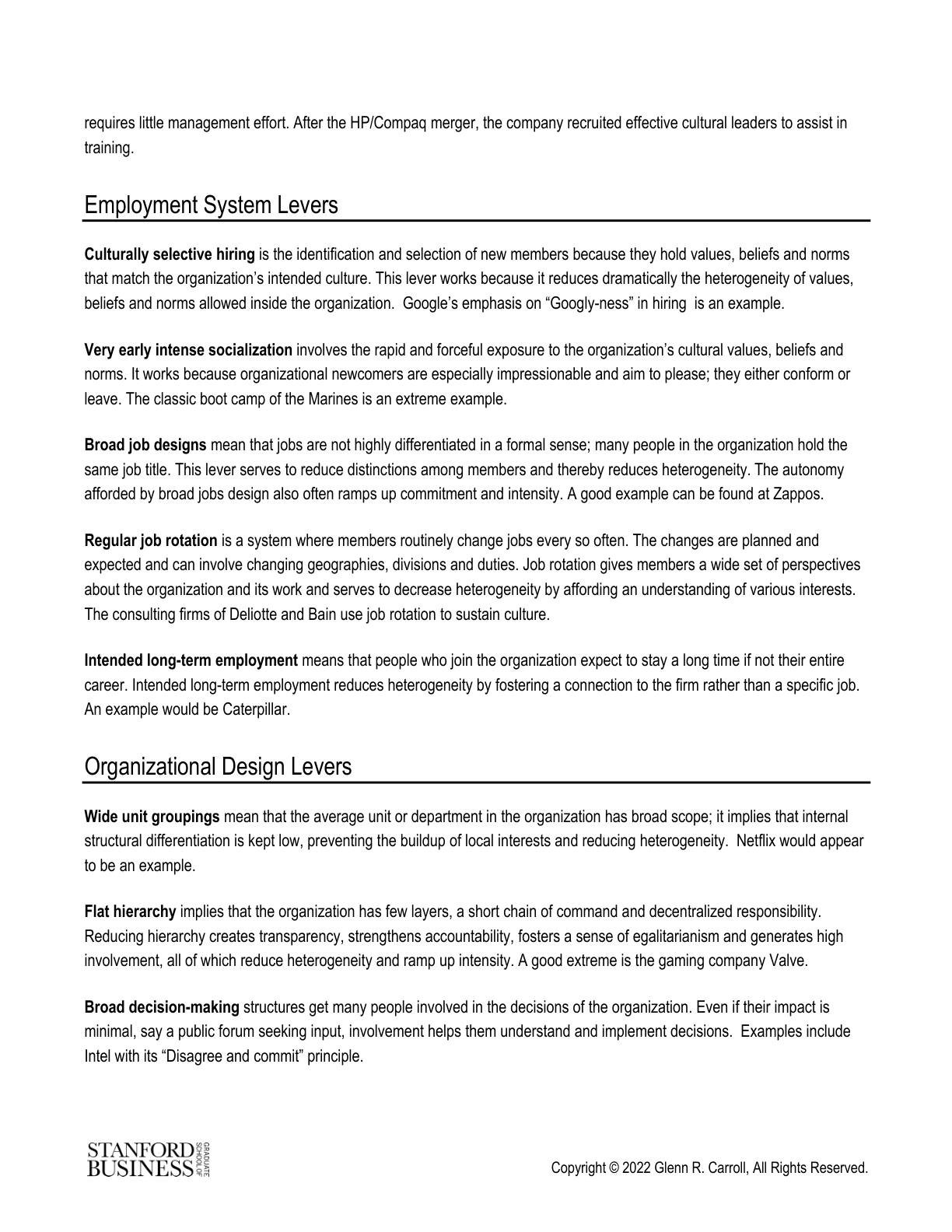
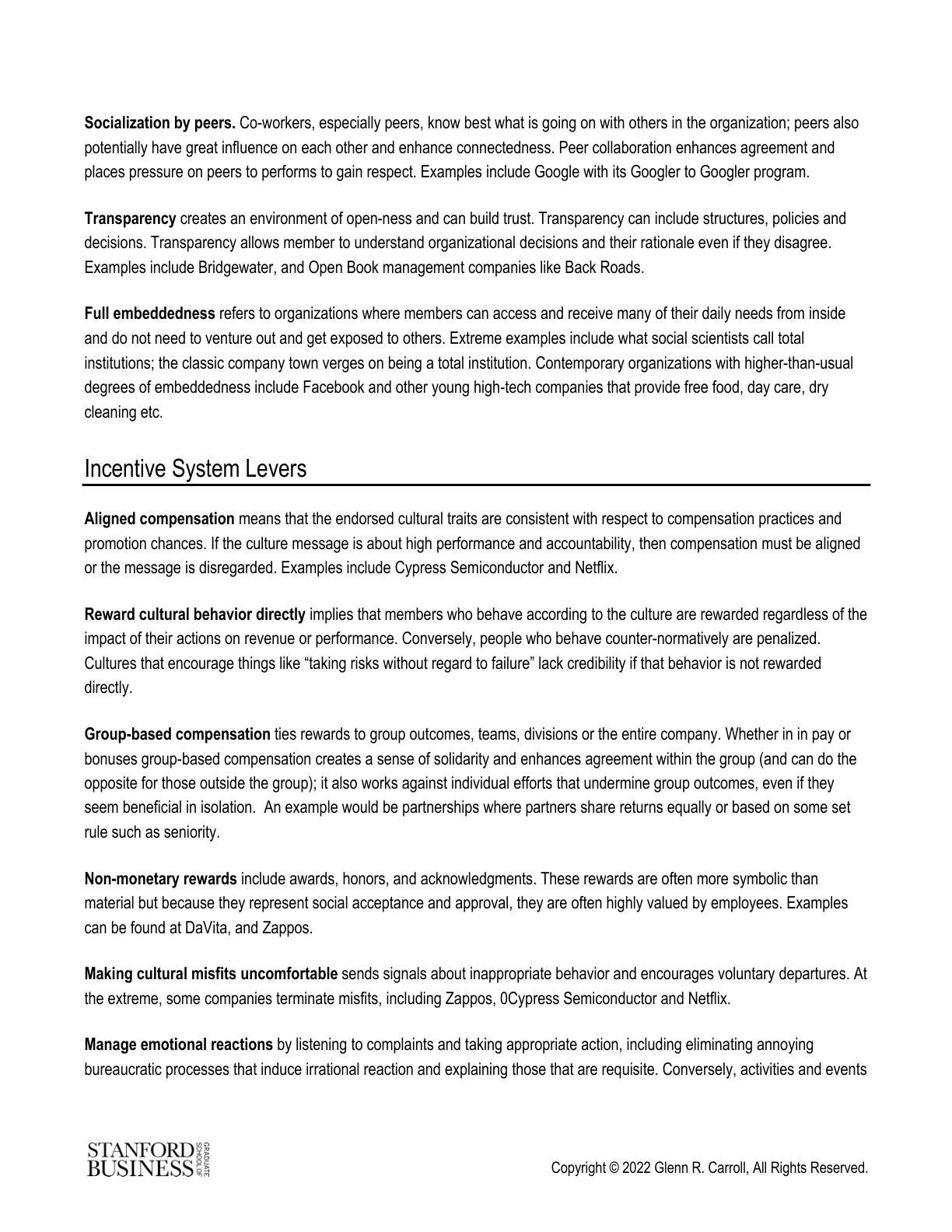
Carroll - Teaching Note on Managerial Levers to Build and Maintain Strong Organizational Culture
PDF page 3
PDF page 4
Click either page to read it at full size. In the reader, use ← → to switch between these two pages.
Managerial levers for organizational culture / summary
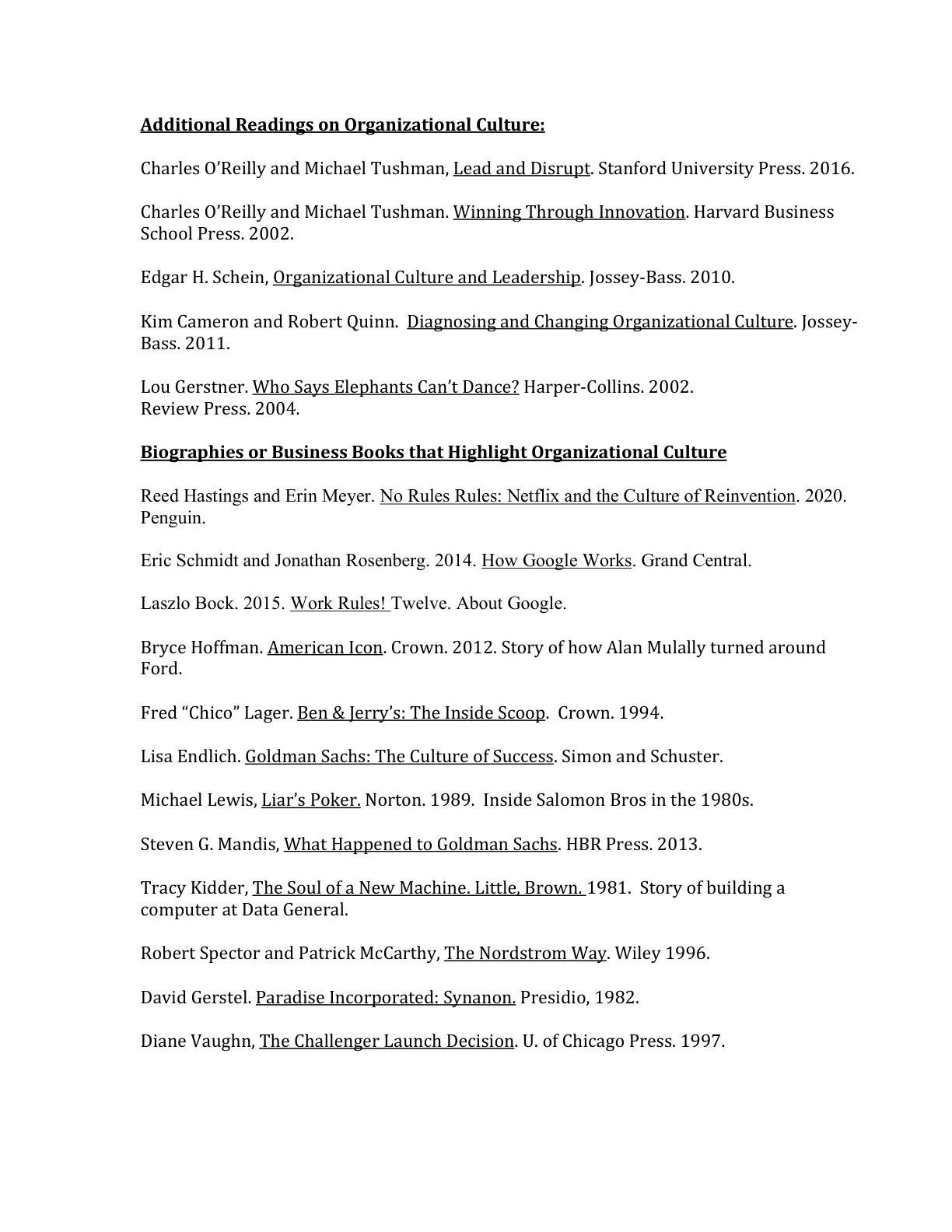
Selected reading: PDF pages 1, 2, 3, 4, 5
The note argues for a comprehensive and consistent system of cultural management. Structural design and everyday consequences complement leader agreement, compensation changes and communication.
Strength has two dimensions
A strong culture combines agreement about values and norms with intensity of adherence. Its content still determines whether that strength helps the work.
Several classes of levers
The note groups levers around cultural content, employment, organizational design and incentives. Managers can affect behavior through more than training.
Consistency carries information
People interpret exceptions, leader actions and real consequences as evidence of what the organization values.
Design supports indirect control
The intended system should encourage the behavior even without repeated managerial intervention. Implementation requires judgment about fit and conflicting effects.
Managerial levers for organizational culture / discussion
Selected reading: PDF pages 1, 2, 3, 4, 5
Critical points
Strength and usefulness
Intense agreement can support a harmful or unsuitable norm. Specify the strategic behavior before selecting ways to strengthen it.
Agreement and diversity
Shared expectations about relevant behavior do not require identical backgrounds or viewpoints. Preserve the distinctions needed for effective work and challenge.
A local contradiction matters
A reward or prominent exception can undermine repeated messages. Investigate actual decisions and consequences before declaring a change successful.
Management levers reinforce or contradict one another
Hiring, onboarding, job design, rewards, leader behavior and peer processes all teach people what matters. The lecture and managerial-levers note emphasize using several levers consistently because a written statement cannot overcome a contradictory system by itself.
Trace a desired behavior through the employee experience. People need the ability, opportunity and credible expectation to act. Watch for a conflict between a collective value and an individual incentive. Repetition over time helps expectations become shared, while exceptions for senior people can weaken credibility.
15
36 / TheoryCulture design & management levers
Shared expectations can coexist with different backgrounds
The source treats diversity as a difficult challenge for organizations relying on strong shared culture. A company can seek agreement on relevant work behavior without assuming that personal similarity is evidence of that behavior.
Translate an intended value into a job-relevant observable practice and a consistent evaluation process. Distinguish disagreement about ideas from failure to meet a legitimate work expectation. A culture that suppresses information from people with different perspectives can weaken the very decisions it seeks to coordinate.
16
36 / TheoryCulture design & management levers
Conventional controls and management through culture
Adapted from Carroll’s Design and Management lecture. These are analytical contrasts, not a rule that an organization must choose only one column.
Management issue
Conventional emphasis
Cultural emphasis in the source
Rules
Detailed instructions
General expectations that guide new situations
Information
Limited distribution
Broadly shared context
Leader behavior
Status and exceptions
Visible participation in the same expectations
Onboarding
Transfer of information
Socialization into shared ways of working
Supervision
Manager monitors conduct
Peers also provide advice and accountability
Motivation
Explicit pay and sanctions
Meaning, belonging and internalized expectations
A practical organization combines formal controls and cultural mechanisms. The relevant question is whether the combination supports the work and produces acceptable consequences.
17
36 / TheoryCulture design & management levers
A complete culture intervention
New teaching example applying the source’s managerial-levers framework.
Lever
Reliability example
Evidence to inspect
Leader modeling
Leaders report their own mistakes
How leaders respond when a report is inconvenient
Employment system
Practice issue escalation during onboarding
New hires can demonstrate the process
Organization
Give teams access and bounded authority
A team can resolve the issue without an unnecessary handoff
Rewards
Recognize useful early warnings
Recognition matches the stated expectation
Peer process
Use a constructive incident review
People share consequential details without concealment
The plan requires repeated, consistent behavior. A successful launch announcement does not establish that the expectation has become a norm.
18
36 / TheoryCulture design & management levers
A credible culture statement
Specific enough to guide a difficult choice.
Connected to the company’s purpose and work.
Understandable to the people expected to use it.
Consistent with decisions, rewards and what leaders do.
19
36 / TheoryCulture design & management levers
Find the contradiction
Stated expectation
Contradictory practice
Question
Collaboration
Only individual heroics are rewarded.
What behavior will rational employees repeat?
Customer care
Speed is rewarded regardless of service outcome.
What trade-off is actually encouraged?
Speak up
Bad news leads to blame.
Why would someone report a problem early?
20
36 / TheoryCulture design & management levers
Culture and diversity need careful distinction
Define job-relevant behavior rather than social similarity.
Different perspectives can expose weak assumptions.
Shared expectations need not require identical backgrounds or personalities.
Watch for “fit” becoming a label that excuses exclusion or unexamined preferences.
21
36 / TheoryCulture design & management levers
Implement and revise
Culture design starts with a behavior needed for the strategy, then checks whether the management system actually encourages it. Treat adoption as an observable process.
01
Specify behavior
Replace an abstract value with an action in a situation. Example: engineers disclose a release risk before the deadline, explain the customer consequence and propose a next step.
02
Align the system
Examine leader reactions, rewards, hiring, routines and resource allocation. A request for early disclosure conflicts with a reward system that recognizes only hitting the date.
03
Observe practice
Look at real decisions and what peers encourage or discourage. Counted activities can help, but investigate whether people actually share consequential information.
04
Revise contradictions
Change the management response or incentive that undermines the behavior. Review again after the change. A new slogan leaves the contradiction in place if consequences remain unchanged.
A credible cultural statement can be illustrated with a decision the organization would make differently because of that norm.
A fictional company says it encourages evidence and experimentation. Promotions go to people who never report a failed test, while managers criticize any revision of an earlier decision. The formal values and the reinforcement system point in different directions.
Which management levers need to change together?
26
36 / Current practiceCulture design & management levers
Current practice: culture levers in hybrid and remote teams
Hybrid can help retention without hurting performance
A randomized trial of 1,612 employees at Trip.com, published in Nature in 2024 (Bloom, Han and Liang), found that two work-from-home days a week cut quit rates by about a third, with no detectable effect on performance reviews or promotions over two years. Managers' estimates of hybrid's productivity effect moved from negative to slightly positive after the trial.
Proximity changes who learns the norms
Emanuel, Harrington and Pallais studied software engineers at a Fortune 500 firm: engineers whose teammates sat in the same building received about 18–22% more online code feedback than those with distant teammates (the figure varies across versions of the paper), while sitting together reduced output, especially for senior engineers. Mentoring and norm transmission are the costs of distance; they must be designed in deliberately for remote staff.
Office policy is itself a culture lever
Amazon announced in September 2024 that corporate staff would return to the office five days a week from January 2, 2025, with Andy Jassy arguing that in-person work makes it easier to learn and strengthen the company's culture. Whatever the policy, the lesson for Relay is to state which norms it is meant to build and check whether they show up for remote and in-office staff alike.
Fictional service company competes through reliable customer handoffs. It wants early problem reporting and shared responsibility. Bonuses currently reward speed alone, and senior staff are exempt from the handoff process.
Your task
Specify two needed behaviors and align leadership, onboarding, information and rewards. Identify one risk of the proposed system.
28
36 / DebriefCulture design & management levers
Worked answer and reasoning
Define early reporting and complete handoffs as concrete behaviors connected to the reliability strategy.
Remove unexplained status exceptions and align speed incentives with reliable outcomes.
Watch for excessive bureaucracy or blame disguised as accountability; observe whether problems become visible earlier.
Venture step: Align Relay's management levers at 22 people
Relay · venture step 36
Month 30, just after the Series A. Relay has grown from 9 to 22 people, 11 of them remote across four states; most new hires joined after the pivot to multi-location groups. Since the PHI near-miss, leaders say 'privacy is everyone's job.' In practice: sales commission pays on signed bookings regardless of implementation promises; engineering performance reviews count features shipped; onboarding is a two-hour HIPAA video; Daniel still approves urgent changes over direct message; incident reviews happen in an office meeting room with remote staff dialing in; nobody has been recognized for reporting a privacy concern.
Your task
Build a lever map: two concrete target behaviors tied to Relay's strategy, then for each lever (leadership, selection, onboarding, organization, rewards, peer process) the current practice, the contradiction, the change, and the evidence you will inspect in 90 days. Name one risk the system creates.
Strategy to behavior: Relay now sells 10+ location contracts to groups that run security reviews, so the required behaviors are (1) any employee stops work and flags a PHI risk before release or a promise to a customer, and (2) sales commits only to implementation scope engineering has confirmed.
Contradictions: booking-only commission rewards overpromising; feature-count reviews reward skipping privacy review; DM approvals by the CTO create a status exception; in-room incident reviews make remote staff second-class participants in the norm.
Changes: pay commission half at signing, half at go-live with no open security exceptions; add 'risks surfaced' and 'review quality' to engineering reviews; route every production change, including Daniel's, through the same review; hold incident reviews remote-first with a written pre-read; replace the video with a hands-on onboarding exercise in which new hires find planted PHI in a test fixture.
Selection: replace 'culture fit' with a work sample (find the privacy flaw in a pull request; for sales, respond to a customer's request for an unscoped integration) scored on a rubric by two interviewers, so 'fit' is not a stand-in for similarity.
Evidence at 90 days: share of near-miss reports filed by remote staff (should approach their half of headcount); number of production changes bypassing review (target zero, including founders); deals with post-signing scope disputes. Risk: review gates can become blame or bureaucracy that slows shipping; measure cycle time alongside the reports.
31
36 / DebriefCulture design & management levers
Reasoning traps
Rewriting the values instead of the reward
When a value is contradicted by commission plans, review criteria or a senior exception, new wording changes nothing. Find the decision that teaches the opposite rule and change it first.
Letting 'culture fit' stand in for evidence
Fit judged by interview rapport selects for similarity. Define the cultural behavior you need, test it with a work sample and a rubric, and stay open to differences on everything else.
Designing the culture for the office
In a half-remote team, the meetings and hallway moments where norms are reinforced must be equally visible to remote staff. Otherwise a strong norm forms in one location and a weak one everywhere else.
32
36 / ReviewCulture design & management levers
What you can now explain
A Relay lever map at 22 people: two strategy-linked target behaviors, the current contradiction and change for each lever, remote-inclusive processes, and 90-day evidence with a stated risk.
Culture design starts from the behavior the strategy requires and works backward to leadership, selection, onboarding, organization and rewards.
A culture statement is credible only when real decisions, especially costly ones and those involving senior people, are consistent with it; inconsistency is the usual cause of failure.
Shared expectations should be defined as job-relevant behavior so a strong culture does not turn into a demand for personal similarity.
Next lesson: Negotiation preparation & claiming value
33
Check your understanding
How do hiring, rewards and leader behavior reinforce a strategy?
Score
Question 1
Relay's values say 'privacy is everyone's job,' but sales commission pays 100% at contract signing, even when the rep promised an integration the security team has not approved. Which change most directly fixes the contradiction?
The contradiction lives in the reward, so the reward must change. Communication and training leave the incentive intact, and rational reps will keep repeating what pays. Tying part of the payout to a clean go-live aligns the rep's interest with the stated value.
Question 2
A startup's hiring panel rejects a strong engineering candidate as 'not a culture fit' because she was quiet in the social lunch. The company's stated norm is 'challenge ideas early.' What is the best critique?
Carroll's ideal is agreement on relevant cultural behavior with diversity on everything else. Quietness at lunch is not evidence about challenging ideas at work. A structured work sample measures the behavior; vague 'fit' invites exclusion.
Question 3
Uber replaced fourteen 2015 values with eight new norms in November 2017. According to the managerial-levers view, what determines whether the new norms take hold?
Carroll's note traces failures to inconsistent and episodic management. Fowler's account showed the old system protecting a 'high performer'; new words only matter if that kind of decision now goes the other way, repeatedly.
Question 4
Half of Relay's 22 people are remote. Incident reviews are held in the Austin office with remote staff on a speaker. Over six months, 85% of near-miss reports come from in-office staff. What is the most likely mechanism?
Norms form through seeing how others respond to reports. If the review where that happens is designed for the room, remote staff learn the norm second-hand and later. Assuming they care less is the attribution error; redesign the process before judging people.
Question 5
Which culture statement for Relay would most help an employee make a hard choice?
A useful statement guides action when values conflict and implies a consequence. The first, second and fourth options are generic; nothing would change if they were removed. The third specifies who can act, when, and how the organization will respond.
Question 6
A company with a strong culture of individual heroics wants more collaboration. It adds 'collaboration' to its values and runs workshops, but keeps ranking engineers only on individual output. After a year, little has changed. What does this show?
Employees infer priorities from consequences. When helping others costs ranking points, the reward system teaches 'help is a personal loss,' whatever the values say. The culture is strong, just with different content; levers have to move together.
Workbook
How do hiring, rewards and leader behavior reinforce a strategy?
Module output: A culture diagnosis and a consistent set of management levers.
Library
Every original page used in this lesson
5 appear in the slides with notes; the rest are kept here for reference.
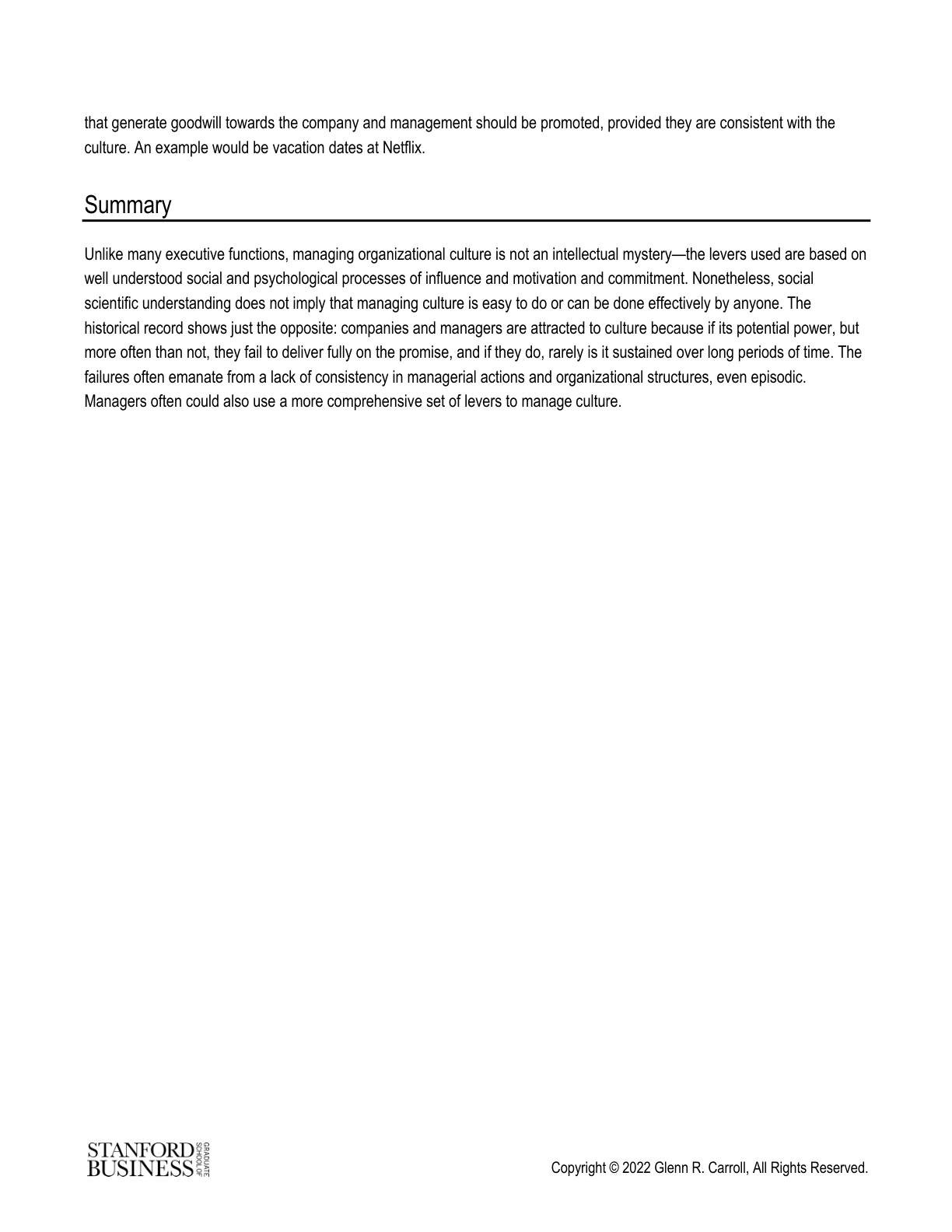
Why culture management usually fails: inconsistencyThe closing summary of Carroll's teaching note on managerial levers. It argues that the levers rest on well-understood social and psychological processes of influence, motivation and commitment, yet companies rarely deliver on culture's promise because managerial actions and structures are inconsistent and efforts are episodic. It also notes that goodwill gestures, such as Netflix's approach to vacation, should be promoted only when consistent with the culture. The diagnosis is not lack of knowledge but lack of consistency over time. A culture program that runs for one quarter and then yields to other priorities teaches people that the old expectation still governs.Carroll - Teaching Note on Managerial Levers to Build and Maintain Strong Organizational Culture · PDF page 5 · in the slides
1
Uber's 2015 cultural valuesUber's fourteen values from 2015, including 'always be hustlin'' (get more done with less, working longer and harder), 'meritocracy and toe-stepping', 'principled confrontation', 'super pumped', 'be yourself' and 'let builders build'. The page asks what you think of them. Each value is specific and was strongly held, which is what made the culture strong. Read them as a set: together they reward aggression and individual heroics and say nothing about how conflict, power or complaints are handled, so status could override everything else.Carroll - From Routines to Norms Slides (Session 1) · PDF page 34 · in the slides
2
Susan Fowler's 2017 account of UberA summary of the issues engineer Susan Fowler described in her February 2017 blog post: a manager's propositions, HR telling her he was a 'high performer' who would not be punished, other women with similar stories, claims that HR misrepresented repeat offenses, political games among managers, an altered performance review, denied transfer requests, retaliation and a falling share of women in engineering. Every item is a management lever acting against the stated value 'be yourself': HR process, performance review, transfer decisions and treatment of high performers. The values on the wall lost to what the system rewarded and tolerated.Carroll - From Routines to Norms Slides (Session 1) · PDF page 35 · in the slides
3
Uber's 2017 cultural normsThe eight norms introduced by new CEO Dara Khosrowshahi in November 2017, replacing the fourteen values: we build globally, we live locally; we are customer obsessed; we celebrate differences; we do the right thing, period; we act like owners; we persevere; we value ideas over hierarchy; we make big bold bets. Compare with the 2015 list: the content shifted from aggression and hustle toward integrity and inclusion, but rewritten words alone cannot change the norm. The test is whether hiring, promotion, investigations and exceptions for star performers changed with them.Carroll - From Routines to Norms Slides (Session 1) · PDF page 36 · in the slides
4
Diversity: the unsolved challenge for strong culturesThree points: culture is the secret sauce and commitment mechanism for some firms; managers will not abandon it for a laudable public goal; the ideal is homogeneity on cultural characteristics with maximal diversity on all other traits. It asks how to achieve that given social processes of influence. The ideal works only if 'cultural characteristics' are defined as job-relevant behaviors. Social influence pushes groups to hire people who look and sound like them and call it fit, which is how strong cultures drift into exclusion.Carroll - From Routines to Norms Slides (Session 1) · PDF page 37 · in the slides
5
Source S48 · Carroll · 5 pages
Teaching Note on Managerial Levers to Build and Maintain Strong Organizational Culture