Silicon Valley Bank, March 2023: GAAP-compliant statements, an insolvent economic position
At December 31, 2022, SVB Financial Group reported about $212 billion of assets and $16.0 billion of stockholders' equity. Most of its securities were classified as held-to-maturity (HTM), which under GAAP are carried at amortized cost. Its 10-K valued that portfolio at $91.3 billion on the balance sheet, against a disclosed fair value of $76.2 billion. The $15.1 billion difference sat in the notes, not in equity, and was nearly as large as the bank's entire book equity. About 94% of deposits were uninsured, and many belonged to startups. On March 8, 2023, SVB said it had sold $21 billion of available-for-sale securities at a $1.8 billion after-tax loss and planned to raise $2.25 billion of equity. Depositors withdrew more than $40 billion on March 9, and regulators closed the bank on March 10. The statements were not falsified; the measurement basis and the notes were the story. Thousands of startups learned overnight that 'cash' on their own balance sheets was a claim on a bank.
SVB's balance sheet complied with GAAP. Which numbers revealed its economic position, which hid it, and what should a startup like Relay, holding $924,000 of cash, change about how it reads its bank's statements and its own?
Assets describe recognized resources. Liabilities describe obligations to other parties. Equity is the residual claim under the accounting model. The identity Assets = Liabilities + Equity holds because each recorded transaction has corresponding effects.
A balance sheet does not report the market value of the entire business. Recognition rules, historical transactions and estimates determine which items appear and how they are measured. A company’s customer relationships or internally developed capabilities can matter economically without appearing as a separately recognized asset.
Revenue and expense recognition can occur in a different period from collection and payment. The income statement measures performance during the stated period under the relevant accounting rules. The cash-flow statement explains movements in cash.
A credit sale demonstrates the difference. Recognizing revenue creates a receivable until the customer pays. Recognizing the cost of goods sold reduces inventory when those goods are delivered. Buying inventory earlier can consume cash before the associated expense appears in income.
The statements answer different questions about the same organization. Always attach a date or period and keep the accounting assumptions consistent.
01
Balance sheet
Shows assets, liabilities and equity at a point in time. After a customer is invoiced but has not paid, a receivable may be present while the related cash has not arrived.
02
Income statement
Shows recognized revenue and expenses over a period. Recognition and matching rules make accounting profit different from the cash collected and paid in that same period.
03
Cash flow statement
Explains cash movements during the period through operating, investing and financing activities. Borrowing creates a financing inflow without creating sales revenue.
04
Changes in equity
Explains movements in owners’ accounting interest. Contributions, distributions and retained earnings can change equity for different reasons. Reconcile the closing balance with the balance sheet.
Read the statements together: the same transaction can change income, receivables and cash at different times. The accounting identity must still reconcile.
Profit follows accounting recognition during a period. Cash follows actual receipts and payments. Timing differences can make a profitable company short of cash.
Income
Recognizes revenue and expenses under the applicable accounting rules.
Cash
Records receipts and payments when cash changes hands. Timing differences can make the two diverge.
Worked application
Illustrative application: a company records a $100 sale on credit and a $60 matched cost under the stated assumptions. The $40 margin does not mean $40 arrived in the bank. If the supplier is paid before the customer pays, the company must finance that interval.
Reconcile revenue to receipts and expenses to payments. The balance sheet records claims and obligations connecting the two timelines.
The statements connect through retained earnings and cash
Profit increases retained earnings unless other equity changes offset it. An owner contribution increases equity without appearing as revenue. A distribution to owners reduces equity without being an ordinary operating expense.
The cash-flow statement reconciles opening and closing cash through operating, investing and financing activities. The balance sheet supplies the closing cash balance and the other assets and claims. When statements disagree, trace the transactions and timing rather than inserting a balancing number.
Financial reporting combines transactions with estimates and recognition judgments. Depreciation allocates an asset’s recognized cost across periods. Expected collection problems affect the carrying value of receivables. These choices influence reported profit without necessarily creating a current cash payment.
A reader should ask how the business generated the reported result and which assumptions affect it. Compare periods using consistent definitions and examine relevant notes. A high profit figure accompanied by rapidly growing receivables can raise a question about cash conversion, but the figure alone does not prove poor reporting.
Book equity is an accounting residual. Market value reflects the price or assessment of an ownership interest under a different set of expectations and rights.
Book value
A result of accounting recognition and measurement at a date.
Market value
A price or valuation influenced by expected future outcomes and risk. The two need not be equal.
Worked application
Illustrative application: contributed capital and accumulated earnings can explain the closing accounting balance. A financing valuation may incorporate expectations about future cash, growth and risk that do not appear as separately recognized balance-sheet assets. The two figures answer different questions.
Use the accounting identity to reconcile statements. Use a stated valuation method and assumptions when discussing what an investor may pay.
Keep the period, units and accounting basis clear.
Look for timing and classification differences.
Ask what important resources or risks are poorly represented.
Use the notes and business context to interpret the numbers.
20
16 / Deep diveFinancial statements & economic reality
Relay's FY1 statements on one page
Illustrative figures. They assume pre-FY1 spending is ignored, the SAFE is classified as a liability (the course convention, common US GAAP practice for post-money SAFEs), and other working-capital items are zero.
Three statements, one story. The income statement shows a $616,000 loss. The cash-flow statement shows $576,000 used, because $40,000 of prepayments came in before the revenue was earned. The balance sheet ties out: $924,000 of cash equals $40,000 of deferred revenue plus the $1,500,000 SAFE minus the $616,000 accumulated deficit.
If the SAFE is classified as equity instead, total equity becomes +$884,000. Cash, burn and runway are identical under both classifications.
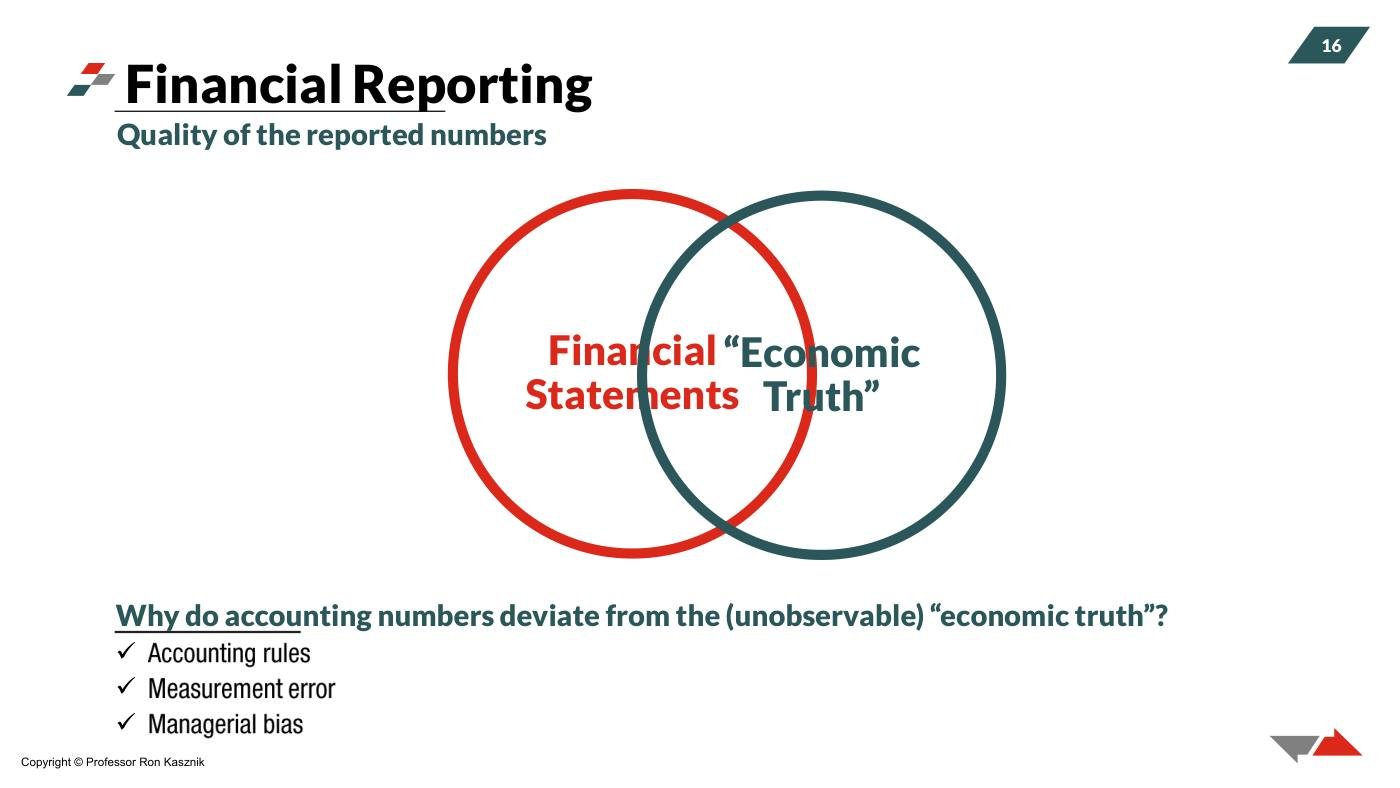
The archived examples ask why accounting statements and market assessments can differ, and why net income need not equal operating cash flow. The point is to interpret what the statements measure rather than expect them to be a complete economic description.
Which statement answers the question you are asking?
27
16 / Current practiceFinancial statements & economic reality
Current practice: what changes on a startup's statements in 2025-2027
Software cost capitalization is being modernized
In September 2025 the FASB issued ASU 2025-06, which removes most references to the 'project stages' in internal-use software accounting (ASC 350-40). Capitalization will instead start when management authorizes and commits funding and completion is probable. It takes effect for annual periods beginning after December 15, 2027, with early adoption permitted. A SaaS company like Relay may report different R&D expense and assets under the new rules without any change in cash.
SAFE classification still drives startup equity
US GAAP has no specialized guidance for SAFEs. At a September 2023 FASB Private Company Council discussion, practitioners said most SAFEs end up classified as liabilities, often remeasured at fair value, while founders and investors tend to think of them as equity. The classification can swing reported equity by the full SAFE amount, so the right answer for a specific instrument needs an accountant's review.
Illustrative packet: a company sells goods for $100 on credit, recognizes $60 cost of goods and pays that $60 now. It begins with enough cash; ignore tax and other transactions.
Your task
State profit, immediate cash movement and the receivable created. Explain what happens when the customer later pays.
Relay closes fiscal year 1 with 60 clinics, 20 of them on annual prepay. Illustrative statements: revenue $180,000; cost of revenue $36,000; operating expenses $760,000 (R&D $420,000, sales and marketing $230,000, G&A $110,000). Deferred revenue at year end is about $40,000. Cash went from $1,500,000 (raised on a post-money SAFE before FY1) to about $924,000. Late-FY1 net burn is about $60,000 a month. A prospective seed investor asks Maya: 'Your books show negative equity. Why should I value you at $16M pre-money?'
Your task
Produce an annotated statement map: Relay's income statement, cash-flow statement and year-end balance sheet, each annotated with the question it answers, plus three economically important facts the statements omit or understate. Use them to answer the investor in under 150 words.
Income statement: gross profit = 180,000 - 36,000 = $144,000 (80%); operating loss = 144,000 - 760,000 = -$616,000. It answers 'how did FY1 perform under recognition rules?', not 'how much cash did we use?'.
Cash flow: operating cash flow = -616,000 + 40,000 increase in deferred revenue = -$576,000. There were no investing or financing flows in FY1. Cash: 1,500,000 - 576,000 = $924,000. The year averaged $48,000 a month of burn, but the late-FY1 rate is $60,000, so runway is 924,000 / 60,000, about 15 months, not the 19 the annual average suggests.
Balance sheet: cash $924,000 = deferred revenue $40,000 + SAFE $1,500,000 + equity -$616,000. Course convention: under US GAAP practice a post-money SAFE is commonly classified as a liability (the actual classification depends on its terms and needs accountant review); founder stock was bought for a nominal amount. If the SAFE qualifies as equity, equity is +$884,000. Either way, assets are unchanged.
Omitted or understated: (1) contracted recurring revenue: exit ARR = 40 x $4,788 + 20 x $4,070 = $272,920, versus $180,000 recognized; (2) customer relationships, outcome data and the EHR integration, none of them recognized assets; (3) $420,000 of R&D expensed, though some internal-use software costs might be capitalizable. None of this changes cash.
Answer to the investor: book equity is an accounting residual of contributed capital minus expensed investment. The seed price rests on expected future cash flows from 60 retained clinics, about $273k ARR and an 80% gross margin. What the investor should test is ARR quality, churn and burn, not book equity.
Dividing cash by FY1's average monthly loss ($616,000 / 12, about $51,000) overstates runway. Use the current monthly net cash burn (about $60,000), which reflects today's headcount and includes prepayment timing.
Reading negative book equity as failure
A venture that expenses its R&D and has not yet earned a profit will usually show an accumulated deficit, and a SAFE classified as a liability can push equity below zero. Look at cash, burn and recurring revenue before drawing conclusions about solvency.
Treating deferred revenue as bad news
Deferred revenue is a liability, but it is cash collected in advance and a signal of customer commitment. The risk to watch is the delivery obligation, and refunds if Relay fails to serve.
Relay's annotated FY1 statement map (income statement, cash flow, balance sheet), a list of three items the statements omit (ARR of about $273k, intangible assets, expensed R&D), and a 150-word answer to a seed investor about negative book equity.
Each statement answers a different question: position at a date, performance over a period, or cash movements, and Relay's -$616,000 loss, -$576,000 operating cash flow and $924,000 cash are all consistent.
Accounting rules, measurement and judgment separate the statements from economic reality: expensed R&D, unrecognized customer relationships and deferred revenue all move Relay's books away from its value.
Book equity is a residual and market value is a forecast; negative book equity and a $12M valuation can both be correct.
Next lesson: Recording transactions & building the statements
34
Check your understanding
What do the statements reveal, and what do they leave out?
Score
Question 1
Relay's FY1: revenue $180,000, cost of revenue $36,000, R&D $420,000, sales and marketing $230,000, G&A $110,000. What is the operating loss?
Gross profit is 180,000 - 36,000 = 144,000; subtracting operating expenses of 760,000 gives -616,000. -$580,000 forgets cost of revenue; -$796,000 subtracts cost of revenue from opex rather than from revenue.
Question 2
Relay's FY1 operating loss is $616,000, and deferred revenue rose from $0 to $40,000 (ignore other working capital). What is operating cash flow?
Customers paid $40,000 for service not yet recognized as revenue, so cash outflow is smaller than the loss: -616,000 + 40,000 = -576,000. Subtracting the increase treats a liability that brought in cash as if it consumed cash.
Question 3
At FY1 end Relay has cash of $924,000 and deferred revenue of $40,000, and its $1,500,000 SAFE is classified as a liability. What is total equity?
Equity = assets - liabilities = 924,000 - 40,000 - 1,500,000 = -616,000, exactly the accumulated deficit. +$884,000 would be right only if the SAFE were classified as equity. The assets are the same either way.
Question 4
A board member says: 'Relay has negative book equity, so the $12M SAFE cap was irrational.' What is the best response?
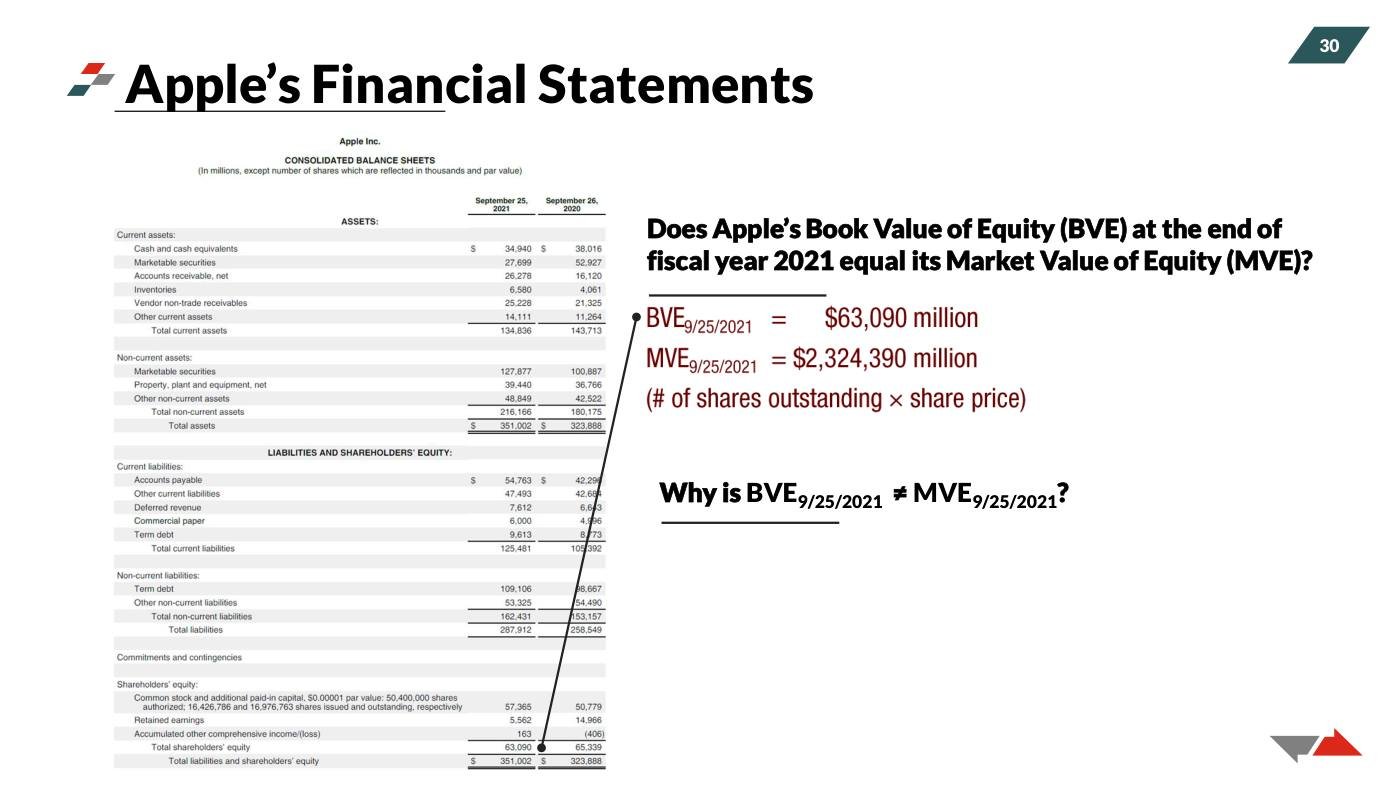
Book and market value answer different questions. Apple traded at about 37 times book in 2021. Negative book equity together with $924,000 of cash and 15 months of runway does not mean Relay is about to fail.
Question 5
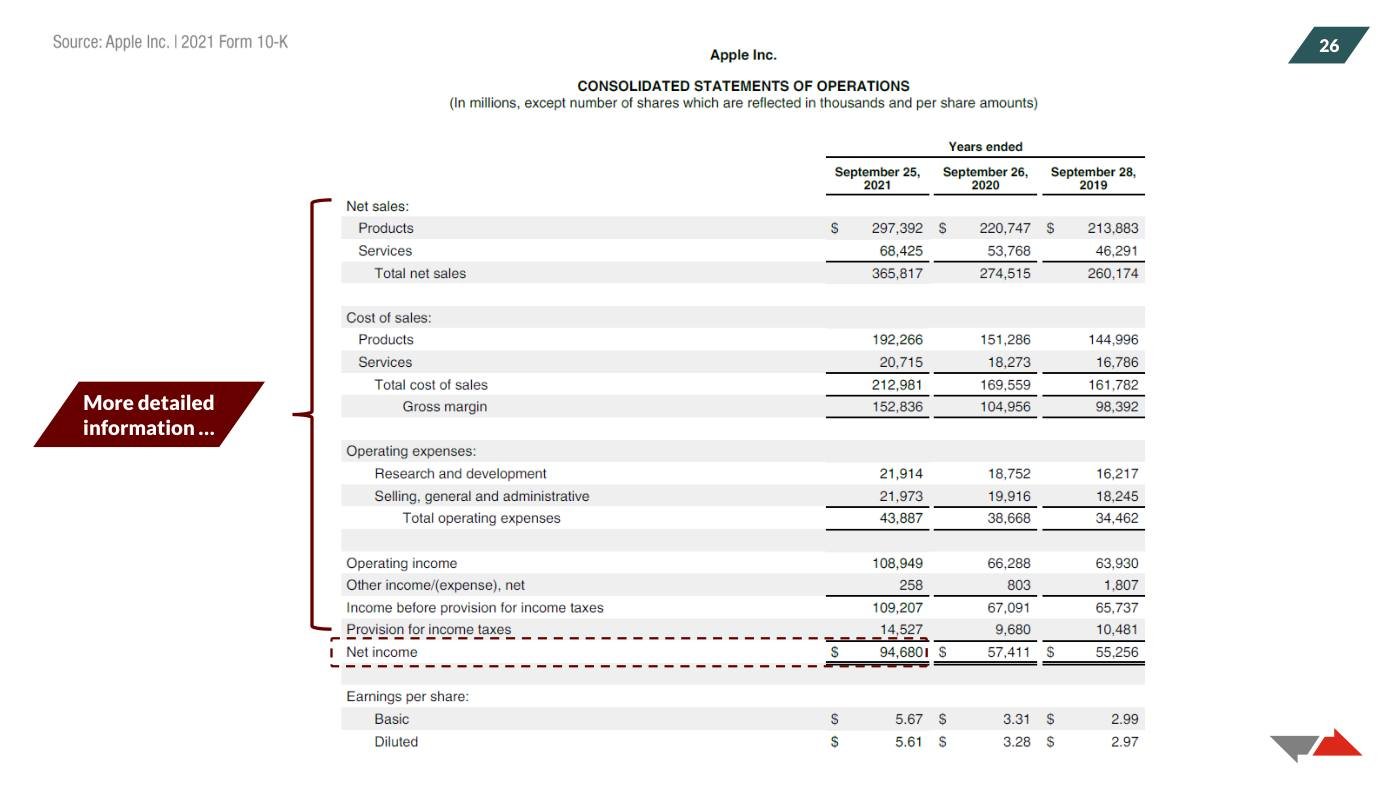
Apple earned $94.7B in fiscal 2021, yet retained earnings fell from about $15.0B to $5.6B. What best explains this?
Retained earnings rise with net income and fall with payouts. Dividends of $14.4B, buybacks charged to retained earnings of $85.5B and share withholding of $4.2B exceeded net income. Retained earnings are not a cash balance.
Question 6
WhatsApp's 2013 balance sheet shows $49.4M of deferred revenue against $10.2M of annual revenue. What does this most likely indicate?
Deferred revenue is a liability for prepaid service, often covering multiple years (here $33.1M is non-current). It is the opposite of an unpaid receivable. The same mechanism creates Relay's $40,000 liability.
Workbook
What do the statements reveal, and what do they leave out?
Module output: A linked financial analysis, operating forecast, valuation and staged-investment decision.
Library
Every original page used in this lesson
10 appear in the slides with notes; the rest are kept here for reference.
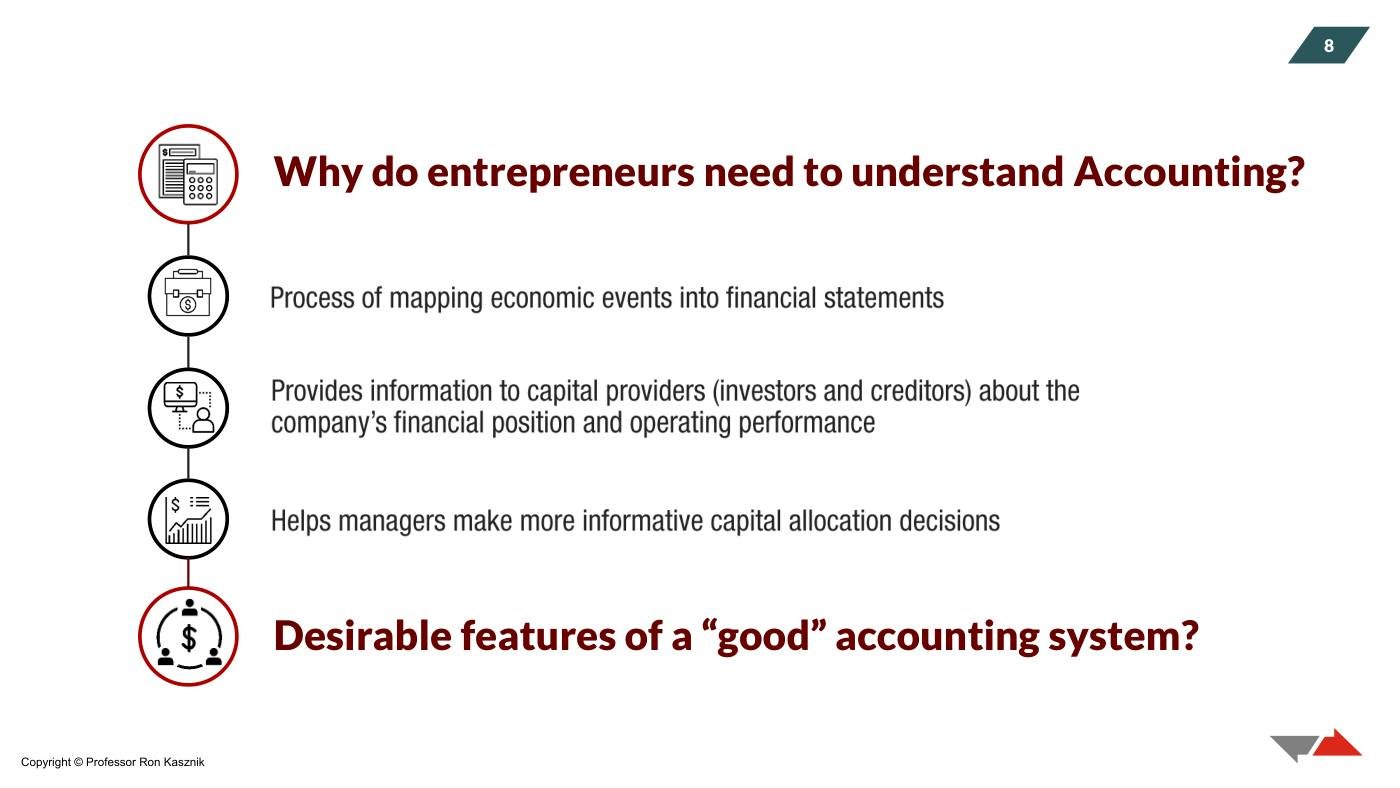
Why entrepreneurs need accountingAccounting maps economic events into statements, informs capital providers and supports capital-allocation decisions; the slide also asks what makes an accounting system good. Framing slide; the native outcomes slide covers the same ground.Kasznik - Financial Statements Slides (Session 1) · PDF page 3
1
Facebook acquires WhatsAppA title card noting Facebook's acquisition of WhatsApp, which closed in October 2014. Sets up the WhatsApp statements on the next two pages.Kasznik - Financial Statements Slides (Session 1) · PDF page 4
2
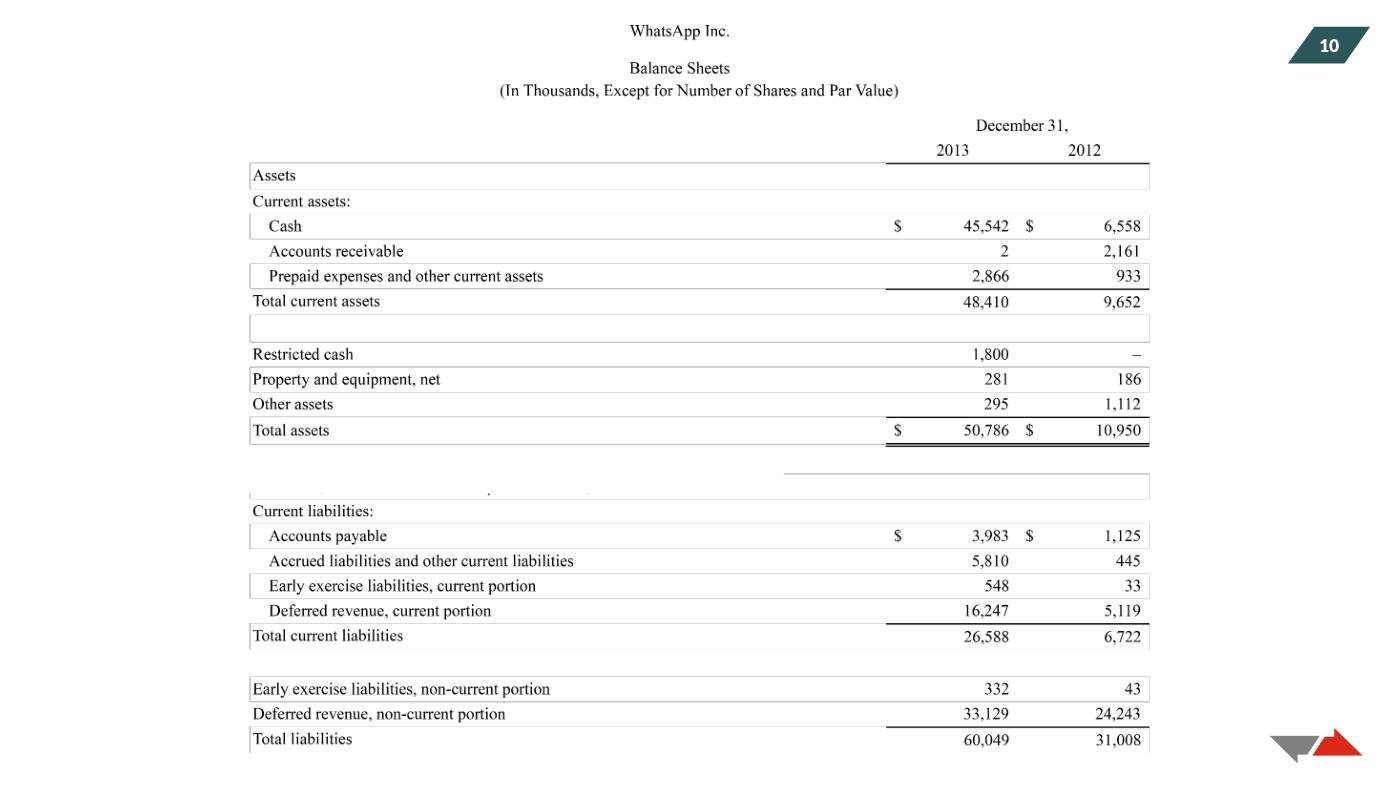
WhatsApp balance sheet, 2012-2013WhatsApp's balance sheet (in $ thousands): total assets of $50.8M at end of 2013, mostly cash of $45.5M, against total liabilities of $60.0M. Deferred revenue makes up $49.4M of those liabilities ($16.2M current plus $33.1M non-current). Liabilities exceed assets, so book equity is negative (about -$9.3M), yet Facebook paid roughly $19B or more. Most of the liabilities are deferred revenue: subscription cash collected for future service. It is the same liability Relay creates when a clinic prepays $4,070.Kasznik - Financial Statements Slides (Session 1) · PDF page 5 · in the slides
3
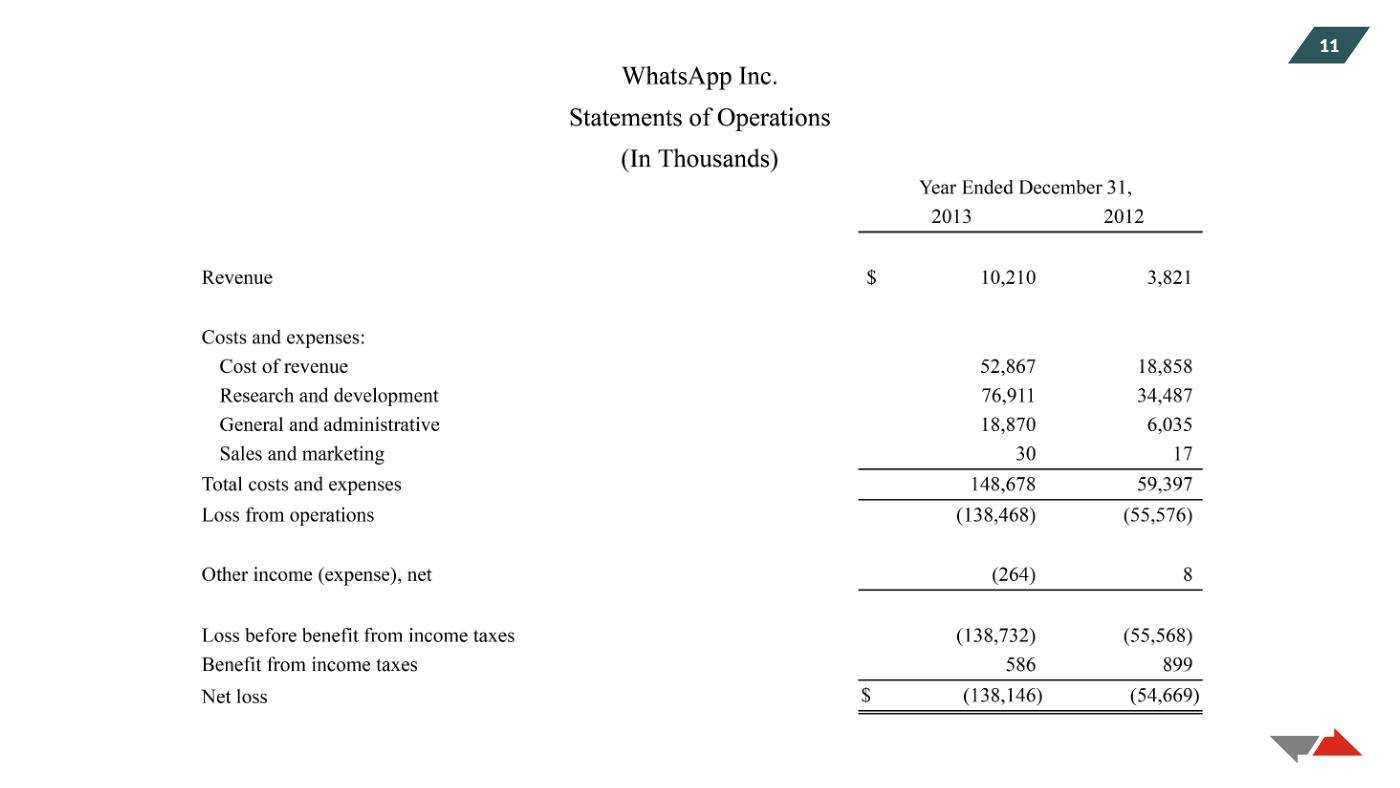
WhatsApp statement of operations, 2012-2013Revenue of $10.2M in 2013 against $148.7M of costs, including $52.9M cost of revenue and $76.9M R&D. The net loss was $138.1M, up from $54.7M in 2012. Cost of revenue is about five times revenue, and the loss more than doubled in a year in which users grew rapidly. The income statement measures recognized revenue and expense; it carries no line for the value of hundreds of millions of users, which is what Facebook paid for.Kasznik - Financial Statements Slides (Session 1) · PDF page 6 · in the slides
4
Financial statements versus 'economic truth'A Venn diagram of financial statements partly overlapping an unobservable 'economic truth', with three reasons they diverge: accounting rules, measurement error and managerial bias. Use the three causes as a checklist. For Relay, accounting rules dominate: expensed R&D, unrecognized customer relationships, and revenue deferred under a prepayment.Kasznik - Financial Statements Slides (Session 1) · PDF page 7 · in the slides
5
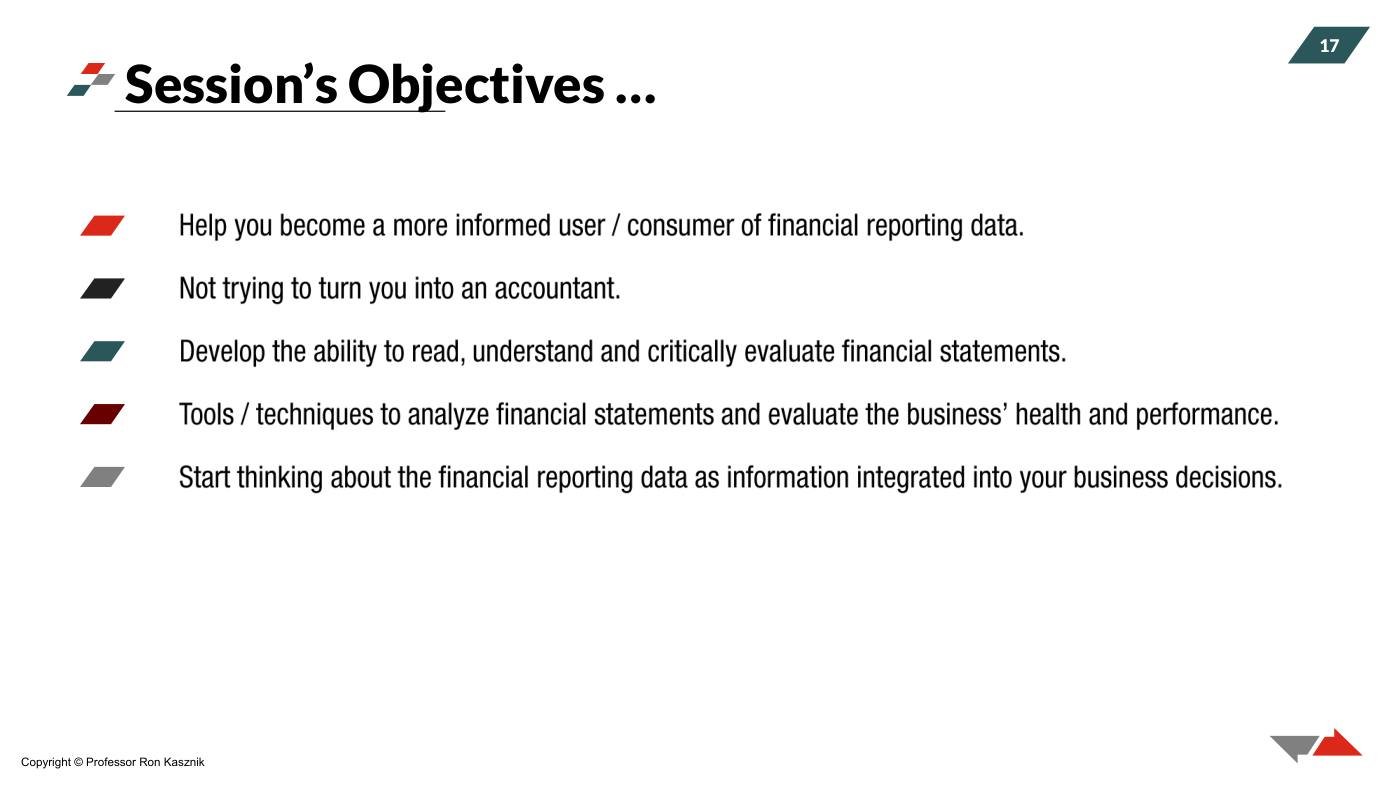
Session objectivesObjectives: become an informed reader of financial reports, evaluate statements critically and use them in business decisions, without becoming an accountant. Agenda slide.Kasznik - Financial Statements Slides (Session 1) · PDF page 8
6
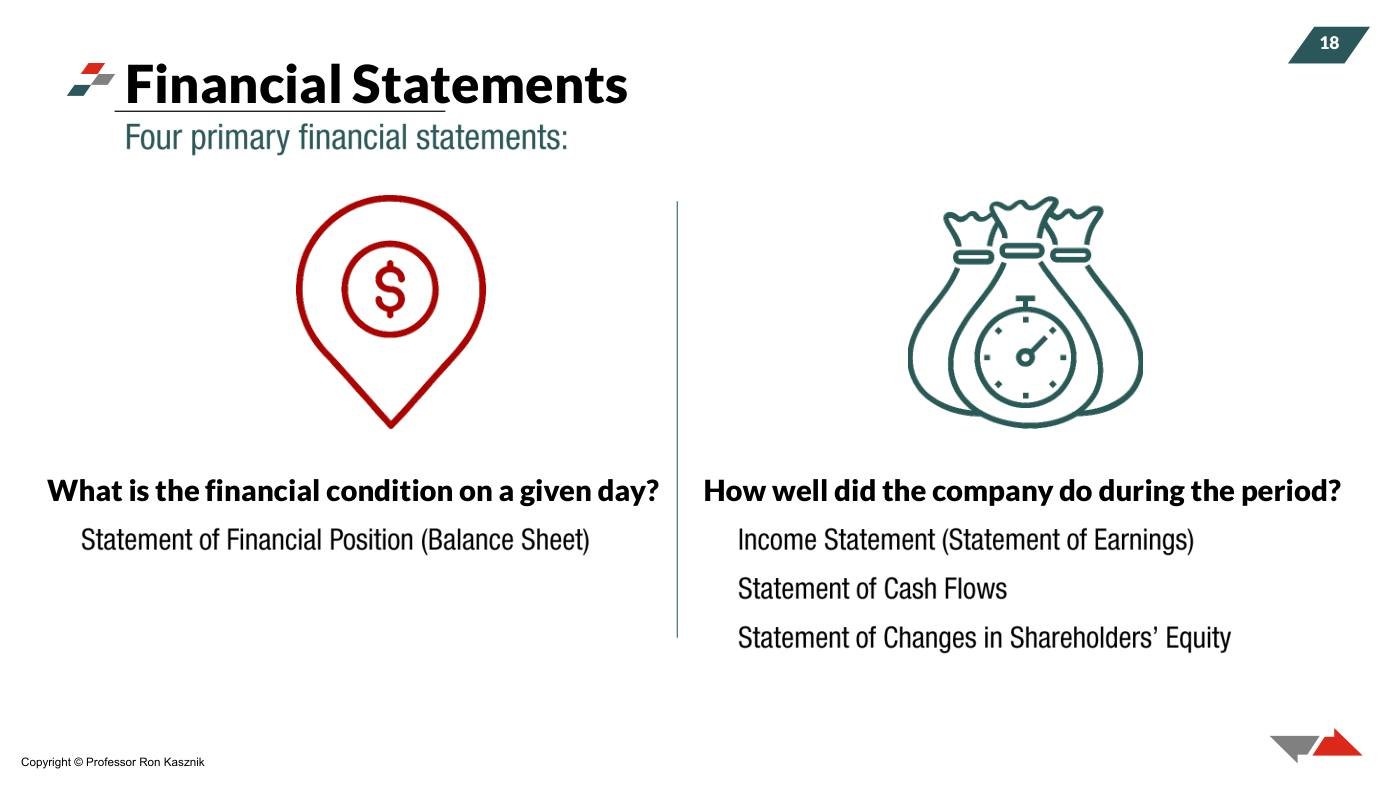
The four primary statementsThe balance sheet answers 'what is the condition on a given day'; the income statement, cash-flow statement and statement of changes in equity answer 'how did the company do during the period'. Covered by native slide 5.Kasznik - Financial Statements Slides (Session 1) · PDF page 9
7
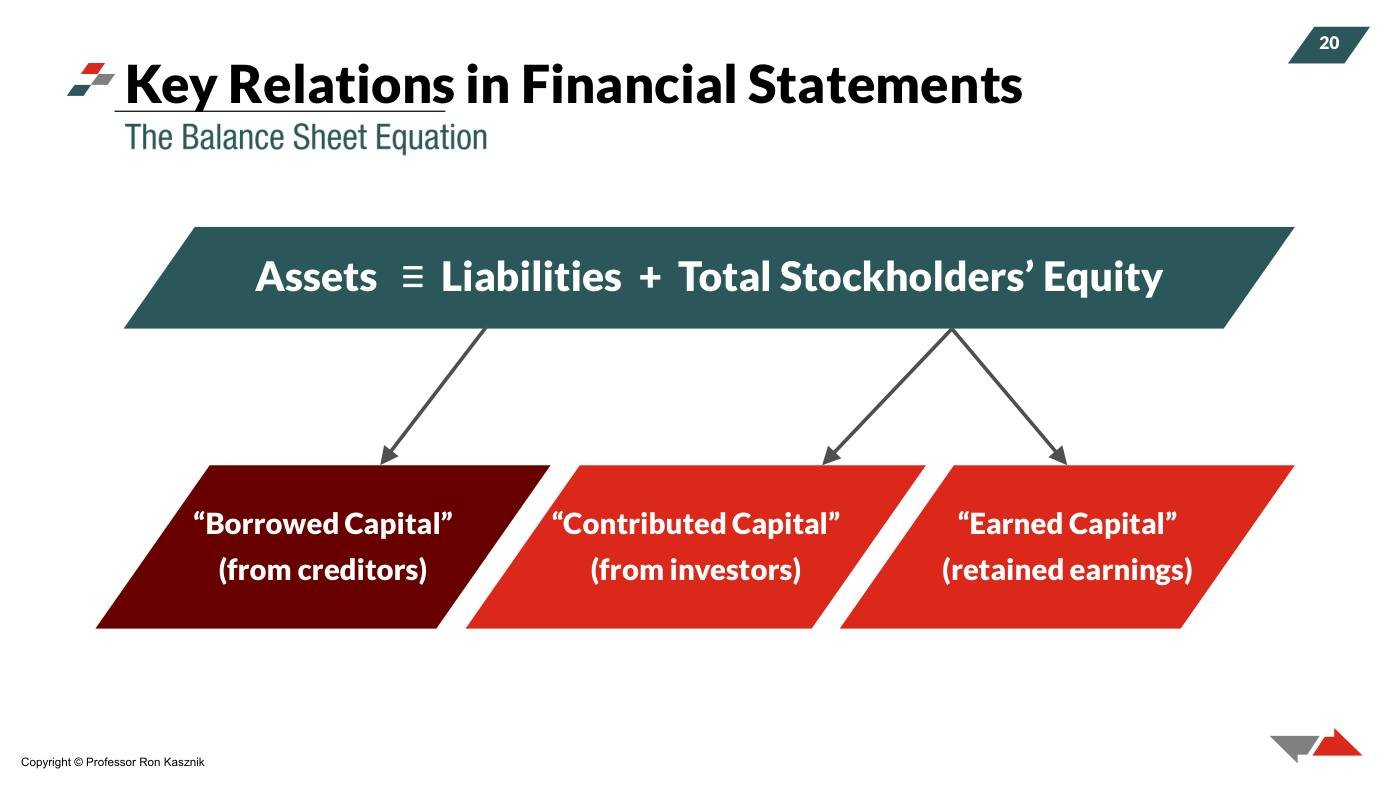
Balance sheet equation: borrowed, contributed and earned capitalAssets equal liabilities plus stockholders' equity, with claims split into borrowed capital (creditors), contributed capital (investors) and earned capital (retained earnings). The three-way split is the quickest way to read a startup balance sheet. Relay's earned capital is negative (an accumulated deficit of $616,000 after FY1), so its contributed capital is what funds operations.Kasznik - Financial Statements Slides (Session 1) · PDF page 10 · in the slides
8
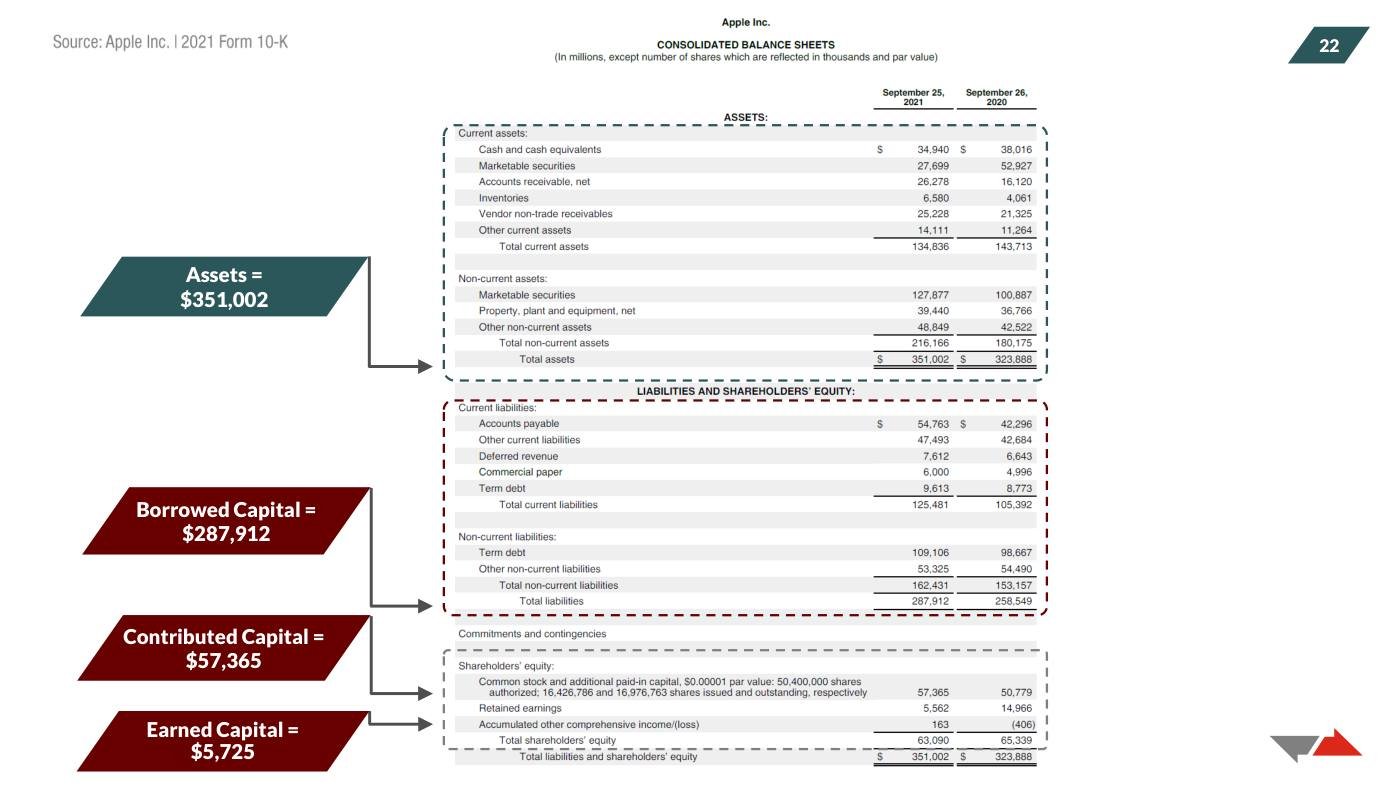
Apple's 2021 balance sheet mapped to the equationApple's September 2021 balance sheet: assets of $351,002M = borrowed capital $287,912M + contributed capital $57,365M + earned capital $5,725M (retained earnings $5,562M plus accumulated other comprehensive income $163M). The world's most profitable company shows almost no earned capital. Liabilities fund 82% of assets, and retained earnings are tiny because Apple returns cash to shareholders. Read the next equity statement before concluding anything from a small retained-earnings figure.Kasznik - Financial Statements Slides (Session 1) · PDF page 11 · in the slides
9
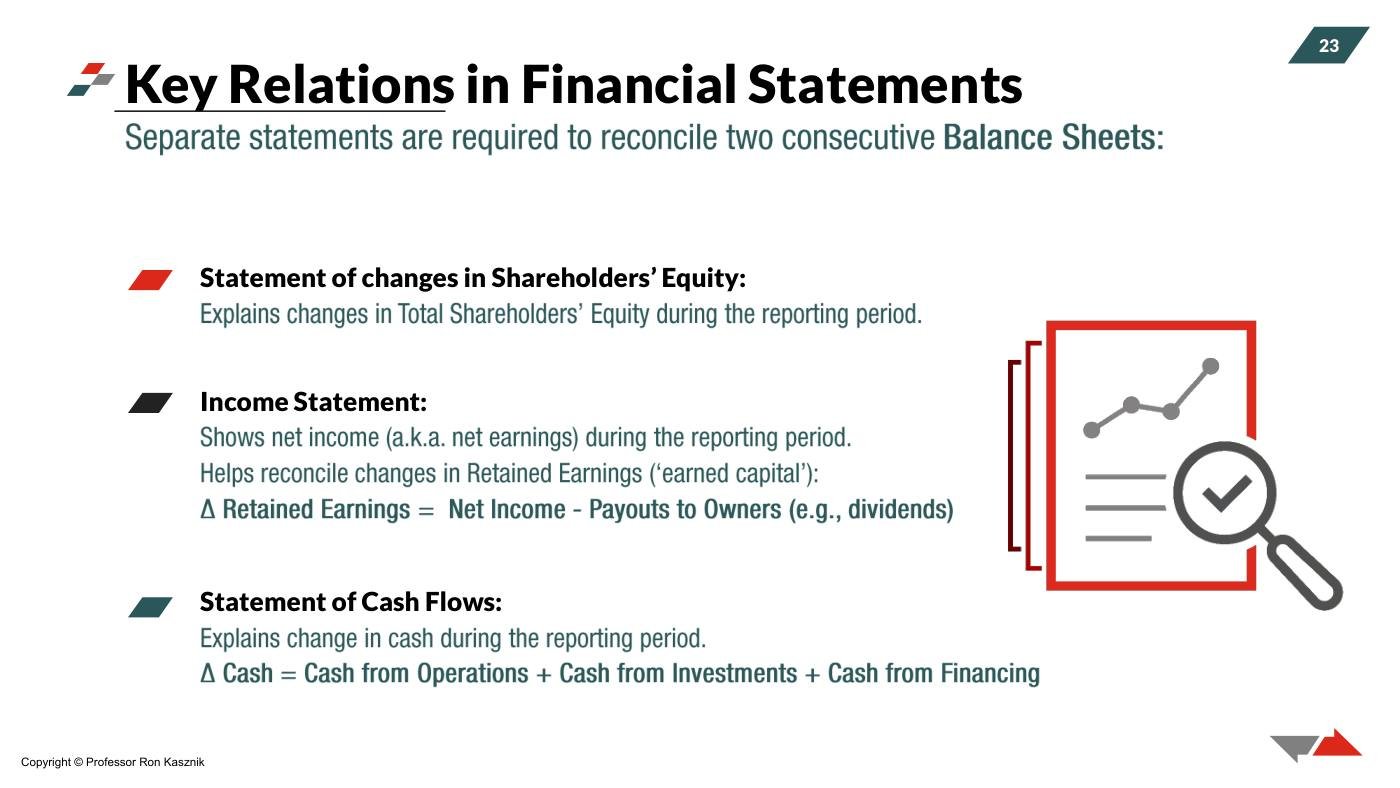
How the statements reconcile consecutive balance sheetsThe equity statement explains changes in equity; the income statement explains changes in retained earnings (change in RE = net income - payouts); the cash-flow statement explains change in cash = operating + investing + financing. Native slides 5 and 18 cover these reconciliations.Kasznik - Financial Statements Slides (Session 1) · PDF page 12
10
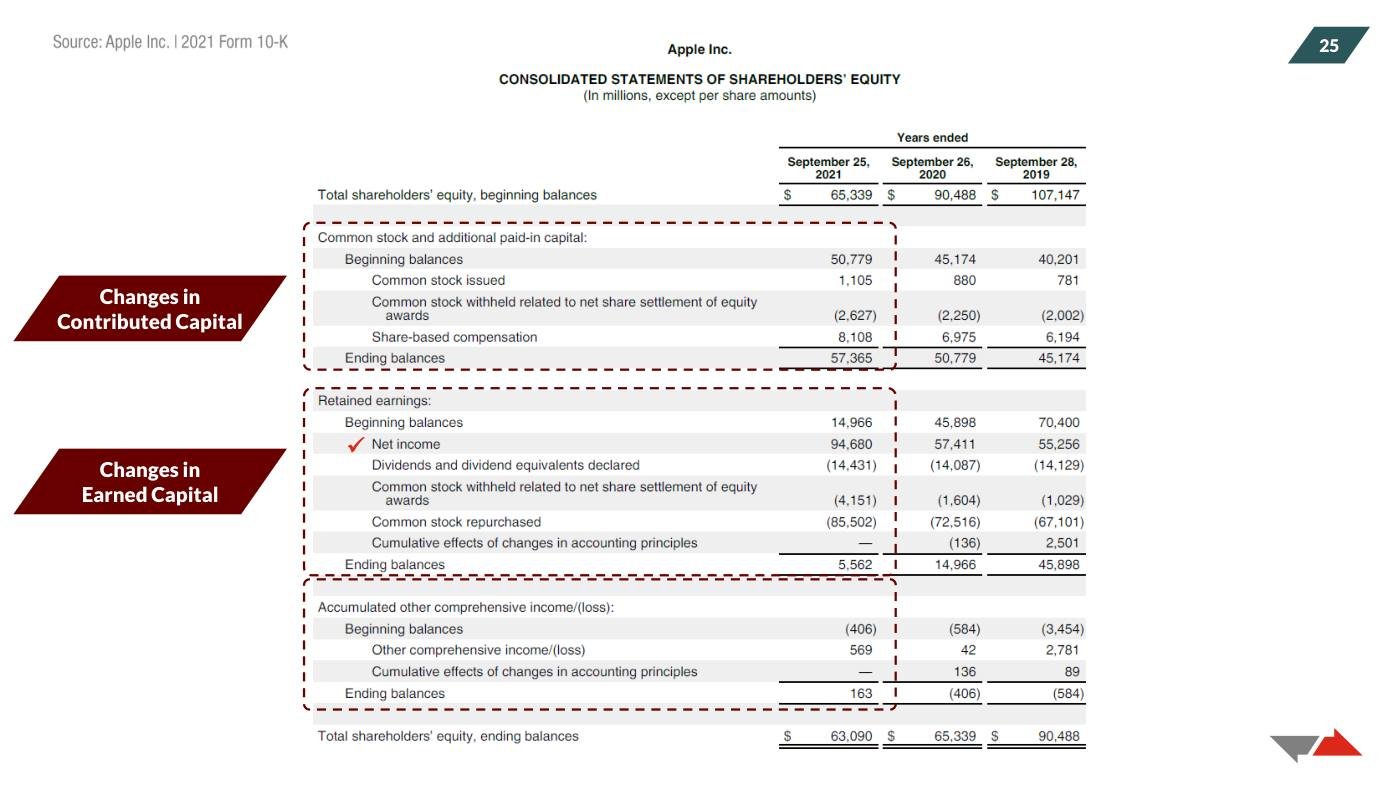
Apple's statement of shareholders' equity, 2021Retained earnings started at $14,966M, added net income of $94,680M, and subtracted $14,431M of dividends, $4,151M of share withholding and $85,502M of buybacks, ending at $5,562M. Profit does not stay in retained earnings when it is paid out. The $85.5B buyback, not a loss, explains why Apple's earned capital is small. This is why native slide 21 insists on reconciling equity instead of inferring it from profit.Kasznik - Financial Statements Slides (Session 1) · PDF page 13 · in the slides
11
Apple's income statement, 2019-2021Net sales of $365,817M in 2021, gross margin of $152,836M, operating income of $108,949M and net income of $94,680M. Supplies the net income used in the equity and cash-flow comparisons.Kasznik - Financial Statements Slides (Session 1) · PDF page 14
12
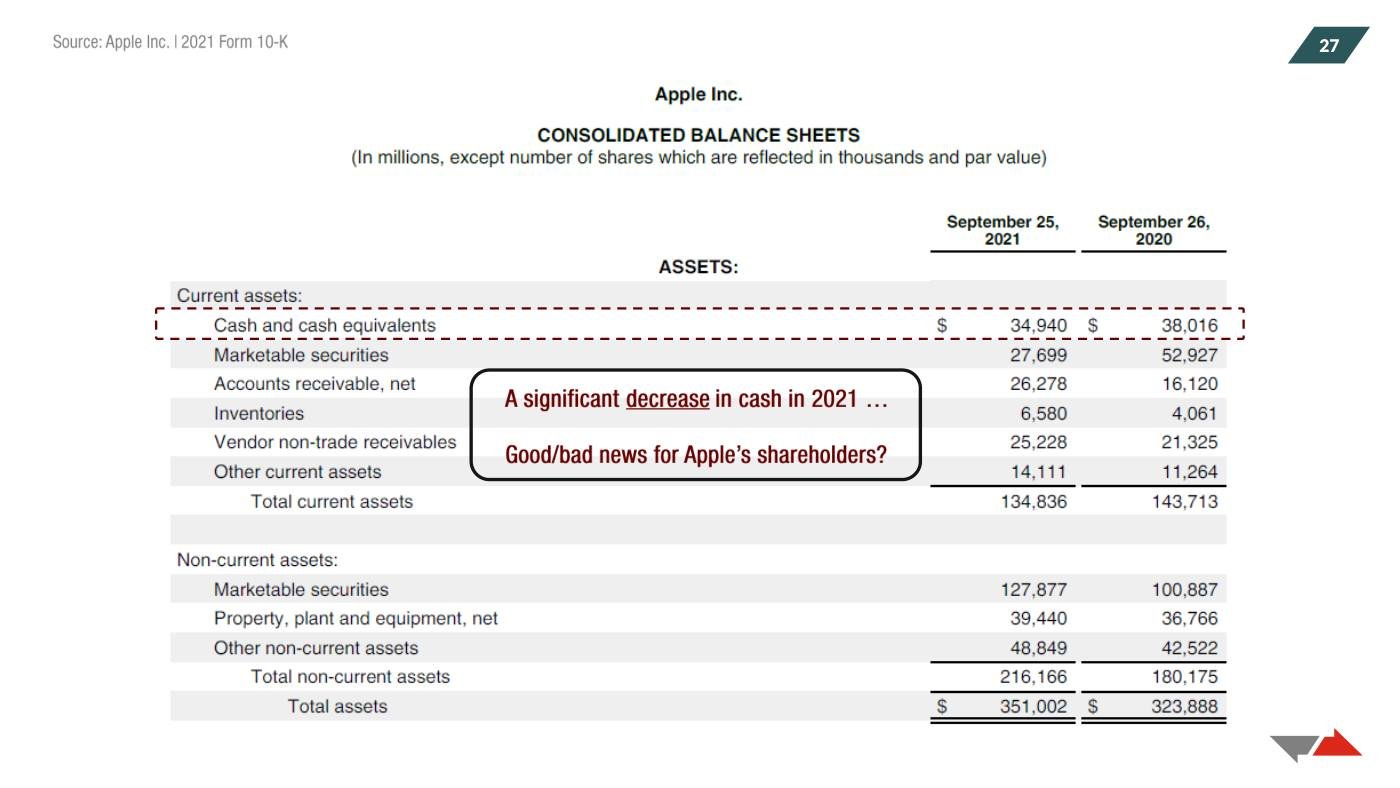
Apple's cash fell in 2021: good or bad news?Apple's cash and equivalents fell from $38,016M to $34,940M, and the slide asks whether that is good or bad news for shareholders. The cash-flow page answers it: the decrease came from returning cash to shareholders, not from weak operations.Kasznik - Financial Statements Slides (Session 1) · PDF page 15
13
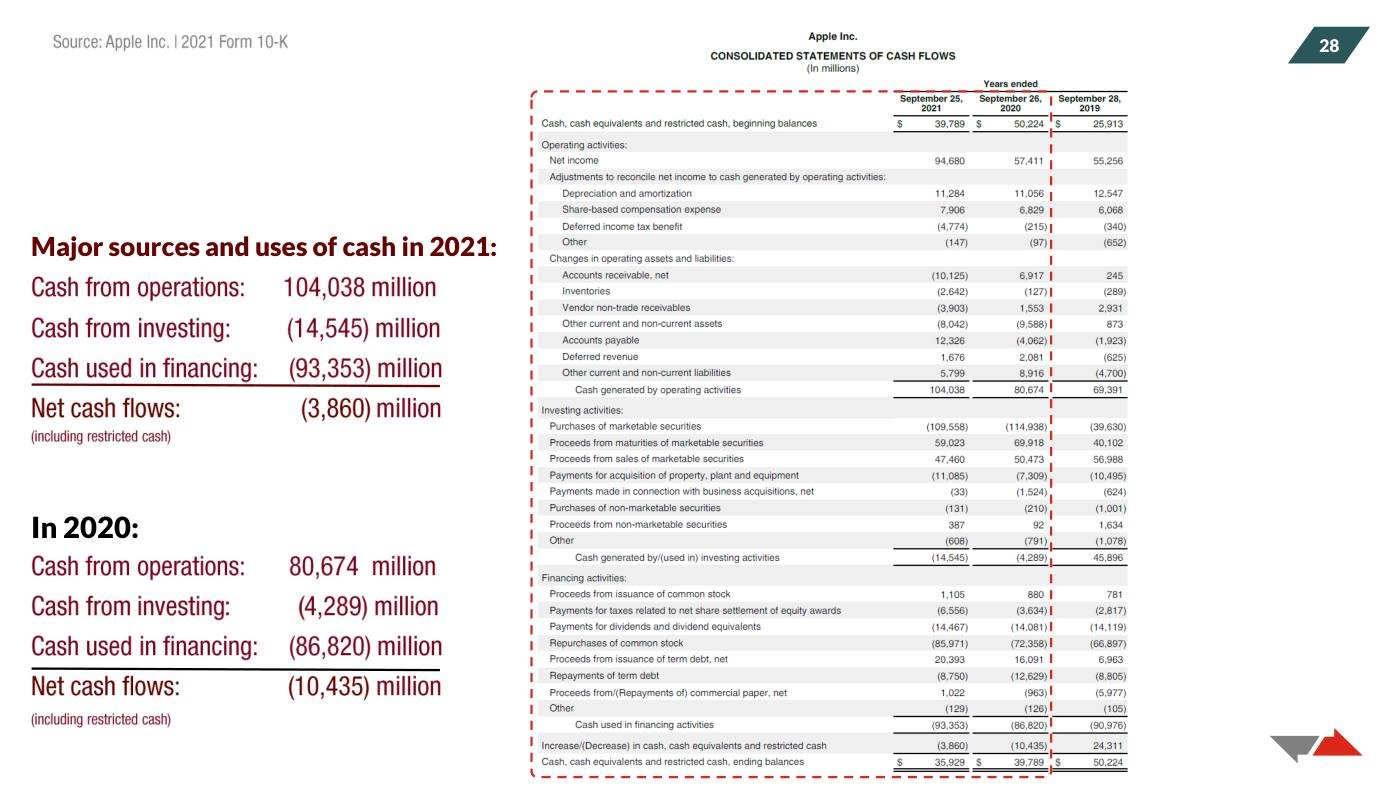
Apple's 2021 sources and uses of cashOperating cash flow of $104,038M, investing of -$14,545M and financing of -$93,353M, a net change of -$3,860M including restricted cash. In 2020 the figures were $80,674M, -$4,289M, -$86,820M and -$10,435M. A falling cash balance can signal strength: operations generated $104B and most of it went back to shareholders. For Relay, by contrast, operating cash flow is negative and financing came before FY1, so falling cash means runway.Kasznik - Financial Statements Slides (Session 1) · PDF page 16 · in the slides
14
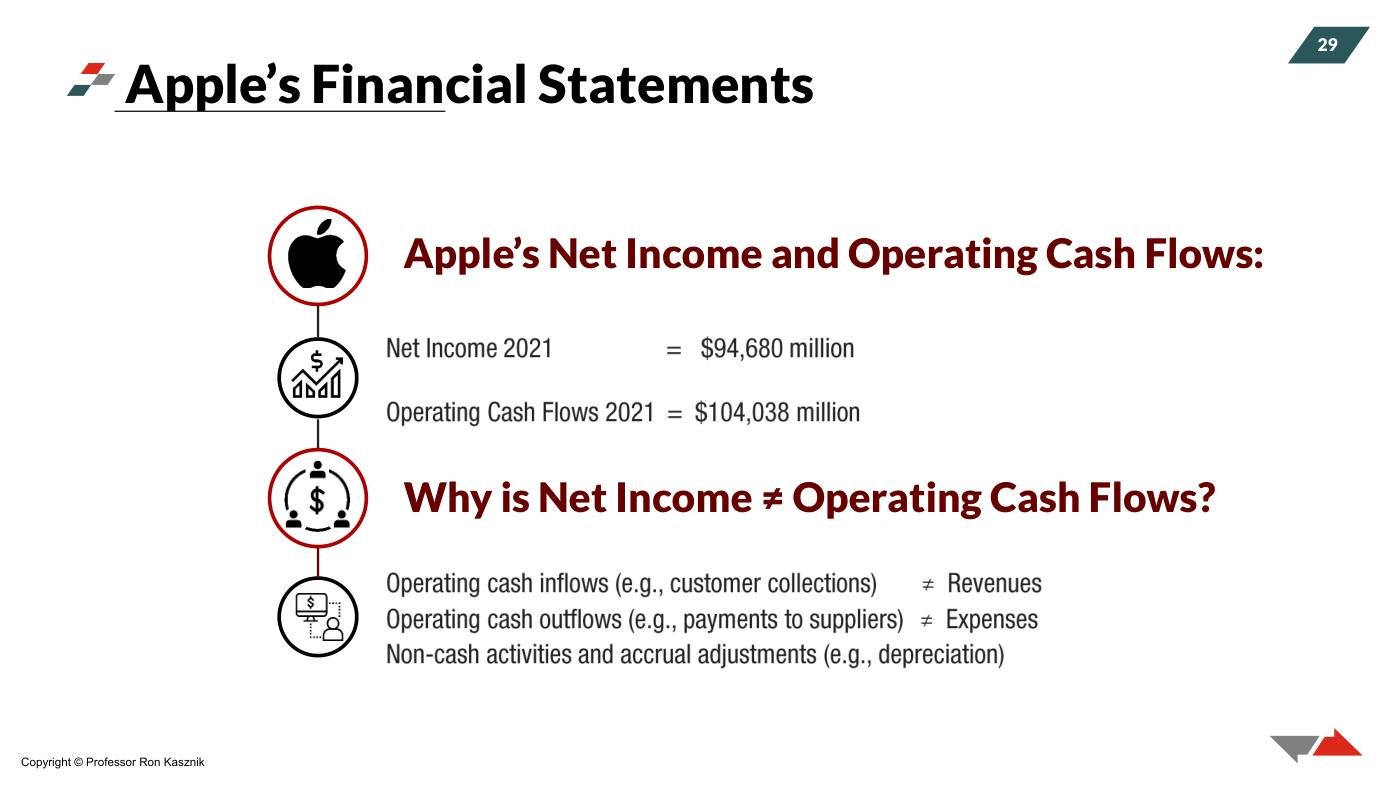
Why net income does not equal operating cash flowApple's 2021 net income was $94,680M and its operating cash flow $104,038M. The gap comes from collections differing from revenue, payments differing from expenses, and non-cash items such as depreciation. For a SaaS startup the main driver usually runs the other way: annual prepayments raise cash before revenue is recognized. Relay's operating cash outflow (-$576,000) is smaller than its operating loss (-$616,000) by the $40,000 of deferred revenue.Kasznik - Financial Statements Slides (Session 1) · PDF page 17 · in the slides
15
Book value versus market value of Apple's equityApple's book equity at September 25, 2021 was $63,090M; its market value (shares outstanding times share price) was $2,324,390M, about 37 times book. The gap is investors' valuation of future cash flows from assets that accounting does not recognize: brand, ecosystem, internally developed technology. Relay's case is starker: negative book equity alongside a $12M post-money SAFE cap.Kasznik - Financial Statements Slides (Session 1) · PDF page 18 · in the slides
16
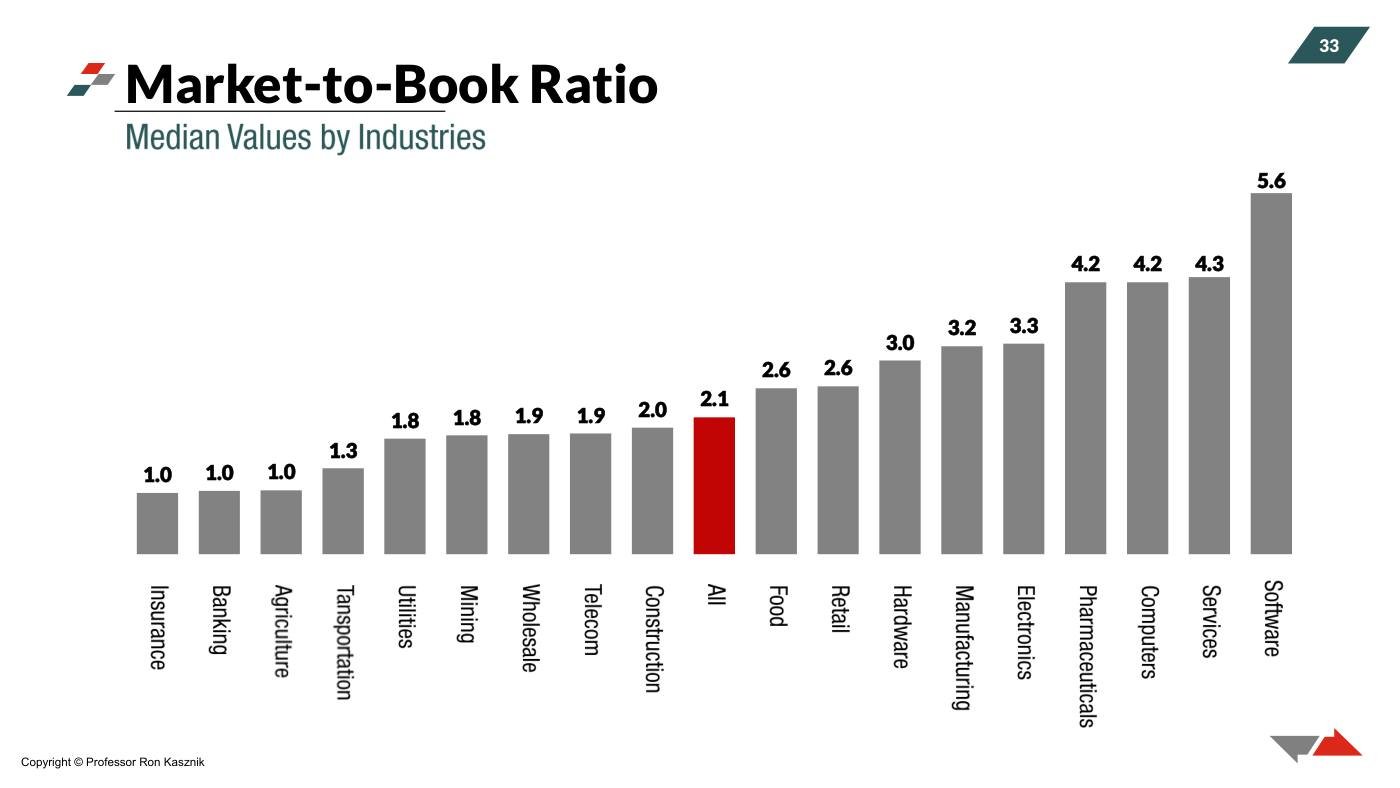
Median market-to-book ratios by industryA bar chart of median market-to-book ratios: about 1.0 for insurance, banking and agriculture, 2.1 across all industries, and up to 5.6 for software. The source and year are not shown, so treat the values as dated. The ratio is highest where value rests on intangibles that GAAP mostly expenses (software, pharmaceuticals). It is near 1 where assets are financial and marked close to market, although SVB showed that held-to-maturity securities can break that assumption.Kasznik - Financial Statements Slides (Session 1) · PDF page 19 · in the slides