09 / OpeningGo-to-market, channels & economic value
The decision and the learning goals
Map the participants required for adoption
Explain who gains and loses from a channel change
Use an EVC comparison to diagnose a selling barrier
90-minute workshopOpening 5 minConcepts and original examples 35 minPractice 25 minDebrief 15 minReview 10 min
2
09 / TheoryGo-to-market, channels & economic value
The channel performs work that the product cannot perform alone
A go-to-market system must create awareness, explain value, establish trust, make the sale and deliver the result. Some products also require installation, training or ongoing service. Different participants may perform these activities.
The Aqualisa discussion shows why a technically attractive product can encounter a channel that has little reason to recommend it. An installer may prefer familiar equipment, predictable work and low callback risk. A consumer benefit does not automatically become a benefit for that installer.
3
09 / TheoryGo-to-market, channels & economic value
Economic value to the customer uses the next best alternative
Economic value begins with the customer’s relevant alternative and adds the monetary consequences of the difference. Include purchase, installation, operating and service costs over a consistent period. Distinguish a demonstrated saving from one that depends on an uncertain behavior change.
The resulting value creates room for a price, but it does not mean the company can capture all of it. The customer needs a reason to switch, and other channel participants may need compensation. Perceived risk and access to capital can also constrain the purchase.
4
09 / TheoryGo-to-market, channels & economic value
Four go-to-market questions
A route to market must perform the work that makes adoption possible. A technically attractive product can stall when a necessary participant lacks incentive or capability.
01
Segment
Name the end user, buyer and buying situation. A homeowner may want a better shower while an installer strongly influences which unit is selected. Their interests need separate attention.
02
Essential work
Map explanation, trust, qualification, installation and support. Determine where adoption currently stops. In a product requiring installation, awareness alone does not guarantee a completed purchase.
03
Participants
Assign each task to a capable participant and examine the reward. If a faster installation reduces the installer’s billable time, end-user value may coexist with channel resistance.
04
Route
Compare direct, indirect and mixed arrangements against that bottleneck. A demonstration or installer trial should test a specific adoption mechanism and measure completed behavior, rather than only attention.
The channel diagram makes the dependencies visible. The later distinction between value creation and capture explains why everyone may not support the same innovation.
5
09 / TheoryGo-to-market, channels & economic value
A channel is a system of incentives
Each participant must have a reason and the capability to do the work required.
6
09 / TheoryGo-to-market, channels & economic value
Essential work goes beyond making the product
Explain the offer and establish trust.
Find and qualify demand.
Sell, install, deliver and support the result.
Decide which participant can do each task economically and reliably.
7
09 / TheoryGo-to-market, channels & economic value
Economic value to the customer
VALUE OF BENEFITS + COSTS AVOIDED − ADDED COSTS
Baseline
What the customer would otherwise use or do.
Value in use
Consequences over the relevant task or life cycle.
Price
How the resulting value is divided among participants.
Illustrative job: old hardware $100 + labor $80 = $180; new hardware $130 + labor $30 = $160. The customer saves $20 if the comparison is valid.
8
09 / Deep diveGo-to-market, channels & economic value
EVC for Relay: choose the baseline first
The same product shows very different value depending on which alternative it is compared with.
EVC compares Relay with what the clinic would otherwise do: phone its waitlist. The headline figure compares Relay with doing nothing, which overstates the value by about $30,000 a year. Use the status-quo figure in front of owners, because it survives their own arithmetic.
Even on the conservative baseline, EVC is about 15 times the annual price. With a gap that large, the selling problem is not price. It is trust, switching effort and front-desk adoption, so the inducement should lower those barriers rather than the price.
Line (per clinic, illustrative)
Versus doing nothing
Versus phoning the waitlist
Empty slots per week
42
42
Fill rate gained
40%
40% - 12.5% = 27.5%
Extra visits per week
16.8
11.6
Recovered revenue per year (x $110 x 52)
~$96,000
~$66,000
Front-desk calling time avoided
n/a
~$5,200
EVC per year
~$96,000
~$71,000
Relay price per year
$4,788
$4,788
EVC / price
~20x
~15x
9
09 / Source pageGo-to-market, channels & economic value
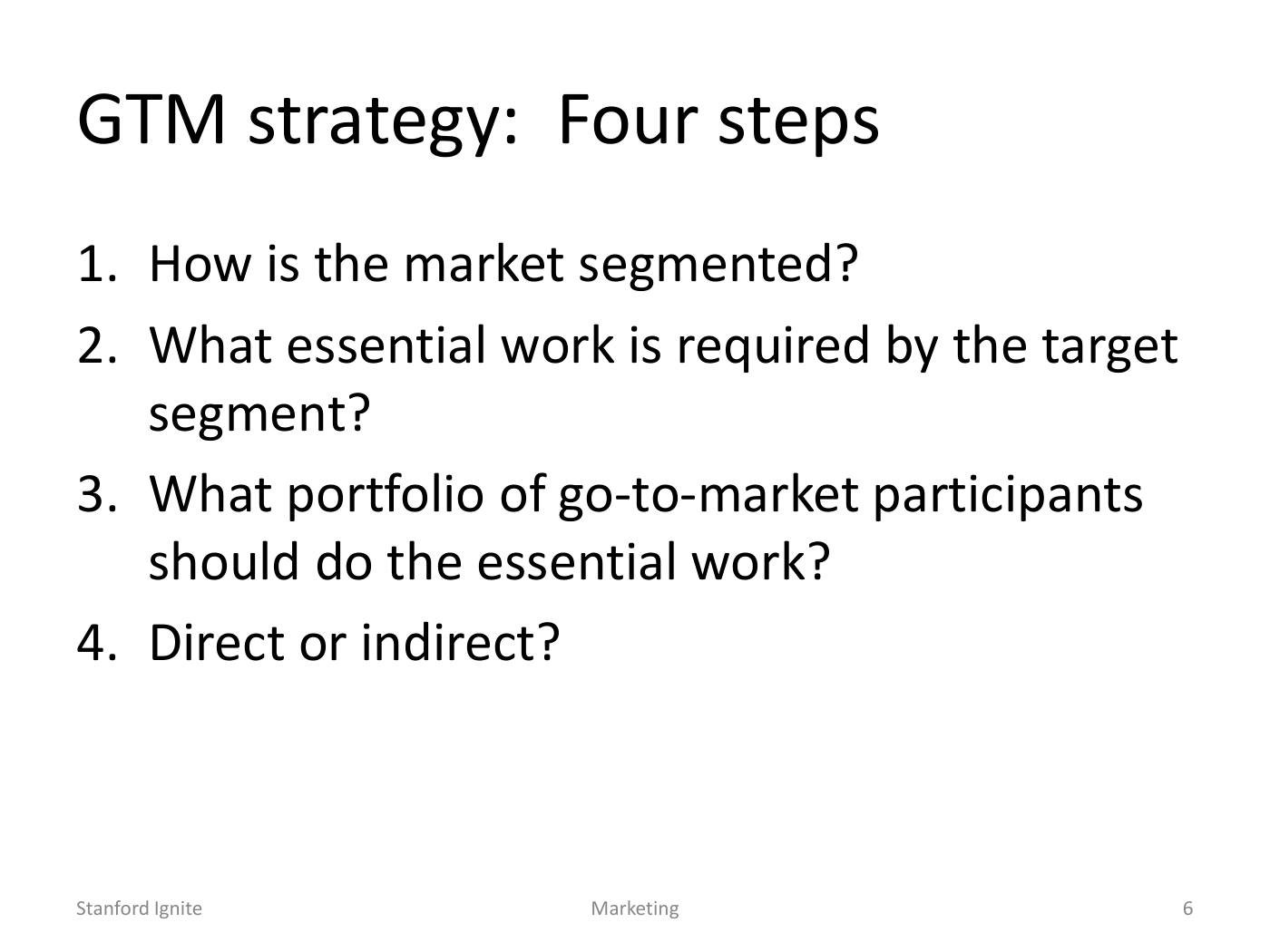
Go-to-market strategy in four steps
10
09 / Source pageGo-to-market, channels & economic value
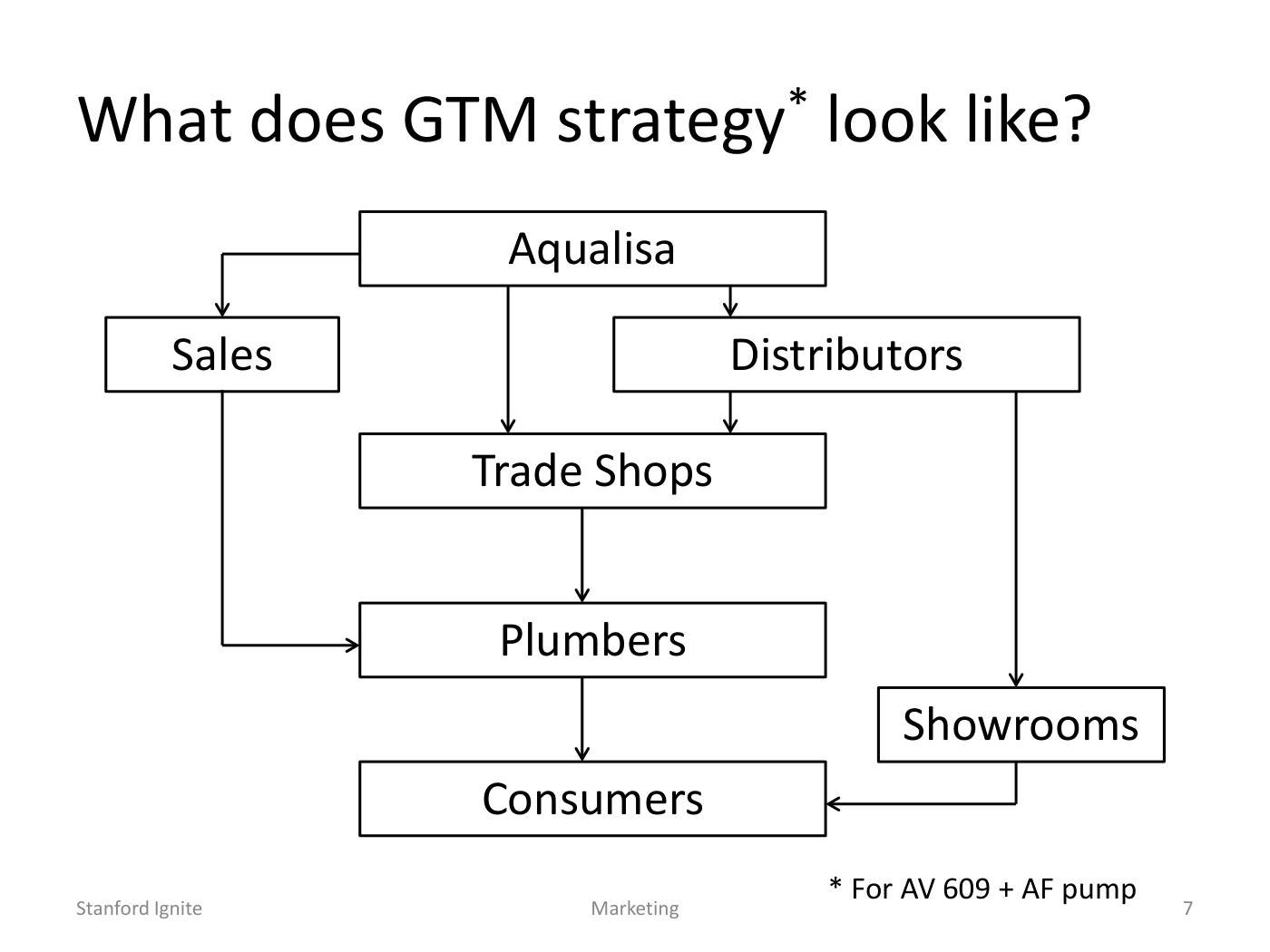
Aqualisa's route to market as a system
11
09 / Source pageGo-to-market, channels & economic value
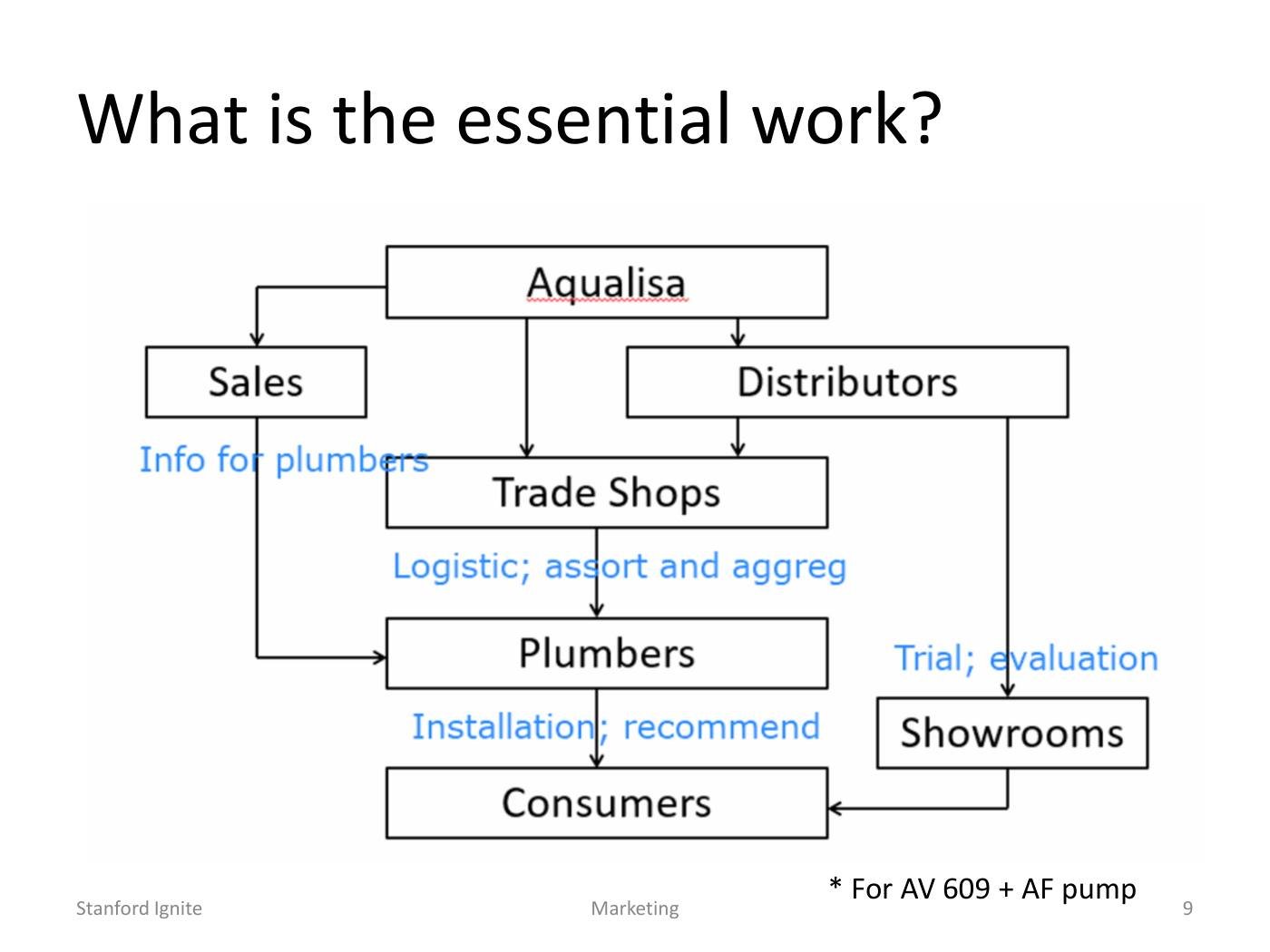
The essential work each participant performs
12
09 / Source pageGo-to-market, channels & economic value
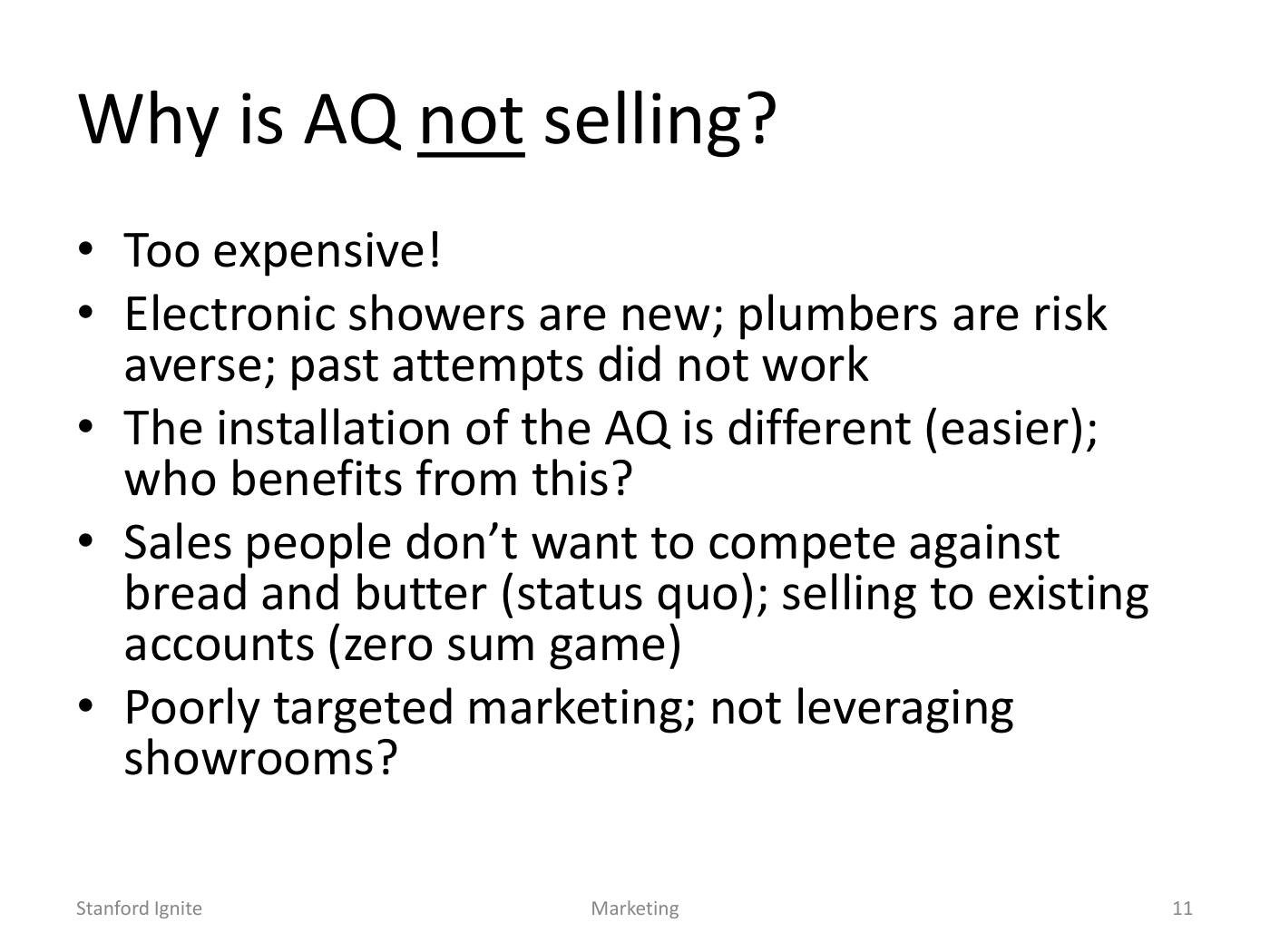
Five reasons a better shower did not sell
13
09 / Source pageGo-to-market, channels & economic value
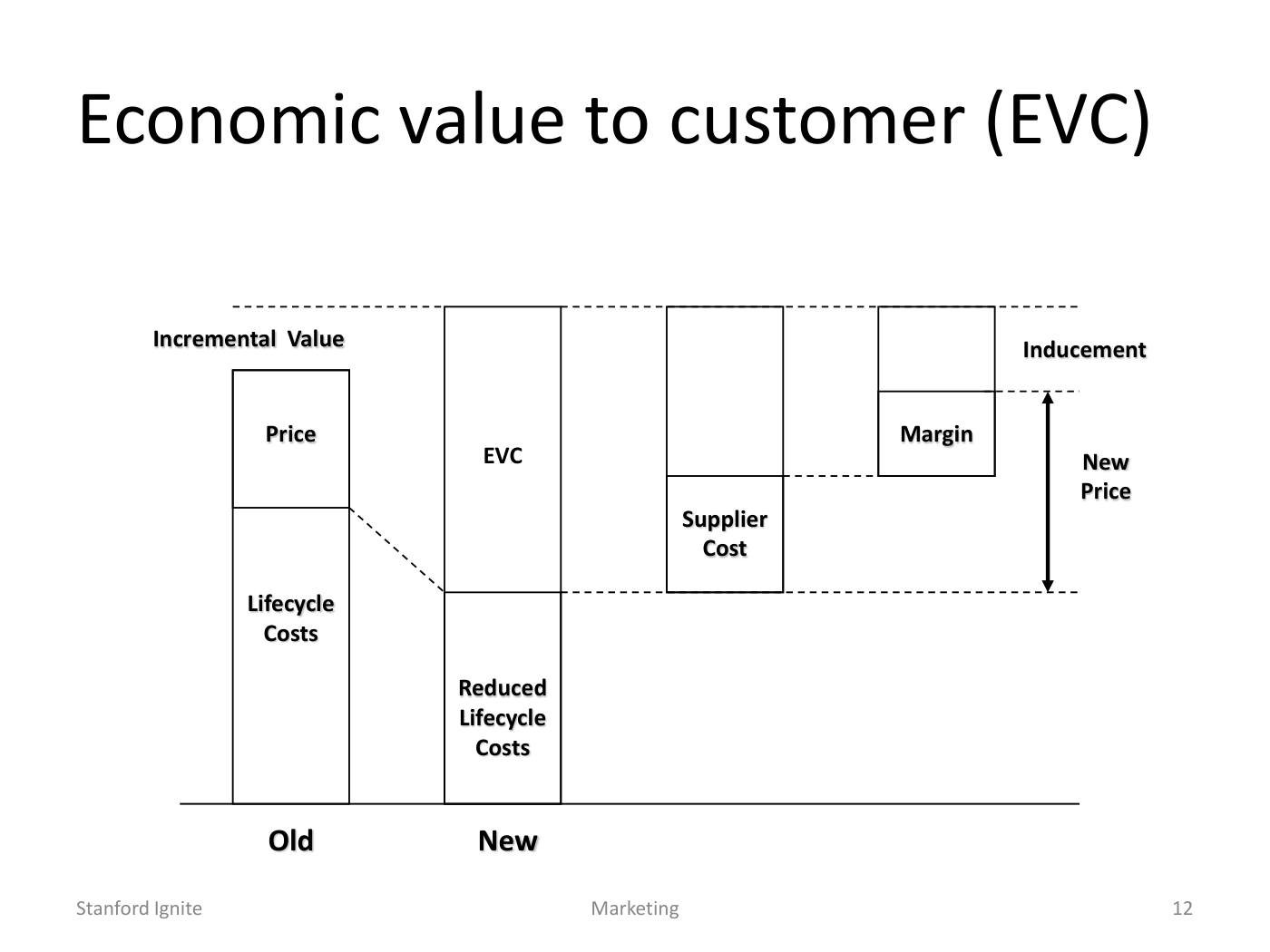
Economic value to the customer (EVC): the build
14
09 / Source pageGo-to-market, channels & economic value
Does the Quartz create value? EVC with euro figures
15
09 / TheoryGo-to-market, channels & economic value
Channel conflict is a consequence of changing incentives
A direct route can improve control over the explanation and customer relationship. It also requires the company to perform work that distributors or installers previously supplied. Selling directly can create conflict when partners believe the company is competing for their customers or margin.
Compare routes by the essential work and the economics of performing it. A channel with broad reach can be ineffective if it cannot explain the innovation. A focused demonstration route can be expensive but useful for learning which explanation and installation process lead to adoption.
16
09 / TheoryGo-to-market, channels & economic value
Adoption experiments need a defined bottleneck
Low sales can arise from weak awareness, an unclear benefit, distrust, a high effective price or an obstacle after purchase. A marketing action should target a specific explanation. Otherwise a successful or unsuccessful campaign is difficult to interpret.
State which behavior should change and where it appears in the route to purchase. A demonstration may increase consideration without resolving installer refusal. A discount may produce purchases that disappear at the sustainable price. Trace the whole process before expanding the intervention.
17
09 / TheoryGo-to-market, channels & economic value
Value created and value captured
A channel participant supports an offer when its own expected consequences are attractive. End-user value alone leaves that incentive question unanswered.
End customer
May gain from easier installation and better use.
Installer or reseller
May lose billable work, face retraining or receive little reward for promoting the new offer.
Worked application
Illustrative application: faster installation can benefit a homeowner but reduce the installer’s billable work. Adoption may require a different payment arrangement, less installation risk or access to additional jobs. Examine the actual participant’s economics rather than assuming resistance comes from ignorance.
Map both the total improvement and how costs, rewards and risks are distributed across the route to market.
18
09 / TheoryGo-to-market, channels & economic value
Aqualisa: why innovation did not settle adoption
The archived discussion highlights installer caution, unfamiliar electronics and changes in installation work.
An existing channel may prioritize familiar products and established margins.
A route that worked for an old product may not fit an innovation.
19
09 / TheoryGo-to-market, channels & economic value
Direct and indirect routes
Route
Possible benefit
Trade-off
Direct
More control over explanation and customer learning.
Must perform channel work and may conflict with partners.
Indirect
Uses existing reach, trust and capabilities.
Incentives and attention may not align.
Hybrid
Different participants handle distinct work.
Boundaries and economics must be explicit.
20
09 / TheoryGo-to-market, channels & economic value
A channel experiment needs a mechanism
Identify the adoption bottleneck.
Change who does the essential work or how they are rewarded.
Measure a relevant behavior, not only awareness.
Check for damage to the rest of the route.
21
09 / Source pageGo-to-market, channels & economic value
How much does Aqualisa capture?
22
09 / Source pageGo-to-market, channels & economic value
What happened: the market turned through showrooms
23
09 / Source pageGo-to-market, channels & economic value
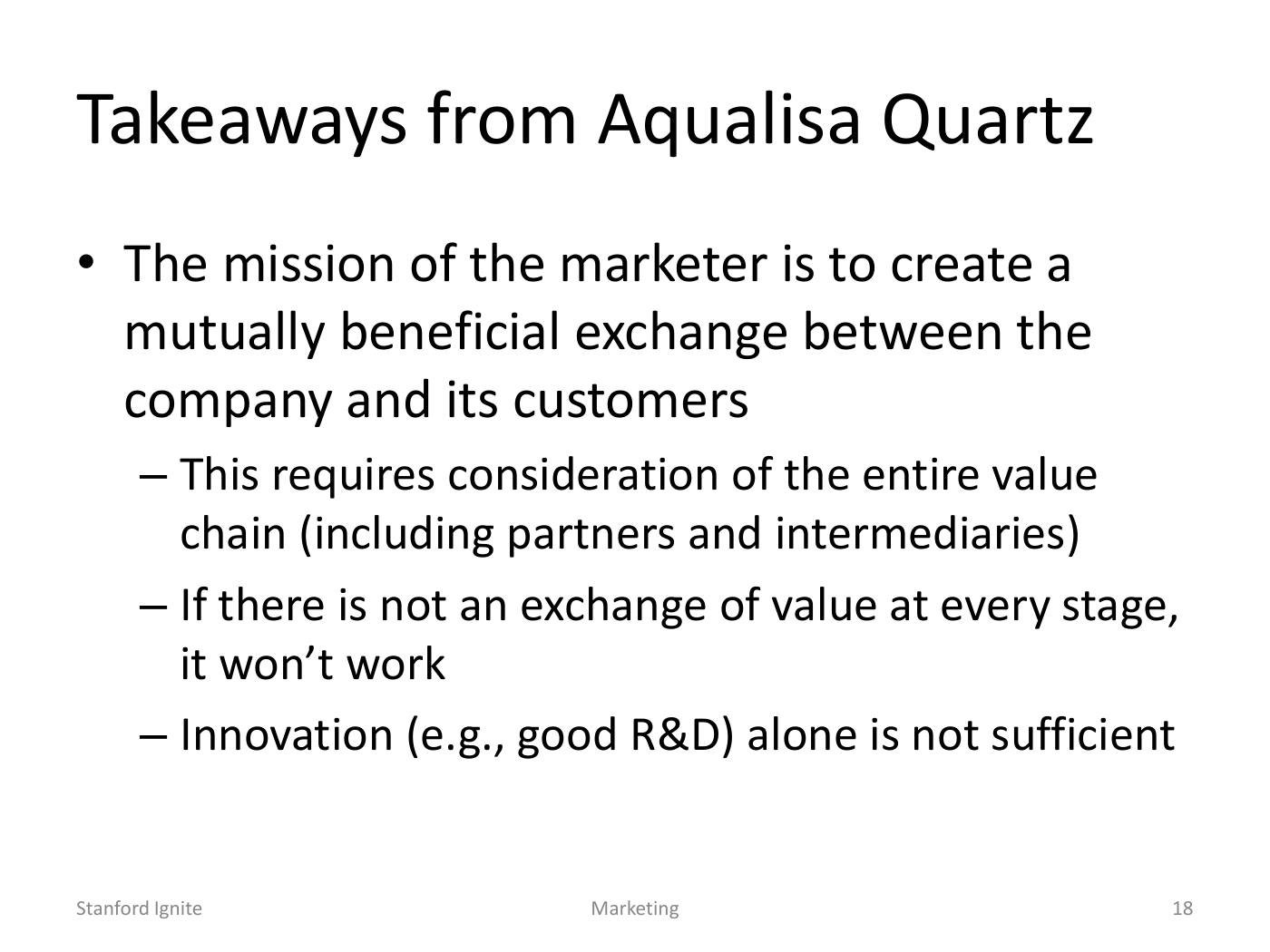
Takeaway: value must be exchanged at every stage
24
09 / Source pageGo-to-market, channels & economic value
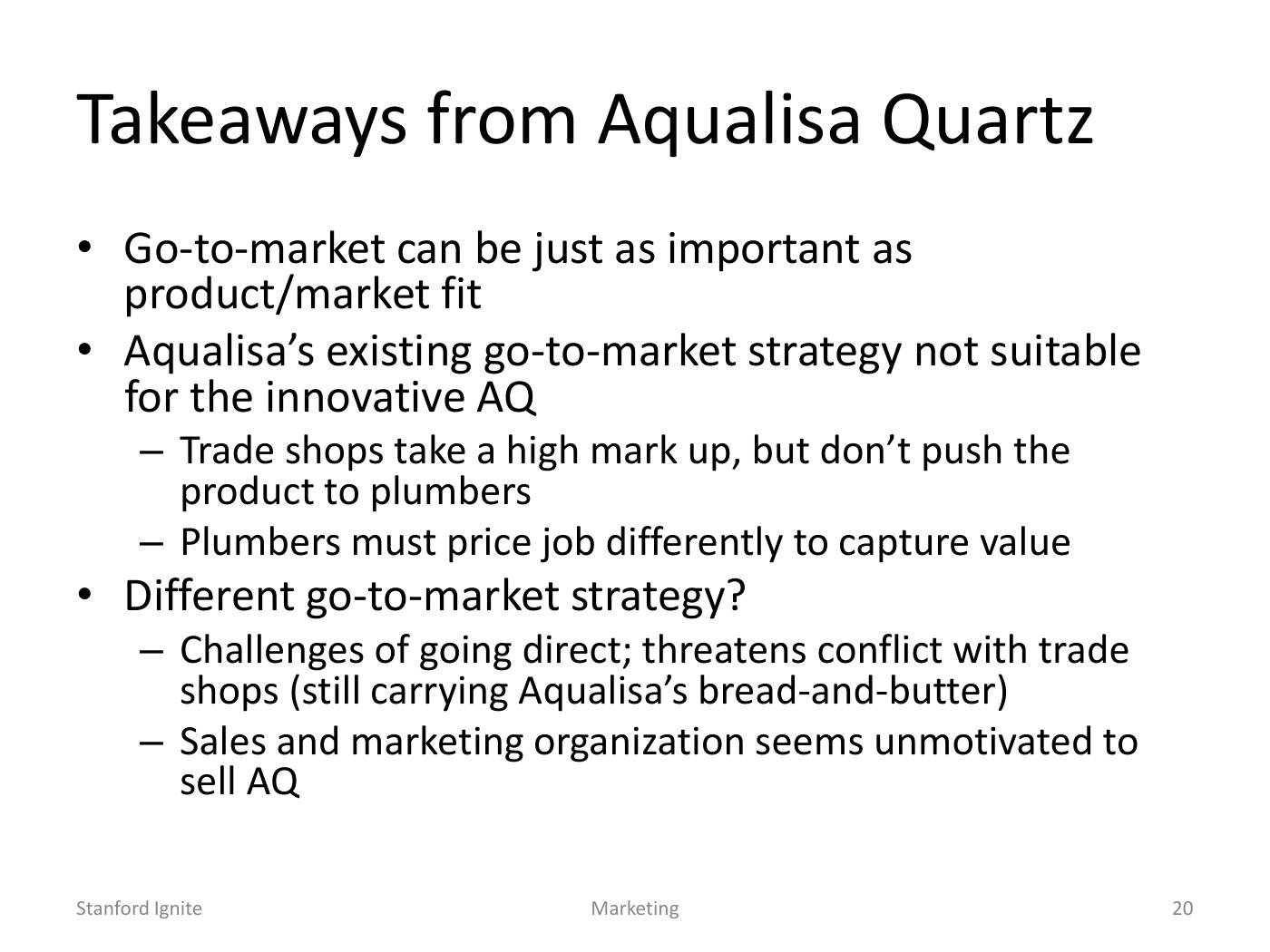
Takeaway: go-to-market can matter as much as product-market fit
25
09 / Original readingGo-to-market, channels & economic value
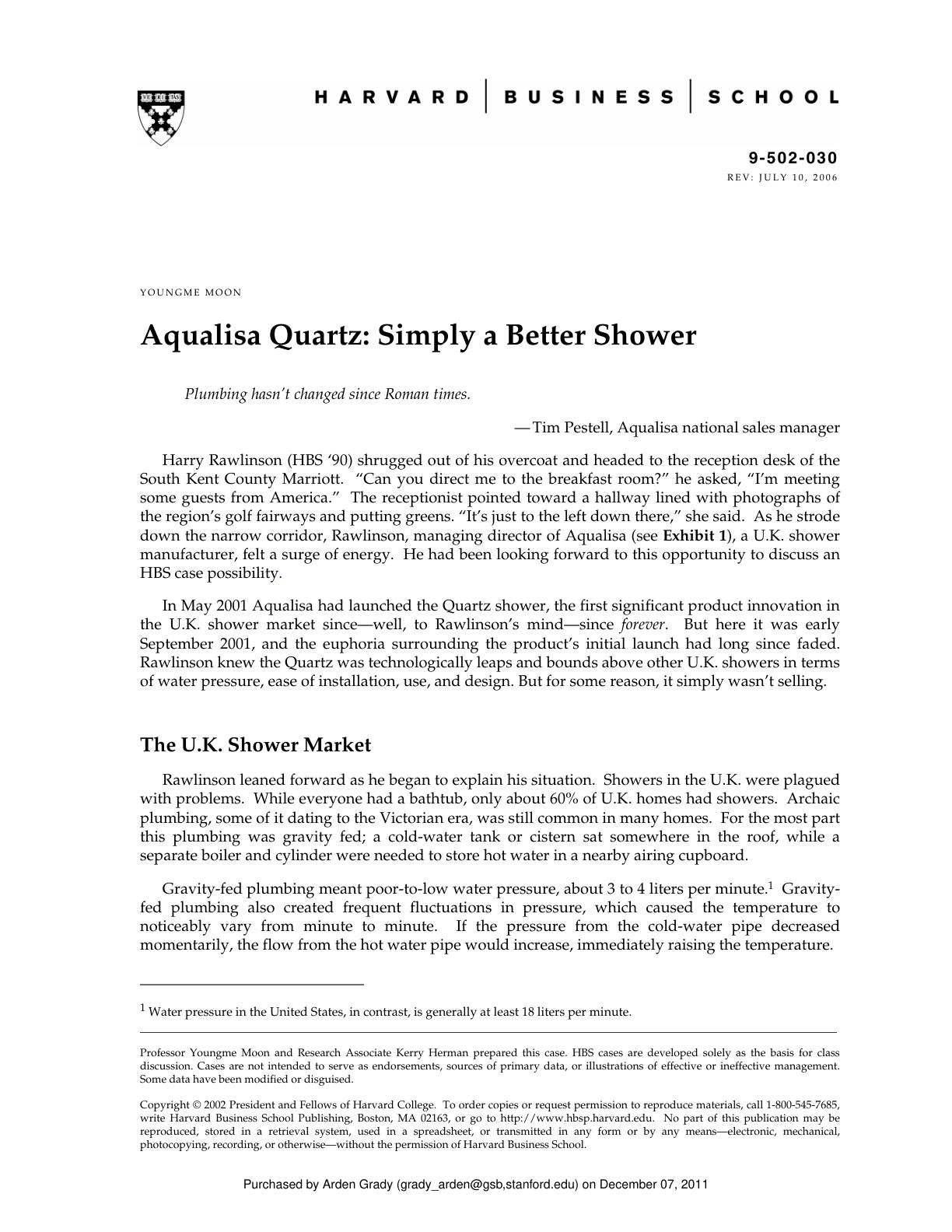
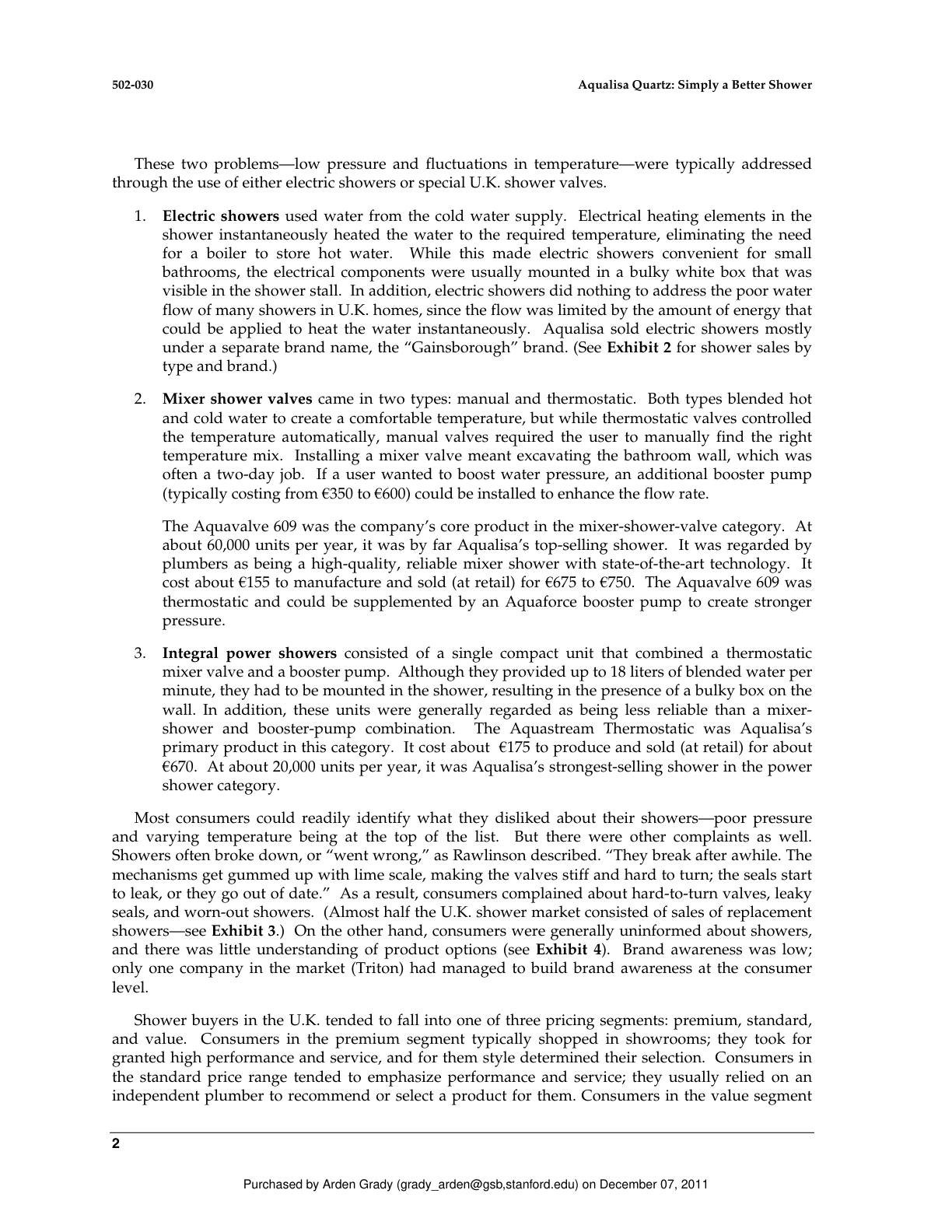
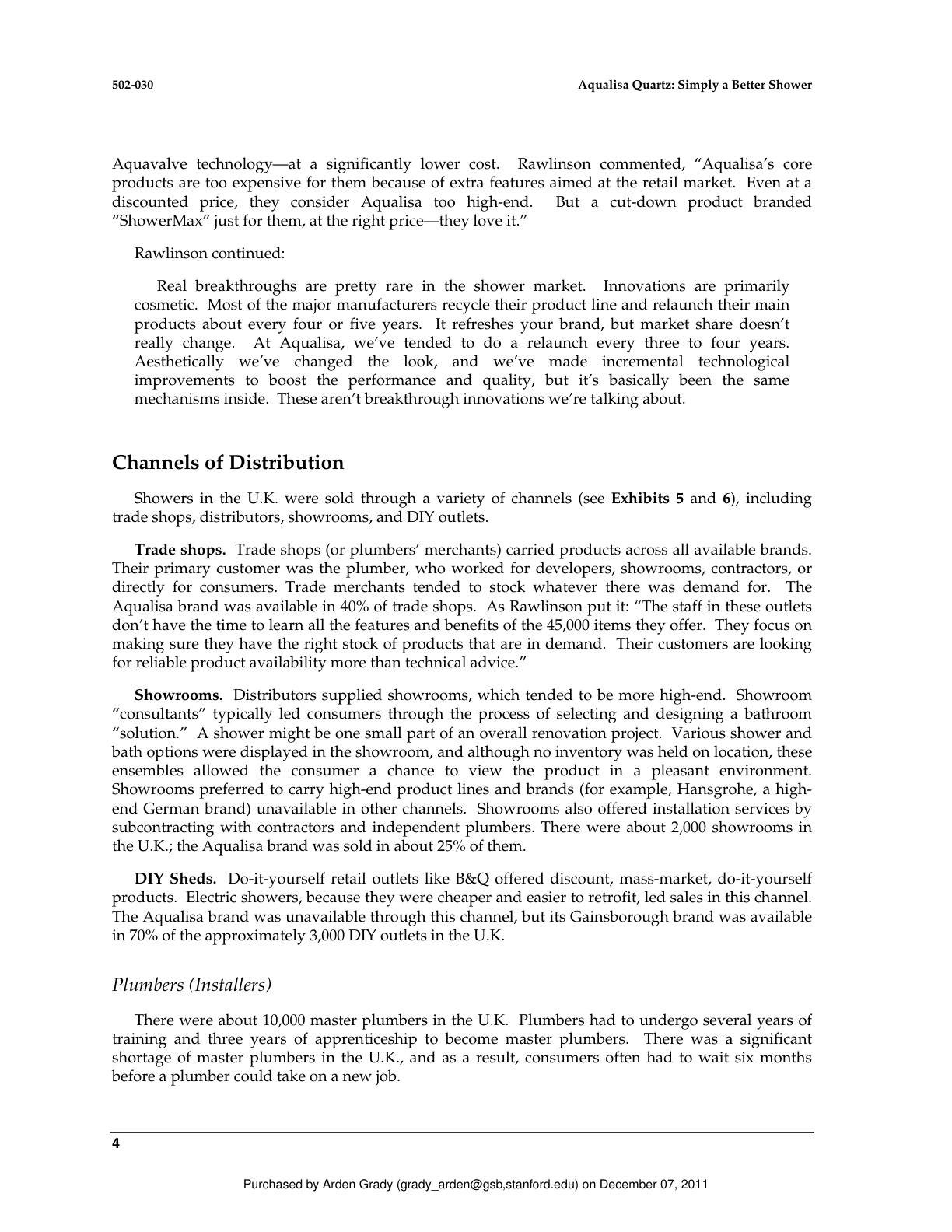
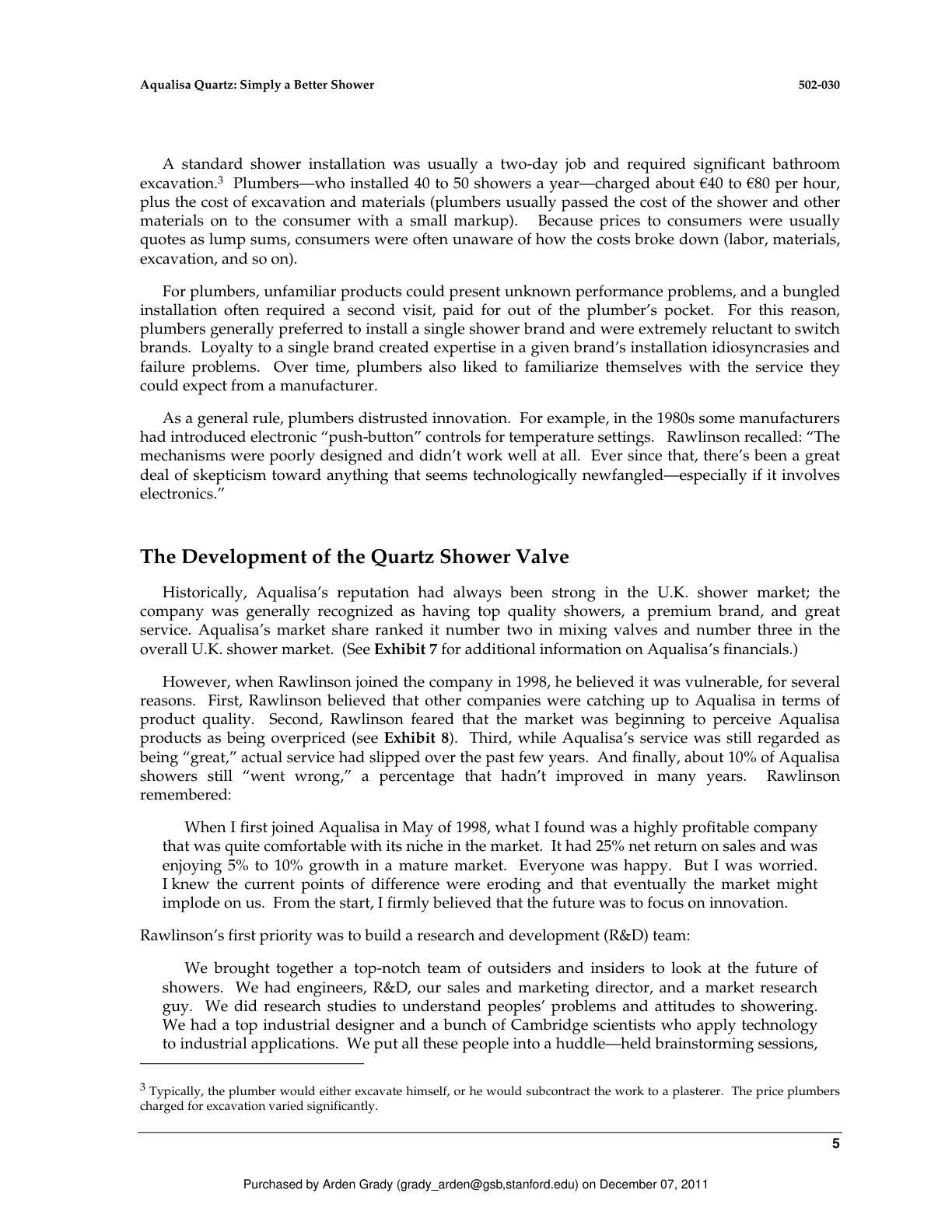
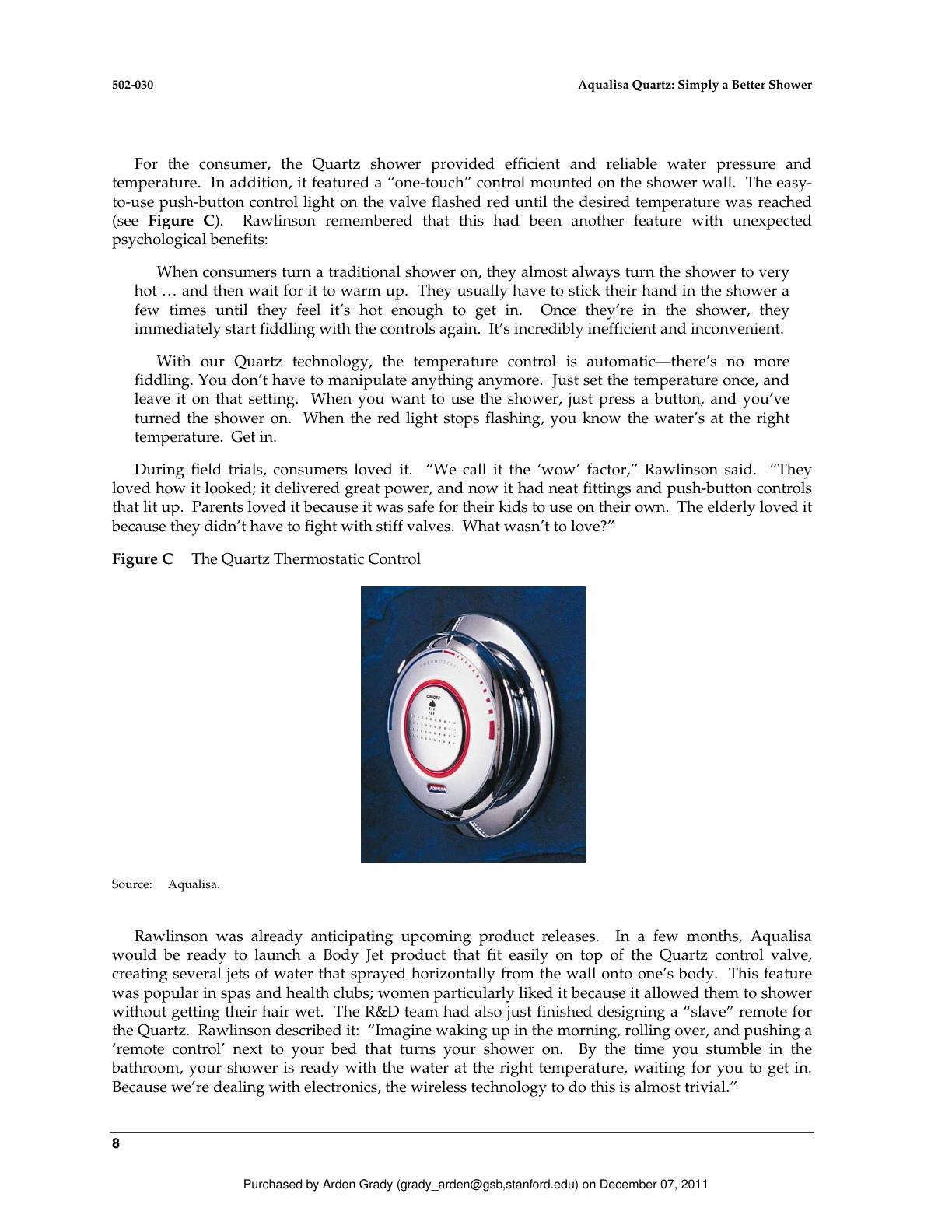
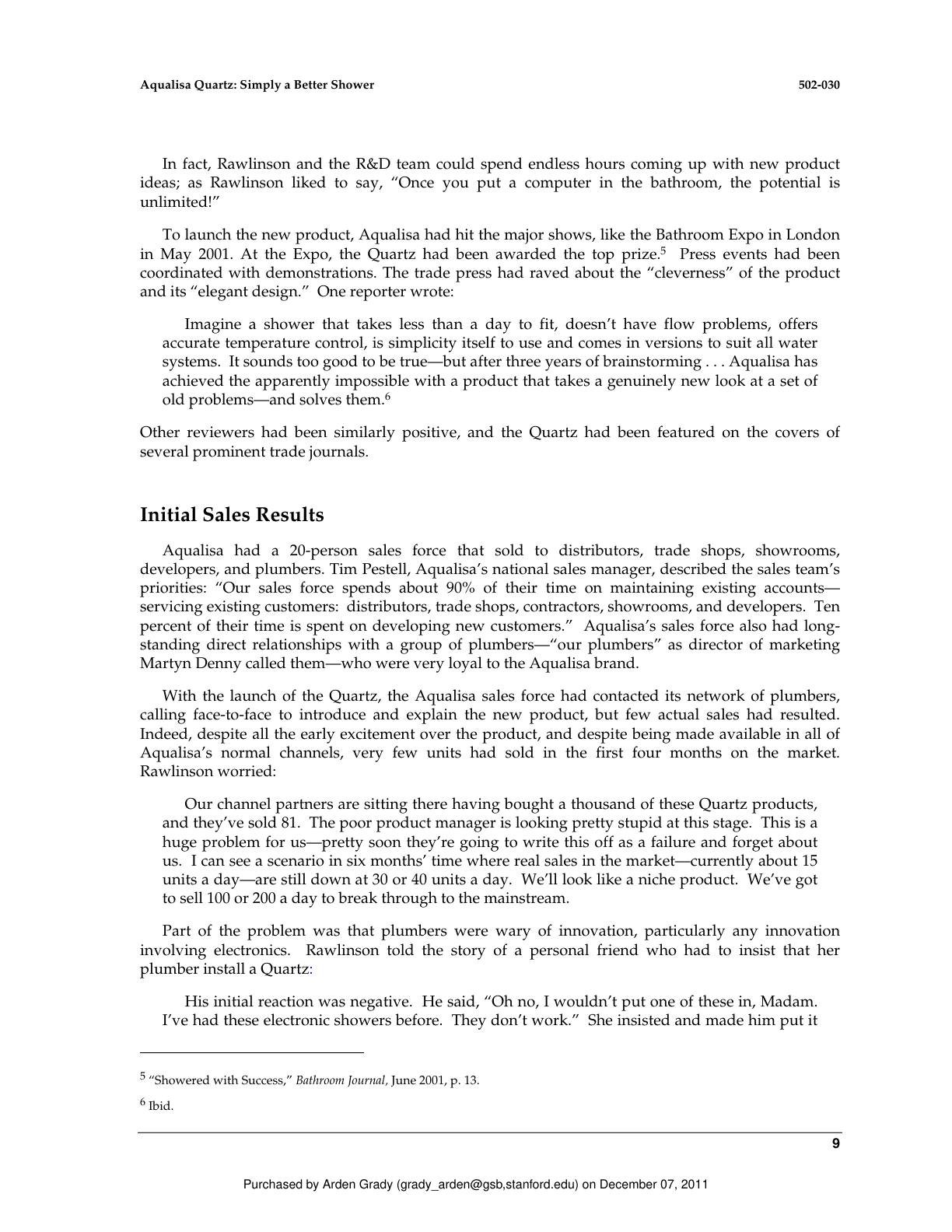
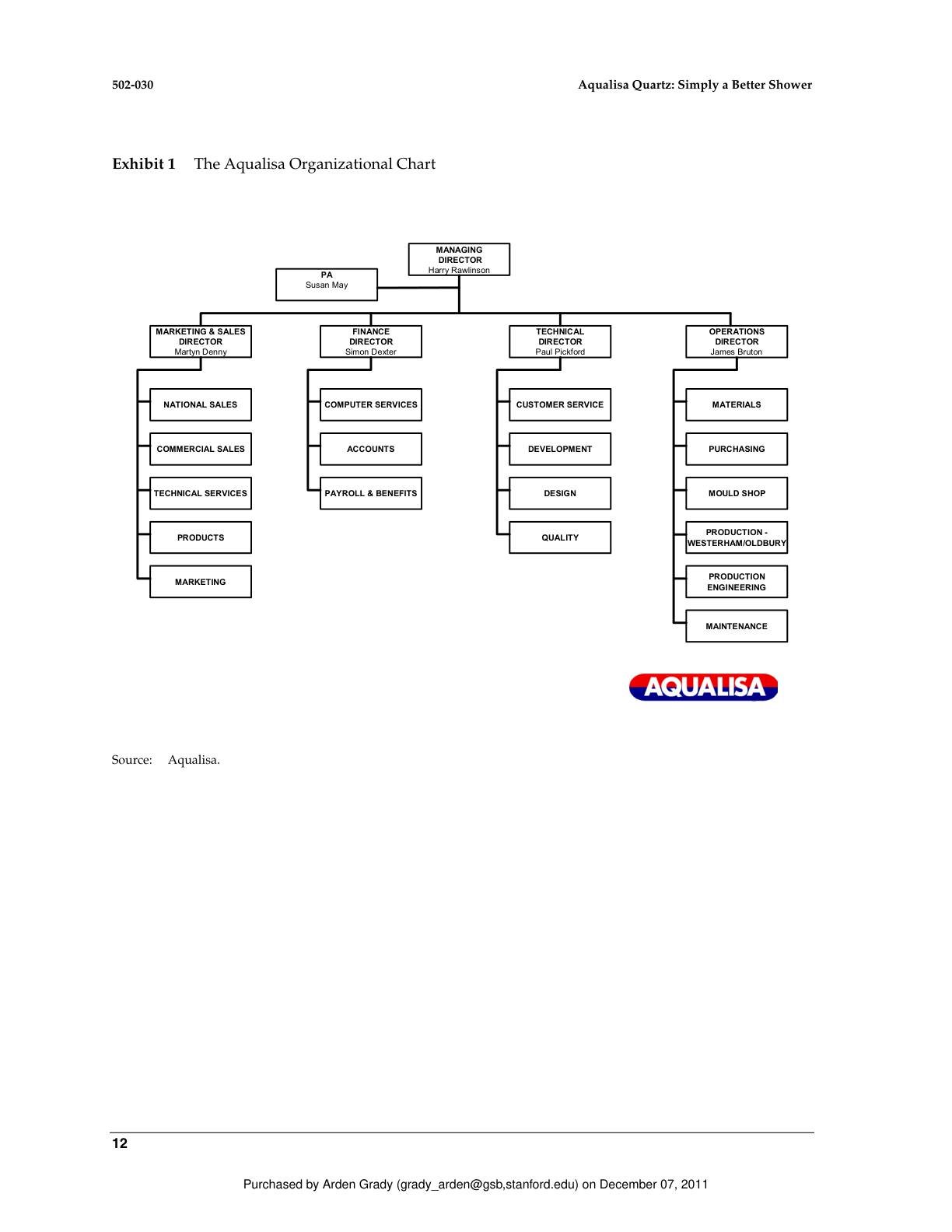
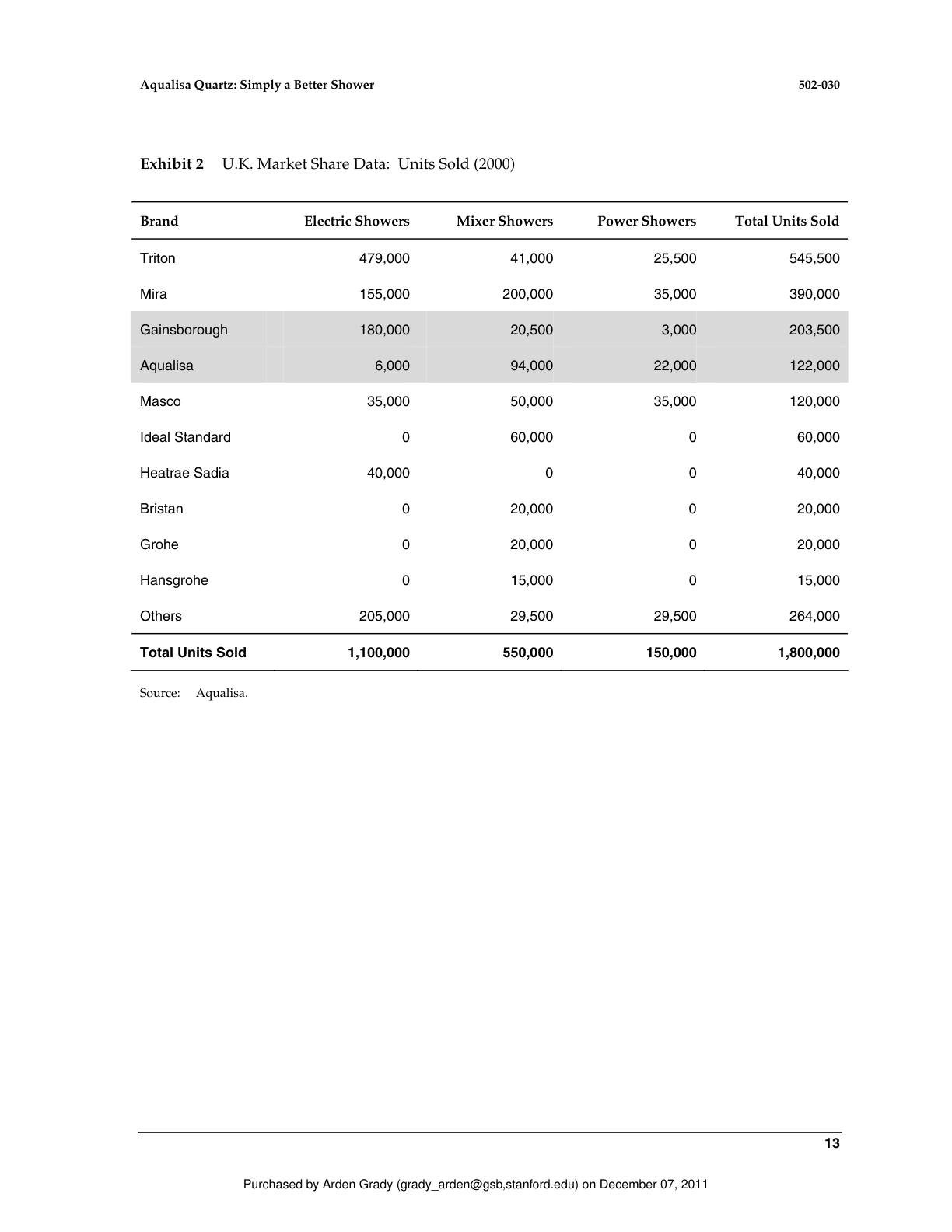
Lattin - Aqualisa Quartz (1)
PDF page 4
PDF page 5
Click either page to read it at full size. In the reader, use ← → to switch between these two pages.
26
09 / Original readingGo-to-market, channels & economic value
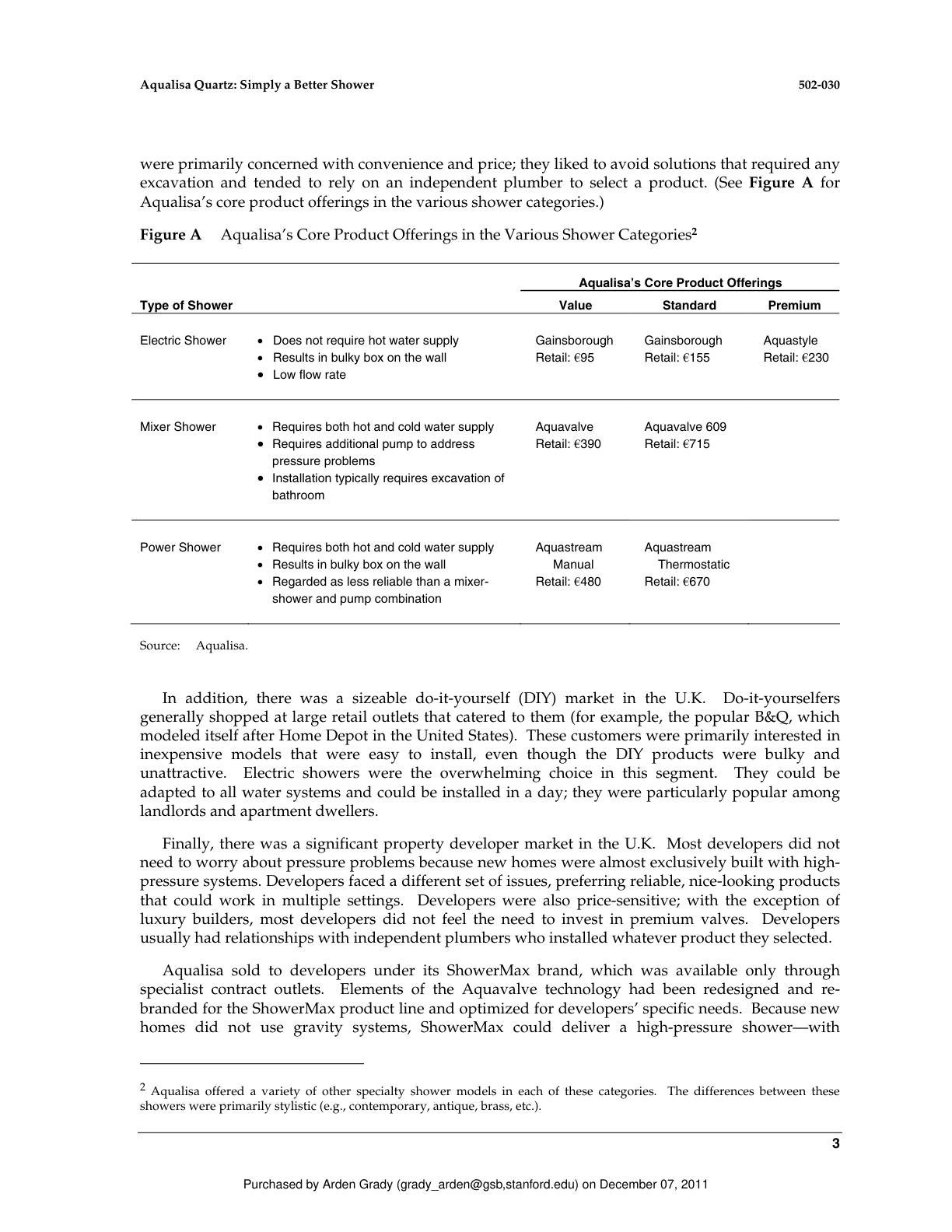
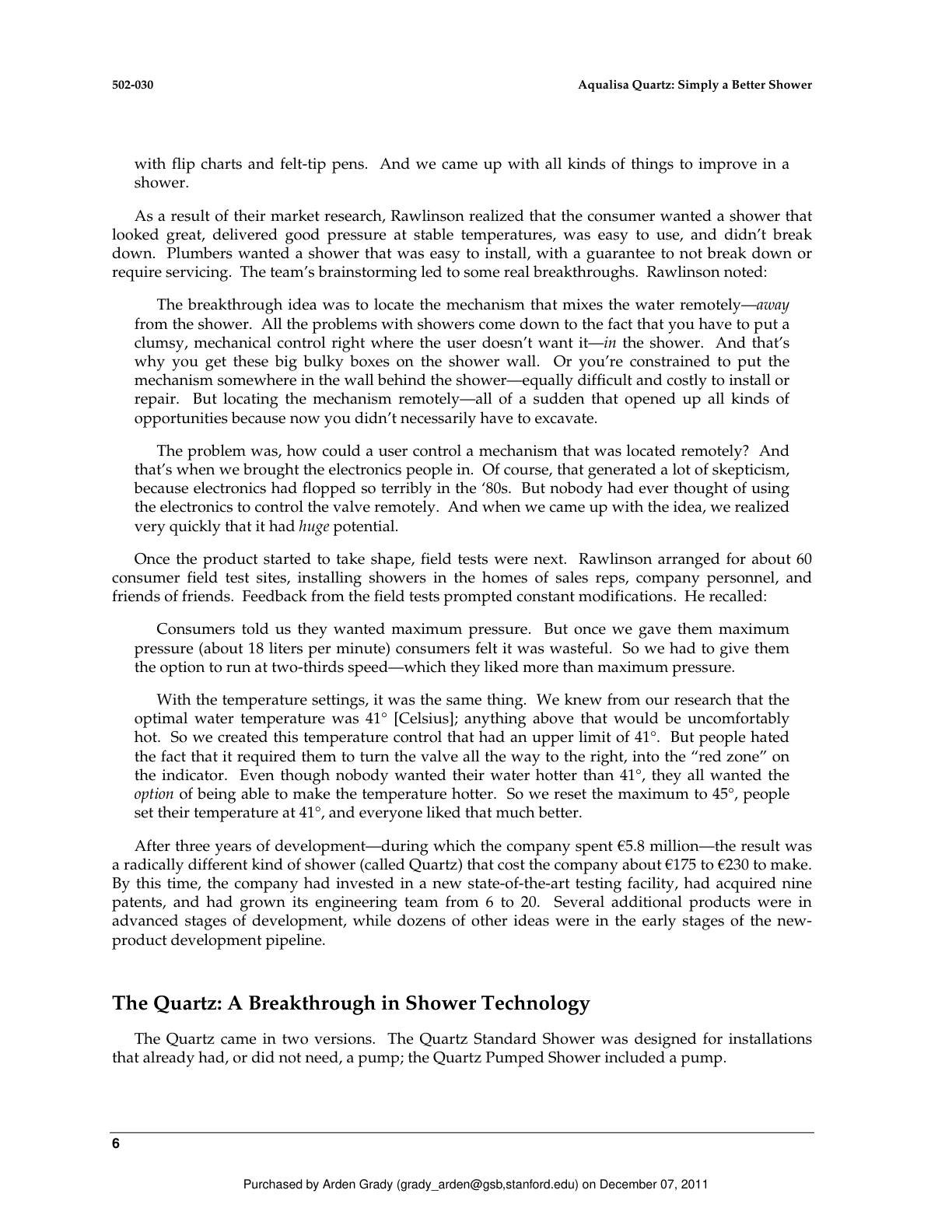
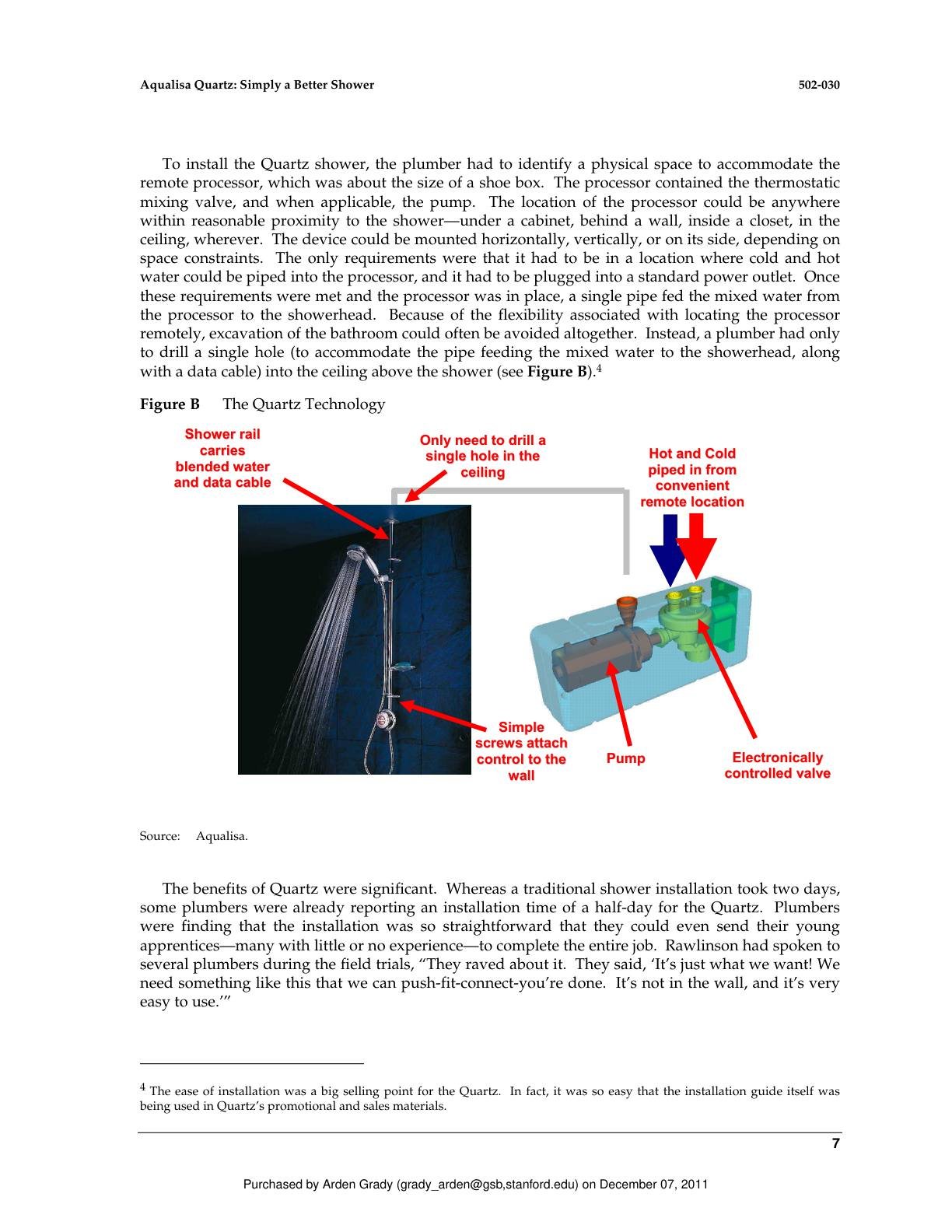
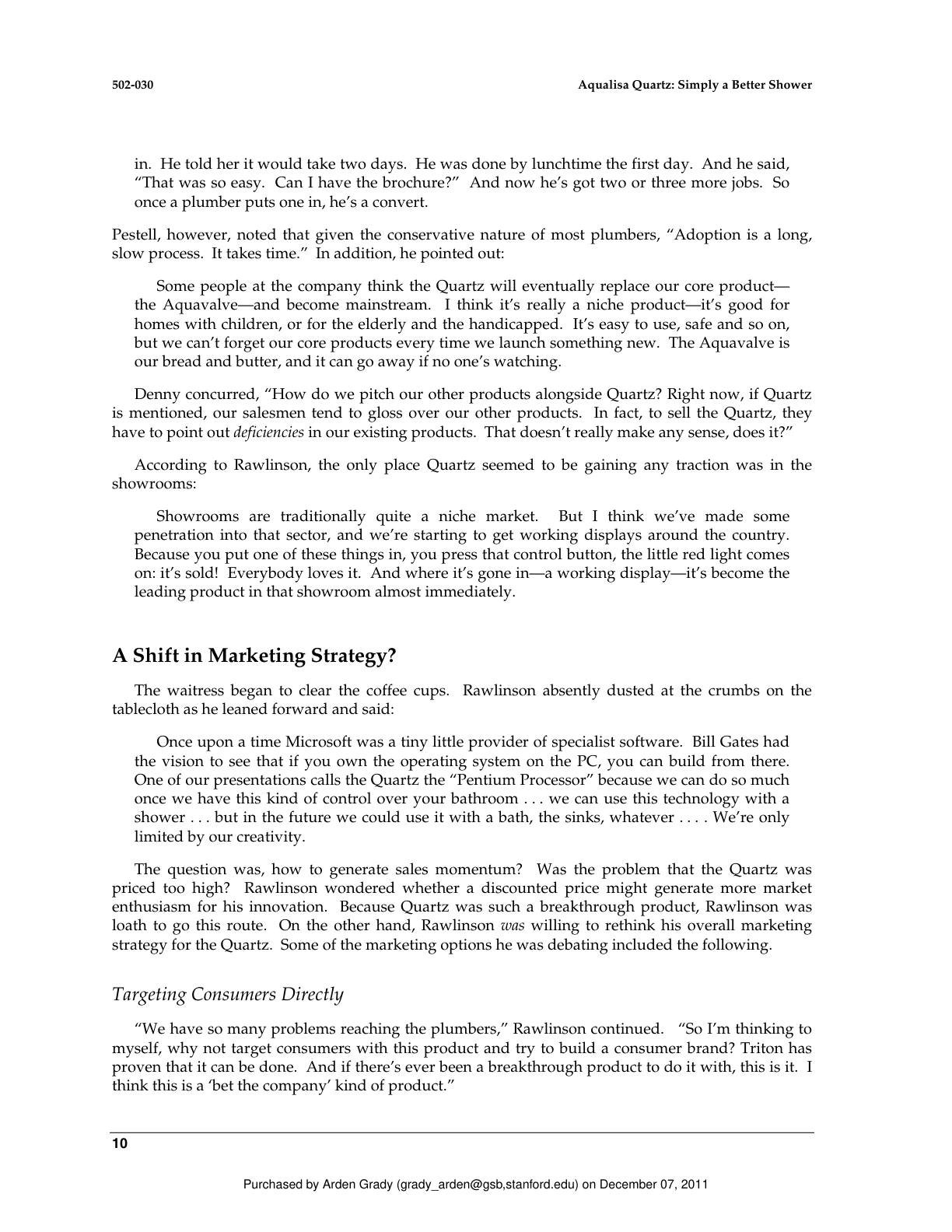
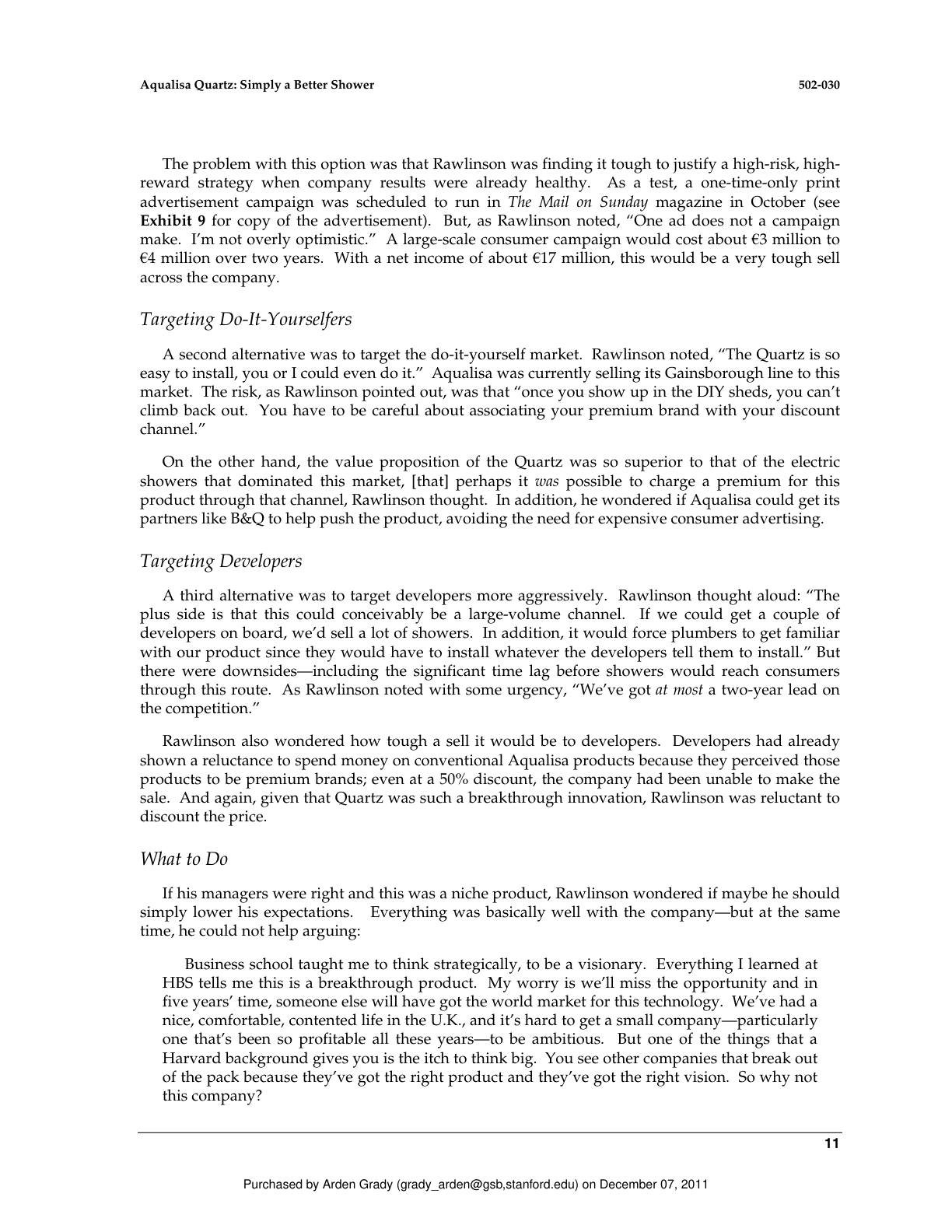
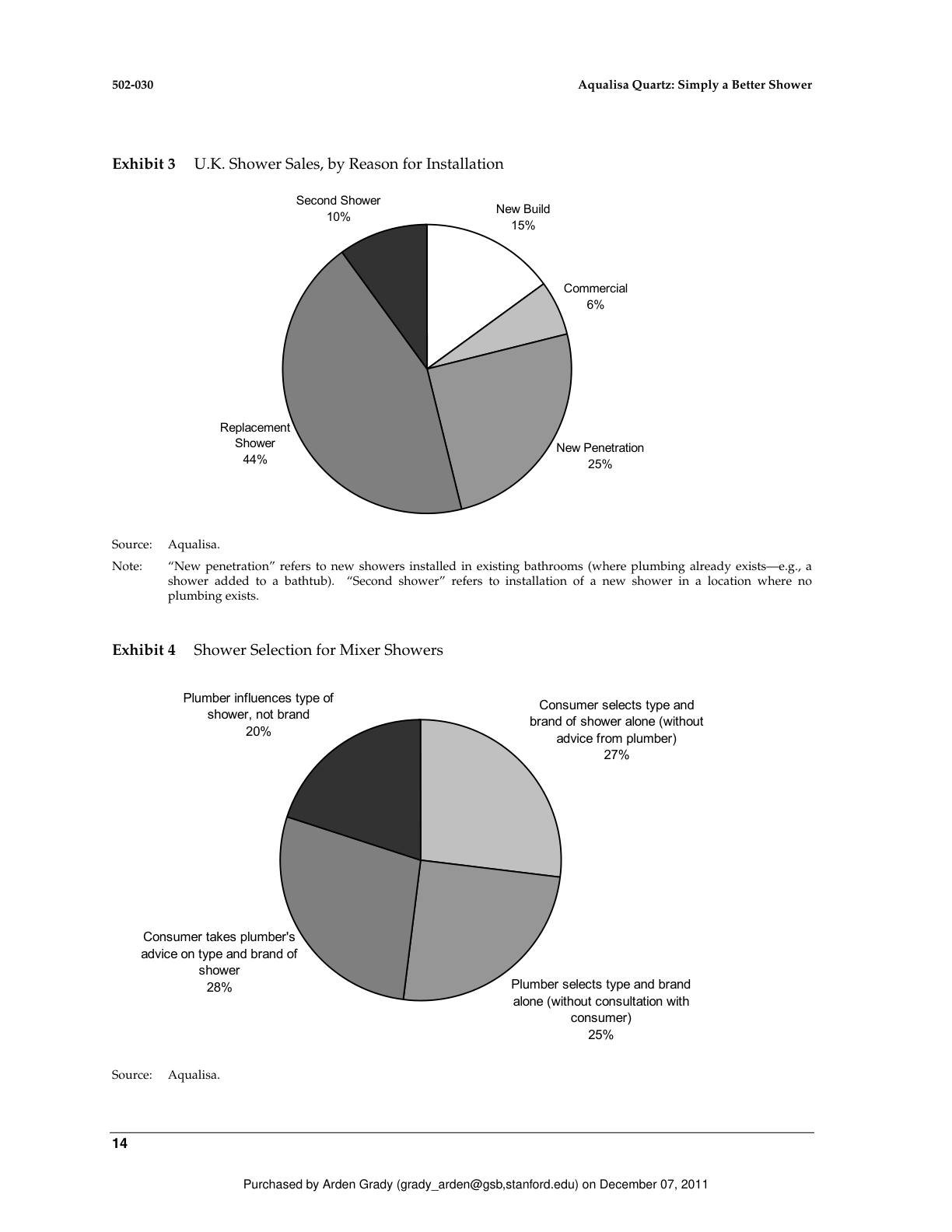
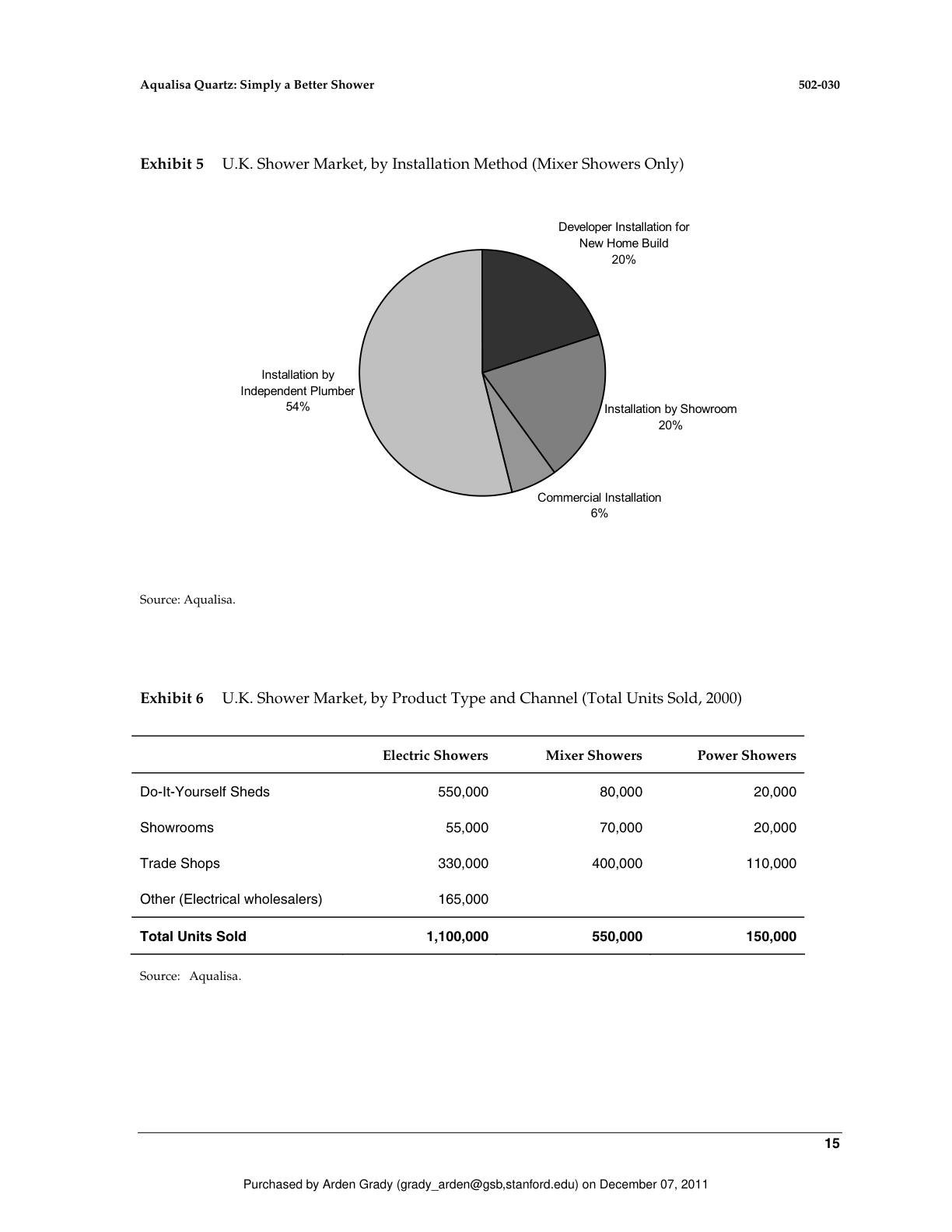
Lattin - Aqualisa Quartz (1)
PDF page 6
PDF page 7
Click either page to read it at full size. In the reader, use ← → to switch between these two pages.
27
09 / Reading debriefGo-to-market, channels & economic value
Aqualisa Quartz / summary
Selected reading: PDF pages 4, 5, 6, 7
Quartz changes both the shower experience and installation work. The excerpt shows why commercialization must account for channel behavior and the installer’s perceived risk as well as product capability.
Several routes to the customer
Trade shops, showrooms and DIY outlets perform different roles and serve different expectations. Distribution is part of the offer’s design.
Installers influence adoption
Plumbers favor familiar brands because expertise and service experience reduce the risk of an expensive return visit.
A technical change creates new value
Locating the processor remotely can reduce excavation and simplify installation. The resulting benefit follows from a specific change in the work.
Field testing refines the offer
The pressure and temperature examples show how observed reactions changed product choices that initially seemed technically reasonable.
28
09 / Reading debriefGo-to-market, channels & economic value
Aqualisa Quartz / discussion
Selected reading: PDF pages 4, 5, 6, 7
Critical points
A benefit and an incentive
Installation time saved has different consequences under different quoting practices and workloads. Investigate the actual installer’s economics before assuming resistance is irrational.
Trial feedback and adoption
Positive reports from field-test installers support the mechanism in that setting. They do not by themselves establish broad willingness to change established behavior.
Several possible bottlenecks
Awareness, reliability beliefs and channel support can each limit adoption. Design an experiment that distinguishes the bottlenecks.
29
09 / ApplicationGo-to-market, channels & economic value
Aqualisa Quartz: benefits were not shared automatically
The historical case presents an innovative shower that could improve installation and customer experience. Installers and existing intermediaries still had to understand the offer, trust it and see a reason to recommend it. Product value and channel motivation were separate problems.
What route would help the product be specified, installed and supported?
30
09 / Current practiceGo-to-market, channels & economic value
Current practice: EHR app marketplaces and platform owners as competitors
EHR marketplaces have become directories, not sales channels
In December 2022 Epic announced it would shut down its App Market, and in January 2023 it opened Connection Hub, a directory open to any vendor with a live Epic connection. In January 2024 it launched Showroom, with tiers that include a $500-a-year Connection Hub listing, curated Toolbox categories and Workshop co-development partners. A listing signals compatibility, but the vendor still does the selling.
The platform owner can enter your category
In August 2025 Epic announced a native ambient AI charting tool built with Microsoft, moving away from relying on partner integrations. In a KLAS survey of 35 Epic customers, 54% said they were likely to adopt Epic's tool within two years, while customers of independent vendors wanted proof of maturity before switching. For Relay, ClinicOS bundling a waitlist is the same risk.
Implication for channel choice
When the channel owner is also a potential competitor, use its marketplace for integration access and credibility. Build demand through routes you control, such as direct sales, referrals and association endorsements, and invest in what the bundle would not match: fill-rate performance and multi-location workflows.
09 / PracticeGo-to-market, channels & economic value
Repair a channel incentive
Fictional adaptation: a new installation method reduces labor from $80 to $30 while hardware rises from $100 to $130. Installers earn a share of labor revenue; customers see only the higher hardware price. The producer’s existing resellers favor the old model.
Your task
Map the work and incentives. Propose two channel responses and a test. Separate customer value from the installer’s current reward.
32
09 / DebriefGo-to-market, channels & economic value
Worked answer and reasoning
Explain total installed value rather than hardware price alone, while checking that the assumed labor saving occurs.
One response is a revised service/package price; another is a route through participants who benefit from easier specification or installation.
Test actual recommendation and installation behavior, including the effect on existing partners.
33
09 / Venture stepGo-to-market, channels & economic value
Venture step: Relay's route to market and EVC argument
Relay · venture step 09
Relay v1 costs $399 per location per month ($4,788 a year). The headline is about $96,000 a year of gross recovered revenue per clinic (illustrative), based on refilling 40% of about 42 empty slots a week at $110. Three routes are on the table: founder-led direct sales (CAC about $2,400); the ClinicOS marketplace, which reaches about 35% of independent clinics but takes a 30% revenue share (CAC about $1,500); and endorsement through a state PT association. The owner signs, the front desk runs it, and ClinicOS controls the API.
Your task
Produce a route-to-market map (participants, essential work, each one's gain and risk), an EVC calculation against the correct baseline, and a recommendation on which route to test first, with the metric that would change it.
34
09 / Venture stepGo-to-market, channels & economic value
Venture step: worked reasoning
EVC against the right baseline: the front desk already fills about 10-15% of gaps, so Relay's increment is about 40% - 12.5% = 27.5% of 42 slots, or about 11.6 visits a week. At $110 that is about $1,270 a week, or about $66,000 a year. Add roughly 1 hour a day of front-desk calling avoided (illustrative: 260 days x $20 = about $5,200). EVC is about $71,000 against a $4,788 price, roughly 15x. The $96,000 headline is gross recovered revenue, not value over the status quo; the $66,000 increment is the revenue figure for value claims and pricing.
Who gains: the owner, through revenue on capacity already paid for. The front desk saves time but loses control, so they need an easy override. Therapists see fuller schedules, which helps only if their pay or targets reward productivity. ClinicOS gains little from Relay and could bundle a waitlist itself, the Aqualisa sales-force problem in a new form.
Essential work: awareness and trust (HIPAA BAA, references), integration with the EHR, front-desk onboarding, and proof of fill rate. Direct sales does all of it, at about $2,400 CAC and limited reach. The ClinicOS marketplace provides reach and integration at a 30% share, which cuts monthly gross profit per clinic from about $319 (399 x 0.80) to about $200 ((399 x 0.70) - 79.80 delivery cost). At 33 months and $1,500 CAC, LTV/CAC is about 7.0 on a channel with no revenue share (PT association referrals) but about 4.4 through the ClinicOS marketplace.
Recommendation: keep direct sales with an association endorsement as the trust channel (no revenue share, CAC about $1,500 if referrals convert), and list on the ClinicOS marketplace for integration access, not as the main demand source. Test with 10 association-referred clinics. Switch emphasis if the association route converts under 15% or onboarding takes over 3 weeks (illustrative thresholds).
Pricing implication: a 15x EVC/price ratio means price is not the bottleneck. The barriers are trust, switching effort and front-desk adoption, so the inducement should be a free 30-day fill-rate trial with a weekly recovered-visits report, not a discount.
35
09 / DebriefGo-to-market, channels & economic value
Reasoning traps
Measuring against zero instead of the status quo
Relay's $96k headline counts slots the front desk would have filled anyway. Measured against the 10-15% the phone list already achieves, the increment is about $66k of revenue (about $71k of EVC including front-desk time), which is still compelling and is a number a skeptical owner can verify.
Treating a marketplace listing as a distribution plan
A listing gives access and credibility, but the platform owner does not sell for you and may bundle a competing feature. Model the revenue share in LTV and keep a route you control.
Ignoring the person who runs the product
The owner signs, but the front desk decides whether Relay is used. If staff see automatic booking as a loss of control, the account churns however good the economics are on paper.
36
09 / ReviewGo-to-market, channels & economic value
What you can now explain
A Relay route-to-market map with each participant's gain and risk, an EVC calculation against the phone-waitlist baseline ($66k incremental revenue, about $71k with front-desk time, vs $4,788), and a channel test with a switching threshold.
A route to market is the allocation of essential work (explain, trust, sell, install, support) to participants who each need a reason and the capability to do it.
EVC is measured against the customer's next best alternative and sets a ceiling; price sits below it to leave an inducement and to pay the participants who do essential work.
A technically better product stalls when the participant who chooses or runs it loses from the change, so diagnose the bottleneck before spending on awareness.
Next lesson: Business models & unit economics
37
Check your understanding
Why might a better product fail to sell?
Score
Question 1
A clinic fills 12.5% of late cancellations by phone. Relay would fill 40%. With 42 empty slots a week at $110, what is the incremental annual revenue that should anchor Relay's EVC (52 weeks)?
The increment is 27.5% of 42, or 11.55 visits, times $110 = $1,270.50 a week, or about $66,000 a year. $96,000 counts every slot Relay fills, including about 5 a week the front desk would have filled anyway, so it credits Relay with value the status quo already delivers.
Question 2
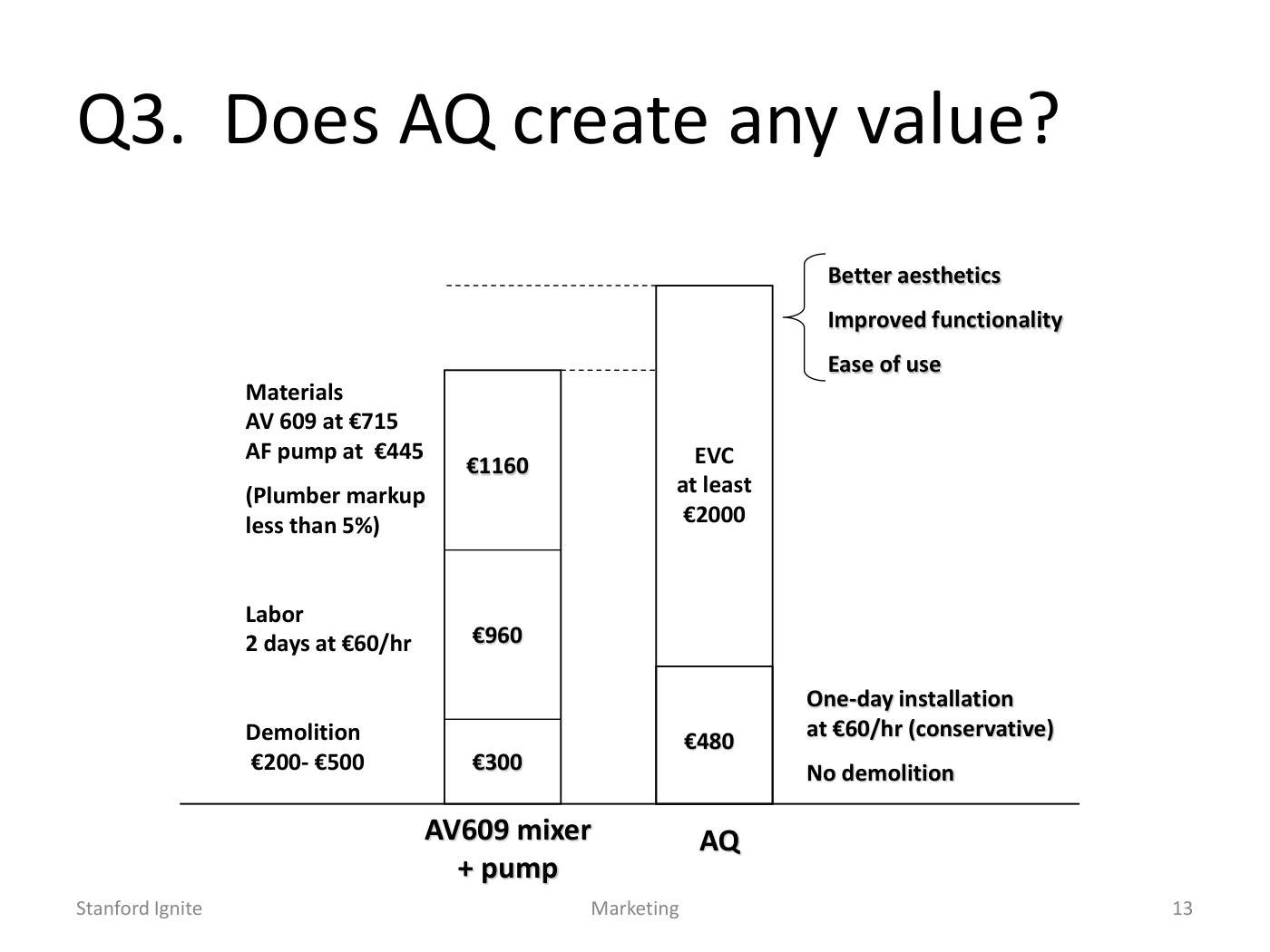
Using the case figures, the old installation costs EUR 1,160 materials + EUR 960 labor + EUR 300 demolition. The Quartz needs EUR 480 labor and no demolition. At what Quartz price does a homeowner merely break even, ignoring aesthetics and convenience?
Old total = 1,160 + 960 + 300 = EUR 2,420. Subtract the Quartz's own lifecycle cost (EUR 480 labor) to get EUR 1,940, the price at which the homeowner is indifferent. Qualitative benefits raise EVC above that, which is why the instructor's page shows at least EUR 2,000. EUR 1,080 is the actual retail price.
Question 3
Why might a plumber who bills by the day resist a shower that halves installation time, even though homeowners benefit?
The resistance is economically rational: a two-day job becoming one day cuts the plumber's income, and an unfamiliar electronic unit raises callback risk. Calling it ignorance leads to an advertising fix for an incentive problem.
Question 4
Relay is offered a ClinicOS marketplace listing that reaches about 35% of independent clinics, with a 30% revenue share. CAC drops to about $1,500. What is the main analytical error in calling LTV/CAC 'about 7' on this route?
LTV must use what Relay keeps. (399 x 0.70) - 79.80 = about $199.50 a month, x 33 months = about $6,580, divided by $1,500 = about 4.4. The channel buys lower CAC with a permanent cut of every month's revenue. Using revenue instead of margin would inflate LTV further.
Question 5
Many owners request a Relay demo, but few clinics go live because front-desk leads stall onboarding. The marketing lead proposes doubling ad spend. What should the team do first?
The bottleneck is after the buying decision, at the participant who runs the product. More ads raise demo requests while leaving go-live unchanged, which is the lesson's 'more advertising, same installation bottleneck' trap. Measure completed behavior, not interest.
Question 6
Which statement about EVC is correct?
Pricing at EVC leaves the customer indifferent, so they have no reason to switch and bear its risk. The supplier's cost sets the floor and EVC the ceiling. Where intermediaries do essential work, the space between them must also pay those participants.
Workbook
Why might a better product fail to sell?
Module output: An evidence log, problem frame, prototype, segment choice, positioning and route to market.
Library
Every original page used in this lesson
10 appear in the slides with notes; the rest are kept here for reference.
Aqualisa background questionsOpening prompts: what business Aqualisa is in, and why a shower manufacturer appears in an entrepreneurship course. Discussion opener with no content of its own.Lattin - Go-to-Market Strategy Slides · PDF page 4
1
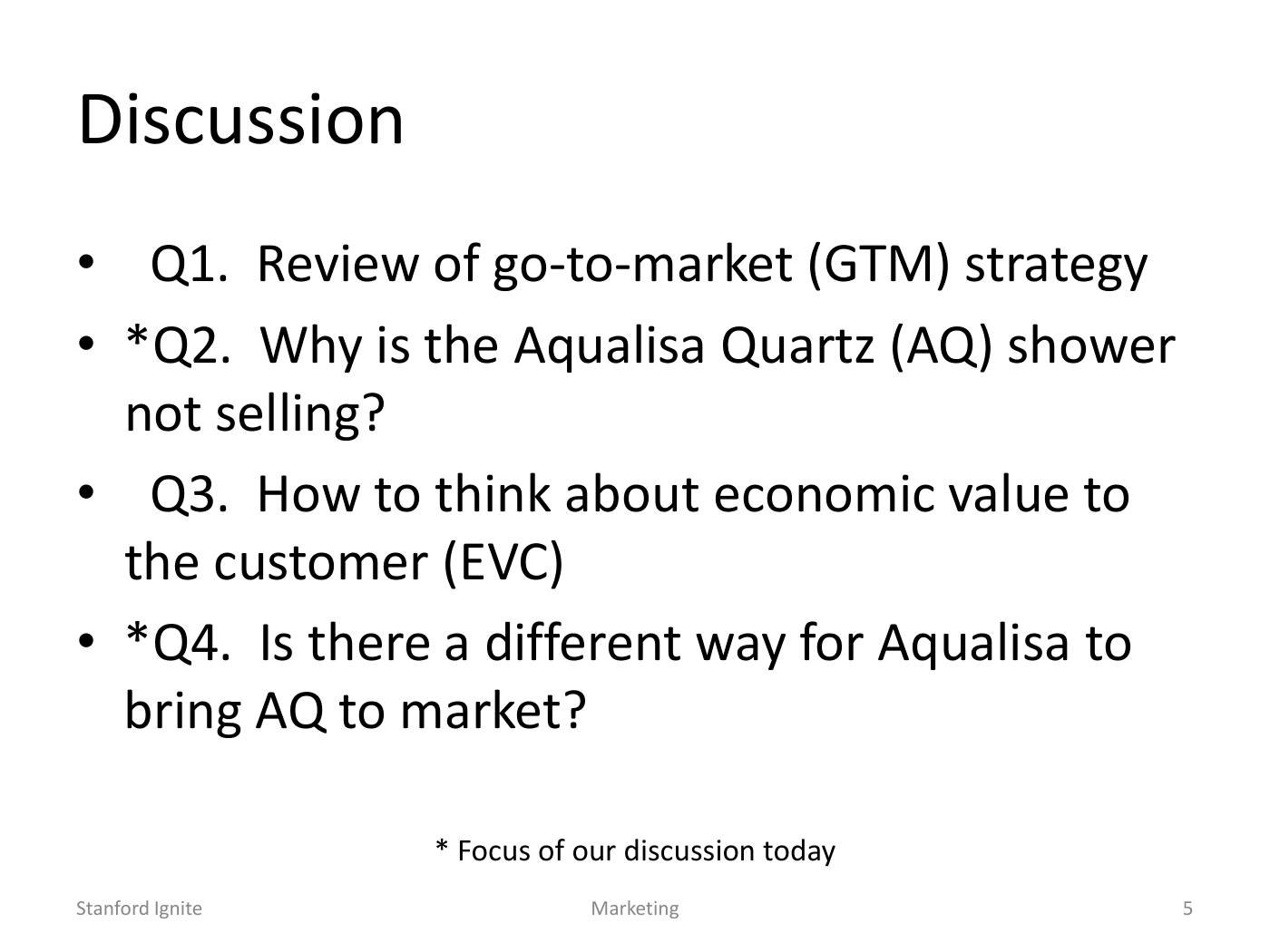
Aqualisa discussion planThe four case questions: review the go-to-market strategy, explain why the Quartz is not selling, think through economic value to the customer, and find a different route to market. The second and fourth are starred as the focus. Agenda page; each question is developed on later pages.Lattin - Go-to-Market Strategy Slides · PDF page 5
2
Go-to-market strategy in four stepsA numbered framework: how the market is segmented; what essential work the target segment requires; which portfolio of participants should do that work; and whether to go direct or indirect. Direct versus indirect comes last. It follows from identifying the work, such as explaining, trialing, installing and recommending, and deciding who can do each part well. Starting with 'should we sell direct?' skips the analysis that answers it.Lattin - Go-to-Market Strategy Slides · PDF page 6 · in the slides
3
Aqualisa's route to market as a systemA flow diagram for the existing AV 609 mixer and AF pump: Aqualisa sells through its own sales force, distributors and trade shops to plumbers and showrooms, which reach consumers. Plumbers sit between the manufacturer and most consumers. The installer, not the homeowner, picks the product in most replacement jobs, so the product has to win the plumber before it can win the household.Lattin - Go-to-Market Strategy Slides · PDF page 7 · in the slides
4
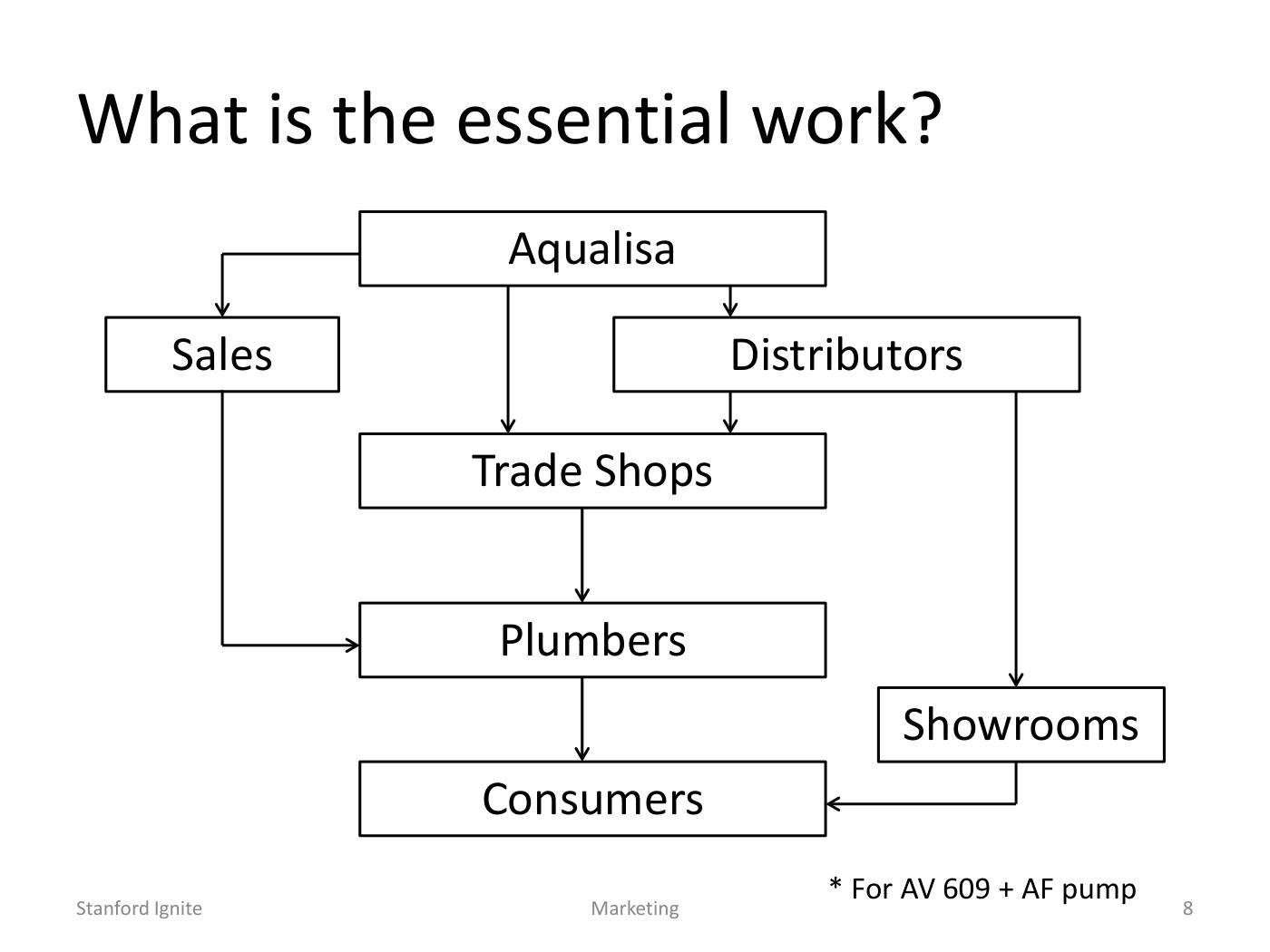
Essential work diagram (unannotated)The same channel diagram as the previous page, repeated before annotation. Build-up slide; see the annotated version on slide 14.Lattin - Go-to-Market Strategy Slides · PDF page 8
5
The essential work each participant performsThe channel diagram annotated with each participant's work: the sales force gives plumbers information; trade shops handle logistics, assortment and aggregation; plumbers install and recommend; showrooms provide trial and evaluation. Each link does different work. Plumbers make the recommendation, and showrooms are the only place a consumer can see and try the product before a plumber is involved, which is why showrooms became the turnaround route.Lattin - Go-to-Market Strategy Slides · PDF page 9 · in the slides
6
Why is the Quartz not selling? (prompt)A prompt noting that there may be more than one reason. Answered on the next page.Lattin - Go-to-Market Strategy Slides · PDF page 10
7
Five reasons a better shower did not sellThe diagnosis: too expensive; plumbers are risk-averse about electronic showers after past failures; installation is easier, so it is unclear who benefits; the sales force would not compete with its bread-and-butter products and saw sales to existing accounts as zero-sum; and marketing was poorly targeted and did not use showrooms. Only one reason is about the product. The others concern participants' incentives and risk, which is the lesson's main point. 'Who benefits from easier installation?' matters most: a plumber billing by the day may lose income when a two-day job becomes a one-day job.Lattin - Go-to-Market Strategy Slides · PDF page 11 · in the slides
8
Economic value to the customer (EVC): the buildA bar diagram. Start from the old product's price plus lifecycle costs. A new product's EVC equals the old total less its reduced lifecycle costs, plus any incremental value. The new price is then set between the supplier's cost and EVC, which splits the gap into the supplier's margin and an inducement left for the customer. EVC is a ceiling, not a price. The inducement is the share deliberately left with the customer to make switching worthwhile, and when intermediaries are involved, part of the value also has to reach them.Lattin - Go-to-Market Strategy Slides · PDF page 12 · in the slides
9
Does the Quartz create value? EVC with euro figuresThe existing system costs about EUR 2,420 installed: EUR 1,160 of materials (AV 609 mixer EUR 715 plus pump EUR 445, plumber markup under 5%), EUR 960 of labor (2 days at EUR 60/hr) and about EUR 300 of demolition (EUR 200-500). The Quartz installs in one day (EUR 480) without demolition, putting its EVC at at least EUR 2,000, plus better aesthetics, functionality and ease of use. Most of the value comes from labor and demolition the homeowner avoids, which is exactly the plumber's income. EUR 2,420 - EUR 480 = EUR 1,940 is the price at which a homeowner merely breaks even before the qualitative benefits. The value is real, but it flows away from the participant who chooses the product.Lattin - Go-to-Market Strategy Slides · PDF page 13 · in the slides
10
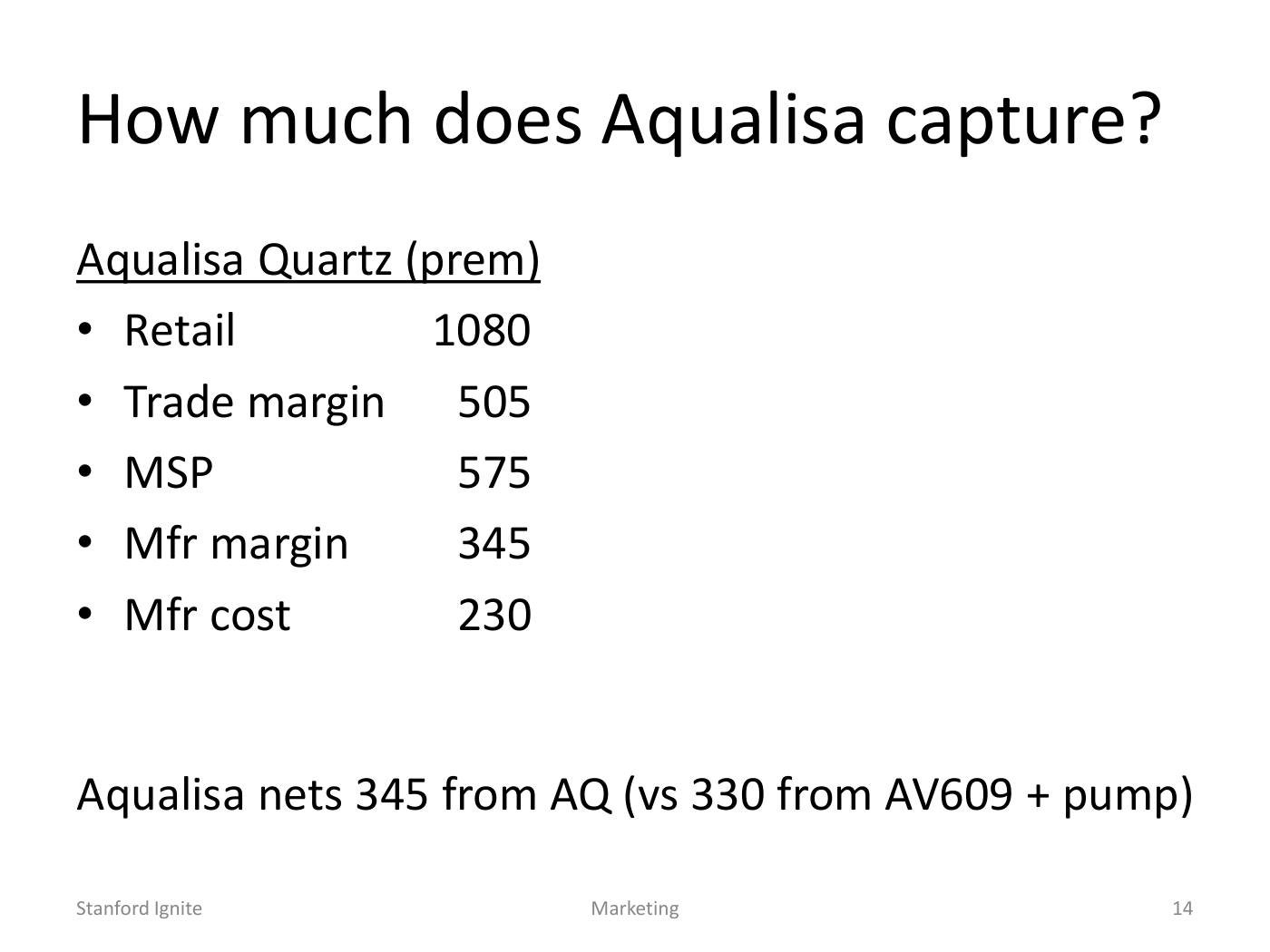
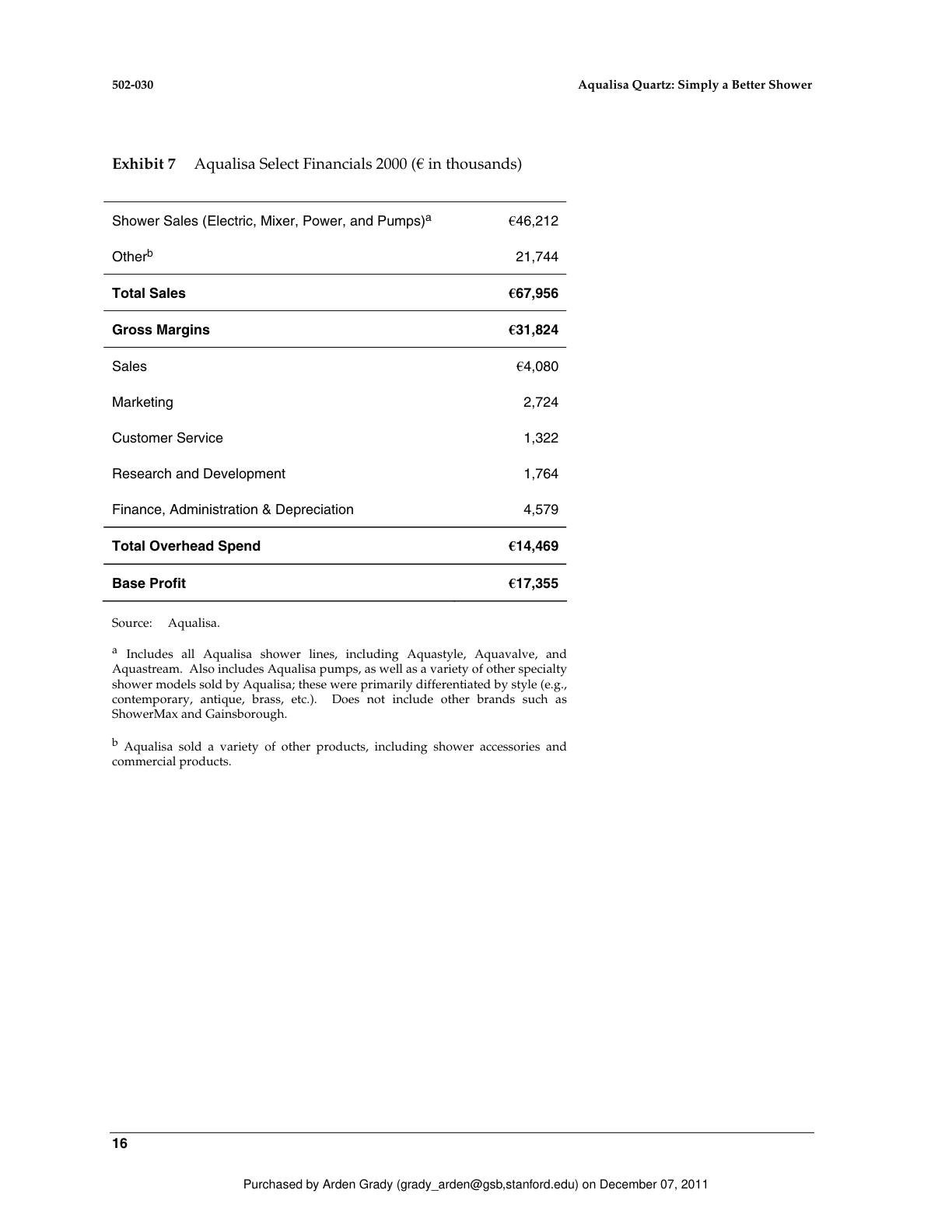
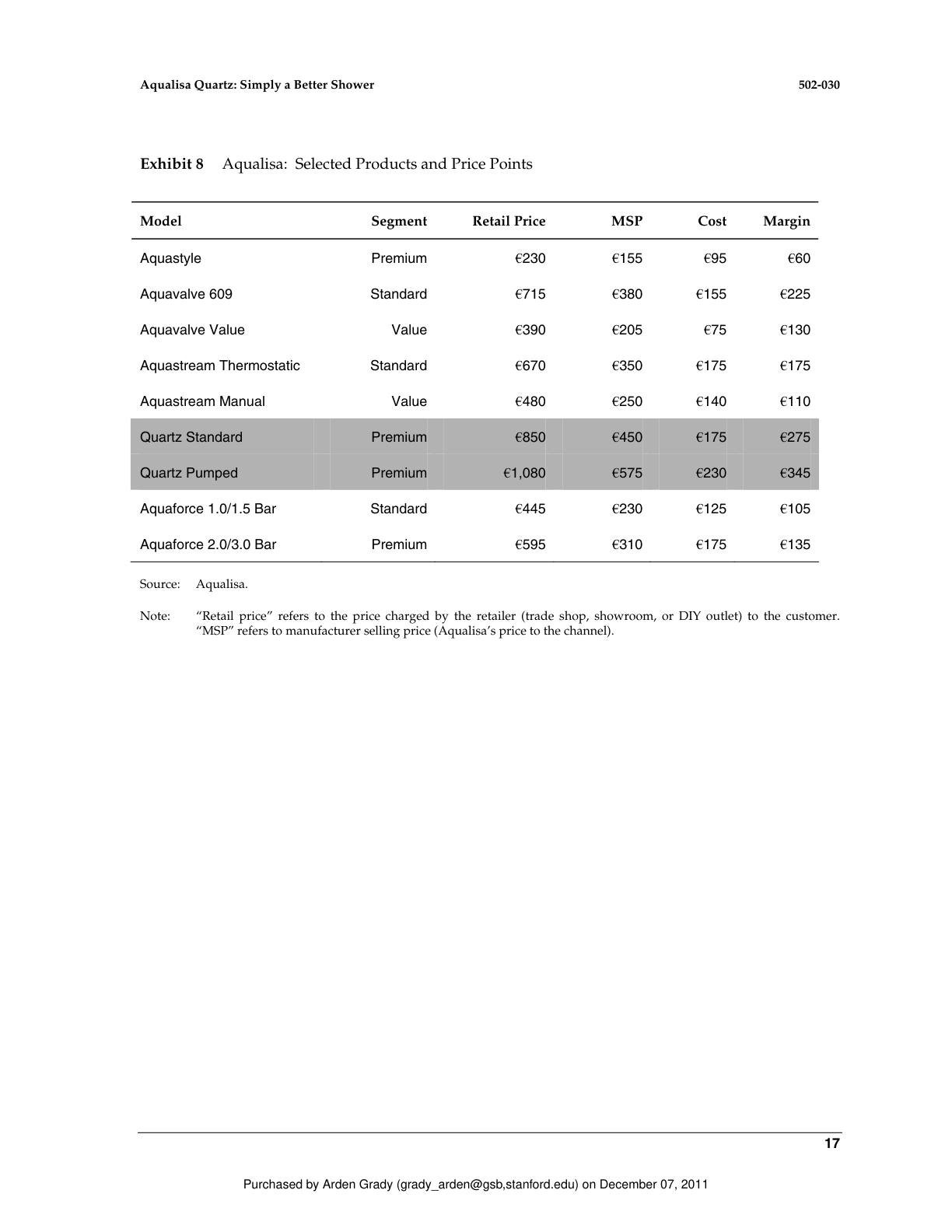
How much does Aqualisa capture?The Quartz price chain: retail EUR 1,080, trade margin EUR 505, manufacturer's selling price EUR 575, manufacturer margin EUR 345, cost EUR 230. Aqualisa nets EUR 345 per Quartz against EUR 330 from an AV 609 plus pump. Trade shops keep EUR 505 of the EUR 1,080 retail price (47%) but do little to promote the product, while Aqualisa earns only EUR 15 more than on the old product. The innovation barely changes the manufacturer's take, so the sales force has little reason to push it.Lattin - Go-to-Market Strategy Slides · PDF page 14 · in the slides
11
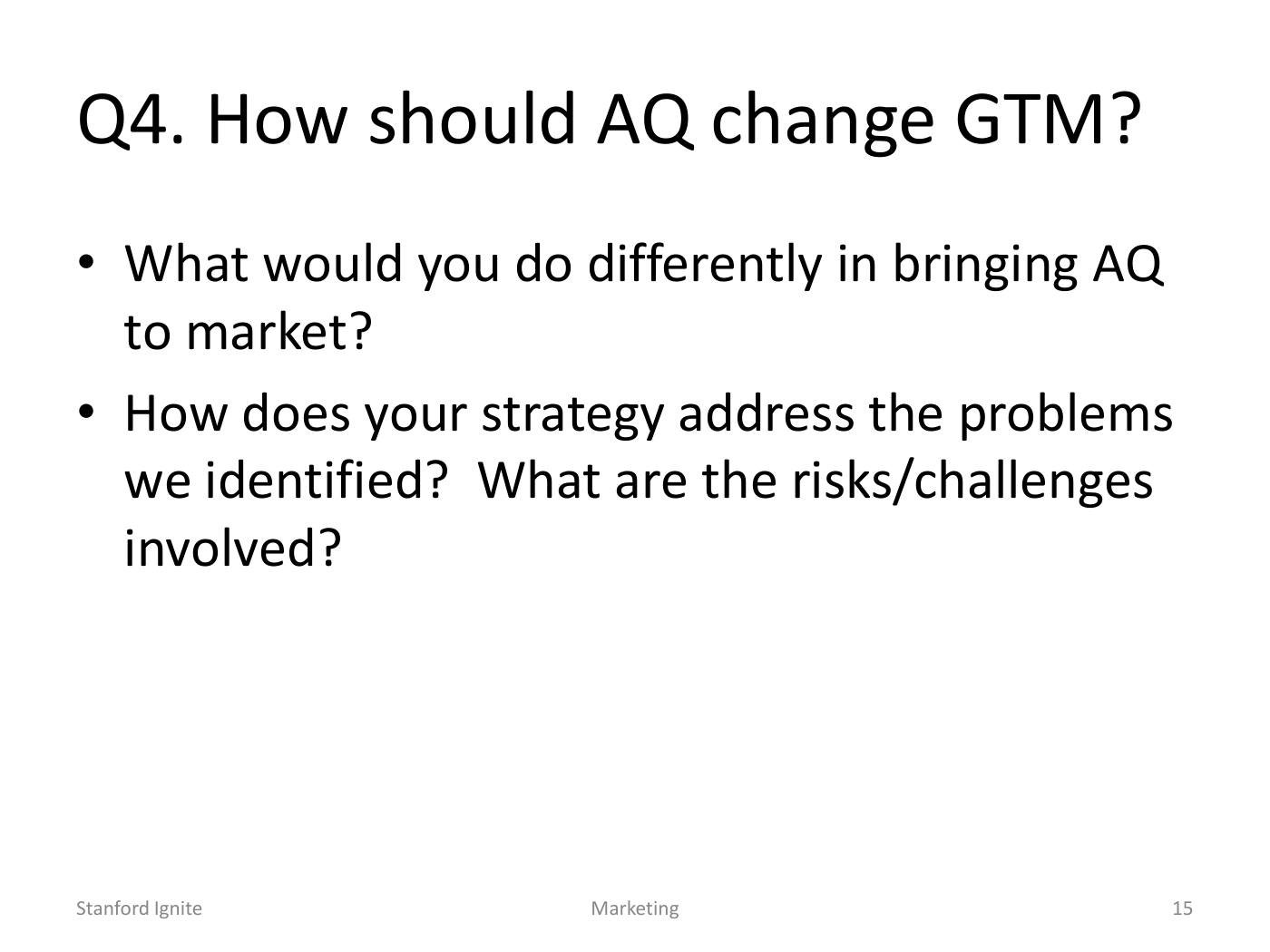
How should Aqualisa change its route to market? (prompt)Prompts asking what to do differently, how it addresses the identified problems, and the risks. Discussion prompt.Lattin - Go-to-Market Strategy Slides · PDF page 15
12
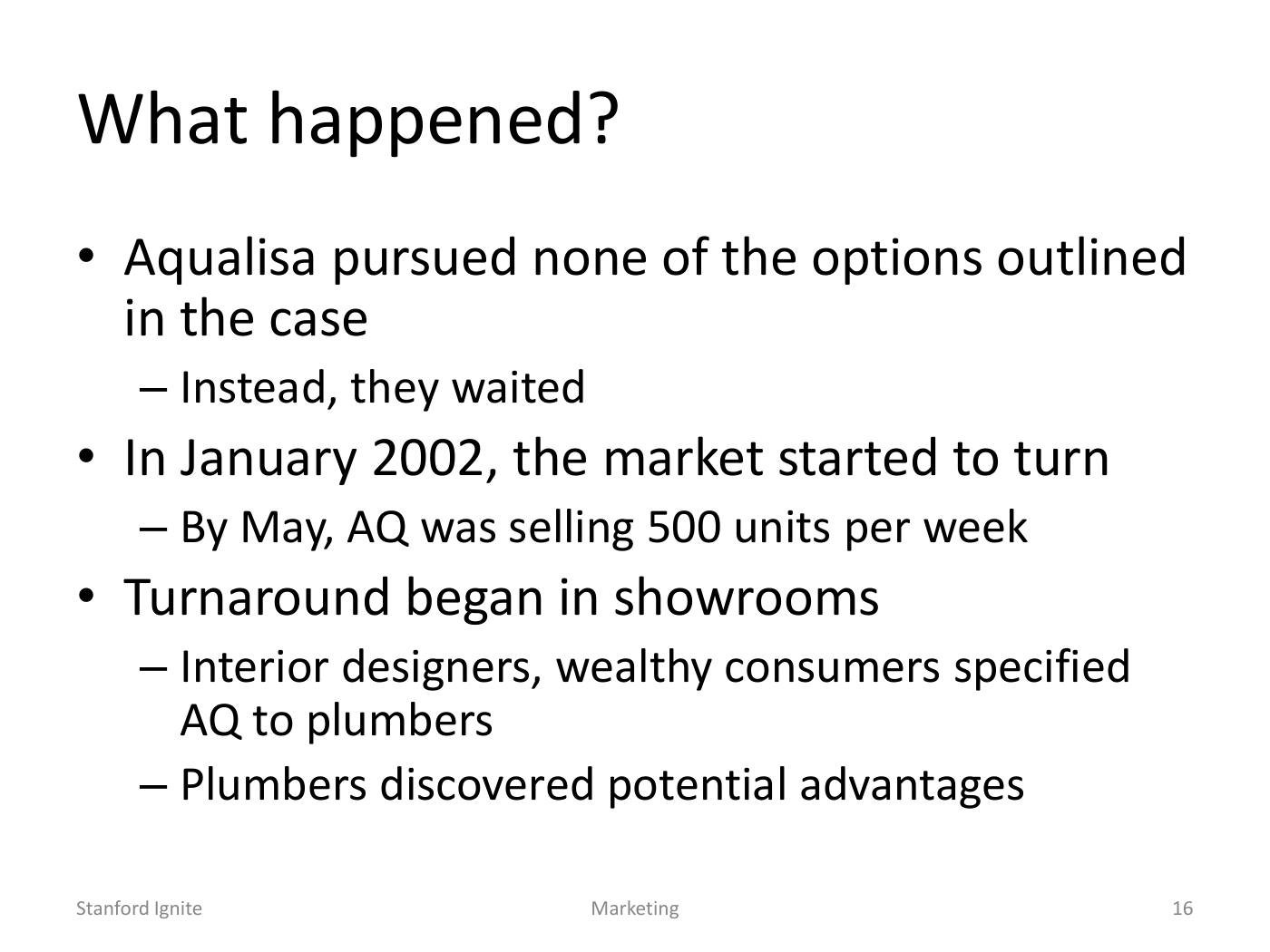
What happened: the market turned through showroomsAqualisa pursued none of the case options and waited. The market began turning in January 2002, and by May the Quartz sold 500 units a week. The turnaround began in showrooms, where interior designers and wealthy consumers specified the Quartz to their plumbers, who then discovered its advantages. Adoption came through the participant who gained most from the product's appearance and ease of use, the specifying consumer, who then pulled plumbers along. The bottleneck was broken by changing who made the choice, not by persuading plumbers directly.Lattin - Go-to-Market Strategy Slides · PDF page 16 · in the slides
13
Takeaway: value must be exchanged at every stageThe marketer's mission is a mutually beneficial exchange between company and customers. That requires considering the whole value chain, including intermediaries. If any stage lacks an exchange of value, the route fails, and good R&D alone is not sufficient. Use this as a test for each link in a route map: what does this participant gain, and what do they risk? Any link without a credible answer is the likely bottleneck.Lattin - Go-to-Market Strategy Slides · PDF page 18 · in the slides
14
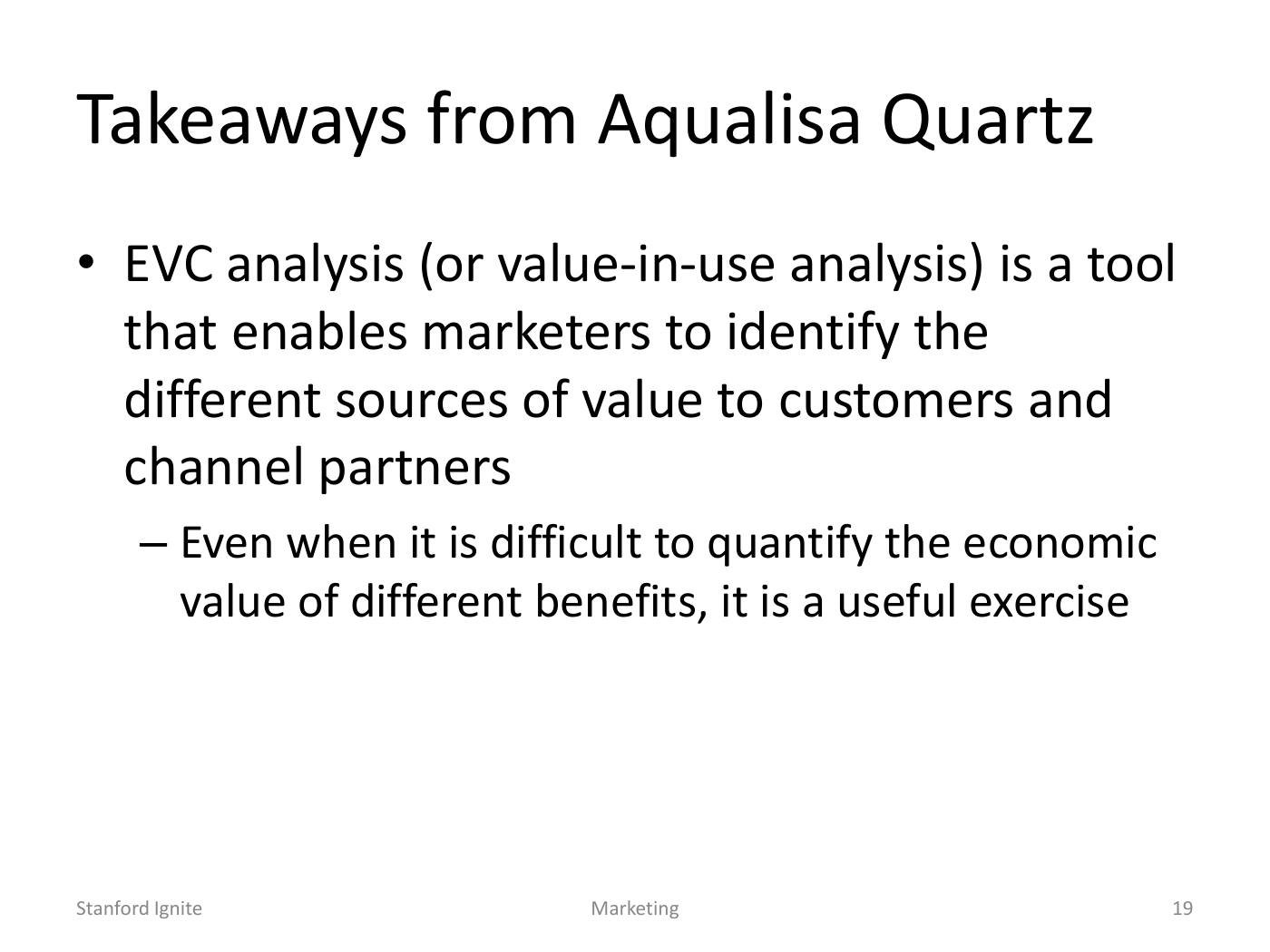
Takeaway: EVC analysis as a toolEVC, or value-in-use, analysis identifies the different sources of value to customers and channel partners, and is useful even when benefits are hard to quantify. Covered in the EVC pages above.Lattin - Go-to-Market Strategy Slides · PDF page 19
15
Takeaway: go-to-market can matter as much as product-market fitAqualisa's existing route did not suit an innovative product: trade shops took a high markup without pushing it, and plumbers had to price jobs differently to capture value. Going direct risked conflict with trade shops that still carried the bread-and-butter products, and the sales organization was unmotivated to sell the Quartz. A route built for an incumbent product can actively work against a new one. The companion caution (slide 31) applies to a startup that depends on an incumbent's channel as well: the channel owner protects its existing business first.Lattin - Go-to-Market Strategy Slides · PDF page 20 · in the slides
16
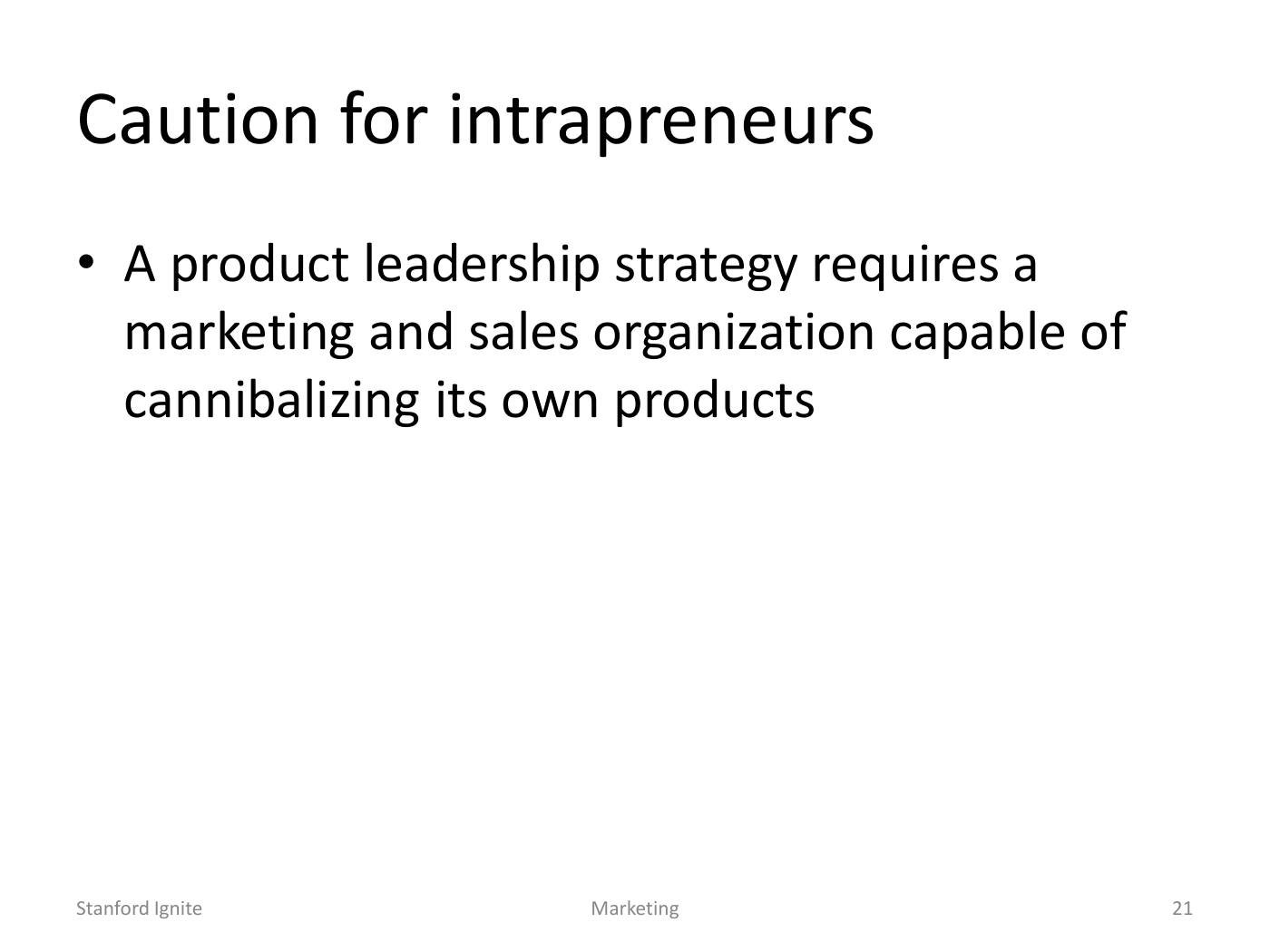
Caution for intrapreneursA product-leadership strategy requires a marketing and sales organization willing to cannibalize the company's own products. Folded into the note on slide 30.Lattin - Go-to-Market Strategy Slides · PDF page 21