In a sequential game, a player can announce an action they would not actually prefer once the later decision arrives. Backward reasoning begins at that later decision and compares the payoffs available then. The earlier player anticipates the likely response.
The source threat games change the payoffs to show how credibility depends on incentives. A forceful announcement has little strategic effect if the other player expects accommodation after entry. A commitment changes the available actions or payoffs, rather than merely repeating the announcement.
Trust and promises face the same later-choice problem
A party may promise to share value after another party makes an irreversible investment. Once the investment occurs, the promisor’s preferred action can change. Anticipating this, the first party may refuse an otherwise productive collaboration.
Contracts, staged commitments, reputation and repeated interaction can alter the incentives. Their usefulness depends on enforceability, observability and the value of the future relationship. A game model helps identify what must change for the promise to become credible.
Game theory examines choices whose consequences depend on other people’s choices. Define the interaction before applying a familiar label such as cooperation or competition.
01
Players
Identify who can make a consequential choice. In a pricing interaction, separate the competing firms from customers and regulators whose behavior may also affect the outcome.
02
Actions & order
Specify available actions and who moves when. A price chosen simultaneously is a different situation from an observable commitment followed by a rival’s response.
03
Information
State what each player knows at each choice. Whether a rival observes a move, knows the payoff or expects another round can change the reasoning.
04
Payoffs
Describe outcomes in the terms the players value. Include relevant future consequences. Work backward in a sequential interaction to check whether a threatened response would actually be attractive.
The payoff structure and timing produce the strategic problem. A matrix or tree is useful only when these assumptions describe the situation being analyzed.
Repeated interaction changes the value of cooperation
In a one-period prisoner’s dilemma, each player’s immediate incentives can produce an outcome both prefer less than mutual cooperation. Repeated interaction introduces future consequences. A short-term gain from defection can be offset by the loss of future cooperation.
Repetition alone does not guarantee cooperation. Players need to observe behavior, care about future outcomes and believe that a response will follow. A known final period can also change incentives. Noise complicates interpretation when a bad outcome does not reveal whether the other person deliberately defected.
Coordination and distribution are different strategic problems
In a coordination game, participants may benefit from choosing compatible actions but disagree about which compatible outcome to select. The risky coordination examples show that fear of another player’s choice can prevent an outcome with higher joint value.
Communication can clarify intentions or create shared expectations. It does not automatically resolve conflicting payoffs. Before applying an equilibrium concept, specify the players, actions, information, timing and consequences. Changing a payoff to reflect reputation or fairness can change the predicted behavior.
Some interactions center on choosing compatible actions. Others include opposing interests over how the resulting value is divided. A single situation can contain both.
Coordination problem
People may share an interest in reaching a compatible choice but remain uncertain about each other.
Conflict of interest
Actions also divide value or impose costs differently, so communication alone may not resolve the problem.
Worked application
Illustrative application: two partner teams both need a compatible interface standard, yet each prefers the standard that lowers its own migration work. Agreeing on compatibility creates shared value, while allocating migration cost remains a distributive question. Treating the whole interaction as a pure conflict can prevent a workable agreement.
Specify the payoff relationships before importing a familiar game. The same visible disagreement can hide different strategic structures.
Include reputation, relationships and other relevant preferences.
Keep one-shot and repeated interactions distinct.
Ask which actions or information the diagram leaves out.
A mathematically correct solution to the wrong game can mislead.
21
13 / Deep diveGame theory: commitments, trust & coordination
Solving the source games
Each archived game reduces to one comparison at the decision that matters.
Work from the last decision backward in trees, and compare expected payoffs in matrices. The 'what changes it' column lists the commitment, information or repetition that would move the outcome toward the better result.
Game
Decisive comparison
Predicted outcome
What changes it
Threat (Game 1)
B after challenge: give in 1 vs fight −1
A challenges, B gives in (1, 1)
Make fighting pay for B, e.g., reputation with future entrants
Promises (Game 3)
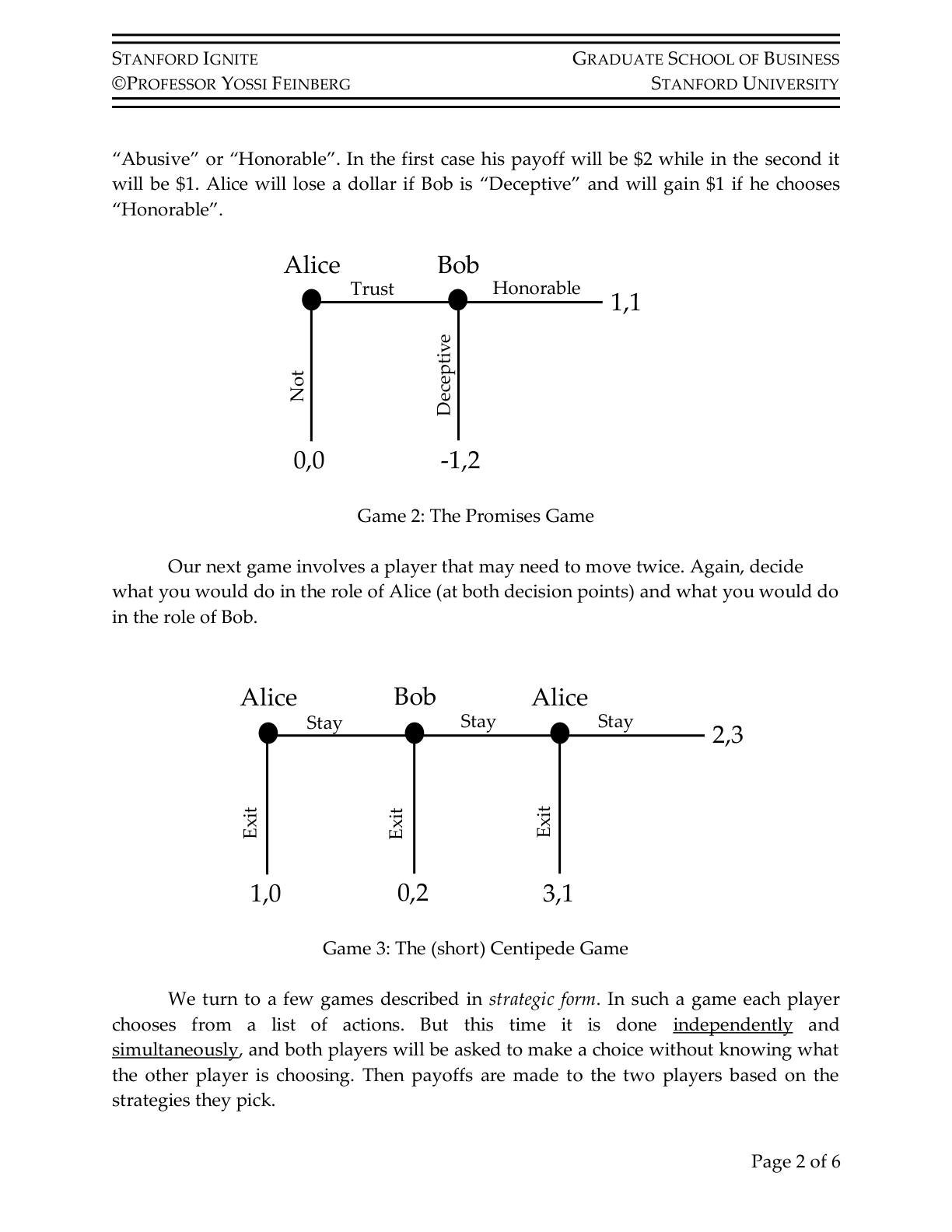
B after trust: deceive 2 vs honor 1
A does not trust (0, 0)
A contract or reputation that makes deceiving cost B more than 1
Centipede (Game 5)
Alice at the end: exit 3 vs stay 2
Alice exits at once (1, 0)
Binding agreement to stay; doubt about the other player's reasoning
Risky coordination (Game 7)
Row 2 is worth choosing if 2.5q − 1 ≥ 1, so q ≥ 0.8
Either equilibrium; the safe one is likely without confidence
The games isolate how timing, information and payoffs affect interactive choices. A strategy specifies what a player would do at each relevant decision point, including responses to earlier behavior.
Sequential choices
The threat and trust games make a later response explicit. Work backward to ask what that player prefers once the decision point arrives.
A strategy covers contingencies
In the centipede setting a player can act more than once. A complete plan specifies behavior at each possible decision point.
Coordination has a structure
The matrix games vary compatible choices and the cost of a mismatch. Read whose payoff appears first before comparing outcomes.
Repetition adds history
The repeated prisoner’s dilemma asks how a response depends on previous play and how the number of rounds affects the reasoning.
A threat announced earlier can become unattractive to carry out. Analyze the actual later incentives before treating the announcement as decisive.
An equilibrium and behavior
A solution follows specified assumptions. Actual play can involve beliefs, mistakes, relationships or objectives omitted from the payoff model.
The horizon matters
Known stopping conditions and uncertain continuation can change repeated interaction. Avoid applying a repeated-game rule without defining the horizon.
A fictional incumbent says it will fight any entrant. If entry happens, accommodation gives the incumbent 2 points and fighting gives it −1. The entrant sees the same incentives.
What makes the announced threat doubtful?
31
13 / Current practiceGame theory: commitments, trust & coordination
Current practice: platform dependence in US health IT
Information blocking now has enforcement teeth
Since 1 September 2023, HHS's Office of Inspector General can impose civil money penalties of up to $1 million per violation on certified health IT developers and health information networks that block information. In June 2024 HHS finalized separate disincentives for providers. On 3 September 2025 HHS announced it would actively enforce these rules. A dominant EHR vendor's option to cut off a third-party app's data access now carries a legal cost. Whether a specific restriction counts as information blocking depends on the facts and exceptions and requires legal review.
A startup's antitrust case against a dominant EHR is proceeding
Particle Health sued Epic Systems in September 2024, alleging that Epic used its EHR dominance to obstruct competing payer platforms' access to data. In September 2025 a federal judge in New York dismissed several claims but allowed the Sherman Act Section 2 monopolization claims to proceed. The case is unresolved and is an allegation, not a finding. It shows that a platform dependent's options include legal and regulatory moves as well as contracts.
Use the entry packet: after entry the incumbent gets 2 for accommodating and −1 for fighting. The entrant gets 1 if accommodated and −2 if fought; staying out gives the entrant 0.
Your task
Reason backward. Then propose one explicit change in payoffs, information or commitment that could change the outcome.
ClinicOS, the EHR used by about 35% of independent PT clinics, offers Relay a marketplace listing at a 30% revenue share. Relay depends on ClinicOS's API for those clinics. A ClinicOS executive hints that it 'could ship a basic waitlist for free' if Relay stays independent. At $399/month and 80% gross margin, Relay earns $319.20 gross profit per location-month directly. Through the marketplace it earns $319.20 − $119.70 = $199.50, but CAC falls from about $2,400 to about $1,500.
Your task
Draw the sequential game (Relay: join or stay independent; ClinicOS: bundle or not), with illustrative payoffs. Solve it by backward induction. Test whether the bundling threat is credible. Then name two commitments that protect Relay from hold-up after it joins.
Unit economics first (illustrative): LTV direct = $319.20 × 33 ≈ $10,530; ÷ $2,400 CAC ≈ 4.4. LTV marketplace = $199.50 × 33 ≈ $6,580; ÷ $1,500 ≈ 4.4. The ratio is the same; the marketplace's real value is faster reach into 35% of independent clinics. Note: the bible's 7.0 channel ratio assumes no revenue share, as with a PT-association channel.
Game (ordinal payoffs, Relay first, ClinicOS second): Join, then not bundle = (3, 3), since ClinicOS earns its 30% share. Join, then bundle = (1, 2), since bundling costs development and cannibalizes its own share. Independent, then not bundle = (2, 1). Independent, then bundle = (0, 2), since a basic waitlist helps ClinicOS keep clinics.
Backward induction: after Join, ClinicOS prefers not to bundle (3 > 2); after Independent, it prefers to bundle (2 > 1). Relay compares 3 with 0 and joins. The threat to bundle is credible only if Relay stays independent. The revenue share is what makes ClinicOS's restraint credible, because ClinicOS then gains when Relay grows.
The hold-up risk is the promises game: once Relay's ClinicOS clinics depend on the marketplace, ClinicOS could raise its share or throttle the API. Commitments that change payoffs: a multi-year marketplace agreement with fixed share, API uptime SLA and 12-month termination notice; customer contracts held by Relay (not ClinicOS); and the second-EHR integration (L21), which lowers the damage if ClinicOS defects.
Make it repeated and observable: quarterly business reviews, shared API logs and joint case studies raise ClinicOS's value from continued cooperation. Restricting a provider-chosen app's access to patient data may also raise information-blocking questions, but that depends on current rules and specific facts and requires legal review.
Before reacting to a dominant partner's warning, write down its payoff from carrying out the threat once you have already acted. A ClinicOS that profits from Relay's marketplace revenue is unlikely to destroy it with a free bundle.
Investing before the promise is enforceable
Building a deep integration on the strength of a partner's goodwill is the trust game: once Relay has sunk the cost, the partner's incentive changes. Get the fixed share, notice period and API service level in writing before committing engineering months.
Solving a one-shot game for a repeated relationship
Relay and ClinicOS will interact for years across many clinics. Modeling the relationship as a single move ignores the reputation, monitoring and retaliation options that can sustain cooperation, and the end-game risk when either side plans to exit.
A Relay–ClinicOS game model: a solved join-or-independent tree, the credibility test of the bundling threat, the marketplace unit economics (≈ $199.50 gross profit per location-month after the 30% share) and a hold-up protection plan.
Test any threat or promise at the later decision point: if carrying it out hurts the party making it, it is not credible unless a commitment changes the payoffs.
Repetition sustains cooperation only when deviations are observable, the future is valued enough (p ≥ 1/3 in the lesson's dilemma) and the response to defection is credible.
Coordination failures come from uncertainty about others; a better equilibrium may require mutual confidence of 80% or more, which communication and visible commitments can supply.
Next lesson: Competitive advantage & barriers to entry
38
Check your understanding
How does your choice change when others reason about you?
Score
Question 1
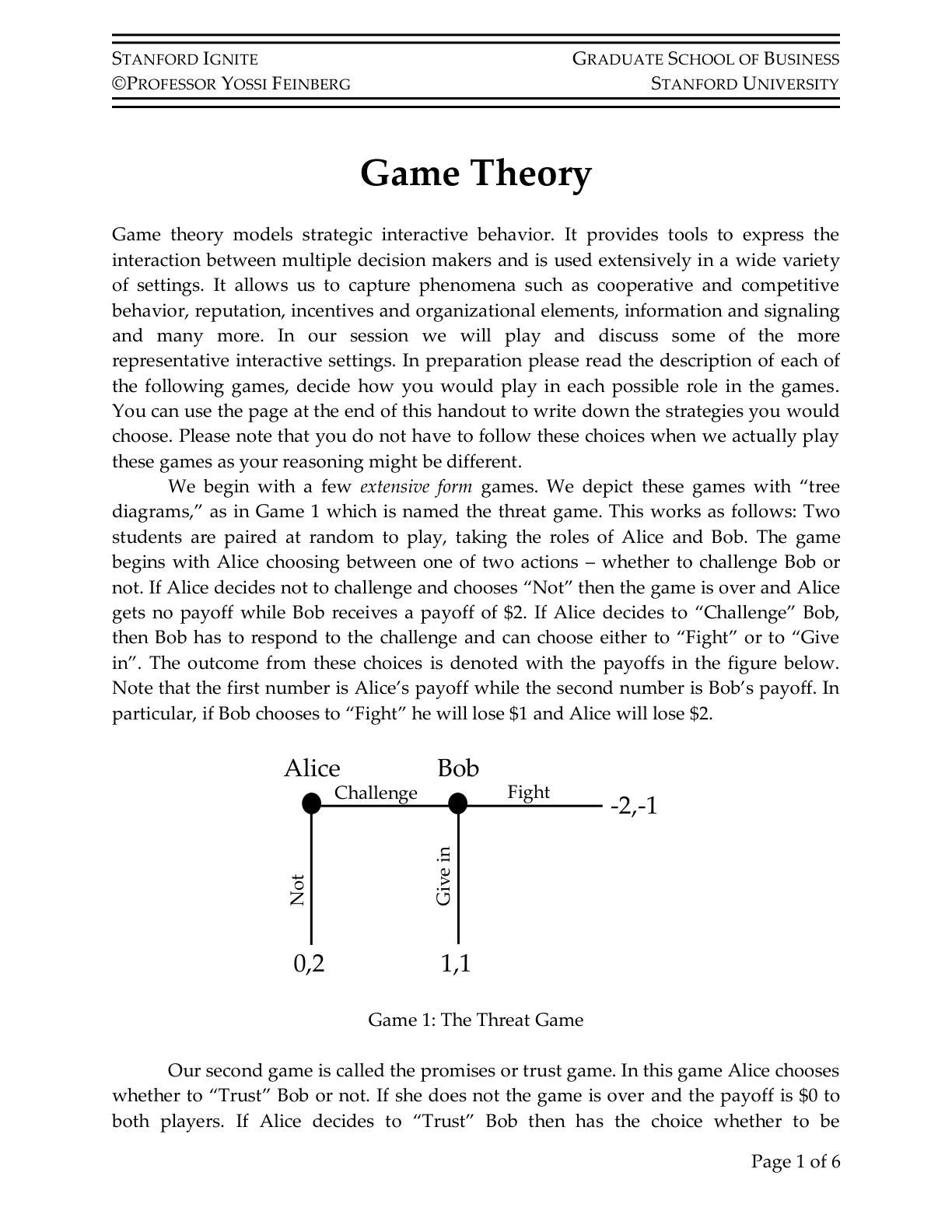
Entry game: if the entrant enters, the incumbent gets 2 by accommodating and −1 by fighting. The entrant gets 1 if accommodated, −2 if fought, and 0 by staying out. The incumbent publicly vows to fight. What does backward induction predict?
At the post-entry node, accommodating (2) beats fighting (−1), so the vow is not credible. The entrant expects 1 rather than 0 and enters. Reputation could change this only if it is modeled in the payoffs, for example with future entrants watching.
Question 2
In the repeated prisoner's dilemma (mutual cooperation 2, temptation 3, mutual defection 0), each player cooperates until the other defects, then defects forever. Each round continues with probability p. What is the minimum p that sustains cooperation?
Cooperating forever is worth 2/(1 − p). Defecting gives 3 now and 0 afterward. Cooperation holds when 2/(1 − p) ≥ 3, that is 1 − p ≤ 2/3, so p ≥ 1/3. Below that, the one-time gain beats the future loss.
Question 3
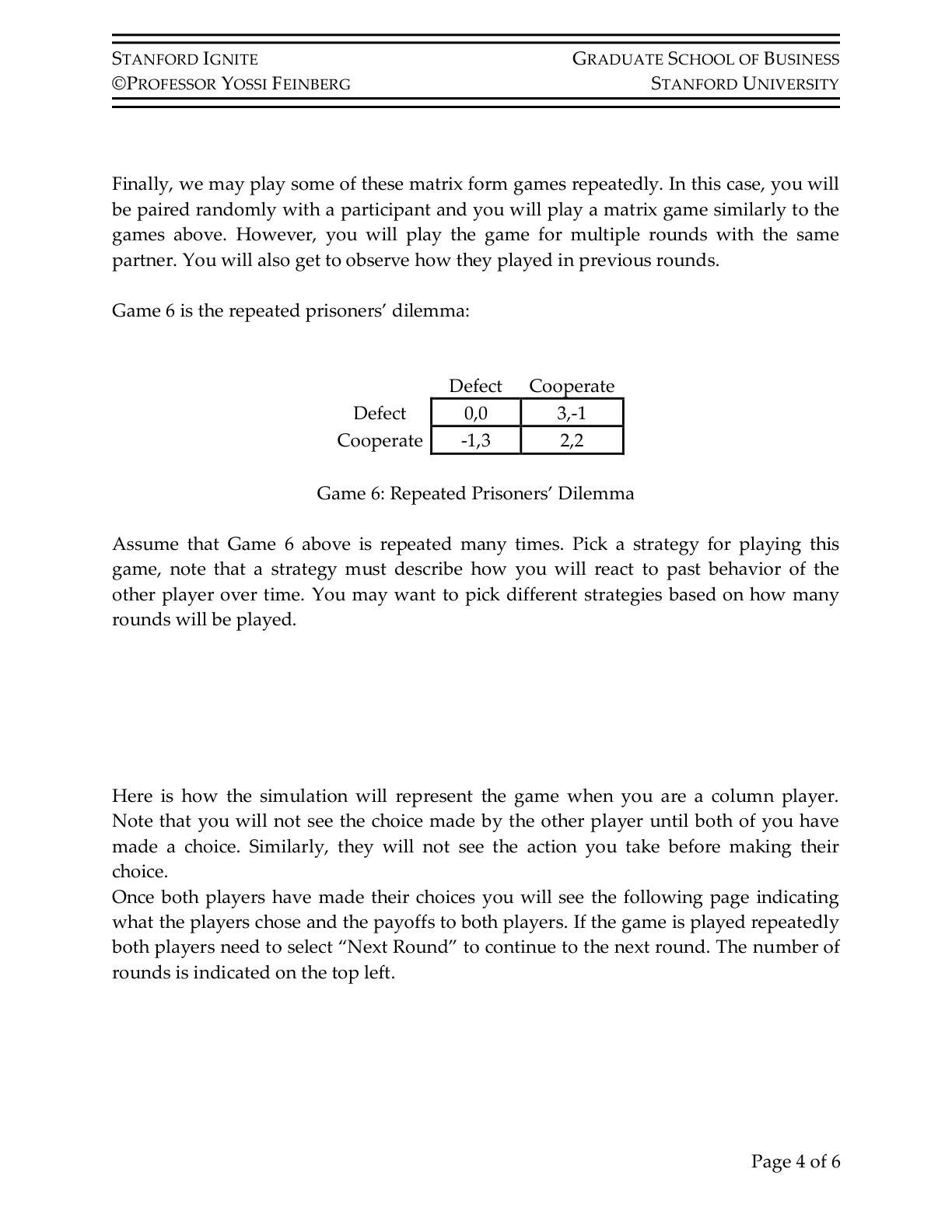
Risky coordination: row 1 pays you 1 whatever the other player does; row 2 pays 1.5 if the other player also chooses the coordinated action and −1 otherwise. What is the minimum probability that the other player coordinates for row 2 to be worth choosing?
Row 2's expected payoff is 1.5q − 1(1 − q) = 2.5q − 1. Setting it at least 1 gives q ≥ 0.8. The better equilibrium needs strong mutual confidence, which is why communication and visible commitments matter in coordination problems.
Question 4
ClinicOS tells Relay: 'Sign an exclusive marketplace deal or we bundle a free waitlist.' Bundling would cost ClinicOS development money and reduce its marketplace revenue share. What should Relay analyze first?
A threat matters only if carrying it out is in the threatener's interest when the time comes. If bundling makes ClinicOS worse off once Relay declines exclusivity, the threat is weak. Product quality and legality matter, but they come after this check.
Question 5
Relay joins the ClinicOS marketplace. Two years later, 40% of its clinics run on ClinicOS. Which commitment best protects Relay against ClinicOS later raising its share from 30% to 45%?
Credible protection changes payoffs or options. A contract makes a share increase costly or delayed. A second integration lowers Relay's loss if the relationship breaks, which weakens ClinicOS's leverage. Verbal assurances and press releases leave ClinicOS's later incentive unchanged.
Question 6
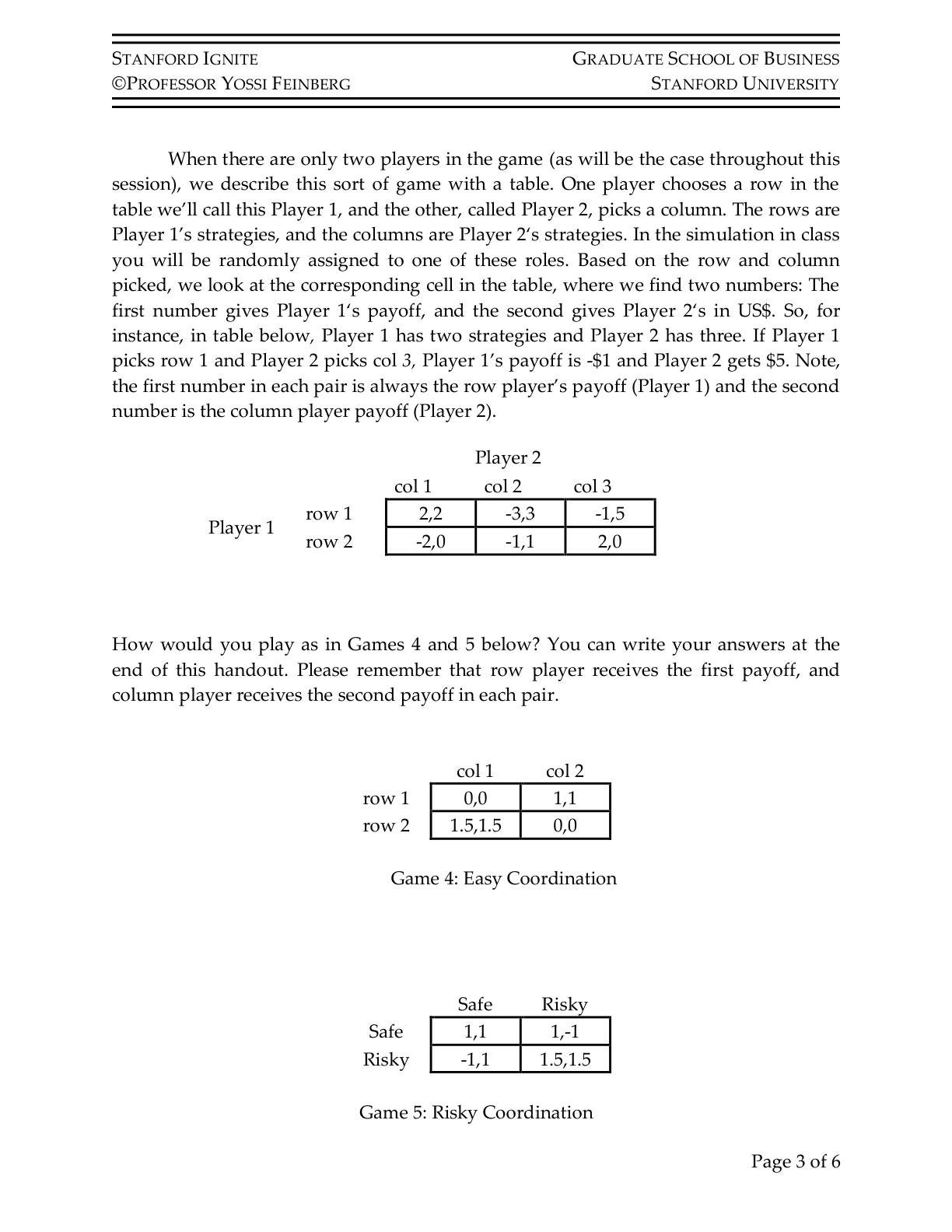
In the centipede game (Alice exits 1,0; Bob exits 0,2; Alice exits 3,1; both stay 2,3), backward induction predicts Alice exits immediately. A student concludes that equilibrium shows the best achievable outcome. What is wrong?
Equilibrium means no player gains by deviating alone at any point. It can leave large joint value unrealized, as in the prisoner's dilemma and trust game. Contracts, reputation and repetition exist to reach the better outcomes that equilibrium alone does not.
Workbook
How does your choice change when others reason about you?
Module output: A business-model map, market/game models and an advantage-and-pivot memo.
Library
Every original page used in this lesson
10 appear in the slides with notes; the rest are kept here for reference.
Game 1: the threat (entry) game, played onceA tree: A chooses Not (payoffs 0, 2) or Challenge; B then chooses Give in (1, 1) or Fight (−2, −1). Payoffs are listed as A, B. Once A has challenged, B gets 1 by giving in and −1 by fighting, so a threat to fight is not credible. Reasoning backward, A challenges and earns 1 rather than 0. The lesson's native entry game uses the same structure.Feinberg - Game Theory Slides · PDF page 3 · in the slides
1
Game 2: the same threat game with roles hiddenThe identical tree and payoffs as Game 1, with the player labels replaced by question marks for in-class play. Used to have students play before analyzing; the analysis is the same as slide 9.Feinberg - Game Theory Slides · PDF page 4
2
Game 3: the promises (trust) game, a one-shot joint ventureA chooses Not (0, 0) or Trust; B then chooses Honorable (1, 1) or Deceptive (−1, 2). After A trusts, B gains 2 by deceiving versus 1 by honoring, so B's promise to honor is not credible. A anticipates this and declines, and both lose the (1, 1) outcome. This is the hold-up problem every startup faces before investing in a partner's platform.Feinberg - Game Theory Slides · PDF page 5 · in the slides
3
Game 4: the promises game with roles hiddenThe same tree as Game 3 with player labels replaced by question marks. In-class version of slide 11; same analysis.Feinberg - Game Theory Slides · PDF page 6
4
Modeling the game: four rules for realistic payoffsFour points: payoffs should reflect actual outcomes, not only immediate money; repeated games must be modeled explicitly; framing effects belong in payoffs or reputation; reputation links past behavior to expected future behavior. Most errors in applied game theory come from the payoffs, not the solution method. If B in Game 3 cares about a reputation for honesty, its real payoff from deceiving is below 2 and the predicted outcome changes.Feinberg - Game Theory Slides · PDF page 7 · in the slides
5
Game 5: a centipede game between Alice and BobAlice can Exit (1, 0) or Stay; Bob can then Exit (0, 2) or Stay; Alice can finally Exit (3, 1) or Stay (2, 3). The slide asks whether each would stay. Backward induction says Alice exits at the end (3 > 2), so Bob exits before her (2 > 1), so Alice exits immediately (1 > 0). The result is (1, 0), even though (2, 3) is better for both. In classroom play people often stay longer, which is the gap slide 15 addresses.Feinberg - Game Theory Slides · PDF page 8 · in the slides
6
Rationality and solution conceptsThree points: dynamic reasoning can look inconsistent unless reasoning is subjective; expectations can form during a single evolving game; solution concepts as intuitive as backward induction and as compelling as Nash equilibrium may fail in practice. Backward induction assumes everyone expects everyone else to reason backward to the end. If Bob sees Alice stay, he learns she may not reason that way, and staying can become sensible. Treat equilibrium as a benchmark to test against, not a forecast.Feinberg - Game Theory Slides · PDF page 9 · in the slides
7
Game 7: risky coordinationA 2×2 matrix (row, column payoffs): row 1/col 1 = (1, 1); row 1/col 2 = (1, −1); row 2/col 1 = (−1, 1); row 2/col 2 = (1.5, 1.5). Both (row 1, col 1) and (row 2, col 2) are equilibria. Row 1 pays 1 whatever the other player does; row 2 pays 1.5 only if the other also coordinates, and −1 otherwise. Row 2 is worth choosing only if you are at least 80% sure the other player will choose column 2, so fear can lock in the worse outcome.Feinberg - Game Theory Slides · PDF page 10 · in the slides
8
Game 9: the repeated prisoner's dilemmaA matrix: Defect/Defect (0, 0); Defect/Cooperate (3, −1); Cooperate/Defect (−1, 3); Cooperate/Cooperate (2, 2), with the note that the game is played repeatedly. Played once, defecting is better whatever the other does (3 > 2 and 0 > −1). Repeated indefinitely, cooperation can be sustained if a defection costs enough future cooperation: with permanent retaliation, a player cooperates when the continuation probability is at least 1/3.Feinberg - Game Theory Slides · PDF page 14 · in the slides
9
Takeaway 1: reason about the behavior of othersA takeaway slide: as an active party in a strategic interaction you must reason about others' behavior. Stated in the lesson's opening; no added content.Feinberg - Game Theory Slides · PDF page 15
10
Takeaway 2: others reason about youA takeaway slide: reasoning about others requires considering their reasoning about you. Restates the lesson question.Feinberg - Game Theory Slides · PDF page 16
11
Takeaway 3: backward induction and Nash are reasoning principlesA takeaway slide: backward induction and Nash equilibria are examples of reasoning principles; others may hold. Covered in more depth by slide 15.Feinberg - Game Theory Slides · PDF page 17
12
Takeaway 4: identify which game is being playedA takeaway slide: the biggest challenge is figuring out which game is actually being played. The same visible conflict can be a one-shot threat game, a repeated relationship or a coordination problem, and each calls for a different move. For Relay and ClinicOS, deciding whether the marketplace relationship is repeated and observable matters more than solving any single tree.Feinberg - Game Theory Slides · PDF page 18 · in the slides
13
Takeaway 5: model payoffs carefullyA takeaway slide: payoffs must reflect the parties' actual preferences. Restates slide 13.Feinberg - Game Theory Slides · PDF page 19
14
Takeaway 6: repetition enables signaling, reward and punishmentA takeaway slide: dynamic and repeated interactions open signaling and communication options; risky or costly cooperation must be rewarded and deviations must be punishable. Cooperation in a repeated game needs a credible response to deviation. In a contract, that means notice periods, audit rights and exit options that both sides know will be used.Feinberg - Game Theory Slides · PDF page 20 · in the slides
15
Takeaway 7: imperfect monitoring weakens coordinationA takeaway slide: imperfect monitoring diminishes the ability to coordinate behavior. If a partner cannot tell deliberate defection from bad luck (an API outage versus deliberate throttling), retaliation either misfires or never comes. Making behavior observable, for example through uptime SLAs and API logs, keeps cooperation stable.Feinberg - Game Theory Slides · PDF page 21 · in the slides